Two Houses and One Quiet Heart
A daughter learns to read between the lines of a life split in two
Read more →
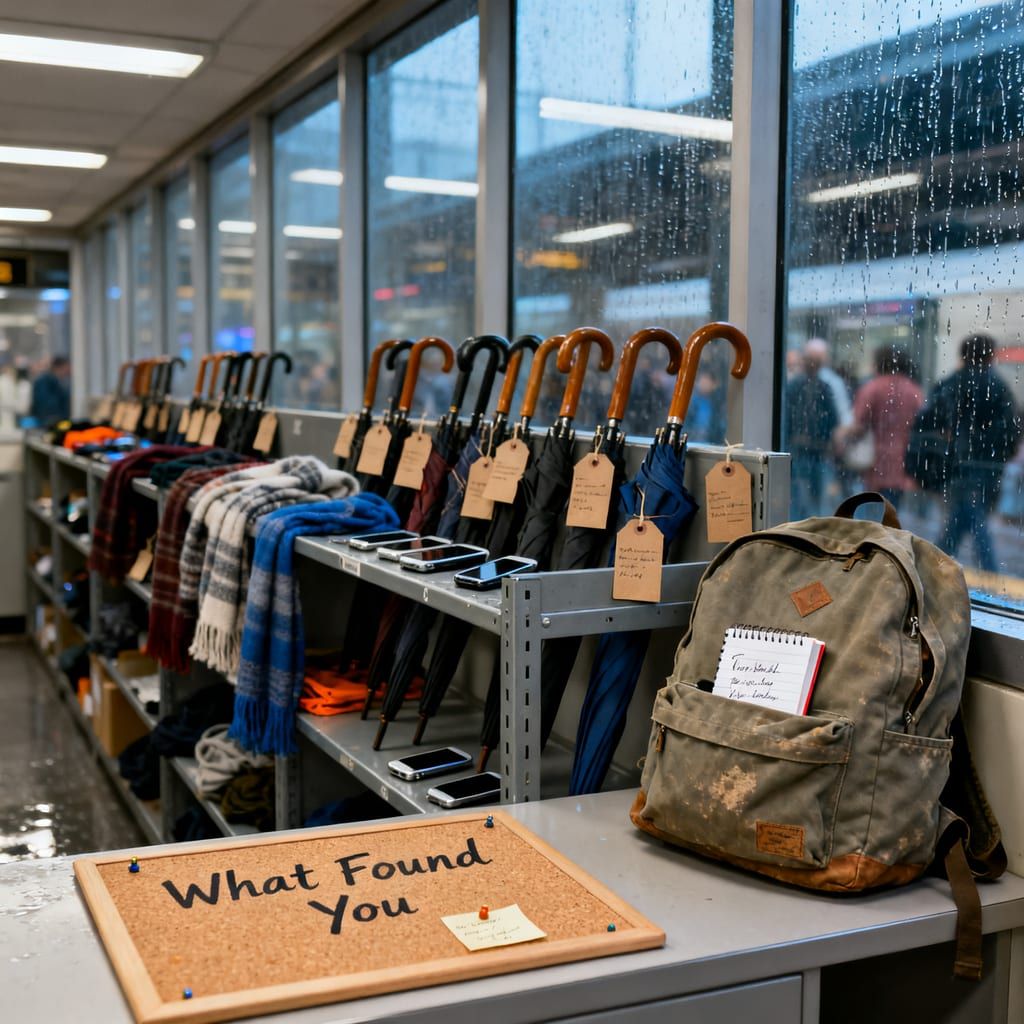
The first storm arrived as if the sky had forgotten how to break gently. It came in sheets, drumming the transit hub's glass ceiling until every footstep sounded like a small apology. By ten a.m., Lena's counter was a neat procession of wet umbrellas-cheap black ones with bent ribs, one with a pattern of moons, a red child's parasol that clicked open like a stubborn mouth.
She liked the order more than the objects: wipe, fold, tag, shelf. The tags were a second alphabet-dates and compartments, the small pleasure of ink that didn't run. She moved through it like a swimmer under the surface, quiet, economical, unseen.
At noon, someone rolled in a battered canvas backpack the color of old cardboard, edges frayed and darkened by years of rain. It had no ID, only a scuffed zipper and a weight that seemed to travel up her arm when she lifted it.
Inside, under a sweater that smelled faintly of eucalyptus, sat a small notebook. On the cover, in a careful hand: For whoever keeps finding what I lose.
She opened it because that's what you do, she told herself, when you're trying to get something back to the right person. But also because the sentence had named her without using her name.
The entries were brief, no dates. A voice that spoke like someone who had learned to leave just enough out.
"Gray scarf with the fraying tassel. I bought it the week my father died because the clerk asked if I wanted the receipt and I couldn't decide. I'm still bad at small choices. If you find this, I hope you keep warm even in supermarkets."
"Dog-eared paperback with a train on the cover-left it on purpose. First book I finished after she moved out. The train never arrives and yet, I loved it."
"Plastic dinosaur lunchbox. I am always late. I'm tired of my son learning that about me first."
Lena traced the indent of the pen on the paper with the pad of her thumb. She knew those items-the scarf that had clung to a stranger's coat like a last thought, the paperback with coffee tide-marks on page thirty-seven, the lunchbox with a chipped T-Rex grin. She had logged them all. She had not asked about any of them.
Outside, the station coughed out a tide of commuters. Inside, Lena slid the notebook back into the backpack and set it on the shelf labeled 24C. She told herself she would hold it like any other thing-two weeks, then auction or disposal-but already the backpack felt less like a possession and more like a held breath.
The man in the soaked windbreaker arrived before the doors had hissed all the rain out of his cuffs. "Dinosaur lunchbox," he said, freckles lifted by a sheepish smile. "Green. Might have a sticker of a rocket on the bottom."
She fetched it. On habit, she asked, "Can you describe what's inside?"
"Half a peanut butter sandwich. Carrot sticks. A note that says, 'Don't forget me this time, okay?' He wrote it to me." He laughed, rubbed a palm over his face. "It's... funny. He's six."
Lena held the lunchbox out. "That sounds like him loving you with very strong punctuation."
The man looked at her hand a second longer than needed, as if the object weighed differently now. "I was in a meeting," he said quietly. "I told myself ten more minutes. Then I told myself ten more. The ten minutes were an hour by the time I got there."
"You're here now," she said.
He nodded, took the lunchbox. "I'm going to set three alarms. Four. Thank you." He looked at the sign with the policy about claims and IDs and timetables. "Do you ever get tired of all this?"
"All this?" She gestured to the shelves, the boxes, the slow drip of water off an umbrella into a tray.
"The weight," he said.
She thought of the notebook waiting on 24C. "Some days it's a relief to lift something that isn't mine."
When he left, he turned back and added, almost to the air, "I'm late too often." It felt like a sentence he needed to say to a witness. Lena let it land between them without trying to soften it.
The violinist came in with a silenced kind of panic, the way people walk into hospitals and churches. She looked twenty-two and sixty all at once. "My case," she said, breath tucked up under her ribs. "Black, with a purple strap. I left it waiting for a transfer because I thought-well. I don't know what I thought."
Lena brought it to the counter, set it down as if laying a sleeping thing gently on a bed.
The girl's hands hovered. "I almost didn't come," she confessed. "I spent all morning trying to decide if losing it was a sign. That I should stop. That the city was making room for someone else."
"Is it?" Lena asked.
The girl opened the latches and drew the violin out like a breath she'd been holding. Her fingers found the chin rest the way the body returns to a shoreline. "No," she said, and a tear slipped without drama. "But I needed to make my hands move toward it to know."
After she left, her scent-resin and wet wool-lingered a moment. Lena flipped open the notebook. A new entry near the middle: "Instrument case with the purple strap. For the hours I spent not playing after she left, and the hours I played too hard. If you find this, let your hands talk to your heart for once."
The pen had pressed harder than in the others, a sentence etched deep as a groove.
A lanky coder with sleep-puffed eyes pointed at a gray hoodie on the top shelf. "That one," he said. "Smells like cedar and bergamot because I never could make it stop."
She brought it down. He didn't reach immediately.
"I'm not sure I want it back," he admitted. "She wore it more than I did. My apartment still... carries." He made a vague gesture, as if scooping air might catch her fragrance.
Lena folded the sleeves in, like a prayer. "You don't have to take it."
He barked a small laugh. "What do you do with clothes you can still feel in the dark?"
"I tag them," she said, and he smiled for real at that.
He pressed the fabric to his face anyway, groaned, "God." Then handed over his ID like a white flag. While she signed it back, he tapped the counter. "Do you ever think people leave things on purpose?"
She thought of the notebook again, a pulse below 24C's neat label. "Sometimes," she said. "Sometimes I think they're seeing if gravity still works."
When he left, she held the hoodie's absence like a scent in reverse.
By the fifth day, the congestion of umbrellas had thinned to a manageable forest. The backpack remained. Every time Lena passed it, she felt the prickle that meant a story had stood up in the room.
At three, he arrived-taller in person than in memory. He stood just inside the door, scanning the shelves the way doctors look at faces: practiced, not unkind. His coat dripped a disciplined pattern onto the mat.
"Can I help you?" Lena asked, and his mouth shifted into a half-smile as if he'd heard that sentence all his life.
"I hope so." He stepped closer. "Canvas backpack. Battered. Smells like eucalyptus and winter."
Her fingers tightened on the edge of the counter. "24C," she said aloud, like a code to herself. She retrieved it, set it down. Up close, he was younger than the notebook's voice but wearing the same patience.
He rested both hands on the bag without unzipping. "When I was a kid," he began, "my mother cleaned this station at night. We'd come in with a bucket and a rusted caddy of sprays. I used to sit in lost-and-found until the clerk let me help."
"Help?" Lena asked, though she already knew. Some truths are doors you open together to be polite.
"Labeling," he said. "He told me every object was a waiting room for a story. People would come in late or embarrassed, and when they walked out, they weren't the same people. The clerk would nod, and they'd nod back like he'd stamped something that wasn't a ticket."
He touched the notebook through the fabric, a gentle pat, as if to soothe it. "I wanted to see if that room still existed."
"You left things," Lena said. It wasn't an accusation.
"I left parts of a life I wasn't saying out loud." He lifted his eyes to hers. They were careful, yes, but not cold-like someone who had practiced going second in conversations and was now learning to go first. "Not to make trouble. To see if a stranger might become a hinge in the door I kept refusing to open."
"You could have just talked to someone." Lena felt both irritated and moved, the way you do when someone offers you a mirror without warning.
"I did," he said. "Through what I could bear to lose."
Silence settled on them. The station groaned, a long metallic exhale. He unzipped the bag, lifted the notebook, thumbed to the middle where the pages bent.
"I read the lunchbox one," Lena said. "And the violin." She kept her tone steady. "People told me things this week. More than usual."
"Then it worked." He laughed, winced at himself. "That sounds like an experiment. It wasn't. Not only." He met her gaze straight on now. "I needed to know if anyone was still listening."
Lena thought of why she had chosen this room three years ago: the way her sister's last message had blinked unanswered on her phone; the precise relief of shelves that didn't ask her to enter any rooms she wasn't ready to name. She had avoided the waiting room of her own story by curating everyone else's.
"I am," she said simply.
He looked at the sign-in sheet like it had just become holy. He signed his name in small, imperfect letters, then handed the pen back with a grateful shrug. "Thank you for keeping the light on. For not rolling your eyes when the same pair of gloves shows up three days in a row."
"I might have rolled them once," she admitted.
"I deserved it," he said, and the smile between them shifted something off center and righted it.
He tucked the notebook into the bag again but didn't zip it. He read the shelves as he stood up-a small farewell-and then he was gone, a wet shape dissolving into the long corridor.
In the lull after the morning rush, Lena stood in front of the corkboard she'd hung crookedly by the door. The header she'd lettered in pencil first, then in marker: What Found You. She pinned an index card she'd written to seed the idea: "My mother's ring taught me to stop rinsing dishes like I was outrunning something." She put out a jar of pens.
People hesitated at first. Then the father of the dinosaur lunchbox wrote, "A calendar app cannot love you, but a six-year-old can," and left a smiley face that resembled a moon. The violinist returned, laid a note that said, "I am still playing," like a vow. The coder printed, block letters: "I wore the hoodie. I did not die."
By closing, the board had a dozen slips. The stories were tidy, uneven, lovely. Left my scarf on purpose to find out if I was brave enough to leave him next. I was. Found my bus pass and my breath after a panic attack. The clerk didn't rush me. Wallet returned with all the cash. I called my mother back for once.
Each note was a small hinge, a soft click. The room felt different not because the shelves had shifted but because the air had started to carry more than forgetting.
She locked the front, pulled the chain, turned the open sign to resting. In the back, the backpack waited. She slid the notebook out one more time. The last page was almost blank.
In the center, in that careful hand: Thank you for holding the door.
Lena stood there with the station humming beyond the wall-the distant surge and brake, the announcement that had learned to speak like rain. She took her phone out of the drawer where she kept the small things that could hurt. Her sister's name was still where she had left it, last fall, a little star beside it from when they were better at needing each other.
She pressed call. It rang long enough to make her consider hanging up. Then her sister answered, voice tired and immediate. "Lena?"
"Hey," Lena said, and the word felt like stepping across something and finding solid ground on the other side. "I'm at work. I've been thinking about-about the casserole you made me after... after he left. I never said thank you properly."
Her sister laughed, a surprised animal sound that softened into warmth. "It was a terrible casserole."
"It was," Lena agreed, and let herself grin at the empty room. "But it found me."
They talked about small things first, because that's how doors behave-not with a crash but with the pleasant complaint of a hinge that hasn't been used in a while. When she hung up, the space inside her ribs felt rearranged, as if someone had filed the air into neat, labeled sections.
She tucked the notebook back in the backpack. Wrote a small card to go on the board: "Sometimes you keep a job for the shelves. Sometimes you stay for the stories." She pinned it in the corner where the light pooled, where people would see it as they walked in wet and unsure.
Outside, the rain thinned to a whisper, like someone finally lowering their voice to listen. Inside, Lena flipped the lights, checked the lock, and stood a second longer than usual at the threshold.
The lost-and-found was still items and tags. But now, as she stepped into the corridor, she could hear the chorus.
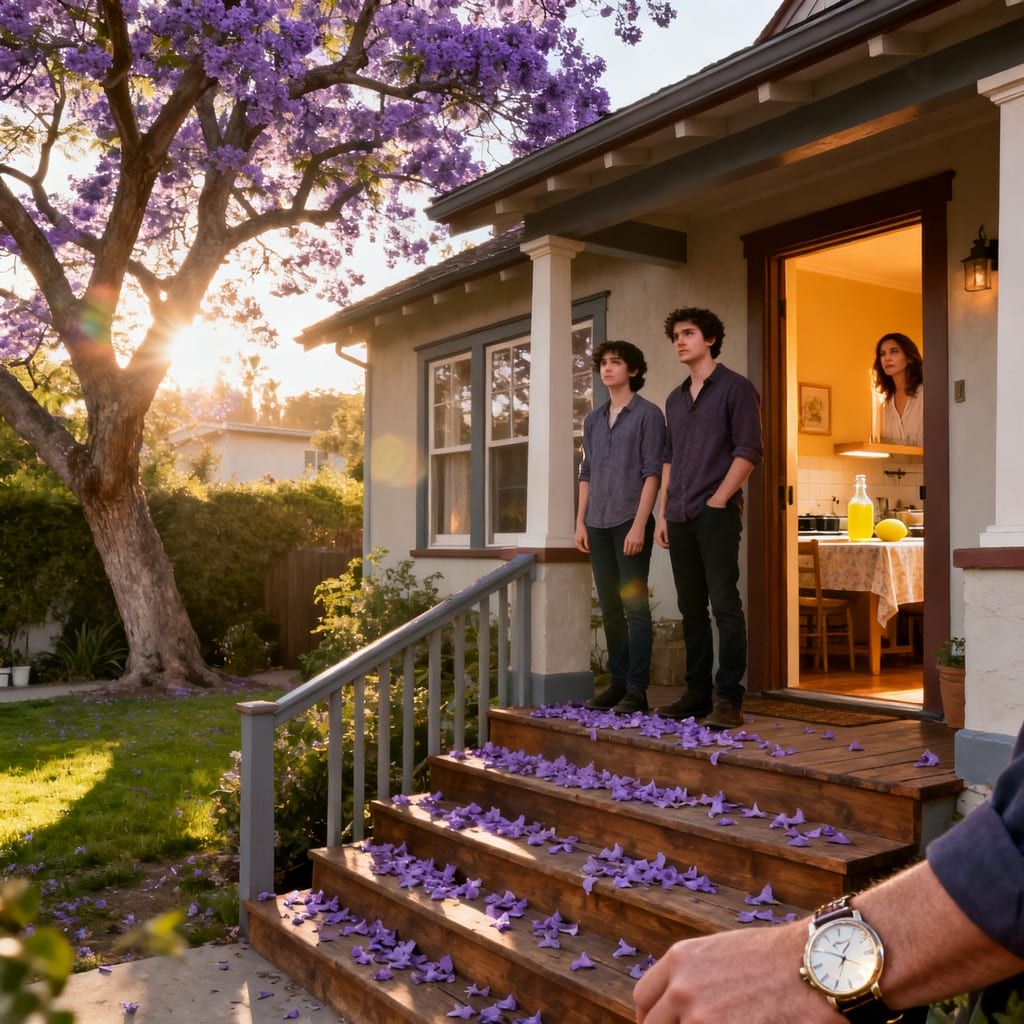
A daughter learns to read between the lines of a life split in two
Read more →
A fog-draped night, two souls found, and the quiet shape of a life
Read more →
Story audiobooks for children of all ages — a new one every day on Smarter Way Stories.