Two Houses and One Quiet Heart
A daughter learns to read between the lines of a life split in two
Read more →
They always looked at the chair like it might start talking.
Naya set it where the wall met the radiator, its vinyl seat the color of old mint gum, its backrest nicked by a decade of coats. She smoothed the cushion with the flat of her palm, the way she might soothe a startled cat. This is for what doesn't fit in your mouths, she almost said, but didn't. She knew better. She believed silence had a shape-you could make room for it the way you made room at a table.
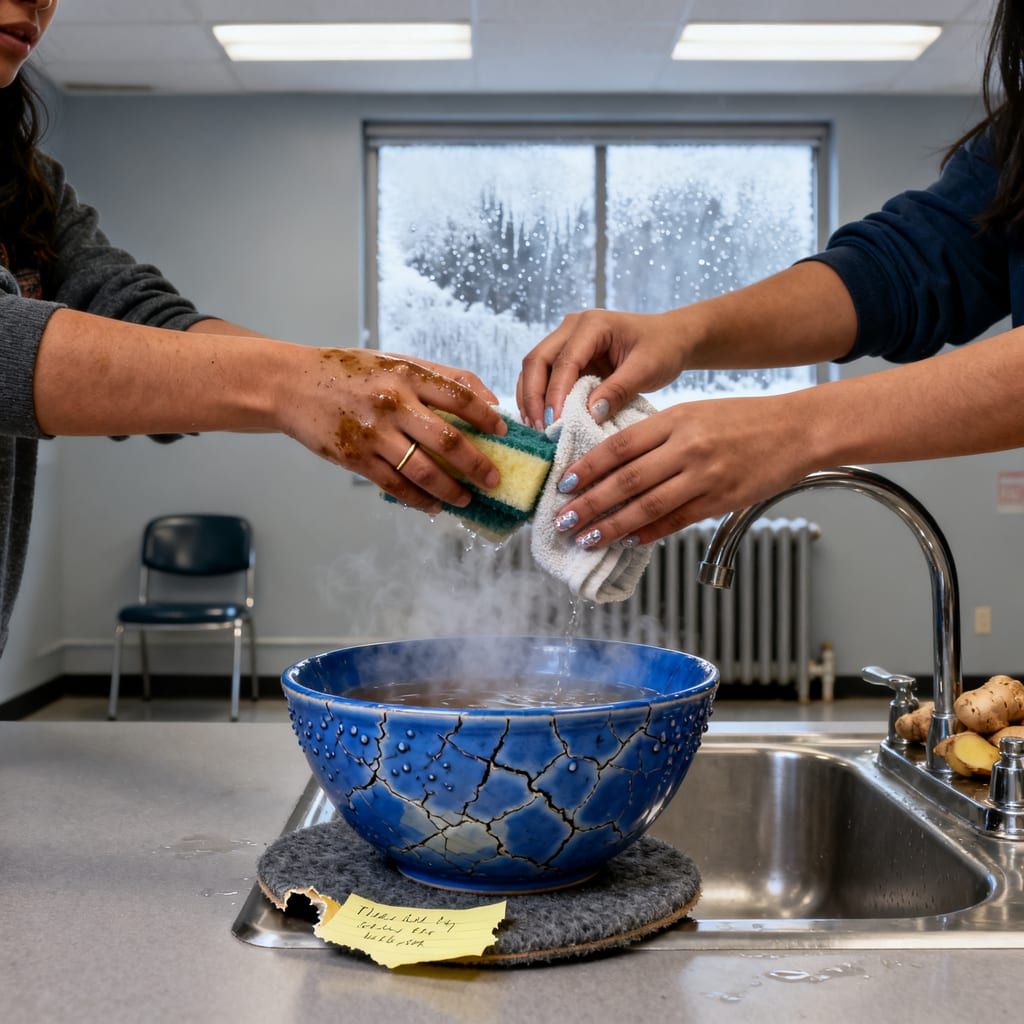
On the metal conference table: tissues, a chipped mug with pens, a tray of paper cups, and in the middle, a cracked blue mixing bowl the Costa siblings brought wrapped in a towel. It was wide as two hands side by side, its glaze spidered with decades. It had survived dishwashers and winters and the kind of arguments that make doors forget their hinges.
Lina came in first, jacket still damp from the sleet, her hair in a severe bun that fought with a stray curl at her temple. She carried the bowl like some people carried urns. "Parking on Western is a mess," she said, as if accusation lived in weather.
Marco followed, late by twelve minutes and a lifetime. His knuckles were oil-stained despite the cold, the smell of someone who fixed things that fought back. He didn't sit. He leaned. He shot the bowl a look that was almost a flinch.
Dani took a chair near the door, cross-legged, a beanie jammed low. She didn't touch the bowl at all. When she smiled-a quick, defensive baring-it was aimed at the ceiling light. "So. We doing this?"
Naya took her own seat and let the fourth chair-no one's chair-keep watch.
"Thank you for coming," she began. Her voice, practiced into softness, could move through a room without turning on lamps. "I'm Naya. I facilitate. I won't take sides. The goal is not a verdict but a path you can all walk without tripping each other. We can start with names and one thing you miss. Not about the house. About Alma."
Lina's mouth made a line. "I'm Lina. I miss... the way Mom would hum to herself before she cooked. Off-key. Like she couldn't help it."
"Marco," he said. He swallowed a word and replaced it. "The way she asked if I was hungry even when I was a whole man."
"Dani," she said, picking at a thread on her sleeve. "The smell of her hair oil in the morning. Like jasmine and old sweaters."
The bowl sat between them, catching light.
Words began to circle without landing.
"I was there every day," Lina said. "Hospice at home was a lot and-"
"Here we go," Marco muttered to the floor.
"No, say it out loud," Naya said gently. "Name it. Then we can set it down."
Lina's eyes shone. "I was there. I took time off. I spooned her medicine while you-" She didn't finish.
Marco kept his arms crossed, wrists like cables. His jaw worked. "I sent money. I did the porch in January. I fixed the furnace when it coughed black smoke-Dani, tell her-"
Dani shrugged. "He did. He also didn't say goodbye. Not properly."
Naya glanced at the empty chair and felt its steady weight. She had learned to let people wear out their patterns until they saw the thread snaking through their fists. She asked small things.
"Name what you regret," she said. "Only one thing."
"Snapping at her because she wanted the windows open in February." Lina's voice thinned. "I closed them anyway."
"Not calling you back the week she fell," Marco said to the table.
Dani looked at her beanie. "I didn't come home for Diwali. I said work but it was... it was not wanting to see her small."
"Name what you're afraid of losing that isn't made of wood or porcelain," Naya said. She kept her breath quiet. In the corner, the radiator began its winter aria-a clank, a sigh, a hot shiver running through old iron.
"Sundays," Lina said. "The loud of it."
"The feeling that I'm useful there," Marco said. "That I'm more than the guy who vanished when it mattered."
"What if you two don't call me anymore after this?" Dani said to a scuff on her boot. "I hate group texts but also... don't stop."
For a while, the bowl was a moon, gravity exerting and constant. They spoke in ellipses; their sentences skimmed its rim. Naya wrote phrases on a legal pad: off-key humming, porch in January, Diwali, Sundays. She circled nothing. She underlined nothing.
Finally, Lina nudged the towel that had carried the bowl. "She wanted me to have this," she said, low. "She said it when you weren't around."
"She told me it was my job to keep the house standing," Marco countered. "The bowl is part of the house."
Dani's laugh was sharp and young. "She mixed my graduation cake in it. She said, 'Baby gets the first taste.'"
Heat rose. Voices went up like blinds yanked too fast.
Naya lifted a hand. "Pause," she said. "Tea?"
The kitchenette yawned from the back wall, two cupboards shy of cozy. It smelled like lemon cleaner and someone else's lunch. Naya filled the electric kettle. It began to hum, a tinny bee.
"Black? Green? Ginger?" she asked, holding up packets like a card trick.
"Black," Lina said, immediate.
"Whatever," Marco said, then relented. "Ginger."
"Green," Dani said, surprising herself.
They stood near the sink, shoulder to shoulder without looking like it. Steam sketched in the air. Naya handed out paper cups, cheap heat warming palms.
"Small favor," she said, not looking at the bowl, which sat absurd and patient by the dish rack. "Would you wash it together? It's been in every story you've told. Let's see what it can hold besides argument."
"Wash it?" Lina's eyebrows lifted to the ceiling tile with the coffee stain.
"Just a shared task," Naya said, as if she were asking them to pass a dish at dinner. "No one expects anything."
Silence held-a shape with edges. Then Marco rolled his sleeves. "Fine."
They moved like people remembering choreography. Marco turned on the tap; Dani adjusted it, cool sliding to warm. The sponge squeaked. Lina added a dot of soap, worked it into lather, her hands sure as if kneading dough. Water ran over the glaze, brightening the hairline crack that faulted it from rim to belly.
"Remember when the pilot light died that winter?" Marco said to the faucet.
"Snow inside the window frames," Lina answered. "We wore two sweaters." Her laugh was unexpected, light as steam. "She mixed powdered sugar just to make the air sweet."
"I stuck my finger in," Dani said, a grin tugging at the corner of her mouth. "She smacked my hand and gave me the spoon."
They passed sponge to towel to dish rack-a relay not unlike memory. Soap film thinned, the bowl shone under the fluorescents' harsh mercy.
"What's that?" Dani said, frowning. At the base, a felt pad meant to keep it from skittering on Formica had loosened. Steam wiggled its edge like a loose tooth.
"Careful," Lina said, though to whom she wasn't sure.
Marco pinched the felt and peeled. Underneath, tape yellow as old stems. He worked a dirty thumbnail under it and tugged. Something came free-a paper rectangle, folded to the size of a playing card, sealed with a corner of tape. In careful blue ink: For after.
They froze. Even the radiator seemed to hold its breath.
"Is this-" Dani started.
"She hid notes everywhere," Lina said, not convincingly. "Recipes. Grocery lists."
"Open it," Marco said, so softly Naya felt the word more than heard it.
Lina's fingers shook. She opened the fold. Ink had bled at the edges, but Alma's hand was unmistakable-looped, patient, the way she wrote checks.
Lina read, then didn't. She pressed the paper to her chest, and in the old fluorescent light Naya could see four children in the room for a moment, not three: the version of each that Alma had coaxed and corrected and held by the scruff of their bad days.
"Read it out," Dani said, the beanie finally pushed back far enough to show her whole face.
Lina swallowed. Her voice found the rhythm of someone obeying a church she hadn't agreed to enter and now somehow needed.
"My darlings," she read. "If you are touching this bowl, I am not there to swat your hands. Good. About time. Lina, forgive me. I took your duty like air-I forgot to thank you for it. You loved me in the hard parts. Marco, I saw the porch. I saw the receipts you hid under the flour bin, boy. Thank you for keeping us standing. Dani, you are not 'the baby'-you were always my bravest, the first to taste."
Her breath hitched. She kept going.
"This bowl is not our heirloom. It is a reminder. We were fed when we had nothing. Share the making, not the thing. Have first Sundays. Pass the spoon. If you must keep a house, keep each other. Love, Ma. For after."
The room altered around the words. Anger thinned into something human. Sleet rattled the window like someone reconsidering a knock and then deciding to come in.
Marco wiped his face with the back of his wrist as if oil lived there too. "She saw, huh."
"She always saw," Dani said. Tears slipped down like they had distance to cover.
Lina folded the paper the way you fold a flag. Her shoulders-those mountains-rolled down.
They returned to the table, paper cups half-collapsed, the towel damp and smelling faintly of lemon.
"What now?" Naya asked. The question was real. She had no script for the moment after a note like that. The empty chair held its place, the custodian of everything not yet dared.
Lina breathed out. "We sell the house," she said, surprising herself with the taste of it. "None of us lives there."
Marco nodded slowly, as if torqueing a decision onto a bolt. "We split it three ways. No lawyer who isn't this lady gets the last word." He gestured to Naya, a brief, wry respect.
Dani leaned forward. "First Sundays," she said, eyes on the bowl. "Rotating. The bowl goes with the meal and the host. No skipping unless you're dead."
"Or in labor," Lina added, and they all startled at the joke made of a future.
"Or fixing the porch," Marco said, which, somehow, felt like an apology to a past.
Naya wrote: Sell together. First Sundays. Bowl rotates. She underlined nothing, but in her chest, something that had been tight for years eased a single notch.
As they stood to leave, Lina paused by the empty chair. Not a glance, not really. More like a nod you'd give a stranger who'd given you their seat on a crowded bus. "Thank you," she said, not looking at anyone in particular.
"Bring ginger next week," Marco told Naya, gruff and tender at once.
Dani tucked the note back under the felt pad, but left one corner peeking, a flag for afters. "See you Sunday," she said to her siblings, as if it had been the plan all along.
After they left, the room felt larger in the reckless way January skies sometimes do once the snow has the decency to fall all the way to the ground. Naya tidied-the sponge back in its place, the mugs corralled, the chairs nested in a neat semi-circle around the table. She touched the empty one last, palm to worn vinyl. It was warm from no one.
Her phone hummed against her hip. A calendar reminder for a board meeting. She silenced it. She opened her messages and scrolled past the unsent draft-Anika, her sister, blue typing bubble forever unbirthed. Their last real words had been iron and ornery and full of all the ways two daughters could miscount what they'd carried to and from a funeral.
Her thumb hovered. The bowl's note walked circles in her mind-We were fed when we had nothing.
She went to her kitchen that evening and pulled the dented steel dabba from the back of a cupboard. Its lids clanged like memory. The turmeric had stained the smallest compartment the color of marigolds. She wiped a handprint off its side, smiled at the way it refused to come clean.
She took a picture of it in the soft light above her sink. Her reflection bent on its belly, a small woman made oblong by old steel.
She typed: I left the extra chair out. Yours if you want it.
She stared at the words until they were both ridiculous and the truest thing she could offer. She sent them.
The reply came while the kettle was only half decided on boiling. A single line: Bring chai.
Naya stood at the base of a stairwell she knew with her feet, even after two years of not climbing it. The bulb on the second landing flickered with proprietary stubbornness. Cooking smells threaded down-cumin, roasted onion, something green trying to be brave in winter.
She balanced two paper cups in a cardboard holder, steam ribboning up into her face, and the dabba tucked against her side like a child. Her breath made small clouds. Her body remembered the turn on the third step that always squeaked.
At the top, the door was open a sliver. Light pooled in the gap, gold as honey, tempting as any myth.
Inside, a small kitchen table held an empty chair. It faced a window rimed with frost, the glass silvering the night. The chair was not fancy-it was the one their mother had rescued from the alley when they were nine and eleven, the one they had painted coral and then, a summer later, the color of rain.
Anika stood at the stove, teabags already surrendered to their cups. She looked up. Her face held all the years: the argument in a cemetery parking lot, the shrug that meant, I can't do this now, the birthday text marked "delivered" and not answered.
"You brought the rust bucket," she said, and it was a joke wearing plain clothes. She reached for the dabba with hands that still had a small scar from the time the pressure cooker hissed too close.
"I brought chai," Naya said. Her voice surprised her-steady as a table with one leg shimmed right.
They set the cups down. They didn't hug. They didn't apologize. They each took a seat-Naya in hers, Anika in hers-and left the empty chair between them to do its quiet work, catching the shapes of everything they'd yet to say so it wouldn't fall to the floor and shatter. Outside, a siren passed, the city remembering its part in the drama. Heat ticked in the vent. Somewhere, surely, a bowl was being washed and handed to the next set of hands.
They drank. The chai was strong and sweet. They opened the dabba and spooned out what they'd made for each other without writing it down.
When Anika finally reached across, fingers skimming the cardboard holder, her pinky brushed Naya's. It was nothing. It was everything. The smallest ritual. A harbor, finally, for return.

A daughter learns to read between the lines of a life split in two
Read more →
A fog-draped night, two souls found, and the quiet shape of a life
Read more →
Story audiobooks for children of all ages — a new one every day on Smarter Way Stories.