Two Houses and One Quiet Heart
A daughter learns to read between the lines of a life split in two
Read more →
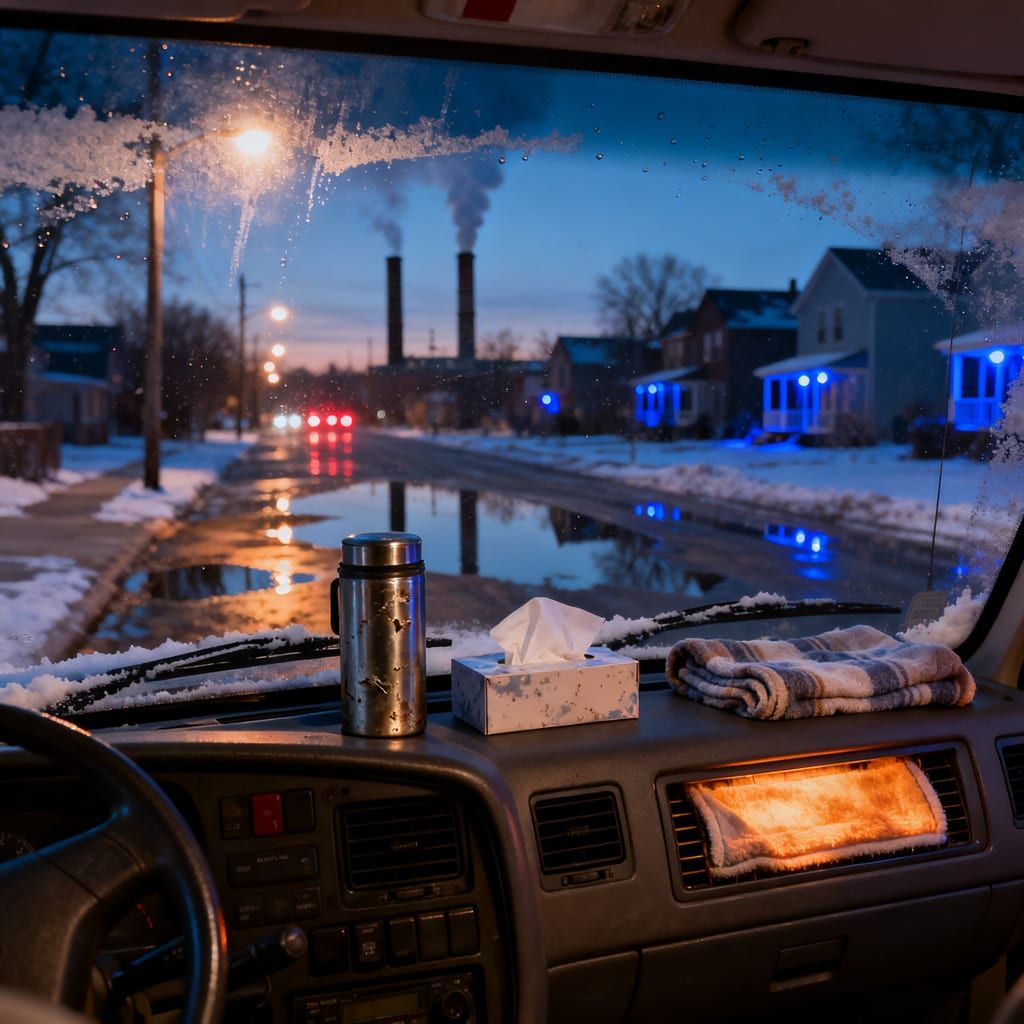
The first snow that stuck came late, sliding into the city with a hush that turned the factories into grey hums and the sidewalks into sugar. Evan kept the radio low, coffee steaming the lid of his dented thermos, wipers smearing half-moons against a windshield salted white. His van idled at a light he knew too well-long, stubborn, a metronome for thoughts he didn't want to practice.
He reached across the console and straightened the box of tissues. The heat blew steady from the vents, warming a clean blanket he'd draped over the defroster. He breathed in the smell of coffee and winter-the metallic tang of snow and brake dust-and watched a blue porch light shine in a second-story window. An ordinary small thing, a dot on a map he didn't know he was drawing.
Evan Ruiz drove people to what they needed: chemo, dialysis, cardiology checkups that left them faint and stubborn. He knew the routes by heart and the potholes by temperament-the wide-mouthed ones by the paper mill, the shy ones that only showed after the plows did their work.
He liked the way the van held a day-soft voices, the cough of an old heater, the quiet rustle of plastic wristbands. He carried no advice, only presence and a blanket that remembered heat. People filled the rest.
"You ever conduct traffic in your head?" Mr. Mahoney asked him once, climbing in with the wobble of a man who had played trombone through three marriages. Retired band teacher, wool cap with a fading treble clef. His hands trembled when the pain meds wore thin. In stop-and-go creek of downtown, he raised both hands and traced crescents in the air, invisible crescendos lifting his shoulders.
"That's a clarinet solo," he whispered, eyelids fluttering as if the notes were warm breath. "Right there, see?"
Evan smiled, eyes on the road. "I hear it."
They let the stoplights count the measures.
Tatiana, who ran a tattoo studio under the old viaduct, wore sleeves even on 90-degree days. Winter gave her cover. She pressed her forearm against the glass once and fogged a heart. It bled into a blur.
"I used to think lines were forever," she said, watching the heart vanish. "Turns out, skin keeps a ledger. Some debts you don't see in ink."
He didn't look at the thin, pale tracks disappearing into the cuff of her sweater. Instead, he changed the radio to the blues station she liked and nudged the vent warmer toward her side.
And then there was Theo-sixteen, thin as a reed, hoodie swallowed in the seat belt. He measured time in liters filtered, always glancing at the clinic clock like it was a scoreboard.
"You cook?" Theo asked on a slushy Thursday, shoes squeaking salt on the mat.
"Used to," Evan said. "Line cook. Burgers. Eggs. Whatever a griddle would take and still be called food."
"Huh." Theo smirked. "I make time."
Evan glanced over. "How?"
Theo lifted his sleeve. A Sharpie grid covered the inside like a calendar fallen asleep. He'd colored in a square for each half-liter. "Bought these minutes with wires," he said. "Might as well spend them."
Evan kept quiet. The traffic lights burned red, then green.
Nora Gale was winter sunlight, the kind that slid through blinds and striped the room just when you needed it. Sixty-one, hospice-bound, a scarf threaded with lilac-colored yarn wrapped twice around her neck. She laughed from somewhere low, like a drum warming up.
"Florist for thirty years," she told him the first day, settling her tote like a pillow against her knees. "I can tell a disagreement by the way someone orders baby's breath."
She asked for a favor at their second pickup, voice soft but not small. "My daughter. She's ten. I won't-well." She tapped her phone on her thigh. "Could you help me record some notes? Memories. Labeled by scents."
They made catalogues at red lights. He held her phone steady as she spoke.
"Lilacs," she said, looking past the windshield, eyes glistening with something not quite tears. "Lilacs for the night I cut my hair short and she said I looked like the cool moms who ride bicycles."
He hit Save and typed: Lilacs-cool moms, bicycles, spring.
"Wet soil," she continued as tires hissed over slush. "For the afternoon she fell off her bike and I followed the muddy streak to find her, cheeks like two crushed strawberries, both of us laughing through it."
Save: Wet soil-bike fall, strawberries, laughter through dirt.
On days the cold bit hard, Nora held her hands near the vent like she could warm the bones with gratitude. "You make it easy to be held by a space," she told him once, thumb tracing the seam of the seat.
He coughed into the back of his hand. "It's just a van."
"There's no 'just' in the middle of winter," she said, meeting his eyes in the rearview. "You know that."
His father started calling in February. The voicemail always found him between appointments: "Evan-call me. Doctor's office says we should-there's a test. Just call."
Evan let them pile up like snow on a porch no one used. He'd been a line cook and then a husband, and then not. After the divorce, he took the job because the hours kept his mind in motion and the nights quiet. He told himself he didn't owe his father anything besides maybe a Christmas card with a picture of a lake.
At a crossing near the rail yard, he watched freights drag past like thoughts he couldn't catch. It can wait. He'd learned patience in hot kitchens and cold cars, but this felt like standing outside a locked door you could easily kick down.
Nora watched him one morning as he finished typing "Daisy chain-kindergarten bracelet, snapped, fixed with tape." She tilted her head. "You have that look of a man with ghosts in his pockets."
He shrugged. "My dad. Genetic test. He's scared. I'm-"
"More afraid of picking up than of what you'll hear?" She smiled, wistful. "We used to hang blue lights on the porch in my support group. It's a quiet signal. Means: this is a place where help is welcome. You don't have to ask, you just step toward it."
"Blue lights," he repeated, seeing again that upstairs glow by the stubborn traffic light. He thought of the map forming without his permission.
"Start there," Nora said. "Look for the beacons. People tell you who they are if you let them."
After that, the blue lights showed everywhere. Above a bakery where the owner kept a jar of sugar-free candies for the dialysis crowd. In a rowhouse with flaking paint where someone had shoveled every neighbor's sidewalk after the last storm. A bungalow on Bartlett where a kid's wheelchair tracks cut neat lines through the powder toward a ramp wrapped with fairy lights.
On a windswept morning, Evan paused at a long four-way stop and counted three blue lights at once-tiny notes in a song he'd almost missed. He felt something loosen behind his ribs. This whole time, there were signals. This whole time, I thought I was only getting people from A to B.
He turned down a side street he'd never needed for work and saw one more-a deep cobalt gleam on a second-floor porch above an old sign shop. He didn't know who lived there. He didn't need to. It was enough to know the network held.
March seeped in with a thaw that turned snow into grey slush and corners into lakes. Nora's appointments tilted toward fewer steps and longer silences. She handed him an envelope one afternoon, edges soft where her fingers had worried it smooth. Her laugh still found its sunlight, thinner now but intact.
"For my sister," she said. "After my last appointment. Promise me you'll deliver it yourself."
He took the envelope like you take a baby bird. "I promise."
He drove slower on the way back, as if time had pockets he could tuck her into. They recorded "Orange blossoms- prom corsage, the way I had to hold my wrists up while my date fumbled with the pin and I pretended not to notice his hands shaking," and "Lavender-when her fever broke. The relief in lavender."
At a red light, he picked up the phone and almost called his father. The light changed without consulting him. He let it go.
The day he returned to the clinic without Nora, the waiting room felt like a room where everyone knew what you didn't want to say out loud. The nurse-Kelsey, mismatched earrings, a dragon tattoo peeking from her scrub sleeve-met him at the curb before he climbed out.
"Hey, Evan," she said, the way people say your name when they need your anchor. "Hold on."
She came back with a thumb drive in a tiny plastic bag, label written in careful block letters: Layover. "The dispatcher and I-we asked some folks. Those who could, anyway. Permissions and all that."
His throat tightened. "What is it?"
"You'll hear it on the way home," she said. "Call me if the file doesn't open."
He slid into the driver's seat and shut the door. The van held its usual smells, the blanket a little toasty from the vent. He slotted the drive into the port and tapped play.
Mr. Mahoney's voice arrived first, shaky but still on tempo. "To the man who conducts between stoplights: You never missed a beat, kid."
Tatiana followed, words threaded with a laugh that had discovered its own scar tissue and was okay with the shape. "Thanks for the heat on my side and letting me draw fog hearts. Keep my station."
Theo's voice was softer than his smirk. "Hey, it's me. I know you don't say much, but you remembered my mom likes seventies ballads. That mattered. Anyway, see you next Tuesday, if I'm lucky."
Others layered in, a patchwork of timbres: a woman whispering about the blanket that smelled faintly of sunscreen and summer, a man promising to bring him pierogies when his stomach could stand it again, a chuckle about how he always had quarters for parking meters. Names he knew. Names he'd gone home and carried without spilling.
Then, Nora. "Evan," she said, and the way she said his name filled the van as if the heater had worked twice as hard. "You made a small space feel like a safe one. For what it's worth-blue light, front porch, always."
He parked at the red light that never changed and let the city pass by in a blur of slush and sodium glow. His eyes gathered water he couldn't explain to a stranger.
He delivered the envelope the next afternoon. Nora's sister wore her smile the way some people wore brooches, not inherited but clearly related. The house had a blue bulb in the porch light. Inside, it smelled like lemon cleaner and carnations. They stood by the door because some conversations had to.
"She talked about you," the sister said, fingers on the edge of the envelope the way one holds a bridge before crossing. "Said you were the only quiet that didn't feel like goodbye."
On the drive back, night softened the sharp lines of the city. He rolled past block after block freckled with blue. Upstairs windows, porches, a stern bungalow with a light so bright it painted the snow cobalt. He could trace a route by them now.
At the long red light, he took the phone out and scrolled to his father. The van idled. The heater hummed. He hit call.
A ring, then another, then the voice he knew like the back of a cupboard you never reached into anymore. "Evan?"
He pressed the phone to his ear and looked at the blue light in a second-story window, one he hadn't really seen until Nora said what it meant. His mouth was dry. Words crowded and jostled at the door.
"Dad," he said, and then nothing, because what do you say after letting snow build until the roof buckles?
He remembered the van. The scent of lilacs meant laughter you could still find. Wet soil meant you'd fallen and would again. Blue lights meant you could ask without making it awkward.
So he did what the van had taught him, what Layover had made plain: he listened. To his father's long breath, to the creak of a chair, to the sound a room makes when a man is trying to be brave.
"I'm here," Evan said finally, and the words were true in a way they hadn't been for a long time. "Tell me what you heard from the doctor."
As his father began, slow and halting, Evan leaned back against the seat and watched the light stay red, and then finally, finally turn green.
He eased his foot to the gas. The tires found grip. The map in his head lit with dots left by people who'd let him in. He took the turn that was his to take.
The blanket drank heat beside him. The van sighed. Outside, the city moved-blue lights like tiny constellations across a winter sky you could walk through, one quiet porch at a time.
A daughter learns to read between the lines of a life split in two
Read more →
A fog-draped night, two souls found, and the quiet shape of a life
Read more →
Story audiobooks for children of all ages — a new one every day on Smarter Way Stories.