When Silence Became the Downbeat
A drummer learns to listen for the rhythms you can't hear
Read more →
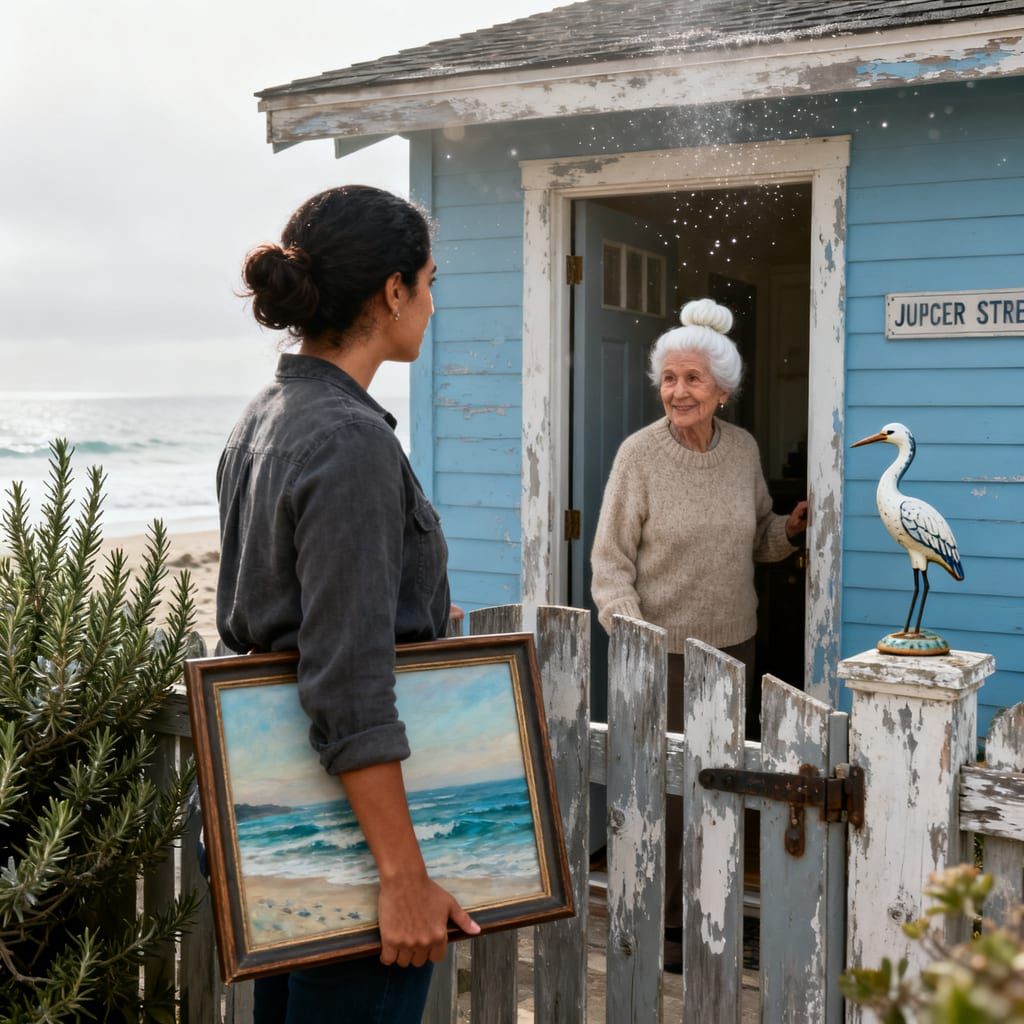
The seascape was five dollars and trying too hard. Waves like icing, sky a polite gray-blue-decor that said no one lives here long. Still, Lina bought it, because the sublet's white walls had begun to feel like blank pages she couldn't bring herself to write on.
She carried it back along the salt-bright street, the frame cold against her fingers, gulls arguing in the wind. In the living room, she held it up to the nail she'd hammered in crooked that morning, squinted, and frowned. Crooked didn't matter here. Nothing stayed long enough to justify a level.
Her phone buzzed on the counter with a name she wasn't calling back-her mother, three years and a quarrel ago. The sound slipped under her skin like a splinter. She turned it face-down and, instead of answering, flipped the painting over to tighten the hanging wire. The backing was thin cardboard, scabbed with old tape. A corner curled up, inviting the kind of picking she was very good at.
Under the peel of tape, pencil scrawled along the brown board. She almost missed it-so faint she had to turn her head, as if catching a whisper. "If you're holding this, I chickened out. Take me to the blue house on Juniper and ask for Ruth. -E., 1999."
Lina's mouth made a small, involuntary oh. Juniper was ten blocks away, toward the water where the sea bled the paint from fences and made windows freckle with salt. She imagined a house once blue, like summer on purpose. She imagined Ruth, any age between twenty and never mind.
She set the painting on the couch and left it there for three days. She stepped around it, ate over it, used it as a place to lay clean socks while they cooled. Each morning she told herself it was sweet, but not hers. Each night she brushed her fingers over the message and felt the urge thrum under her ribs.
On the fourth day, she tugged on her jacket as the kettle shrieked and the phone blinked silently, and she thought: Fine. Half a walk.
Wind coming off the ocean pressed against her, smelling like cold pennies. Lina counted doors. Past the store that sold shells that had never met the sea, past the laundromat with the lone pliant ficus, to where the street dipped and Juniper began to taste like brine.
The house at number 41 had been blue in the way of old photographs-softened, bleached, honest about its years. The railings were mended with kindness and spare parts. A ceramic heron guarded a patch of rosemary that looked like it had outlived a hundred winters. The door's paint had slivered into the fine lines of a palm.
Her knuckles hovered. She half-hoped no one would answer. Then the knob turned.
An older woman opened the door, white hair gathered into a small, decisive bun. Her face had that ship-in-a-storm steadiness some people carry into their eighties. She was wearing a sweater the color of oatmeal and the kind of sensible shoes that had learned all the sidewalks in town.
"Yes?" the woman said, and then, seeing the painting Lina held like a shield, "Oh." Her eyes lifted to Lina's, sharp with a question she didn't make Lena answer.
"I found this at the thrift store," Lina said. She sounded like she was fifteen and giving a book report. Her voice tried to be braver. "There's a message on the back. It says-"
"Let me see," the woman said gently, and opened the door wider.
Inside, the house smelled faintly of lemons and wool. The entryway walls held a crowded, careful life: postcards faded to a pleasant blur, a row of small stones labeled in a tight hand-Gull's Eye, Nova Scotia, Doorstep, 1966, Not Really a Stone, 1978.
"I'm Ruth," she said, as if offering water.
"Lina," Lina said. She slid the painting from its paper sleeve, turned it over, and revealed the pencil script.
Ruth didn't reach for her glasses. She didn't need to. Her breath went in, and out, long, like a wave laying down. "E.," she said softly. "Eli."
They stood with the quiet for a beat that felt respectful, not awkward. Ruth's mouth made a shape that was not quite a smile, not quite pain.
"He was an amateur painter," she said. "And not much of a framer. May I? Let's take it to the kitchen. There's better light."
Ruth's kitchen table was scarred with a hundred small dinners. A pot of thyme leaned toward the window as if it loved gossip. Lina placed the painting face-down. Ruth fetched a small tin from a drawer; inside, a neat assortment of patient tools-an old butter knife honed to a chisel, a pair of needle-nose pliers bright as fish.
"He vanished for a week once," Ruth said conversationally, as she levered up a rusted tack. "Came home with a scar on his forearm and a softness he hadn't had before. Couldn't look me dead-on for months, like he'd misthreaded himself." She flicked the tack into a jam jar with a soft ping. "He never said where he'd gone. It was 1999. The year all the computers were supposed to stop telling time. Seems fitting." A small, dry amusement warmed the words.
They worked around the frame, passing the tools between them the way you pass a bowl at dinner, careful not to break the old wood. Dust lifted and caught in the kitchen light, making its own weather.
When Lina lifted the final strip of backing, something slid-just enough to show its edge. A brittle envelope, foxed with age, tucked under a slat.
Ruth's hands held very still. Then they moved with the exactness of a ceremony.
She eased the envelope free. On the front, in the same pencil hand, it said: "For Ruth (and the stranger who got braver than I did)."
Lina didn't mean to gasp. Ruth didn't either. But the sound was in the room.
"Would you-" Ruth began, and stopped. She took a breath, and handed the envelope to Lina. "No. We'll do this together."
Lina slit it open with a butter knife edge and unfolded paper that had taken the habit of the envelope's dark. The first line wobbled, then steadied.
"Ruth," she read, her voice working to be even. "I ran because the doctor said my name with a word that made men stand back from me, and I am not good at letting people stand back. I imagined your face when I told you, and I was afraid I would only be my sickness in your eyes. I did not want to be pitied by you. It is the one thing I could not have borne."
Lina paused. The kettle in her memory screamed again. She kept reading.
"So I did the stupid act of a coward who thinks himself poetic. I left a message behind a picture I couldn't sell, as if asking a riddle of a stranger excused me from being brave. I walked until night got tired of me and sat down in a motel with a Bible and a spider and an ice machine that thought it was Niagara Falls. In the morning I was no less me. It turns out running rounds you right back."
Ruth made a small sound like a laugh that had lost its way. She closed her eyes, opened them.
"I am sorry for leaving," Lina continued. "I am sorrier I wanted you to be the one to make it okay. I wanted you to be strong enough for both of us so I could be a child. You married a man who trips over his own heart; I am, regrettably, consistent. If I am back when you read this, then I was lucky and ashamed and I hope I told you. If I am not-if something cowardly in me failed to climb the last step to our door-then know I loved you without dignity, which is to say completely."
The final lines had a smaller handwriting, as if the paper had fought him.
"P.S. Stranger: the thing you're avoiding is small until the day runs out. Make the call."
The kitchen had become very present. The tick of the wall clock was a metronome for their breathing. Outside, a gull screamed at nothing and was answered by nothing in particular.
Ruth touched the edge of the page with one finger. "He did come back," she said quietly. "Sat on the stoop like a schoolboy in trouble. Told me everything but this letter." Her lips pressed together, then softened. "Two years later, it was over. Not the love. The body. He was right about the word that made men stand back. We sat very close anyway."
They stood in the warmth of it. The thyme offered its small, patient scent.
Lina's throat had tightened at the P.S., a precise grip. She could see, with unwelcome clarity, the last day she and her mother had spoken. The words had been sharp tools. Her mother had asked questions in the tone that sounded like disapproval because it was. Lina had answered with righteousness because it was easier than hurt. They had hung up before either could ask for the other's softer self. And then, because she was brave at work and in restaurants and with strangers who needed directions, Lina had not found room to be brave where it mattered.
"I haven't called my mom in three years," she said, and the admission came out like an apology to the thyme, to the table, to this woman she had just met who somehow felt like a neighbor she had always had. "Over a life I don't even want anymore."
Ruth's eyes found her with a clear, unsentimental kindness. "He was so scared I'd look at him different," she said. "I looked at him the same. That was the whole tragedy, and the whole relief of it." She folded the letter back into itself with tenderness. "I forgave him before I knew I'd need to. Mostly, I wanted the truth. We can carry more than the people we love think we can. That's one of the silly gifts of love."
She lifted the seascape, its waves harmless as cake, and put it into Lina's arms as decisively as she might hand someone an umbrella when rain begins.
"Take it," she said. "He meant it to find you too."
Lina almost argued. It was Ruth's letter, Ruth's story braided into its frame. But Ruth's grip was firm and practical. The exchange felt less like charity and more like the completion of a task.
"Let me make you tea," Ruth added, already at the kettle. "Then, if you're going to make a call, best to have something warm in you."
Lina walked home with the painting's old weight under her arm and something else lighter underneath her ribs. Juniper spilled back into her neighborhood's straight lines and convenience. A little dog escorted her for half a block and then forgot her. The air held a suggestion of rain that never arrived.
Her apartment felt the same, and then it didn't. She set the seascape on the floor, leaned it against the wall, and let herself sit beside it. The phone on the counter was a small, hesitant square. She reached for it before the courage had time to learn doubt again.
Her mother answered on the third ring, her voice cautious and immediate, like someone opening a door with the chain still on. "Lina?"
"Hi," Lina said. Just that. The old defense rose up-You first, you admit-but she let it break on a quieter shore. "I-wanted to hear you."
A pause. Then the sound of her mother exhaling a leftover worry. "I wanted to hear you too."
The conversation did not redeem the whole of things in one sweep. It stuttered. It doubled back. They bumped into the sharp shapes of habit. Her mother made a half-apology that wasn't yet fully formed. Lina found herself saying, "I was proud in the wrong places," and the words surprised her with their own accuracy. There were silences that didn't scare them as much as they used to.
When they reached the end of what could be done in a first call, her mother said, more question than statement, "Tomorrow?"
"Tomorrow," Lina said. The yes felt both brave and ordinary. She let it live there.
She hung up and only then realized her shoulders had been hiked toward her ears for the last half hour. They dropped. The room made space for their descent.
The nail on the wall still sat crooked as a shrug. Lina stood, lifted the painting, and hung it from the skewed hardware anyway. The seascape's pale waves looked smaller now, less like an imitation and more like a map done by a child who loved the place purely. She stepped back.
Nothing magical happened. The air did not shimmer. But the room changed in the way rooms do when you've just told the truth inside them. The seascape was not remarkable. The backing board, the letter, the penciled note-those had been the private theater under its surface. What remained was a rectangle of calm color and the knowledge of what it had carried.
Lina stood there long enough to watch the light puddle and slide down the wall as the afternoon shifted. Her phone lay on the table, ordinary now. Juniper St. and a kitchen with thyme and a woman with a clear gaze existed ten blocks away; that fact steadied her.
She touched the frame, fingers finding a nick in the wood, a small roughness like a landmark one returns to out of habit.
Outside, the gulls were still arguing. Inside, the room held quiet evenly.
She went to the kitchen to put on water for tea, thinking-not about what she'd avoided, not even about the bravery she'd borrowed, but about how many pictures in how many thrift stores might be hiding a story that is really a dare. The kettle began to mutter. The wall clock tapped its calm tap. The blue reached out from the frame and found its echo in the chipped mug, the distant bay, the vein at her wrist.
When she sat again, she took in the room the way you check your face in a window at night: not to admire, but to recognize. It was still a sublet. It was still temporary. And yet, for the first time since she'd moved in, it felt like a place you could come back to and find your own breath waiting.
A drummer learns to listen for the rhythms you can't hear
Read more →
In Los Angeles, a daughter learns how to carry two lives forward
Read more →
In the soft hours before dawn, staying becomes its own kind of rescue
Read more →Story audiobooks for children of all ages — a new one every day on Smarter Way Stories.