Two Houses and One Quiet Heart
A daughter learns to read between the lines of a life split in two
Read more →
On Tuesday nights, the lights in the community center buzzed like a low-grade headache, and the floor smelled of mop water and rubber mats. Arun tugged a rattling fan cord and watched the blades shake warm air into a tepid breeze.
He led his class into standing, feet whispering over scuffed basketball lines. "Find your edges," he said. "Then soften them."
He didn't mention the video.
A stranger's phone had caught him in the park last month-Arun alone at dawn, following a slow arc of "White Crane Spreads Wings" when his hip jammed and his right foot skittered on wet grass. He'd caught himself, palm to thigh, breath a visible ghost in the cold. The caption: When strength looks like softness. It spread like ivy. He'd pretended not to see.
Now, beneath fluorescent hum, he pretended nothing had changed.
There was a rhythm to who trickled in. Delivery drivers with tendonitis, dropping their keys in the same tin bowl. A baker with flour ground into the creases of his hands. A new mother, hair in a sleep-deprived knot, cradling a pelvis that felt both too loose and too tight. A retired mail carrier named Mr. Ortiz with calves like braided rope. An ER nurse, late, always late, the elastic at her wrist tattooing the skin.
She slid into the back that night, tucking a loose bang behind her ear. "Lina," she said during warmups, when introductions loosened tongues. "I work at St. Joseph's. Nights. I saw your..."
Arun pivoted into "Parting the Wild Horse's Mane." "Nice to have you, Lina," he said, too quickly.
"The video," she tried again, breath shallow from the stairs. "It was-"
"Step back, shift." He smiled without teeth. "Let your heel kiss the floor before your weight finds it."
They watched his feet; he watched their eyes. He kept the sequence just enough-not easy, not punishing. He was forty-one and wired like a phone on ten percent, and his usefulness, he suspected, hinged on looking endlessly charged.
Two weeks later, a paper notice bloomed on the door: FUNDING SUSPENDED UNTIL FURTHER NOTICE. The director had explained with the brittle cheer of someone trying to sell you your own favorite chair-maybe in a few months, maybe never.
Arun thought of cancellations as small deaths. He stared at the empty gym, the echo of their steps already nostalgic, and picked up his phone.
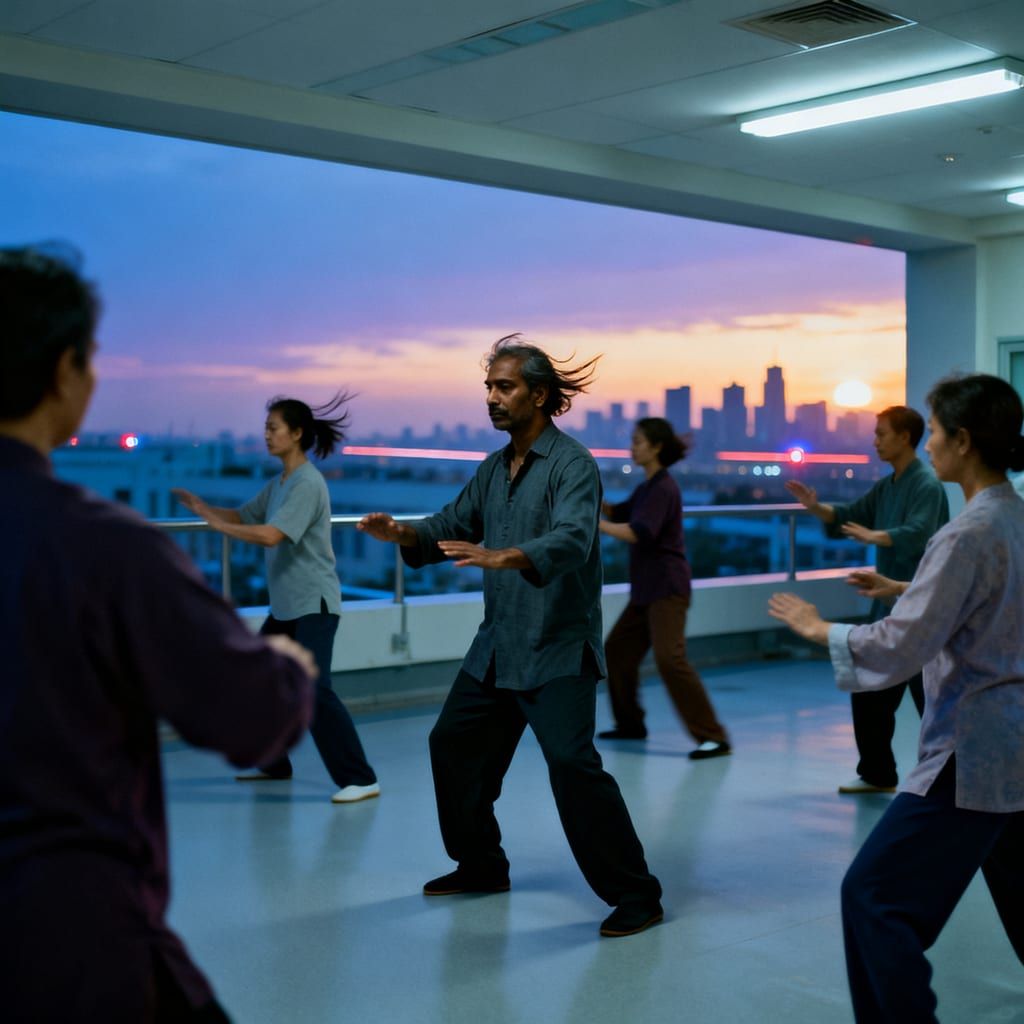
St. Joseph's Hospital had a flat roof and a view that made even gridlock look like choreography. He found an administrator willing to barter: health staff wellness hours in exchange for space. He learned the access code, the wind patterns, which corner collected leaves, which one the smokers liked.
On their first rooftop night, dusk curled around the skyline like a cat. Sirens threaded the air, thin and insistent. The students' faces lifted into the wind, hair and jacket hems restless.
"Out here, the air moves you," Arun said, half joke, half instruction. "Let it teach you to sway instead of brace."
Lina exhaled, her jaw unclenching. Mr. Ortiz rolled his shoulders, something popping like a knuckle. The baker brought sesame buns, still warm, wrapped in a towel. The new mother set her baby monitor on a yoga block, a green LED blinking, small alien heartbeat.
They began.
"White Crane Spreads Wings," Arun said, and his voice steadied his body. Rise through soles, lift through crown, arms wide as a question.
Halfway through the form, a hot wire lanced from his hip to his knee, a live, thin electricity that made his teeth ring. He hit a limit the way headlights hit deer-too fast to be graceful.
He tried to blur it. He softened the knees, found a ghost of weight shift. He aimed for elegance by subtraction. But the tremble exposed him-micro-quakes in his right leg, the kind you feel before you see.
He tasted salt. He tasted the metal of swallowed apology.
Arun had taught them to surf inside their pain, to test its edges like tongues test a chipped tooth. He had taught them to look like water. He had not taught them how to look at him when he froze.
The city kept breathing. A helicopter stitched light over the far river. Somewhere, someone burned toast.
He braced for the scrape of shoes heading for the door that wasn't there.
Lina stepped closer, not a rescue, a rhythm. She softened her ankles, dropped her weight to match the centimeter Arun could travel without flaring. Her eyes kept offering a question; her shoulders did not offer pity.
"Smaller," she said. "Follow him."
Mr. Ortiz, veteran of thirty winters on slush and steps, shaved his motions down to grains. The baker, who knew the economy of motion at 3 a.m. when dough sticks and wrists ache, mirrored the arc of Arun's elbow, a sliver of moon above a counter.
The new mother tipped her pelvis into the precarious trapeze where comfort lived and sent a nod through the circle. Breath linked them-four seconds in, six out-the ratio they'd found that didn't light up anyone's edges.
It was not the named sequence. It was not the poster in the community center, the one laminated and coffee-stained. This was form remixed by need, bone and weather.
Their feet made no sound. Wind cuffed their sleeves, their hair, and carried away what they didn't need.
Arun felt the tremble broadcast back to him, not as a flaw, as a metronome. His own fear thinned, a fog burned off by a steady sun.
He let his right heel land a breath later than his left. They waited. He tipped three degrees into the pain, the way you lean into a friend's quiet. They tipped, too.
He didn't hide. He didn't dissolve, either. He was a man in a blue sweatshirt under a sky that forgot to be kind. He was a spine learning ecology.
After, twilight having completed its slow theft of color, they coiled their bodies back into standing. Shoes squeaked. Joints clicked. Someone laughed-one of those relieved little barks after a storm skews right of you.
A set of keys chimed near the stairwell door. The janitor-Tomas, the small metal nameplate said-tilted his mop into the corner. He was one of those presences you feel the way you feel the hum of a refrigerator-constant, unvalued until the power cuts.
"Excuse me," he said, not meeting anyone's eyes. His English wore an accent like a jacket that didn't quite fit. "I hope is okay I watch."
Arun nodded, a corner of tired pride lifting. "It's okay."
Tomas held the keys like a bouquet. "When they want to close the roof at seven, I tell the manager... I tell him my wife, she-" He pressed a fist to his sternum, searching for the English. "-she can't sleep most nights. She likes to come up and... move slow. With you. From the door."
He gestured to the shadow just inside the stairwell, where the wind softened and the city grew quieter by one decibel. "She say it make the worry... not go, but get softer on the edges."
He looked at Arun, finally. "So I say, let them stay."
A small ache opened at the base of Arun's throat, the good kind, the preface to tears that never arrive. He pictured unknown eyes in the doorway, collecting their own fragments, letting them settle.
Lina lifted the towel from the buns. Steam curled into the blue hour. "You fed him," she said to the baker. "Let us feed him back."
They ate in a small circle, chewing like a benediction.
On the train home that night, Arun finally watched the video to the end. There he was, breath a cloud, weight snagging on an invisible hook. He saw, for the first time, not his mistake but the moment after: the way his hand found his thigh without self-scolding, the way his breath lengthened like pulling an old sweater over a stubborn shoulder.
He tapped the comments open. Most were noise-hearts, emojis, a few jokes about tai chi being fight club for leaves. But salted among them were little testaments:
My dad watched this before his chemo. Helped him not be afraid.
Delivery driver here. I thought slow meant weak until my wrists gave out. Thanks for showing the other way.
Nurse, nights. Beauty in the stumble. Came to class.
He pressed the phone to his chest, then to the seam of his hip where the hot wire had first sung. Not healed, he thought. Not hidden. Something inside him exhaled like a room when you open a window.
A week later, the sky loosened from white to lavender as they gathered. They named it without ceremony-someone joked, someone shrugged, and then they had it: the Wind on Rooftops form. A sequence arranged like a quilt-stitched from what didn't hurt today, from what offered, if not ease, then company.
They began with the breath that had saved them on the windy night-four in, six out. Mr. Ortiz tilted at the ankles first; Lina softened her jaw before her knees;the baker set imaginary loaves where his hips asked him to; the new mother checked the small green eye of the monitor and then gave her pelvis back to gravity.
Arun stepped into the center, not because he was leader, but because a circle needs a middle to know it's a circle. He did not perform. He inhabited.
Pain arrived as it always did-late, then suddenly early. He watched it come and didn't sharpen against it. He let it braid into the movement the way wind braids hair. He felt what he had not allowed himself to feel in months: usefulness unclipped from proof.
A siren dopplered toward them and away. The air smelled faintly of rain that might change its mind. A helicopter laid another yellow stitch across the river.
They raised their arms as if asking a question no one needed to answer. They turned their palms toward the city and then toward themselves. They moved slow enough to stay.
Afterward, they lingered, as people do who have learned that leaving too quickly steals some of the thing you made together. Shoes back on. Jokes low. Hugs that respected each person's map of pain.
Lina stood beside Arun at the parapet, the breeze skimming their sweat into coolness. "I came because of the video," she said, not a confession this time, just a fact offered like bread.
He nodded. "I know."
She looked at his hands. "There was beauty in the stumble. It made room."
He followed a pigeon's lopsided flight to a ledge and back to open sky. "Some rooms you only find when you fall into them."
Below, the city kept resolving into smaller and smaller human acts-someone washing a dish, someone lifting a child from a car seat, someone unlocking a night shift door. Above, the first star arrived with an old generosity.
On the way down, the stairwell smelled of bleach and faint sesame. Tomas's keys rang again, a sound you could follow home if you were quiet enough.
Arun's hip ached, untidy. His steps were measured but not staged. Beside him, the class drifted like an extra lung. He did not speed up, did not apologize, did not pretend to be unbroken.
He matched his breath to the pace of the group, and in that small, exact tempo, the body he'd once tried to outrun finally heard itself.
A daughter learns to read between the lines of a life split in two
Read more →
A fog-draped night, two souls found, and the quiet shape of a life
Read more →
Story audiobooks for children of all ages — a new one every day on Smarter Way Stories.