The Weight We Hold Together
In the soft hours before dawn, staying becomes its own kind of rescue
Read more →
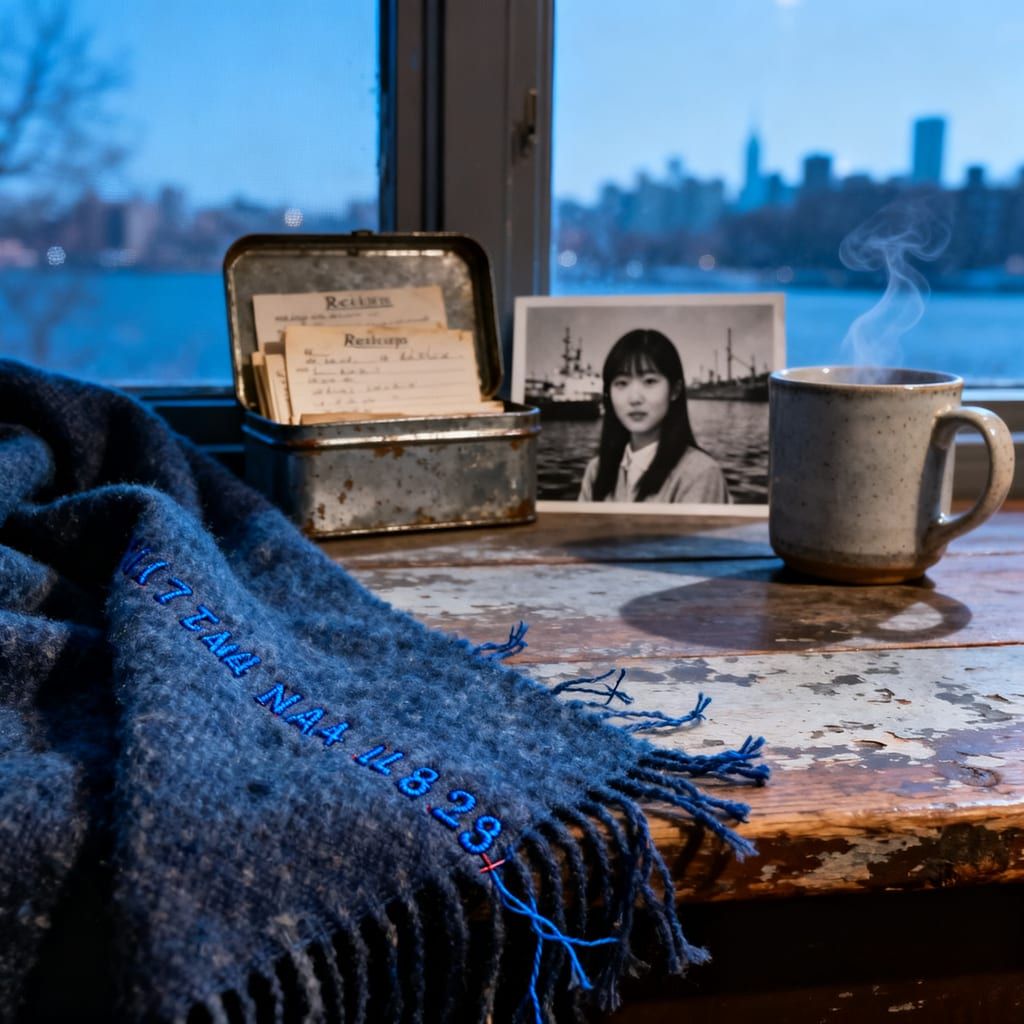
The scarf smelled like cedar and dust and a winter two generations old. Lena tugged it free from the highest shelf in her grandmother's hall closet and a small snowdrift of napkins and rubber bands came down with it.
Frayed wool the color of early dusk. Along one edge, cramped blue stitches marched in a narrow ribbon-letters, numbers, dates-so small they felt almost private.
Her grandmother had been a quiet woman with strong hands and few stories. Bread left on neighbors' doorknobs. A pot of seaweed soup on birthdays. The scarf had always been there, folded above reach, a shadow of habit. No one had asked why.
Lena laid the scarf across the dining table, smoothing its softened itch with her palm. The apartment-Queens brick with radiators that hissed like cats-hummed around her. Outside, a bus sighed. A siren stitched past.
She leaned close. The thread was indigo, the letters exacting. She could make out "Park" and "Choi," then a number, then the number again, smaller, almost like a whisper. Dates, some clustered in late December. A few names bled into the seam as if they'd been sewn in a hurry, or with cold fingers.
She snapped a photo, sent it to her mother. Any idea? Did Halmoni make this?
A bubble ellipsed, then stopped. Finally: She always kept that scarf high up. Said it was old. Maybe tailoring notes? Ask Mr. Kim at the corner if he can read it.
Lena wrapped the scarf around her neck even though it scratched. The weight of it-like carrying someone else's winter.
The bell at Kim's Deli rung a bright note that trembled into the cold air behind her. The store was the kind of place where the lottery tickets fanned like peacock tails and orchids bloomed weakly in the front window.
"Ah, Lena," Mr. Kim said, as if he'd been expecting her. He was a compact man with eyes that smiled before his mouth did. He'd known her since she could afford her own instant ramen.
"I brought something," she said, laying the scarf on the counter between the plastic-wrapped muffins and a display of cough drops. "Can you read this? It looks like names. My mom thinks it's tailoring stuff?"
He leaned in without touching it, as if the thread were a flame. His glasses slid down his nose, and he did not push them back up. For a beat, all Lena heard was the refrigeration unit's low hum and a blade of radio static.
When he finally spoke, his voice was careful. "These are names," he said. "Ages. Family groups. And numbers to match them."
He traced one line with the air above his finger. "Forty-seven," he read. He swallowed. "That was me."
Lena felt the floor tip. "What?"
"This is a manifest." He looked at her, and for the first time since she'd known him, there was something like weather in his gaze. "This belonged to a young woman at Hungnam. She sewed our names into her scarf so we wouldn't be lost when the ships left. Your surname-Park. I wondered... but I wasn't sure."
He cleared his throat. "She wore it like this." He pantomimed tying something snug at the base of his throat. "Blue thread. Fast hands."
The radio in the corner broke into a Christmas commercial about ham. It felt obscene.
That night in the apartment, Lena sat cross-legged by the radiator and let the heat pink her knees. The scarf lay like a coastline in her lap. She opened her grandmother's recipe tin, more talisman than cookbook-yellowing cards in her grandmother's neat hand, sesame oil smudges in the corners, a brittle church bulletin used as a bookmark.
The bulletin was from a small Korean church in Flushing, dated December 24, 1978. A mention in the back of the program: Grateful for the courage of the Seamstress of Hungnam-unknown to the world, known to God.
On a recipe card for soybean paste stew, a faint practice line: han sook han sook han sook. The H underlined, then not. Below it, stitched in pen with tiny care, was an almost-calligraphic line of hash marks-like someone planning stitches before the needle.
Her great-grandfather had been the figure family stories orbited. A stoic man who survived a war and later sold produce on Northern Boulevard, who could lift watermelons with one hand. The story had stopped there, as if that was the only kind of courage their lineage could hold.
Lena ran her finger over the indigo names. Between the loops and bars of thread, she could see the ghost map of a port city. The crush of bodies, the stink of diesel and brine, the clatter of boots on gangways. A scarf clutched at a woman's throat as the wind bit the sea into ribbons.
From declassified archive footage, Lena watched black-and-white snow of people move across a winter-stunned pier. Men, boys, women with babies cocooned under their coats. Soldiers with faces like closed doors. The camera stuttered, then steadied: a young woman at the edge of the crowd, a knotted scarf at her throat. Her hands were moving-faster than the frame could catch.
She printed the frame anyway and set it on the table like an icon.
At the Queens Korean Community Center, someone had taped up a flyer: Story Circle for Elders-Remembering Journeys. The room smelled like barley tea and Bengay. A woman with hair the color of sea foam said she remembered a girl who kept saying, Write your names, write your names, I will not leave you behind. Another lifted a cracked Polaroid out of an envelope. The photo was decades newer than the war, bleached to fog at the edges, but there was the scarf-blue at the throat, wool catching light.
"She tied it like that," the woman said. "Tight, because the wind." She pressed the photo into Lena's hands. "Keep it for now. You bring it back."
No one knew the girl's name. They knew her hands.
Lena returned to the deli with the photo and the scarf and a jitter of reverence she wasn't sure what to do with.
"I found this," she said.
Mr. Kim took the photo with the gentleness of someone receiving an infant. He looked for a long time. "Her," he said. "Always a little out of breath. Like she'd been running to catch us all."
"Did you know her name?" Lena asked.
He shook his head. "The men spoke to soldiers. We children clung to cloth." He hesitated. "When I first saw your mother, years ago, I saw Park on the check, and I looked again. I thought-maybe. I kept an eye." A small shrug, almost apologetic. "A private gratitude. I could never repay."
He pointed to a blue line near the scarf's edge. "Forty-seven," he said. "Kim, age seven. Sister, five. December twenty-four, nineteen fifty. My mother's hand on my collar." He closed his eyes as if to hold something in place that kept wanting to slip.
"Do you want to... tell me?" Lena asked.
He nodded, then did not speak of bombs or hunger. He spoke of the smell of pine tar and mackerel. The taste of candy a GI had pressed into his palm, the shock of sweetness like fireworks in his mouth. The way the girl with the scarf cupped his sister's cheeks and said, name? name? until she answered. How the girl anchored thread with her teeth when her hands were too cold. How, when a wave slapped the dock and people surged, he felt his name in the scarf like a rope tying him back to himself.
By the time he finished, a thin line of customers had formed and dispersed quietly, buying cigarettes in whispers. Someone left exact change for milk on the counter and touched the scarf with two fingers before leaving.
Back home, Lena poured the blue thread into a small dish, the way her grandmother had always prepped beans for rinsing. She found a needle, the silver eye like a bright door.
She wasn't a seamstress. She knew enough to knot and mend. The scarf's fray was worst at the edge where the names began; the thread there had paled to cornflower, then white. She made the smallest, most faithful stitches she could, following the older woman's ghost-hand, reinforcing without remaking, care where she could offer it.
Between names, she left room for breath.
When the scarf held its shape again, when the blue resumed its path like a brook finding its bed, she sat with it in her lap and cried in quiet, surprised little bursts that left her raw and oddly light.
She slid the recipe card from the tin and compared the practice stitches to the sewn letters. The same impatience at the cross of the H. The same steadiness between the A and the N. Han Sook.
Her great-grandmother's name, not just a line on a family tree or a face in a black-and-white oval, but a habit of hand, a faith that had made itself practical.
In the bodega window, under the fading lotto posters and neon Open sign, Lena taped a flyer: The Names Sewn Into Winter-An Exhibit. Community Center, Saturday, 2-5.
She paired each indigo name she could translate with a living face or a story. She sat with elders as they pointed and nodded and closed their eyes. She made small placards that fit in the palm the way the scarf did when it was folded-paper thick enough to feel like a thing.
Mr. Kim stood near the hot water urn, fingers pressed to styrofoam, listening. He said little and everything in the way he held the space.
A man from the back of the room brought a box of mandarins and set them by the door. "For sweetness after salt," he said, then blushed at his own poetry.
When a woman arrived with a cane and the exact blue of the scarf's thread knitted into the brim of her hat, Lena felt the room widen. The woman lifted the scarf and kissed the edge where the names began. "We were number sixty-one," she said, tapping lightly. "All winter, I've been dreaming of this."
The week after, Lena filled out forms and sat through orientation at a local refugee intake office. Fluorescent lights, stale coffee, a child's drawing of a house taped to a cinderblock wall. A woman from Darfur taught her to say hello in her language three times until she heard it right. A boy from Kharkiv hugged his backpack so close to his chest it might have been a rib.
Lena's hands, which had been good at clicks and swipes and pixels, found their way into different usefulness-pouring water, translating intake questions into softness, finding a pen when they were scarce as luck. She didn't tell anyone about the scarf. Or if she did, it was only to calm a fear with a story of names not being lost.
Sometimes, walking past the deli, she saw Mr. Kim look up and tip a coin of a nod. The scarf hung in the community center for a month, then came home to Lena, who folded it and set it-on purpose-on a middle shelf, where she could reach for it when winter pressed its cold mouth against the glass.
On the first real snow of the season, she met her mother at the cemetery where the wind stitched through the bare trees and the stones wore their white with humility. They stood by her grandmother's name and spoke to the air as if it had ears.
"I think Halmoni knew," her mother said, voice catching on a laugh. "That we'd need something to find our way back."
Lena looped the scarf around her mother's neck. Blue on gray. Past on present.
They walked back to the car slow, as if the ground might change its mind.
That night, Lena dreamed of a woman at a harbor with needles between her teeth, a scarf bright against a winter that wanted to take names the way the tide takes footprints. She woke with her palms open, the way her great-grandmother must have held them open for small hands to press into.
Some mornings, when she ties her own scarf low and tight, she feels a light encoding at her throat-something like a vow, something like a simple way to move through the world: hold what you can, write the names, leave room between them to breathe.
In the soft hours before dawn, staying becomes its own kind of rescue
Read more →
Story audiobooks for children of all ages — a new one every day on Smarter Way Stories.