Two Houses and One Quiet Heart
A daughter learns to read between the lines of a life split in two
Read more →
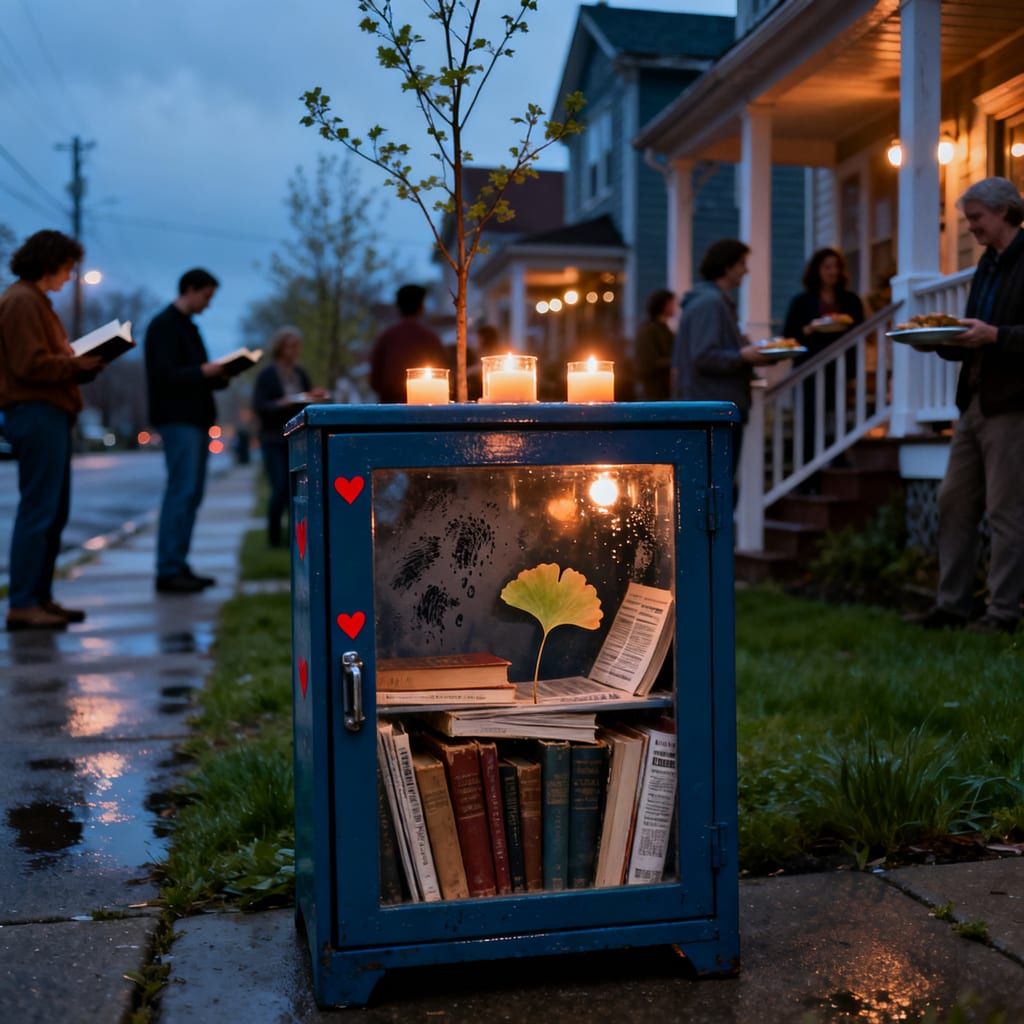
Early spring on Willow Street smelled like thawing soil and last year's leaves-wet paper, sweet rot, a promise. Lena set the first coat of blue at dawn, the color of late August water, onto the old newspaper stand someone had left at the curb with a crooked FREE sign. Her hands shook from the chill and from the kind of tired that lingers behind the eyes. She kept painting anyway.
By noon the box stood beneath a lanky elm, glass door polished, a handwritten sign taped inside: Take a book, leave a book. The hinges clicked shut with a soft, certain sound. Lena stepped back and watched it as if it might introduce itself.
The first week, the block kept its distance.
Scuffed work boots paused without stopping. Curtains lifted then fell. An old man with a cane made a half circle around the elm and shook his head like a dog coming out of rain. On Thursday, someone left a torn romance novel-cover ripped, a woman on a cliff in a wind that couldn't possibly hold up that dress.
Lena wiped fingerprints from the glass and tried not to hear the hiss of a coffee machine in a break room three miles and three months away, the clipped voice of a product manager asking for "one more iteration" of a button that made her chest ache. She took a photograph of the box with her phone and did not post it anywhere.
On Sunday, a hardback appeared. The dust jacket had been lost to time; its cloth was the faded green of old school chalkboards. Inside, pressed flat as breath held too long, lay a golden fan of ginkgo. Beneath it, in careful blue pen: For whoever needs to begin again.
She touched the leaf with a finger and felt a current run through her-the cool of a lake at the ankle, a door opening to a room she already knew.
Books bred books. A paperback cookbook leaned against a moss-soft volume of poems. A dog-eared parenting manual arrived heavy with penciled underlines and notes that sounded like a late-night friend: Page 67-remember to drink water. You're doing better than you think. Someone tucked a memoir into the corner with margins talking back to the author: Yes, but what about the sister? Tell the truth here.
Lena went to the drugstore for index cards. She cut them in half at her kitchen table and slid one into each spine with a question: What did a chapter give you? What would you give a neighbor? Leave a line.
She checked the box every morning like a gardener looking for cotyledons. People answered.
A neat script in green ink: A recipe for lentils-stapled to page 112-potluck, anyone? A looping hand with stars in the corners: Chapter five told me I'm not the only one afraid of the dark. Me too?
She drew a small red heart on a sticker and pressed it onto the box's side each time she found a card that said simply, Me too. The paint took them like freckles.
The next Saturday, three card tables appeared on the sidewalk. A woman in a rust-colored headwrap set down a Dutch oven that breathed cumin and tomato into the street. A man with sawdust in the cuffs of his jacket brought cornbread that broke with a sigh. Lena made a salad with her mother's dressing in a bowl that had crossed a border wrapped in picnic towels. They ate under the elm while the wind threaded napkins through chair legs, and someone played a playlist too softly from a phone so that the guitar was only an idea of a guitar.
"Who started this?" a tall teenager asked between bites of lentils. His hoodie read CITY CODING CLUB in peeling letters.
Lena shrugged. "The box did."
He lifted a sci-fi paperback from one of the tables, thumbing its bruised spine. "Spaceships are just buses that never touch the ground," he said, like a confidence, and later he slipped the book back with a pencil sketch tucked inside-a slender ship arcing over a line of row houses, a phone number scrawled below. Free coding club, downtown. First Tuesdays.
Storms started visiting in late April. One thunderhead came riding low and mean, cracking an elm on the next block in a sound like a house gasping. Wind slapped the blue box. The glass door fractured into a cobweb and slumped forward, defeated, scattering a wet tarot of paperbacks across the sidewalk.
Lena stood on her porch watching rain stitch the street into a single sheet and felt something inside her want to match the storm for noise. She pressed her fingers into the porch rail until the wood made half moons in her skin and went to bed with the lamp on.
In the morning, the street had been arranged while she slept.
Half the block stood under umbrellas and broken hats-bucket brigade of residents passing books hand to hand. The old man with the cane held a Phillips screwdriver like a conductor's baton. A woman in a postal uniform knelt to sweep glittering glass into a dustpan by feel. The tall teenager arrived with a sheet of Plexiglas and a grin that didn't apologize for anything.
"Brought extras," he said, holding up a small sack. "Also, donuts."
A man Lena recognized as the one who had glared at the box on its first day-broad shoulders, a jaw that looked carved for saying no-knelt on the wet sidewalk, unscrewing the bent hinge. He glanced up without the glare. Rain trembled on his eyelashes like confetti that hadn't decided where to land.
"We can fix it," he said simply.
They did. The new blue came out deeper than the first, a shade made for river shadows, and the paint went on with too many hands and not enough brushes. Later, when it dried, you could see their fingerprints if you stood close enough to fog the glass.
More notes now. A thin book of poems appeared, white as a communion wafer, its margins annotated with dates and weather: Nov. 12-couldn't sleep, thunder over lake. Page 14 kept me company. On the back page, someone had written a name that made space of Lena's chest: For M.
The parenting manual came back with a folded letter tucked gentle as a bird under the flap. Whoever wrote on page 67-your kindness got me through last night. There was vomit. And fear. We're okay. A block away, a baby wailed in a key that made even the old men blink hard for a second.
One afternoon, a hardback arrived that no one could place-vintage cloth, soft as the inside of a jacket collar. Inside cover, in looping cursive that walked the line between casual and ceremony: For Marisol, who built our first library, 1978. To be continued.
Tucked like a secret between chapters three and four: an obituary clipping for Marisol Vega. A small photograph showed a woman whose smile was a comma, as if she were about to add something. Lena realized she'd seen her-two houses down, on a porch that had bloomed with people until winter came and then it didn't.
A ache threaded through the block like a draft under a door.
Lena stood with the book open on her palms as if it were asking to be weighed. Behind her, a screen door creaked. The man with the carved jaw leaned on the railing, eyes on the ginkgo leaf taped beside the sign like a small fan of applause.
"You knew her," Lena said. Not a question.
He nodded, once. "My mother." The words landed between them and did not break.
"I'm Lena."
"Aurelio," he said, and his voice had the gravel of a road that knew where it was going. He sat on the step below hers, both of them angled toward the box like parishioners.
"She used to run a book swap from our porch," he said after a while. "Summer nights. She'd light two candles and say it was our lighthouse. When I was little I thought we were calling ships."
"You were," Lena said, soft. "Just not the kind with sails."
He smiled without his mouth changing much. "After she died, I couldn't sleep. I started walking. Some nights I'd bring a book and leave it. It felt like-" He gestured toward the blue door, toward the hearts stickered along its side. "Like I was dialing a number I used to know."
"Were the notes yours?"
"Some." He looked embarrassed, then relieved to be embarrassed. "Not the good ones. The poem dates-those are Harold's, down at the corner. The parenting wisdom? Tess across the way. She's got three under five and still remembers to label things."
They sat, watching the street breathe-mail truck exhaling diesel, a delivery bike chittering past, wind lifting and lowering the edges of doormats. The box stood humming with quiet purpose.
The next day a note bloomed in the vintage novel like a morning glory. It was written in the same looping hand as the inscription, though older now, a tremor at the end of certain letters: Thank you for giving us a door to walk through, Lena.
Her name looked unfamiliar on paper in someone else's ink. She touched the curve of the L like it might open to a room where a woman with a comma-smile sat with a stack of paperbacks.
She went inside and wrote three words on a new index card: Dusk reading, Friday? Then she added, Bring a page you love. She taped the card inside the glass and waited to see who would answer.
They came with pages tucked into pockets and cradled under thumbs. Harold from the corner brought his poem book and read a line about thunder making furniture of the sky. Tess wiped spit-up from her shoulder with one hand and read page 67 aloud like a prayer that promised nothing it couldn't keep. The teen from the coding club read the first paragraph of his sci-fi and announced a meetup after, right there, on the curb, for anyone curious what a loop was besides something you tighten when you're nervous.
Aurelio unfolded a sheet of paper worn thin at its creases. He did not clear his throat or apologize. "My mother," he said, and then he read the inscription again, but slower, like it was a bridge he was laying with his mouth. To be continued.
Neighbors who had only waved before learned each other's names by how they sounded when someone else said them. A woman from the rust-colored headwrap crowd-Amina-brought lemonade that caught the late sun like stained glass. A kid with shoelaces no one had ever tied properly before curled up on the curb with a comic, head on his dad's knee. A man Lena had only seen smoking alone on his porch wrote Me too on a card and then added, didn't know I needed this. He looked surprised by his own handwriting.
As the street blue-d to night, someone lit two candles and set them on the blue box-thin pillars casting taller versions of themselves on the glass. The block fell quiet, in that crowded way that is anything but empty.
Lena watched light move across faces she didn't know she'd memorized-the cut of Aurelio's cheek where the beard refused to grow, the way Harold's hands shook only after he read, Amina's earrings like parentheses catching what the air might say next. She thought of push notifications, of sprints and velocity charts and a thousand iterations that never made anyone feel held.
The candles guttered and rose. In the new stillness, Lena slid her own note into the spine of the vintage novel. It didn't say much. It didn't need to. Just, Here when you are.
They made it a ritual without deciding to. First Fridays, then the next, and the next-the box gathering breath between them. Aurelio started leaving a book each month from a cardboard archive he said was a closet and Lena suspected was a shrine. The coding club grew until they needed two tables. Someone brought a sketchbook and drew hands instead of faces; another drew doorways and left them unsigned.
The hearts on the box multiplied, not like stickers but like constellations. Each one a reply. Each one a filament catching the day.
Sometimes Lena woke in the middle of the night to rain and thought of the glass door holding, of ginkgo leaves fanfolding shut in the dark. She would pad to the window and look down at the blue shimmer at the curb and feel quiet assemble inside her ribcage like furniture being put back in the right room.
On a June evening, kids ran with sparklers before anyone had officially declared it holiday season. The sparks made commas in the air-pauses, not endings. Lena stood with Aurelio by the box, the two candles again softening the corners of things.
"She'd have liked you," he said, not looking at her. "My mother."
Lena glanced at his profile, at the way grief had decided to stay but not to rule. "I like her," she said, and it wasn't past tense.
They stood listening to the neighborhood speak itself back into being-the low negotiations of bedtime, the click of a grill cooling, the sequined laugh of teenagers making plans. A book's spine creaked as if something inside was readying itself to turn the page.
When the candles finally puddled, someone-no one could say who-tucked a new card into the door frame: To be continued.
And the street believed it.
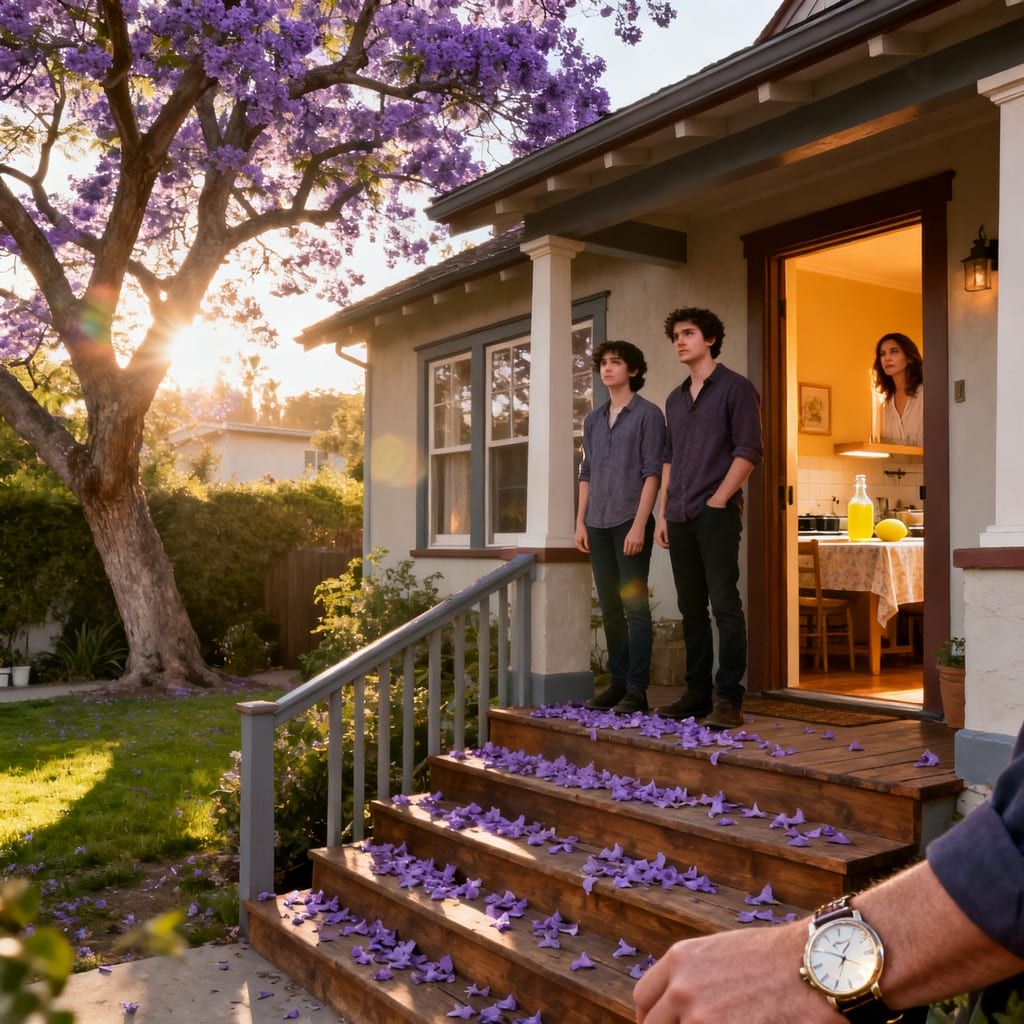
A daughter learns to read between the lines of a life split in two
Read more →
A fog-draped night, two souls found, and the quiet shape of a life
Read more →
Story audiobooks for children of all ages — a new one every day on Smarter Way Stories.