When Silence Became the Downbeat
A drummer learns to listen for the rhythms you can't hear
Read more →
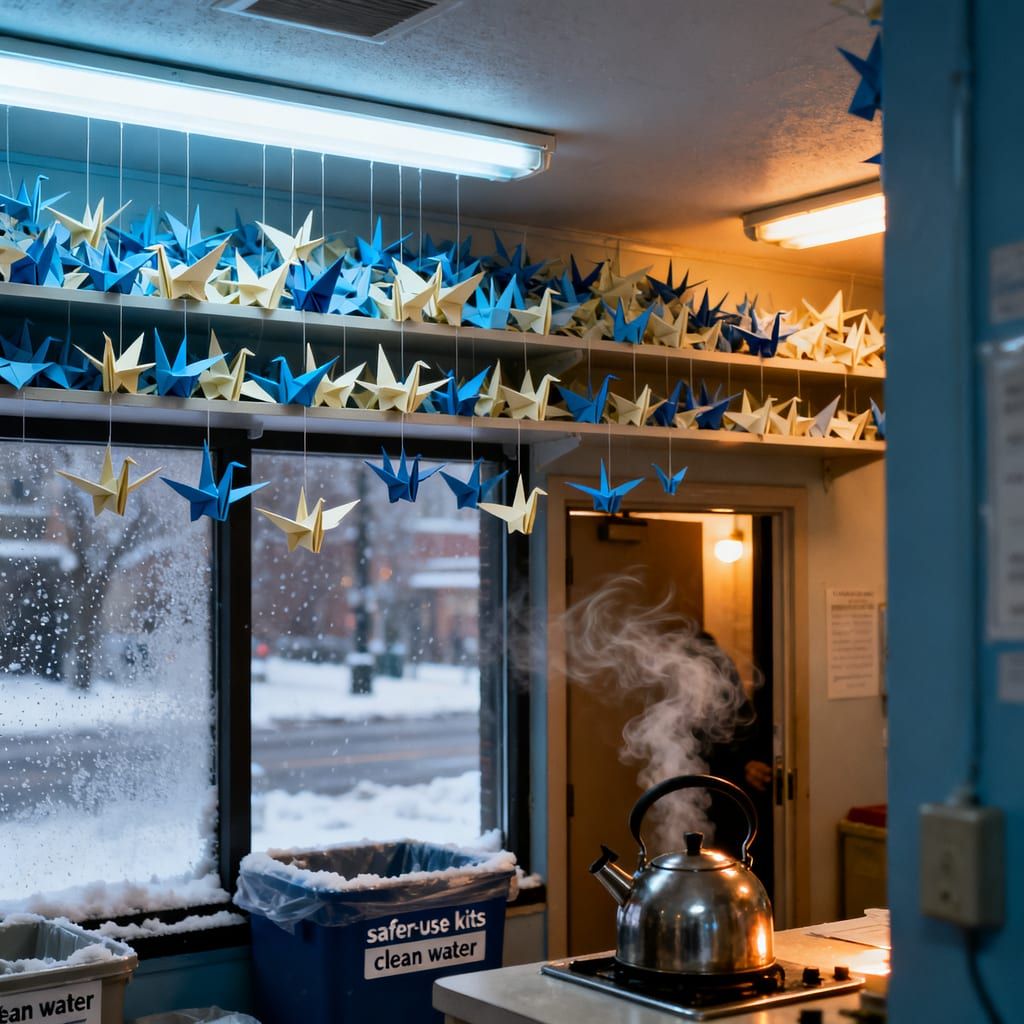
On the nights the snow comes sideways off the lake, the kettle at the site sounds louder. A steady hiss, like a relieved breath.
Noor learns the winter by people's sleeves. Wool slick with slush. Denim gone hard with frost. She labels the bins in neat block letters-safer-use kits, clean water, wound care, test strips-and tucks a space heater under the desk to keep the floor from numbing her ankles.
At five, she clicks the door sign from Closed to Open, flips the porch light, and pockets the phone. The first voicemail of the day is already there, timestamped 4:52 p.m. Her neighbor from two blocks over has that clipped, exhausted voice that only relaxes to accuse.
"You're not helping," it says. "You think you are. You're not. You're keeping them here."
Noor deletes it and ties her hair back. She has learned the shape of what she can hold, and what she can't.
They come in from the wind, shoulders up around ears, hat brims dripping. Names offered like sparklers-quick, burning, sometimes false. Noor doesn't ask for IDs. She asks which arm they like. She learns voices by coughs and laughter, learns hands by the way they reach for cotton balls over bleach.
On the metal shelf by the door, under a handwritten 'found' sign, a soft pile gathers: a wool scarf someone left on a chair, a broken silver bracelet with one missing link, a button shaped like a star, a note on yellow paper that says simply, M-Meet me where we last didn't say goodbye.
Finn appears with the first rush at six, hood up, mouth chapped, shivering like a dog. He signs himself Finn on the clipboard and turns Noor's intake form sideways to make more room. When he finishes answering the questions-Have you used today? Any allergies?-he creases the paper down the middle and then again, thumbs quick and sure, until he's pressed a bird out of bureaucracy.
"Origami?" Noor says, smiling before she can help herself.
"Hands need something," he murmurs, not looking up. The crane's head tilts as if listening.
She slides a stack of scrap paper across the desk-photocopy rejects, outdated pamphlets. "For the ones that don't need to be filed," she says.
He tucks the crane into the crook of a shelf bracket, a pale paper sentinel looking down at the needle bins like it will scold someone for reaching too fast.
By the second week, the cranes have multiplied. Blues and browns, a corner of a city council memo tucked slyly into a wing, a maple leaf watermark blinking from a tail. Noor moves them higher, out of reach, their beaks pointing in different directions like a compass unsure which way is mercy.
The neighbor's voicemails arrive in a rhythm Noor recognizes from shift work: Tuesdays before dinner, Thursdays after a meeting somewhere uptown. Once, a string of them at midnight that begin as ragged sobs and end with a whisper, "I can't sleep with your lights on."
Noor listens in the quiet between visitors, in the moment after the kettle clicks off and before it begins again. She has cut a thousand chest compressions into the memory of her hands. There was the cousin with the copper hair who didn't make it. Who didn't want to be saved. The ER lights were white as dentist teeth; the shift never ended, only clicked into the next. When the city posted for harm reduction staff, Noor went to the interview in the same shoes she'd worn to her cousin's funeral and answered simply: I don't need to fix everything. I just need to keep people alive long enough for everything else.
It happens on a Wednesday when the snow has teeth. The kind that stings the skin and makes the streetlights look like lit cigarettes in the dark. Finn coughs into his sleeve, says he's cold, nods when Noor puts a mug of tea in his hands. The TV above the sink is muted on a loop of weather maps-arrows swirling like somebody has taken a finger and stirred the whole lake, counterclockwise.
He goes into a stall. Ten minutes. Fifteen. Noor knocks the way they all agree to-two short, one long. No answer.
Her hands move the way they always have, calm and separate from fear. She slides the key into the lock and turns-the way the click echoes in tile, she will feel later. Finn is folded on himself, cheeks white-blue, lips a poor purple. She speaks his name because names anchor. She hums under her breath because it steadies her own ribs.
Naloxone. Tilt the head. Clear the airway. "Breathe with me, Finn." Another spray, a metronome of her voice. "Come on back."
His chest stutters. A sound like a match striking. His eyes flutter open, wide and animal, scraped with panic.
"Hey," Noor says softly, one palm on his sternum so he knows he isn't drowning alone. "You're here."
He is trembling now, breath sawing. Noor guides him onto his side. She has a question she keeps for this exact moment, worn smooth by use. "If there was one person you wish knew you were alive," she says, "who would it be?"
Finn's mouth works around air, then a name falls out, broken at the edges. "Ana." He closes his eyes and lets go of the world again.
Noor finds his phone facedown beneath the paper towel dispenser, the screen spidered. In the contacts: Ana (Do Not Call). She knows that particular parenthesis. She writes the number on his wrist in the thick blue marker they use for labeling sharps containers-the ink that never forgets. Then she takes one of the cranes off the highest shelf, a cream one with a faint watermark of a town budget, and sets it on Finn's chest like a little guard, wings tented in wait.
She waits, too. She waits until his breath evens, until she can feel the warmth of his skin rise back into the air.
The next day, Finn is gone. He doesn't take the crane. The ink on his wrist will take days to fade.
Noor doesn't pretend that the neatness of a phone number or a folded bird has anything to do with survival. She makes tea for the morning crowd. She tapes a sign over the door that says, We see you. We'll be here, even if you're not. Someone draws a smiley face beneath it with a Sharpie the color of blueberries.
The cranes multiply. They dust the air with lightness that doesn't deny weight. Some of the crew start leaving their own, hands clumsy, wings crooked. Noor doesn't correct.
The neighbor's voicemails continue, grievances curling around the same post. "You're ruining the block," she says. "You're making it easier." Then, one message that arrives on a quiet Sunday, the voice raw. "What if they never come back?"
Noor keeps working. Eight cups of tea an hour on the coldest days. Track marks cleaned like a ritual. Stories told sideways-about a dog, about the way the light looks on the tracks when the sun finally shows up.
By March, the snow has lifted into dirty edges along the curb. The city calls a community meeting in the basement of a church that has seen a century of winter coats. Metal chairs squeak across polished wood. Noor sits near the back with a stack of pamphlets no one ever takes and a pen that she clicks when the room gets tight.
The neighbor is there, of course. Noor recognizes her by the posture-like a board slipped down the spine-and the way she holds her handbag as if it's a fragile thing she might drop.
When she stands to speak, her voice trembles. Not with rage this time, but with the courage it takes to punch a hole in a story you've been telling yourself.
"My brother," she says, eyes fixed on the back wall. "He disappeared. Years ago. We..." She swallows. "We were not kind. We were-afraid. Of the calls. Of the knock at the door. Shame is...loud. Louder than sense."
Somewhere, a radiator ticks. Noor's pen stills.
"I called here," the woman says, gesturing in a vague circle that seems to include Noor without landing. "I said terrible things because it felt like action. Like I could shape the danger with my mouth." Her breath hitches. "Last month he called me. He said he saw my number in his own handwriting and he knew he'd put it there. He said-he said he'd come home. He's in a program now. He said a woman kept him breathing."
The woman sinks back into her chair like someone has gently removed a stone from her chest. No one claps. The room is respectful with its quiet.
Noor sits very still. She imagines Finn's wrist under the tap, the blue number holding.
Two days later, a box arrives on the stoop just before opening. It's heavy in that humble way paper is when you give it a job. Noor carries it inside, slices the tape with a key, and folds back the flaps.
They are so beautiful it knocks the breath from her. A thousand cranes-she counts five before she knows the number with the softness that roundness carries. Blues and creams, wings sharp and clean, made by hands that pressed and pressed and steadied grief into pattern. The note is plain. A single initial closes it like a door with the light left on.
"For the ones who kept him breathing long enough to come home. -A."
Noor lifts one by the neck, carefully. The paper is thick, with a velvet tooth. Ink smudges her fingers faintly. A. Ana. Of course.
She climbs a stepstool and begins to arrange them along the top shelf, then the one above, then threading some with fishing line so they hang and do not collect dust. They move with the air when the door opens-small breezes, small blessings.
The kettle sighs. The radiator answers in clicks. The room, suddenly, feels taller.
A week later, a woman lingers by the door. Ink smudged along her ring finger, like she has been making something and forgot to wash her hands. She doesn't take off her coat. She watches the cranes like they might fly away if she startles them.
"Can I help you?" Noor asks, the way she always does, the question not a test but a place to set a pebble down.
The woman looks up. Her eyes are glassy the way a lake goes right before it freezes-or melts. "You wrote my number on his wrist," she says. "He read it in the mirror."
For a moment they stand in the middle of the room that smells like wet wool and black tea and bleach, the city's noise muffled by old brick. Then Noor reaches out, and the woman takes her hand.
"He came home," the woman says, and her smile is shy, like a bird's first step onto a finger. "He said someone asked him who he wished knew he was alive."
Noor squeezes once and lets go. "I'm glad," she says. Two words, all the truth they can carry.
They look up together. The cranes shift as the door opens and closes for the evening crowd. Their paper bodies cast soft shadows that look like flight caught in the act.
Outside, the snow is melting into honest puddles that reflect the sky. Inside, the shelf of cranes lifts the ceiling a little higher. The kettle murmurs. The lights hum. Noor flips the sign to Open and greets the first pair of hands through the door by name.
The voicemails do not stop. But in between them, on a small line scratched between harm and help, Noor keeps time-the way you keep it for someone learning to breathe again. She stacks kit by kit. She learns the names. She replaces paper with blank scrap. And when a new crane appears on the desk-uneven wing, wobbly beak-she places it among the others without measuring it against anything but the air.
On the walk home later, past the thawing park and the bike locked to a railing with its wheels long gone, Noor tips her face up to the first soft rain. It tastes like metal and old snow-the city rinsing itself. She breathes it in, counts to four, breathes out, counts to six. Her cousin's red hair flares in a memory and then eases, not gone, never, but lit differently under this sky.
By morning, the cranes will have settled a little. Or maybe they will have shifted into a new arrangement all their own, each wing edge catching light the way a body catches, and then keeps, one more day.
A drummer learns to listen for the rhythms you can't hear
Read more →
In Los Angeles, a daughter learns how to carry two lives forward
Read more →
In the soft hours before dawn, staying becomes its own kind of rescue
Read more →Story audiobooks for children of all ages — a new one every day on Smarter Way Stories.