Two Houses and One Quiet Heart
A daughter learns to read between the lines of a life split in two
Read more →
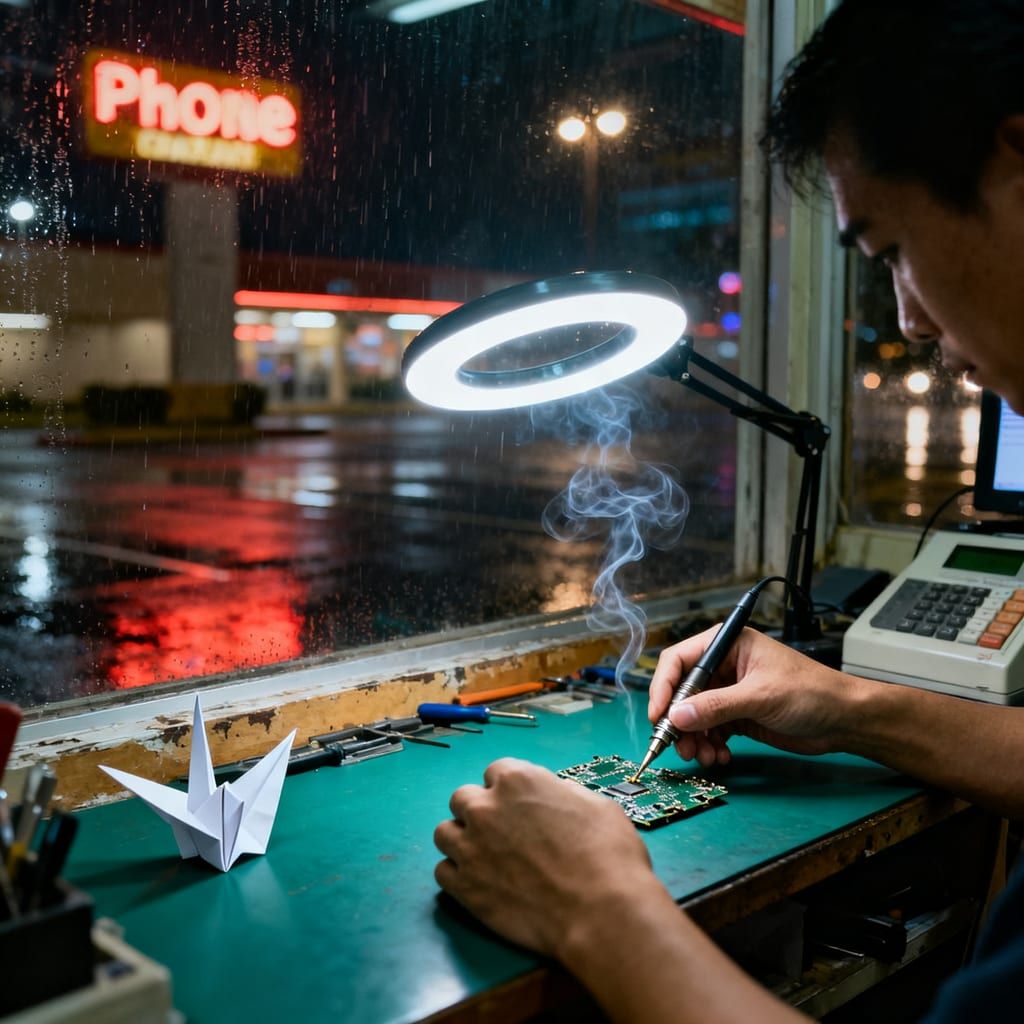
By six, the strip mall's neon had smeared itself across the wet asphalt like someone had dragged a brush through a handful of light. Inside Unit 14, the smell was solder and stale coffee-the perfume of evenings that never learned how to end.
Leo Alvarez stood at his bench, the magnifier's ring light haloing a cracked logic board. His fingers moved in short, sure gestures-a wick pressed to a bead of tin, a touch of flux that caught the air with a sharp pine note. Outside, the rain made the glass door rattle a little, tapping like a caller who didn't believe in time.
He was efficient, polite, numb. The rhythm of the work steadied him. He didn't think about the guitar case in his hall closet, the one with a broken latch and a watercolor of dust where a sticker had once been. He didn't think about the unsent draft in his messages, or the way he always made more coffee than he drank.
The bell chirped, and a woman stepped in, cradling a zip-lock bag with paper towel cocooned inside.
"Hey," she said, voice soft with embarrassment. "It went in the sink. Twice."
He smiled without teeth. "We've seen worse."
She set the bundle down like it might wake up and run. Her coat was dark with rain; her hair held drops the way grass holds morning. She was somewhere in her thirties, maybe a little older, skin pale from autumn, eyes set with a purpose he recognized but couldn't yet name.
"Nora," she said when he asked for a name. "There's-there's one voicemail on there I can't lose."
"We'll do what we can," he said, and meant it. He always meant it. The difference lived in how those words landed.
He unwrapped the phone like a burned letter. Water marked had crept under the shield can; corrosion had made a turquoise lacework of the board. The device was a small tragedy, delicate and fixable only if the gods of patience held still.
He logged it in-black model, cracked screen, water ingress-and slid it into a tray. Out of habit, he powered it just for a second to see what heartbeat remained.
The screen lit, dim and bruised along one edge. Then, like a whisper arriving late to a conversation, a text notification bled across the glass:
"To the person fixing this: Please don't listen to the voicemail from January 12. It's the last time my husband said my name. If you can save it, you're saving something alive."
The words landed in his ribs and stayed there, a weight he could carry but not set down. Leo was used to accidental intimacy-the floating detritus of strangers' lives: half-typed apologies, grocery lists that remembered cilantro but forgot milk, the way arguments spelled out in green bubbles. He had learned to look without seeing, to be the priest of a secular confessional.
But this was not accident. It was craft-a tether knotted and thrown.
He set the phone facedown as if it had grown eyes.
It would be easier to preview the file. Safer, in a way-confirm it was there before sinking hours into rescue. He pictured his old bandmate Felix shrugging and telling him to take a listen. It's just data, man.
Leo unplugged the battery.
He moved like he did when the guitar's neck had fit his hand like a hand-precise, unplodding. The logic board came out under the hot air's breath; he slid the shields off with tweezers, baring the corroded trenches. An ultrasonic bath hummed, clouding the solution with flake and grief. He brushed traces with a fiberglass pen until the copper flashed like tiny sunsets.
The shop filled with the small talk of machines: the air pump's steady sigh, the fume extractor's gentle throat clearing, the kettle thinking about boiling again. On the TV in the corner, muted footage of a game flickered like an aquarium.
He reflowed a power management IC, hands steady on the last exhale. A pad lifted-just a hair-like skin that had blistered and peeled away when you weren't watching. He swore under his breath and reached for micro-jumpers, wire finer than a hair.
"Come on," he said to the board, to the world. "Give me this."
The board gave him the smallest click of compliance when the connector finally seated. The battery, reconnected, made the tiniest spark he felt more than saw. He didn't press the power button. He called Miguel across town, the only person he trusted to extract audio without temptation.
"Got a live one?" Miguel said, his voice poured over speaker.
"Waterlog. One file. January twelfth." He paused. "I'm not listening."
There was a silence that understood him. "Bring the donor board," Miguel said. "We'll splice and pull if she boots. You buying tacos."
It took longer than he'd quoted. The donor board was a slightly newer revision; a corroded trace fought him like a last bad mood. A stubborn connector seated only after he put down the tweezers, rolled his shoulders, and breathed like the first chord of a set.
He watched the progress bar inch across Miguel's screen, the file blooming from the phone's little kingdom of storage like a seed stolen from winter. At ninety-four percent, the software threw its hands up. Error. They tried again. Again.
"Hey," Miguel said gently. "Walk away for five."
Leo stood on the sidewalk under a neon pharmacy cross. The rain had thinned to a mist that made everything feel like memory. He looked at the bus stop across from his shop, an empty shelter with a torn ad for a dentist who promised painless crowns. He rubbed his thumbs together. They smelled faintly of flux no matter how many times he scrubbed.
Back inside, on the fourth try, the file completed. Miguel didn't play it. He named it simply: Nora_0112.mov, cutting the time of day because time didn't matter in that way anymore.
"Got your relic," Miguel said. "Go be a saint."
"I'm not that," Leo said, but pocketed the drive like a communion wafer.
Back at the shop, the lights had softened to their late-hour warmth. The bell chirped. Nora stood in the doorway, hair damp, coat buttoned to the throat.
"I took longer than I said," Leo admitted.
Her mouth tightened, then let go. "Is it-"
"It's there," he said. "I didn't listen."
He placed the phone on the counter like a relic and slid the file over as well. His fingers hovered over the speaker icon out of habit, then fell away. "You can, uh, test it here if you want."
She nodded. Her hand trembled a little as she typed in her passcode. The screen's light painted her face a shallow blue. Her shoulders tightened, then folded in smaller when the message list scrolled and that date-the date that mattered-appeared.
Leo turned away and pretended to re-sort a tray of screws, as if the difference between a 1.2 and 1.5 millimeter mattered more than the world.
He heard almost nothing. The volume was low, more breath than sound, more presence than language, a tide you felt with your feet. A syllable like a shell pressed to the ear-then a soft laugh that broke him in a place he'd been careful to board up.
Nora's breath hiccuped. She put a hand flat on the case, as if warming an animal back to life. When the sound ended, she didn't move for a beat, then two. The room was full and empty at once.
"Thank you," she said finally, without spectacle. Her voice had the steady of a person who had practiced gratitude in a hard season. She reached into her bag and pulled out a small paper crane, clean white against the oil and matte black of the counter. "For luck," she said, almost apologizing. "I make them when I'm waiting."
He took it like a signature.
At the door, she paused. "You didn't listen," she said, a statement folded into a question.
"I wouldn't know how to carry it right," he said.
She nodded, a small thing that felt like absolution, and stepped into the rain.
Closing time slid by without the ritual-no second coffee poured, no mindless wipe of counters. He locked the register, straightened the crane by the tip of a wing, and shut off the open sign. The rain had settled into a whisper that made the city seem like it was thinking.
He saw her across the street before he meant to look. Nora at the bus stop, the phone to her ear-no, not to her ear, but held near her lips as if the person on the other end needed warmth to understand. She whispered into it with an attention that pulled the air around her tight. Her shoulders were no longer folded; they made a language of their own.
A bus arrived with its big soft sigh and kneeled for her. She got on without urgency, one hand not leaving the phone, as if the hinge of the world had just found a kinder way to swing.
Leo stood in the threshold, half in the smell of solder, half in the breath of rain. Something unclenched-no violins, no sudden thunderclap of joy, just a small space in his chest that wasn't boarded anymore.
He went back inside, sat at the bench where screws hid like stars in a night tray, and thumbed open his messages. The unsent draft blinked at him: a text to his brother that began and ended with nothing. Years of holidays avoided. I'm sorry about- deleted, rewritten, deleted. An orbit of almost-said.
He placed the phone flat on the work mat, squared to the grid of blue lines he used to keep things true. He typed without rehearsing.
"Hey. I'd like to talk when you're ready. I miss you."
He hovered, then frowned and added, "No pressure. I'm here."
His thumb paused. The shop hummed the way it always did-old refrigerator muttering in the back, fume extractor clicking as it spun down, rain checking in at the door. He hit send.
The message left with a whoosh that made him a little dizzy. He watched the three dots appear and vanish, as if spoken language were trying to remember how to be typed. He could wait. He could repair without needing to know when it would finish.
The ping came sooner than he'd let himself bargain for.
"I'm here," it said.
He set the phone down and let the sound settle into the room, into the tools, into the coil of jumper wire and the tweezers that had learned the softness of impossible parts. He looked at his hands-the pads smudged from graphite, the crescent where the soldering iron had kissed him months ago, the callus that still lingered from a different neck and a different night.
They felt different. Not steadier-he had always had steadiness. Something else. As if whatever current he'd learned to coax from copper ran now in him as well, bridging what had been severed by corrosion and time.
He lifted the crane and placed it on the shelf above his bench, where the dust gathered slow. Under it, he slid a small square of masking tape and wrote in his neat, small letters: January 12.
Outside, the bus groaned away and the neon kept bleeding into rain. Inside, a fixer took a breath that felt like a measure before a song you don't know you know, and turned back to the next small impossible thing.
The workbench hummed as usual. But when he reached for the next device, he did so as if it were alive, as if, in some way that mattered now, it always had been.
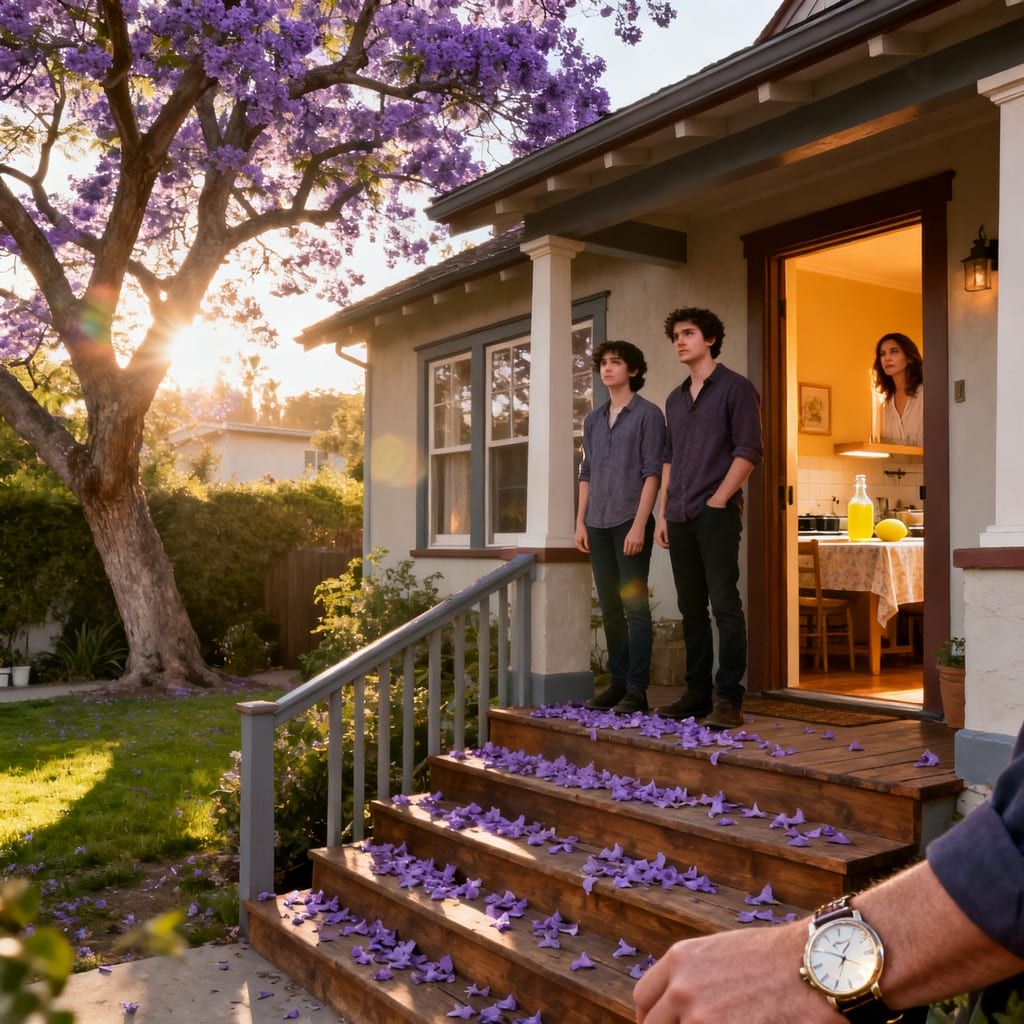
A daughter learns to read between the lines of a life split in two
Read more →
A fog-draped night, two souls found, and the quiet shape of a life
Read more →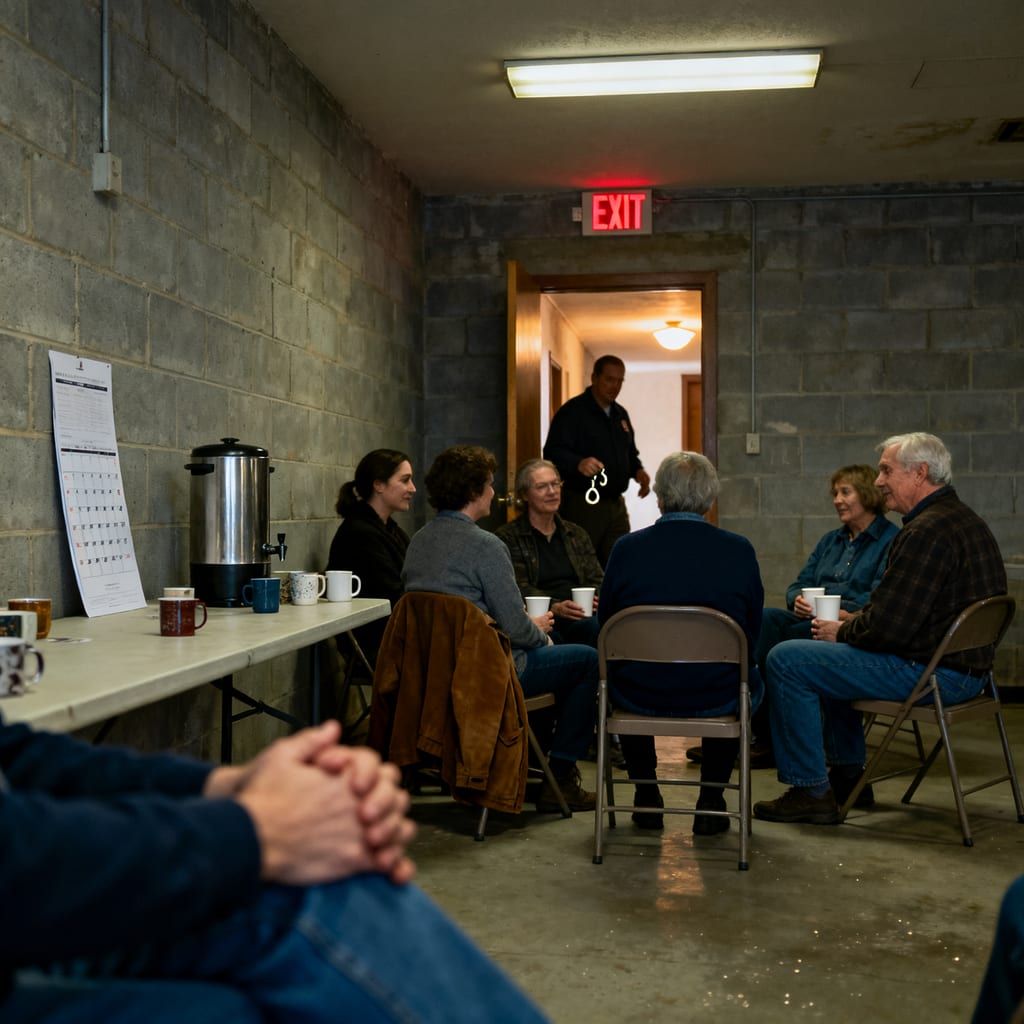
Story audiobooks for children of all ages — a new one every day on Smarter Way Stories.