Bridges Built From Quiet Words
Where ceasefires fray, a thread of kindness holds
Read more →
He almost set the postcard back because there was dust on it-gritty, like flour rubbed into paper-and because he no longer trusted himself to want anything. The estate sale on Wolcott smelled like attic cedar and weak coffee, tables quilted with other people's lives: chipped teacups, a jar of buttons, a brass lamp with a dent that gave it a permanent wince.
Elias Park held the postcard up to the light. A curling view of a gray-green sea, gulls caught mid-tilt over a plank pier. The stamp was the thing-a commemorative misprint from the eighties with the tiniest inverted wave. Worth a few dollars more than it should've been. His old life would've passed it by. His new one counted small lucks like rainwater in a jar.
He paid two dollars and walked home with it in his jacket pocket, the cardboard warm against his ribs like it had a pulse.
At his kitchen table-circles of old coffee like moons around his elbows-he turned it over. The pen strokes had the steady lift of someone who'd learned to write when people still addressed envelopes with care. Innocent talk of gulls and weather. Except the spacing didn't sit right. Commas where a breath didn't go. Every third word capitalized, like secret stepping-stones.
He traced the phrases with a finger. His brain, built for patterns, began to tug.
The postmark was a smudge, but one word was clean: Sparrow Street. He passed it daily on his way to the library he wasn't sure he needed anymore, beneath a billboard that told him to Think Bigger while he figured out how to make small days useful.
He flipped the card. Along the bottom, in tiny print: a string of numbers like an ISBN's quiet cousin-the printer's code. He should have looked away. He didn't.
Curiosity sharpened at the edges. It felt like being thirsty after forgetting thirst existed.
He mapped the capitalization. Every third word, pull the letter. The stray commas became markers-first edition habits he'd only ever met in footnotes. The numbers on the bottom, split into pairs, insisted on a catalog. He logged into the library database because he still had the habit of free places. The code resolved to a single title he'd never noticed despite passing the spine a hundred times: "Chicago Rooms: Quiet Corners of a Loud City."
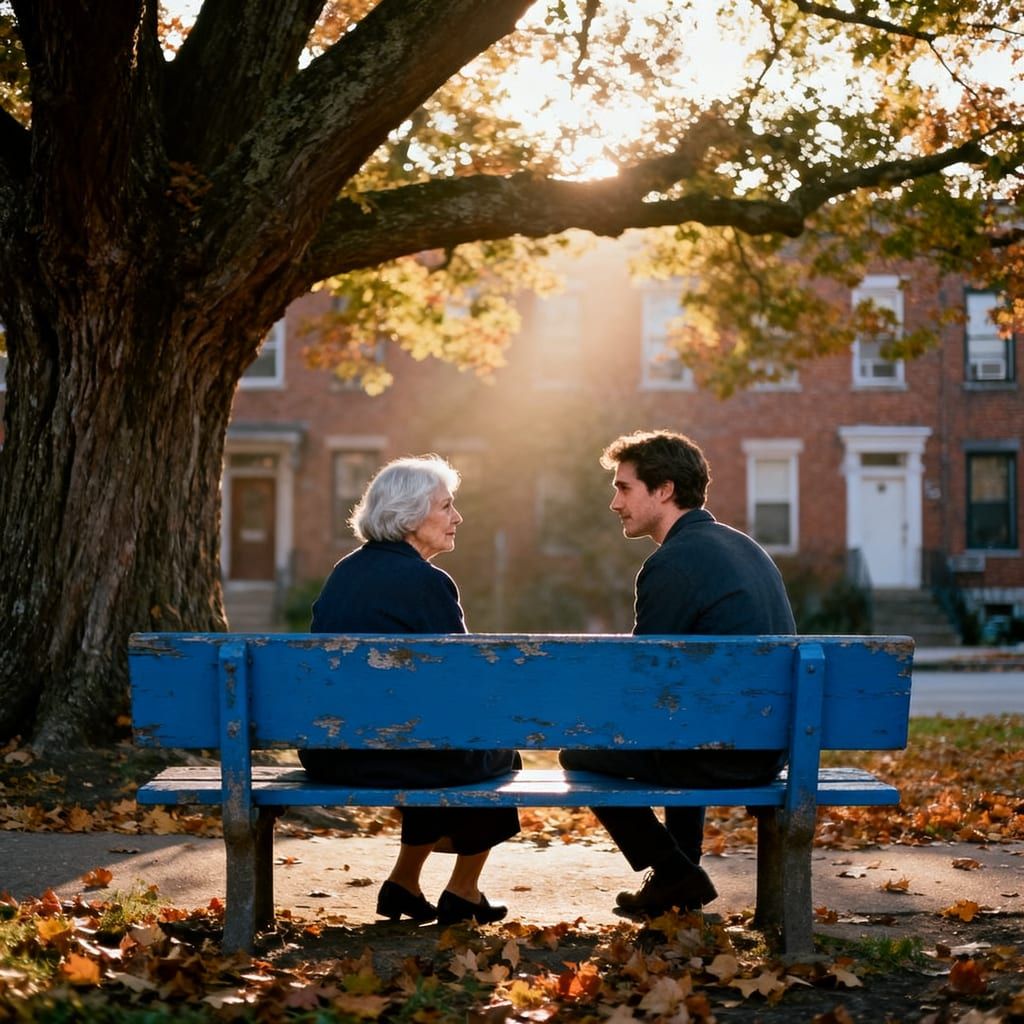
He checked it out at the kiosk by touching a chipped screen with the same care he reserved for the radiators that banged like kettles in his apartment. On page two hundred and nine, he found a photograph of a blue bench beneath an elm, the caption naming Sparrow Street in a serif that made it feel certain.
From there, the cipher was patient. He followed a simple book code-page, line, word-guided by the capitalizations and the commas, which told him where the pairings broke. The message assembled itself with a thrift he respected: bring the card to the blue bench under the old elm on Sparrow Street, Saturday at 4 p.m., and read the last line aloud.
He stepped back from the table, the apartment's dimness gently threaded with afternoon. It had the coil of a prank. It had the shape of a dare. Mostly, it had a promise, like a door left on the latch.
The bench had a hollowed grace, paint faded to a denim softened by countless backs. The elm above it let go of an occasional leaf with ceremony. The street was one of those Chicago miracles where quiet manages to live between bus lines, everything softened by the neighborhood's kindly shrug.
He sat. He tried not to wring his hands but did. His phone became both friend and mirror, catching his face in the black glass: thirty-six, cheeks a little pale, layoff written in the way his shoulders had learned to fold inward.
An older woman sat down at 3:58, no hesitation. Silver hair cut practical, a coat the green of a winter meadow. She didn't look at him; she looked at the tree, and then at her watch, and then at her hands.
"I'm Elias," he said, surprising himself. "I found a-"
"Postcard," she supplied without looking, as if the word had been sitting under her tongue. She turned then, her gaze steady as streetlight. "Ada."
"The instructions said to read the last line aloud," he said. "May I?"
She gave a small nod.
He swallowed, the cheap paper whispering in his fingers. He read the final sentence, the ink looping slightly darker as if the hand had pressed harder there: "Brass bell, rain on the steps, say home like you remember it."
He felt foolish for a heartbeat, like a child saying a password to an empty room.
Ada's face softened the way paper softens when it's been folded and unfolded many times-creased, but gentle. "We used to invent games," she said. "My husband, Martin, liked to come back to himself through puzzles. When his mind started..." She didn't finish the sentence, didn't have to. The pause did the work. "We designed trails that would bring him to things he loved. Sounds. Benches. Bells. The last one-this one-never found him in time."
She nodded at the card. "I printed copies. I tucked them in boxes and secondhand books. Let the city decide who would care enough to finish it. I didn't expect to meet anyone. But I came every Saturday anyway. To keep my side of the conversation."
The elm shivered. A leaf landed on Elias's shoe and clung there, half-heartedly gold.
"What did he like about bells?" Elias asked softly.
"They were a measure," she said. "You can't argue with a bell. It claims the air and tells you where you are in time."
Some small, unhurried ache moved through him. He thought of the dull Mondays since the layoff, days stacked like blank pages with no lines to tell him where to write. "I'm... between things," he said, a flimsy shorthand for a longer loneliness. "My sister and I, we-" He stopped, then tried again. "After our mother died, I said careful things in the wrong voice. We folded ourselves into separate rooms."
Ada listened the way some people pour tea: both hands, no rush. "I was afraid," she offered, "that without someone to meet at this bench, I'd forget who I'd been to Martin. The way you are with a person isn't stored anywhere else."
They sat in that kind of autumn quiet where the world is not hushed, exactly, just less inclined to interrupt.
"Four-thirty," Ada said, glancing up the street as if the hour traveled on foot. "The church at the corner rings then. It's the bell in the clue. One of our early puzzles took Martin there to listen from the steps because the rain made the sound different. Louder, but also softer around the edges."
She slid a hand under the bench seat, fingertips searching with muscle memory. From the hollow at the underside-wood smoothed by years of private traffic-she drew an envelope the way a magician who doesn't care for applause produces a coin. The paper had thinned with time, corners suede-soft.
"For whoever came," she said simply. "I used to imagine it would be him on a good day. Then I understood that good days aren't a kind of person; they're a kind of weather."
She let him take it. Inside, an old photograph of the bench, a younger Ada and a man beside her with eyes that smiled before his mouth did. There was a handwritten line on the back, a tight script that leaned like it was hurrying home: "Thank you for finishing my sentence."
Elias read it twice. The shape of the cipher settled in his gut, differently now. The message was never about aiming at a particular set of hands. It was a seed tossed onto the world's wind, an act of faith that some stranger would care just enough to help a promise arrive somewhere useful.
He looked up. Ada was watching him watch the photo, not to manage his reaction but to share it.
"He used to trail commas through everything he wrote," she said, smiling. "As if breath itself were a pause he could add."
"That's how I knew," Elias said. "The commas were wrong and right all at once."
They walked the half block to the church. The red brick held the afternoon's warmth even as the light thinned. The steps wore a glaze from last night's drizzle; when a breeze moved, the elm's leftover wet leaves rasped like small animals telling secrets.
At 4:29, the world held its inhale. Then the bell-one note, then another-laced the air. It wrapped itself around the corner, touched their shoulders without asking.
Ada closed her eyes. Elias listened the way you listen to the hum of your own refrigerator after you've learned to live alone-the ordinary made suddenly deliberate.
"Rain changed the sound," Ada murmured, barely above the bell's carry. "Made it less sharp, more... forgiving."
"Home," Elias heard himself say, and the word felt like a coat he hadn't worn in years, one that still somehow fit.
Ada reached out, not to hold his hand exactly, but to stand near enough that the warmth volunteered across the small geography between them. They stayed until the last ripple of sound threaded itself into the day and was gone.
Back at the bench, she tucked the postcard into the hollow with the same ceremony with which she had once probably tucked her husband's gloves into his coat sleeves. "There should always be one here, waiting," she said, and he heard neither superstition nor sentiment-just the simplest form of care: a door on the latch for the next cold night.
"Would you-" Elias began, then stopped. He felt the old habit of minimizing ask to come along. He sent it away. "Would you like to get tea somewhere that isn't a memory?"
Ada laughed, the sound not girlish but clear. "Yes. But first, do something for yourself that scares you only in the right way."
He knew what she meant before his hand found his phone.
He framed the bench in his camera. The elm made a green ceiling, the blue was bluer because the day was giving it back. He typed, deleted, typed again. His sister's name at the top of the screen felt like a bruise you press to catalog its pain.
He tried apologies that sounded like negotiations. He tried jokes that sounded like blinking through tears. He tried, finally, the thing that felt like standing on the step in the rain and letting the sound be what it is: "I found a bench that kept someone's promise. Can we try again?"
His thumb hovered. He considered the peculiar bravery of small sends. Then he pressed the arrow and watched the message slip into the indifferent confidence of the ether.
Beside him, Ada took a photograph of her own, then tucked her phone away as if photographing the bench were a nervous system function like blinking.
"You know," she said, "we thought we were building a map for one person. Turns out maps don't like to be that possessive."
He smiled. "I used to tell myself I was a person who didn't need many maps. I think I just didn't like asking for them."
They stood when the bell at the half hour began again, not because it asked them to but because the world tilted minutely and they felt like answering. The sound folded the small street into something that felt, fleetingly, like a room where everyone might be listening for the same cue.
Ada tucked her arm lightly into his, a temporary architecture built of courtesy and shared errand. "Tea," she reminded him.
"Tea," he returned.
As they walked, the bench kept its place under the elm. A leaf let go and landed on the seat, claiming it for a second before the breeze reclaimed it. On Sparrow Street, the blue waited without impatience for whoever might come next, the day already editing itself into the sort of memory that doesn't demand an explanation, only a companion.
In his pocket, his phone buzzed once. He didn't look yet. They crossed the street beneath the billboard that said Think Bigger and did not seem to be speaking to either of them anymore.
Ada laughed again, softer this time. "He used to say, when we'd finish a puzzle together: that's better, now the day makes a different kind of sense."
Elias felt something loosen-no fireworks, no epiphany that rearranged the furniture of his heart, just a hinge that swung without complaint. He looked up at the thinning sky and let the bell's phantom echo occupy the place where anxiety usually rented a room.
"That's better," he said. "Now it does."
Story audiobooks for children of all ages — a new one every day on Smarter Way Stories.