Two Houses and One Quiet Heart
A daughter learns to read between the lines of a life split in two
Read more →
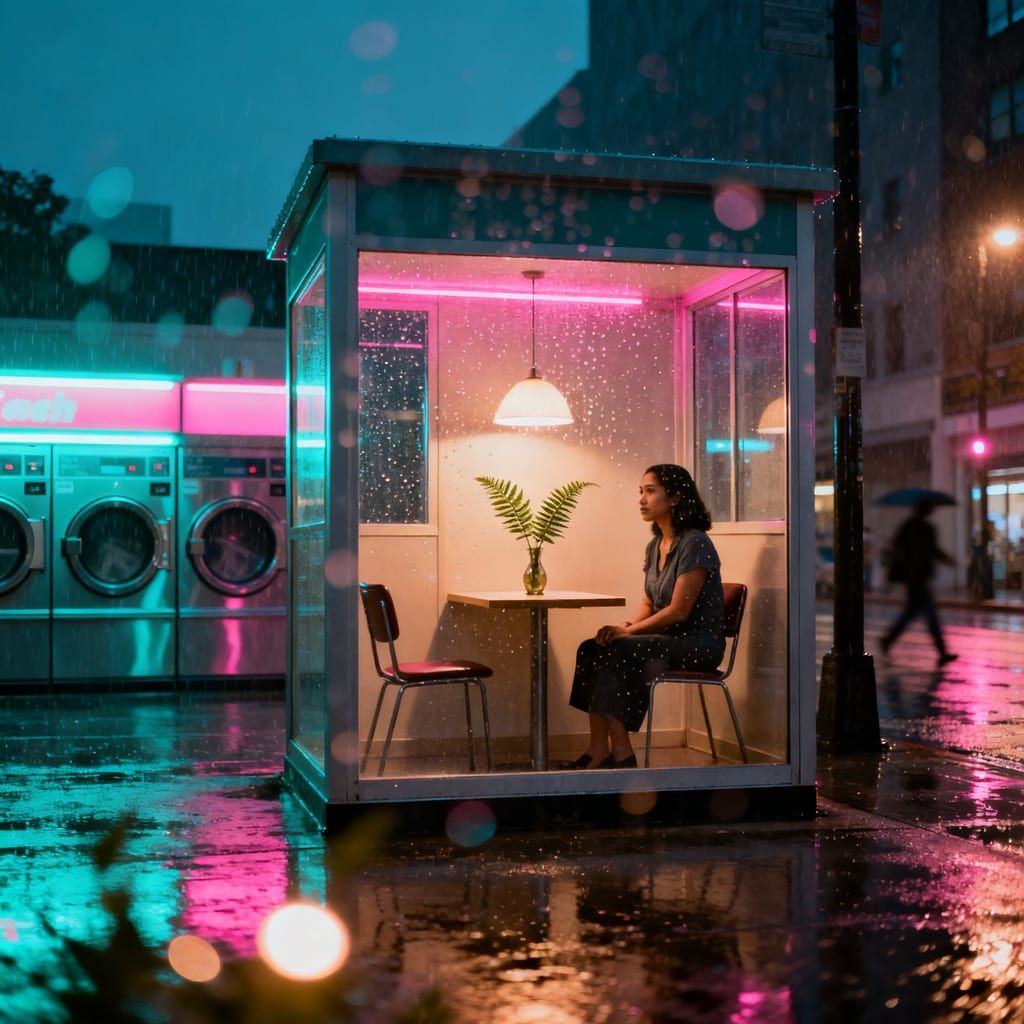
The first hour, Noor counted quarters.
They chimed into the laundromat changers beside her booth, bright coins rolling like minutes, and the dryers heaved their steady breath-hot, lint-scented, a low animal warmth. Neon washed the window in a tired pink. She sat beneath a hand-lettered sign taped crooked to the glass: "Listening-Pay What You Can."
The empty chair across from her looked like a dare. She'd arranged it with care: a small vase with one fern frond, a chipped mug for tea bags, a coaster darkened by old cups. Her severance check had taken care of one month's rent and the painted booth partitions; after that, she trusted the same mathematics that kept planets circling: momentum and a kind of faith.
Outside, someone shook a rug over the sidewalk. Inside, detergent carried the sugared note of lavender and something like old pennies. Noor set her notebook on the table and wrote a single question in neat blue ink: Is there more?
The first person to sit crossed one ankle over a knee and kept their hands on their own shoulders, as if pinning themselves in place.
"I'm Dawn," he said, though he was twenty-two and barista-thin, his wrists a constellation of coffee burns. "Not like a name-name. Just...for here."
"Hi, Dawn," Noor said.
He told her about tampers and shots and the way the espresso machine coughed at the end of the day, almost relieved. He told her about his father-alive-but fixed in his mind as a hinge that had rusted shut. "Seven years," he said. "I keep telling myself I'll unstick. Then I steam milk and I think you can't unburn milk."
Noor listened. The dryers ticked. Dawn's hands uncurled. He ran out of words and stared at the floor tiles, so clean they reflected the fluorescents in fractured white.
She asked, very softly, "Is there more?"
He blinked. "There's always more," he said, and began again.
She wrote his chosen name in the notebook. The list began: Dawn. Sparrow. Maple. It felt like tending small, bright birds no one else could see.
At midnight, the first week, the phone she'd mounted to the wall rang. A number, unknown. Noor pressed the receiver to her cheek and heard a breath, then a whisper that trembled like a taut string.
"I just put her down," the voice said. "She's so small. I'm-how do you guard something so...so breakable? Loving her is like walking around with my heart in a paper bag."
They talked about the dark hunger of 2 a.m., the way fear can be a second baby, colicky and loud. Noor stayed quiet except to offer back the phrases as they arrived, like driftwood: You're not wrong to feel this. You're not alone at this hour. The caller chose "Sparrow," softly, then hung up with a thank-you that sounded like a hand released from a fist.
Later that week an Uber driver left a voice message caught between pickups. "In the daytime, I have to talk," he said. "At night, the silence sticks to me. I watch my own breath in the rearview. It fogs, then it clears. I don't know what that says about me."
Noor saved the message. The laundromat hummed like a low choir. She discovered she liked the shape her name made in other people's mouths when they were asking nothing of her.
Word spread the way dandelions do: a few bright seeds floating, catching; little suns where there had been none.
Photos appeared online of the modest booth with its fern and chipped mug. Comment sections filled with equal parts thanks and alarm. "Scam," someone wrote. "Therapy without training," another warned. An email came from the city, then a letter in a stiff envelope: possible violation for offering counseling without a license. The notice smelled faintly of toner and disapproval.
Noor reread it sitting cross-legged on the thin rug behind the booth. She sipped tea that had gone cold hours ago. Not therapy, she thought, but she remembered job reviews that had turned her into a problem set, the way voices in glass-walled conference rooms sounded when people used words like deliverables as if they were small grenades.
At the public hearing, she wore a navy dress that made her feel upright. The room itself had too much air-conditioning and an old flag in the corner that looked like it had earned its wrinkles.
"No advice," Noor said, palms open, voice level. "No diagnosing. People come to tell their story. I hand them silence to set it on." She could hear the laundromat in her mind, that friendly drag of wet denim.
A man with a square tie said, "You're selling empathy."
She thought of quarters. Of Dawn's hands learning how to unclasp. "A cup of coffee is empathy for a cold," she said. "A park bench is empathy for tired feet. I rent a chair."
Then a woman spoke, careful and composed, her syllables lined up like cutlery. "You make it sound simple," the woman said, "but you operate under the trust people place in therapists without the training. The risk isn't theoretical. People come to you in pain. What if they need more than a chair?"
Noor met her eyes and felt a small tremor under her breastbone she didn't show. "Then," she said, "I have a list of resources on the wall, and I tell them I'm not equipped. I don't pretend to be anything I'm not."
Notes moved like minnows from hand to hand. The chair of the committee leaned close to the microphone and said they'd take it under advisement.
That night the rain found every shallow angle of the city and worked it.
The laundromat glowed like an aquarium. Noor sat in the booth alone. The fern bowed to each draft. She listened to the rain needle the glass and tried not to hear that woman's cadence again, precise as a metronome.
The phone rang.
"Listening," Noor said.
A pause. A breath she recognized because she had been meeting it in increments for weeks, the way you meet a neighbor on stairwells and learn their rhythm.
"It's Maple," the caller said.
Maple had always brought small weather-neighbor's cello, train horns turning melancholy at midnight, the phrase her mother used for grief, how it arrived like mail delivered to the wrong porch. Tonight her voice contained a new, taut thing.
"I was hard on you," Maple said, and in the booth Noor felt the air tilt. The metronome cadence. The careful placing of words. Noor saw, in her mind, the councilwoman's clean-lined blazer, the way she did not let her hands flutter.
Noor did not say, You were in that room. You were the room. She did not move at all.
"I don't know what to do when certainty leaves," Maple said. "It's my job to be sure. Lately, grief-" The word snagged. "Grief has scrambled my controls. I stand at a crosswalk and forget which color means go." She laughed without air. "I told a room you were dangerous because I couldn't forgive myself for needing a stranger."
Noor let the dryers carry the pause. The rain stitched a bright seam along the curb.
"Is there more?" she asked.
Maple cried then-the quiet kind, almost polite, like someone moving a stack of newspapers from a doorstep so the door can open. She told Noor she had lost a sister last year, not to death but to a slow vanishing: a depression that made her a ghost with a beating heart. How the rules of her life didn't apply there. How she collected tiny proofs of the world's order and brought them to her sister like offerings-bus schedules, temperature maps-only to discover they could not coax her back.
Noor listened. She paced her own breathing to Maple's untidy inhale. When Maple faltered, Noor offered the same strand: "I'm here."
By the end, Maple's voice had thinned into something like sleep.
"Thank you," she said. "I won't apologize at a microphone. But I will find a way."
They hung up. Noor pressed her forehead to the cool glass and watched a man collect still-warm shirts into a basket, pressing each one to his chest as if in benediction.
The regulators returned with a different letter.
The envelope was the same stiffness, the toner the same flat smell, but inside the paragraphs had softened. The city distinguished "peer-based, non-clinical listening" from therapy, permitted the booth as a community service with posted resources and clear limits. Noor tacked the new rules to the wall with painter's tape and stood back. The fern nodded.
She taught others to do what she did: to sit on their hands when advice itched, to treat silence as a bowl a person could pour into. Volunteers practiced phrases until they tasted true.
"Would you like me to reflect that back?"
"Do you want quiet, or do you want words?"
"Is there more?"
They learned to hear how a story crouched behind a story. They wrote down the names people chose with reverence. Dawn. Sparrow. Maple. Finch. Harbor. Some days the list read like a migration.
The text from her brother, Dante, came one afternoon: a simple "Coffee?" that felt like someone had kicked the floorboards and found a hollow place.
They met at a café with overwatered plants and brushed-concrete walls. He was taller than her memory of him and wore their father's impatience at the corners of his mouth.
"You're famous," he said, not unkindly, not kindly. He stirred sugar into coffee he didn't sweeten. "Mom sends me your links. She doesn't send mine."
Noor wrapped her hands around her cup and wished it would burn.
"I don't know how to talk to you when you're always the ear," Dante said, and the sentence landed like a glass left on a table without a coaster. "I start and you-go quiet. I need you to fight with me sometimes." He smiled, a little. "I need you to be a person."
She opened her mouth and found it full of other people's nights. When she tried to speak, she discovered her throat was the booth and it was closed.
They parted with a hug stiff as cardboard. Noor walked back to the laundromat through afternoon heat that made the asphalt smell like memory. Inside, the dryers rolled their unjudging suns.
She flipped the sign to Closed, sat in the client's chair-the one that remembered weight-and dialed the number taped to the wall.
"Listening," a new voice said. The volunteer's tone held a beautiful uncertainty, like a violinist about to play their first note.
Noor swallowed. She looked at the fern. She looked at the place on the glass where her forehead had made a faint oval.
"I don't know what I'm doing," she said, and flinched at the truth of it. "I built a room where I disappear. Turns out I can't find my way back in."
The volunteer breathed softly, as Noor had taught. She waited. The silence ran its hands over Noor's sentences, smoothing them enough to speak.
"My brother thinks I've become a bowl," Noor said. "Useful. Emptied. I think-" She stopped. The dryers offered their round insistence. Outside, someone laughed, a bright crack that made the booth feel temporarily taller. "I lost my job last year and with it I lost my name on doors and the version of myself who knew where to knock. So I opened a door. People came through. I forgot that I could, too."
"Is there more?" the volunteer asked, gentle, Noor's own cadence returned to her like a warm glass of water.
"Yes," Noor said. "Always."
She told the simple story beneath the elaborate ones she'd kept. How she had loved being useful because it felt like permission to stay. How she had mistaken vanishing for virtue. How part of her was mad at Dante because he could say what he wanted without first apologizing to a room that did not, in fact, require apology.
When she finished, the volunteer didn't fill the room with wisdom. She did the thing Noor knew but needed to feel again.
"I'm here," the volunteer said. "Would you like me to reflect that back?"
"Yes," Noor said, and leaned her elbows on the table and listened as the shape of her own story returned to her, trimmed of fear, tender at the edges.
She cried the way Maple had, tidy tears that honored both the mess and the wish it could be otherwise. After, she laughed-small, clean-because her body had remembered how.
They left the sign Closed a few extra minutes that night. Then Noor turned it back to Open and watched a boy press his nose to the glass and fog it with a smile. Someone inside the laundromat pulled a fitted sheet like a sail between them, catching a bright, brief wind.
In the notebook, Noor made a new column. Not for names, but for questions worth keeping.
Is there more?
Do you want quiet, or do you want words?
What would make this feel safer?
She added one for herself: Where am I in the room?
The booth did not fix grief. It did not fix fathers or crosswalks or the certainties that abandoned people when they needed them most. It offered, instead, a small bowl of attention and the permission to fill it. Some nights, that was enough to tilt a life half a degree toward light, and in time, trajectories obeyed small degrees.
Around closing, the barista-Dawn-stopped by with a free coffee and a smile that had loosened since that first day.
"Milk still burns if you look away," he said, setting the cup down, "but I'm getting better at catching it before it does."
Noor nodded. The dryers thrum-thrummed. Rain had passed; the street steamed like a page turned under a palm.
"Thanks for the chair," he said.
She watched him go and wrote his name one more time, not because she would forget it, but to feel the way letters stood for a person and a day and the particular gravity of both.
When the last load finished, the machine sang its strange, cheerful song. Noor turned off the lamp. The neon made a quiet halo around the fern. She stood in the doorway and listened to the city breathe and felt, in her own chest, something answer-steady, present, welcome.
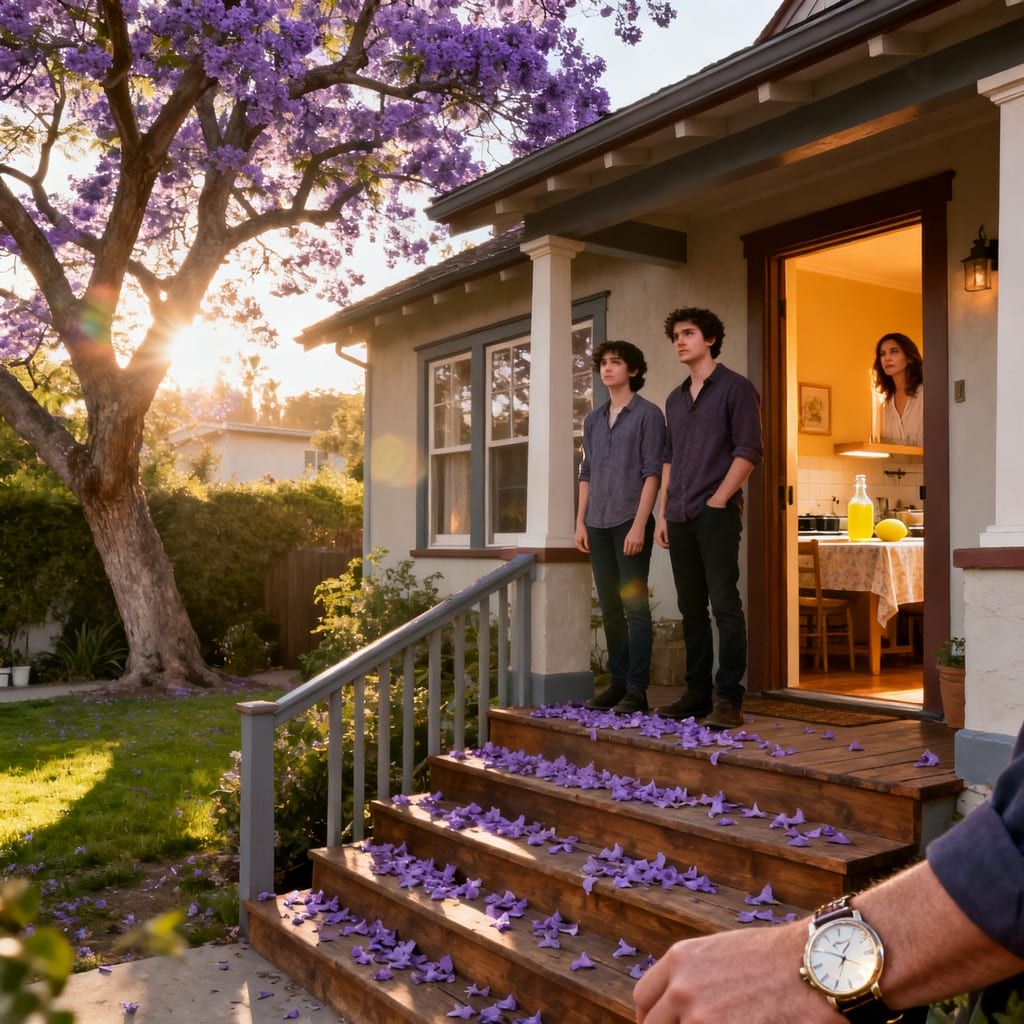
A daughter learns to read between the lines of a life split in two
Read more →
A fog-draped night, two souls found, and the quiet shape of a life
Read more →
Story audiobooks for children of all ages — a new one every day on Smarter Way Stories.