Paper Cranes at Shift Change
A winter of small mercies, folded and kept
Read more →
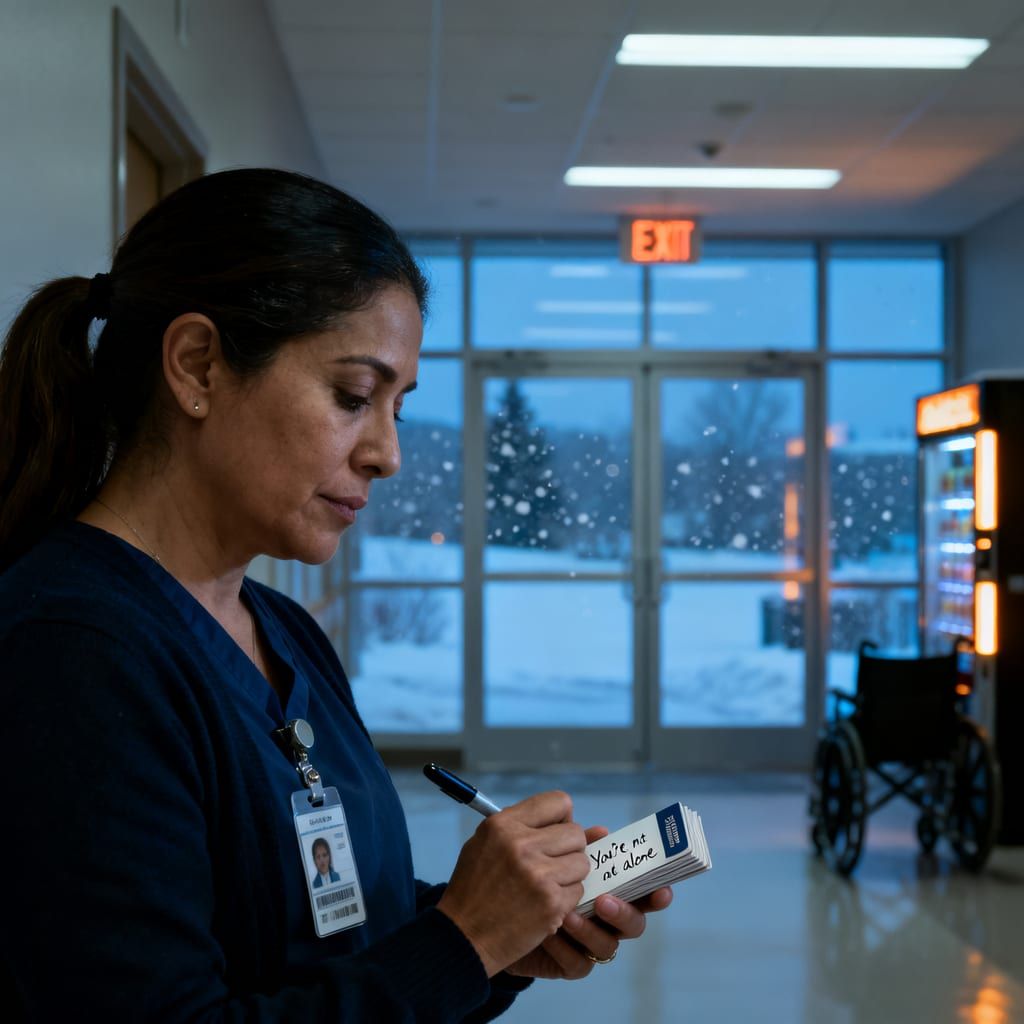
The first snow arrives on tiptoe, pressing its fingers to the glass. In the triage bay, the fluorescent lights buzz like a mild headache, steady and inescapable. The vending machine hums. Someone's coffee steams forgotten on the counter, the lid warped from heat.
Nora Alvarez wraps her hands around a paper cup of water and feels the thin warmth of her own skin. Outside the sliding doors, Denver shrugs into a white coat. Inside, the night has its own weather.
She starts with the bartender-twenty-three, still in his apron, face the color of paste. The robber took the cash and his sense of gravity. He grips the edge of the bed as if the floor is tilting.
"I keep seeing the barrel," he says, thumb rubbing a raw crescent on his palm. "Like it's still there. Like I'm-"
"-stuck in it," Nora finishes, pulling a chair close enough that their knees know the same square of linoleum. "That can happen. Want me to sit while your hands stop shaking?"
He nods. She passes him the cup. He watches the water move as if it knows something he doesn't.
Later, in Room 14, a couple-early fifties-struggles to knit sentences after a hit-and-run. One of them has a neck brace and a new jagged sadness between her eyebrows. The other keeps opening his mouth like a fish introduced to air.
Nora leans on the doorframe, the angle someone takes when they don't intend to leave fast. "We can piece it together slowly," she says. "Chronologically can wait. How about moments?"
"Moments," the braced one repeats, trying on the word. She tells Nora about the sound first: a split plank, a swallowed thunder. The other partner speaks next, voice thin. "I didn't see a plate," he whispers, as if this is a confession.
"That's okay," Nora says. "There are other ways." She slides a form forward and leaves the pen in the middle of the table, not near either hand. Neutral. Patient.
By midnight, the snow has decided itself. A mother named Camila sits in a chair with her jacket still on, her son asleep like a folded kite on the gurney beside her, fever cooled to a manageable glow. There is a bruise beneath her left eye with no ceremony, the color settling toward yellow.
She doesn't look at Nora directly. That's fine. Some conversations are best aimed two inches to the left of the truth.
"I don't want to make trouble," Camila says, tracing a dark thread on her cuff between forefinger and thumb.
"Sometimes not making trouble keeps the storm right where it is," Nora says, and immediately regrets the metaphor-too sharp. She softens. "We can talk about options. Or not talk at all. I can sit."
Camila breathes once, a leaf-sigh. "If I took a number-just in case. For later."
Nora opens the pamphlet and draws a small star by the shelter's after-hours line. She doesn't push it across the table yet. She looks up instead. "Do you want water?"
Camila nods. When Nora returns with the cup, their fingers don't touch, but their shadows do.
Two a.m. is always a thinner blue. The hallways feel like the spaces between ribs-protective and hollow at once. Nora keeps moving not because she's needed in every room but because standing still makes her own heart louder.
Her badge hits the bones above her sternum when she walks. She counts the doors. A volunteer wheels a cart of magazines no one wants. Somewhere, an alarm goes off and then thinks better of it.
"Alvarez," a nurse calls, soft but urgent. "ED intake. They asked for you."
At the desk, a security guard with frost on his shoulders explains without quite looking up. "Older gentleman. Robbed outside a bus stop on Colfax. No injuries, just... shaken. Keeps asking for an advocate. Said, and I quote, 'the lady with the quiet hands.'"
The phrase lands in Nora's chest like a dropped key. She nods and signs the form with the pen that always writes a little too wet.
He sits hunched in the plastic chair, coat too thin, hat with a pom-pom that has lost its pride. His fingers worry a laminated card until the edges fray into fuzz.
"Nora?" the nurse says, ushering her in.
The man's eyes find her hands before they find her face. He smiles with two teeth missing, a child's lopsided grin worn thin by years. "It's you," he says. "Or-no. You got her hands."
"I'm Nora," she tells him, easing the chair so its feet don't squeal. "You must be Mr. Reed."
"People keep telling me that." His laugh has more breath than sound. "Got rolled for my wallet like I'm a couch on Craigslist. Didn't even have enough cash to make it worth their bad knees." He taps the card. "But I got this. Still got this."
He reaches it toward her. The laminate is soft as skin. The ink has bled to a midnight blur in places, but the name is clear enough to stop time.
Marta Alvarez, Victim Advocate.
For a second, the room tilts, that subtle elevator drop when your life takes a floor you didn't choose. The card is the color of coffee lightened twice. The phone number is a museum piece.
"She sat with me," Mr. Reed says, his voice gentling like weather. "When my Ruth-when she-" He tapers the sentence with his hand, a disappearing horizon. "Your mama had quiet hands. Didn't talk too much. Brought me a cup of water and told me it was okay if I didn't drink it. Can you beat that? Telling a man he doesn't have to be grateful."
Nora swallows around the grit in her throat. She remembers her mother's hands over pie dough, over a loose ponytail, over the belly of a family dog that accepted the world as it came. She'd been thirteen when death became plural in their house. Marta had called her work sitting in the storm. Nora had rolled her eyes, then memorized it anyway.
"She died a while back," Nora says, not trusting more syllables. "My mom."
"I figured. World wouldn't let a light like that burn past its stubborn prime." He leans forward with tender conspiracy. "But look at you. Same hands. Even the same way of keeping quiet when a man is flapping his mouth to feel alive."
He looks tired to the marrow. Nora turns the card over, hesitant as if she might smudge history. The back is plain, except for a small line of handwriting at the bottom, pressed deep enough to ghost the paper.
You're not alone.
Her breath catches. She knew the phrase in her bones but hadn't known it had ink.
"Can we make a police report?" she asks, once the room has steadied. "If you want." She places the option between them like a bowl of fruit. Take, leave-no wrong move.
Mr. Reed hesitates, shoulders sagging into their old map. "Statements're like fishing. I cast, they call it a lie because the fish was bigger when it was swimming in my head. But-" He nods toward the phone in Nora's hand. "You can help me say it. I'll trust those hands."
They go slow. He tells her the bus stop advertisement (a cruise line promising sunlight), the smell of cigarettes riding the cold, the way the snow glowed violent under the streetlamp. He gives her the cadence of the mugger's footsteps, quick and stiff-someone with a bad ankle or a habit of leaving.
His words stack into a shaky geometry but they stand. When they wobble, Nora's silence steadies them. When they stall, she puts a small stone of a question in the path and waits.
After, she calls the neighbor he trusts. She finds the taxi voucher and folds it like a blessing. She slips the worn card back into his wallet with a reverence that startles her.
"Can I keep it?" he asks, the humility of a child requesting a second story at bedtime.
"Of course," she says, nearly laughing. "It's yours."
"Good," he says, patting his chest. "For luck." He dries his eyes without apology. "Tell your mama thank you, if she's anywhere listening."
Nora's hand finds his shoulder, familiar terrain. He closes his eyes. "There," he murmurs. "That's the hold."
By five, the city light has softened to a forgiving blue, that stalled dawn when even winter considers mercy. The bartender peels his wristband off with a theatrical wince, then laughs unexpectedly-one clean note.
"That joke," he says, when Nora looks up. "About tap water being 'vintage Denver.' I get it now."
"I didn't mean it as a joke," she admits.
"That's why it was funny," he says, and the grin changes his face from startled animal to person again.
In the pediatric bay, Camila's son snores into the sleeve of a donated sweatshirt. Camila holds the pamphlet like a passport she might or might not use. She taps the star with her fingernail.
"I won't call tonight," she says.
"You don't have to," Nora replies, and this time the words don't try to be more than they are.
Camila slides the paper into her purse, then out again. "But I know where it is."
"Good," Nora says. She thinks of high ground, of flood maps. Of the way a person can memorize the route without moving yet.
At the exit, Mr. Reed's neighbor arrives, coat zipped to her chin, eyes the bright red of duty. He takes her arm like it's a habit. He turns once and raises the wallet as if in a toast. Nora raises her paper cup back, the universal hospital chalice.
In the break room, the microwave clicks without heating anything. There's a stack of stale ginger snaps in a communal tin. Nora sits, then doesn't. Fatigue curls around her ankles, forgiving but insistent.
She opens her phone and composes a text to a contact labeled Nora (then). It's a private ritual she'd never confess to-messages unsent, saved as drafts like pressed flowers.
You don't have to save anyone to matter, she types. Sit. Breathe. Hand them the water and don't count the sips.
She stares until the letters blur, then closes the screen without sending. The words don't need a recipient to do their work.
Her head finds her hands. Between the cords of her fingers and the bench's cool metal, she feels something unspool-tension loosening its jaw, grief folding itself to fit a quieter pocket. She thinks of the cards in her locker awaiting a new delivery. The old laminate, softened by decades. The handwriting on its back.
Work that doesn't end a storm. Work that teaches where the high ground is.
She gathers her coat and the small duties of leaving: log out, dump the cup, flick the light that won't pay attention. The doors whoosh open. The snow has re-written the parking lot, but the paths are edged by shallow ridges where others have already walked.
In her pocket: a fresh stack of advocate cards warm from the print shop. Name, number, the hospital's crest. She pulls a pen from behind her ear and, against the hood of her car, in letters small but deliberate, she writes at the bottom line of each:
You're not alone.
She blows on the ink, adds a period she knows her mother never did, and smiles at the difference.
Nora tucks the cards away and steps into the morning. The air bites with a promise. Somewhere behind her, in the place where lives braid and unbraid without witness, a man turns a softened card between his fingers and feels, for a second, that old hold on his shoulder.
The snow hushes the city, yes. But it is the hands-quiet as breath-that keep watch.
A drummer learns to listen for the rhythms you can't hear
Read more →
In Los Angeles, a daughter learns how to carry two lives forward
Read more →Story audiobooks for children of all ages — a new one every day on Smarter Way Stories.