Two Houses and One Quiet Heart
A daughter learns to read between the lines of a life split in two
Read more →
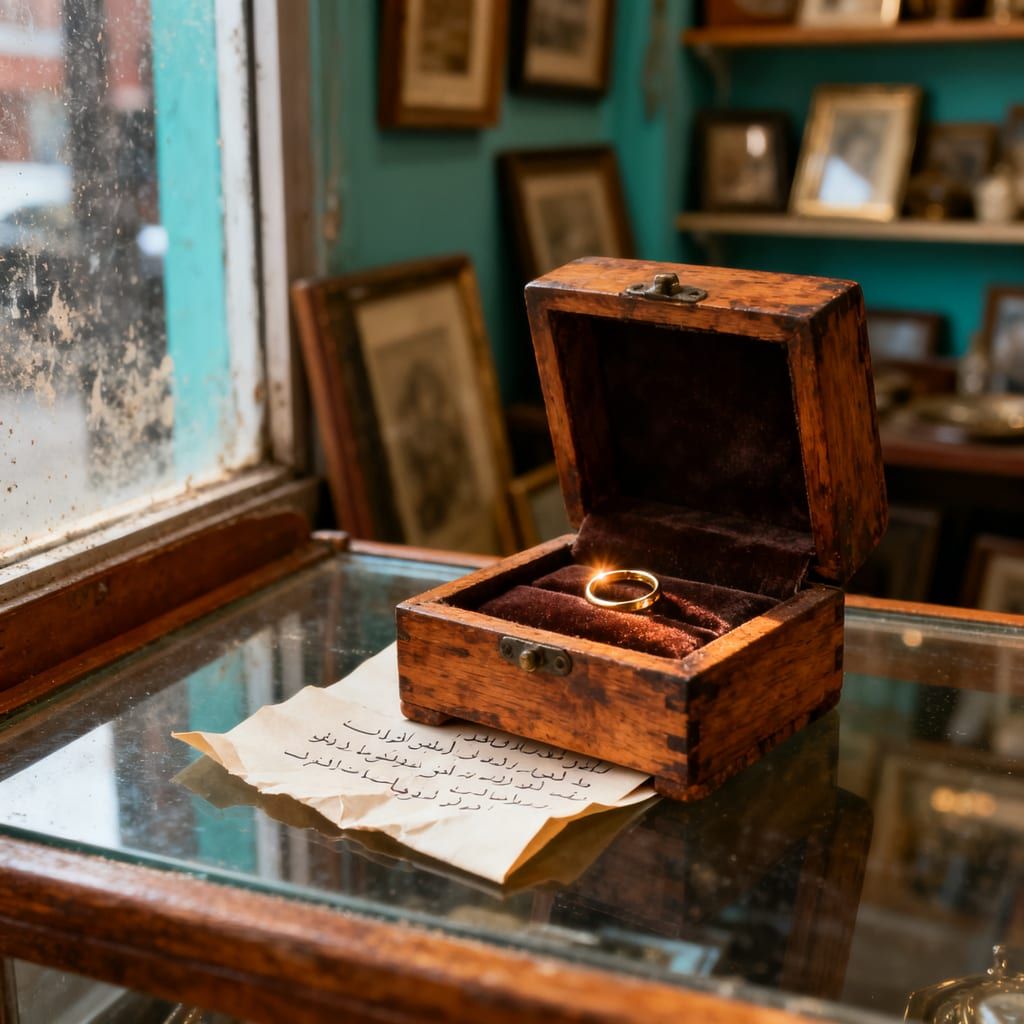
The cedar box had tucked itself between a frame with no glass and a watercolor of a sailboat that had never seen wind. Noor found it during the slow hour, when the fluorescents hummed in a register that made her think of winter radiators and boiling milk. She lifted the lid, and air the color of old closets slipped out-mothballs, rosewater, a memory of soap.
Something rattled softly, the way a secret does when it thinks you're finally listening.
She tilted the box toward the light. The velvet lining, once burgundy, had thinned to the pink of worn tongues. A simple gold ring lay in the valley, unassuming until she caught the engraving-two initials and a date from the 1970s-teeth marks of time on its edge. Her thumb found a rough seam at the bottom. She worried it loose with the corner of a paperclip until a false panel lifted like a breath.
Beneath: a letter. Blue-lined paper, creases like roads. Arabic script in careful lines-an old hand, deliberate as prayer.
She held it by the corners as if the ink might smear, as if the years beneath her fingernails might leave a mark.
At Second Chance Collective, donations arrived in unmarked bags and left with paper tags and new beginnings. Noor had worked the counter long enough to recognize good denim by its wash and sincerity by the weight of a box set on the counter. She priced picture frames, posted found cats on the community board, answered the phone with her name soft so people weren't startled by it.
Between customers, she spread the letter on the counter mat and read the opening aloud under her breath. The words tugged at parts of her she kept tamped down: the ones that remembered a Damascus stairwell smelling of cumin and hot dust, her mother's handwriting around grocery lists that were really budgets for hope.
"Ya banati al-anidat," the letter began. My headstrong daughters.
She translated line by line in a school notebook, penciling English below the Arabic like shadow. She stopped, sometimes, to breathe when the old ink turned tender.
-The ring belonged to your grandmother. It waited in her teacup the day your father asked for her hand.
-When you are ready to forgive, the ring belongs to the younger sister. If you are not ready, keep it where you can see it and remember that readiness is a kind of courage, too.
-Forgive me for the ways I taught you to hold on like fists.
The donation receipt that day held only a cleanout company's sticker, its adhesive giving up at one corner. A number to nowhere.
Noor could have slid the ring into the safe they used for laptops and cash. Instead, she cleaned the cedar with a toothbrush dipped in olive oil she kept in her lunch bag, working the bristles into the carved leaves until they were leaves again. She set the ring on a scrap of muslin. She wrote a post for Instagram with the kind of care she rarely afforded her own messages home: Found: a cedarwood jewelry box with a family letter-contact us if you can describe it.
She pinned a note to the community board with a dull thumbtack and waited for the board to do what boards sometimes did-summon the right person out of the ordinary air.
They came in pings and walk-ins. DMs full of stories that didn't fit: a cousin who'd once had a ring lost at O'Hare, a neighbor who swore the box had been her aunt's until she couldn't describe the scent. A man asked about the gold weight before he asked about the handwriting. Noor learned, again, to hear the shape of wanting.
On Thursday, when the sky over Chicago looked like wet newspaper, the bell above the door rang and a woman in a navy peacoat stepped in, hair pulled back as if she'd just had it out with wind. She clutched a takeout coffee by its collar, thumb returning to the seam as if the cup had a pulse she meant to steady.
"I'm Leila," she said at the counter, eyes skimming the glass case, the spin rack of postcards (Niagara Falls, Daytona Beach, a cornfield in Iowa). Her gaze landed on the cedar box as if it had called her by name. "Your post-" Her voice caught. She swallowed. "I can describe it."
"Tell me," Noor said, one hand on the register, the other on the box's lid as if she were greeting a skittish cat.
Leila's eyes reddened at the edges the way eyes do not when they mean to perform. "It smells like my mother's scarves," she said, and the word "mother" found something unguarded in the room. "There's a chip on the left side near the hinge that always snagged her nail. The ring will have-" She closed her eyes, seeing it. "Two letters. R and L. And a date-seventy-seven. March."
Noor felt the box grow lighter or her hands grow steadier; she wasn't sure which. She opened it, and the old air rose like forgiveness.
Leila stared. The coffee trembled. "I hired a company to clean out her apartment," she said before Noor could frame a question. "My sister-Rana-we had a fight. A long fight. It felt like the kind of fight that becomes the weather of a family." She smiled without showing teeth. "I told the men to take everything. It was all too heavy. Things were just-things. Until I saw your post."
"Would you like me to read the letter?" Noor asked, and it surprised her how gentle her voice could be around strangers.
Leila hesitated, then nodded. She slid the coffee aside like a prop in a play she was no longer in.
Noor read the letter in Arabic first, letting the consonants rise and fall the way they wanted to. She reached for the English she'd penciled underneath, reading again, slower, shaping each sentence with care the way her mother had taught her to fold grape leaves.
When she finished, the sound in the store was the buzz of the fluorescent bulb, the thud of a dryer in the back. Leila was very still. Only her fingertips moved, worrying the lid's edge.
"She wrote that," Leila murmured finally. "She wrote it down like directions for when the stove won't light." She huffed a laugh that belonged to someone who had not known she needed it. "Can I... can I take a photo? Not to keep the letter. Just to send to Rana."
Noor thought of the thin blue aerograms her mother had saved, wings of paper that carried a life forward a few ounces at a time. She thought of the unopened envelopes in her own nightstand-letters in a script her aunt had learned as a girl and that Noor still sometimes found too full to bear.
"Take the box," she said. "Take the ring. Take the letter. Just bring me back a copy of the letter and a story of where they went."
Leila blinked. Trust, when you haven't seen it in a while, can stun like bright light. "You don't even know-" She stopped. "Thank you."
"Bring me back a story," Noor repeated, as if she were pinning a tag to a dress: condition good, history intact.
They didn't hear from Leila for six days. In that time, a boy bought the sailboat painting for three dollars and a dare. Someone left a bag of pots whose handles had grown loose from years of being asked to do too much. Noor priced a quilt stitched with birds, each one a different kind of blue.
On the seventh day, the bell chimed and Leila stood there with the peacoat open and no coffee like a shield. She held a photocopy in one hand and a breath she seemed ready to release.
"She came," she said without preamble. "Rana. We met in our mother's kitchen. It looks big now, with the table gone. Her shoes were still by the door, though. My sister... she wasn't ready to be soft right away." Leila smiled crookedly. "Neither was I."
She set the copy of the letter on the counter. The toner had made the loops darker, the lines more certain.
"We argued about everything and nothing. About who left first and who left worse. Then I put the ring on the counter between us." She moved her hand, drawing a circle in the air. "It felt like a ceasefire. Not a surrender. Just... a pause. She cried like she hates to-quietly, into her sleeve. I cried like I do-loudly, with my whole face."
"And the ring?" Noor asked, because sometimes you had to ask the simplest question to find the truest answer.
"I slipped it onto her finger," Leila said. "She let me. We decided to keep the box on the kitchen shelf between our apartments. We don't live together, but we made a shelf. We'll rotate it every six months. Not because the letter said to." She glanced at the copy. "Because the act might keep us remembering."
Something eased inside Noor, the way a knotted chain sometimes releases all at once if you catch it at the right angle.
Leila folded her hands on the glass. "I thought things were just things. But this-" She touched the photocopy with one finger. "This was a map back to each other."
Noor nodded, because there are words you don't step on by adding more around them. She slipped the photocopy under the counter and taped it, carefully, behind the register where only she would see it. An anchoring. A reminder to keep a soft space for what people bring and the weight they can't name.
"Will you keep in touch?" Noor asked, and the question surprised her only a little.
Leila smiled. "We're making tea on Sunday in a kitchen that isn't quite ours anymore. I'll let you know if the tea remembers us."
They stood for a moment, two women holding a thin rope between them that looked, from a distance, like air.
Lunch was lentil soup from the bodega and flatbread wrapped in paper gone translucent at the edges. Noor sat on the stoop behind the store where a milk crate stood in for a chair. The phone felt warm palmed against her thigh.
She dialed her mother. The ring sounded twice, then three times-the small, bright insisting of a thing that wants to be answered.
"Habibti," her mother said, voice threaded with the clatter of pans, with the scrape of a chair on tile, with home.
"Hi, Mama," Noor said, and the word loosened something between her ribs. They talked about onions being too expensive this week, about the neighbor who kept feeding the squirrels bread as if winter could be bribed, about a cousin's baby with cheeks like dough proofing.
Noor didn't say everything. She didn't need to. Some seams hold because you trust the stitch, not because you can see every knot.
When she hung up, she wiped a small ring of oil from the counter, armed the pricing gun with a new strip of yellow tags, and went back to the work of sending things out into the world with a better chance.
By the time the bell chimed again, the photocopy behind the register had settled flat, the tape doing its quiet job. Noor reached for a dress with mother-of-pearl buttons and squeezed the trigger-two quick clicks that felt, in her hands today, like affirmation.
Somewhere, on a shared kitchen shelf, a cedar box was learning a second life. Here, in a thrift store that smelled of old books and possibility, a clerk returned to her task with a steadier breath-certain, now, that sometimes we are meant to be caretakers of what others forgot how to carry.

A daughter learns to read between the lines of a life split in two
Read more →
A fog-draped night, two souls found, and the quiet shape of a life
Read more →
Story audiobooks for children of all ages — a new one every day on Smarter Way Stories.