Where the Fire Meets Home
A backburn, a shoebox, and the promises we keep
Read more →
The clerk at the passport office licked her thumb and smoothed the corner of Nora's application like it might misbehave if left alone. Fluorescents hummed. A poster of a cartoon globe smiled at a line of restless strangers.
"I'm sorry," the clerk said, voice flattening into procedure. "Your original birth certificate is sealed by court order."
Nora's mouth tasted like copper. "Sealed?"
The clerk tapped her monitor. "Under public safety." She glanced up, the way people look when they wish they hadn't said a thing.
That night the hospital breathed its peculiar orchestra-monitors chirping, wheels squeaking, someone somewhere laughing too loudly because the alternative was crying. Nora took report with a plastic cup of stale coffee warming her hand. A teenager in Resus. A man who'd swallowed a battery. Two flu patients in matching misery.
"Hey, Ishikawa," Jorge called from triage, "your janitor friend left you the fancy tea."
On the desk: a paper cup with a lid, a Post-it in tidy block letters-something strong for a stranger's storm-and two saltine crackers, nested like little rafts. Mr. Doyle's handwriting. Steel-wool eyebrows, shoes that never squeaked. The man moved like a rumor, always arriving where the floor was dirtiest and the night heaviest.
Nora cracked a saltine in half and thought of seals and safety, two words that should have comforted but didn't. Her adoptive parents had kept their promise-"When you're ready, we're ready," her mother had said at sixteen, at twenty-two, at thirty-but the word sealed made someone else's hand close around her life and lock it.
On her break at 3 a.m., Nora wrote the appeal on a sticky keyboard in the staff lounge, the vending machine whirring like an answer. She expected forms, another line with a glum poster. She expected time to fold itself into the rest of the waiting.
Instead, a week later, a slim envelope landed in her mailbox. No return address. Her name in unfamiliar ink.
Inside: a safety deposit key tucked into a paper sleeve; a photocopied court note, its black bars neat and relentless; a single typed line:
Release permitted upon maternal death.
Her hands shook hard enough that the key chimed against the table. She called her parents. Her mother inhaled the way a person does when she's bracing and about to smile anyway. "Come by," her father said. "We'll make tea."
The bank was cool and beige, a room that believed in numbers and endings. A young banker with a new tie led her to a vault that smelled like pennies and old gum. The box inside weighed more than it should have. Nora sat alone at a polished table under the kind of light dentists love.
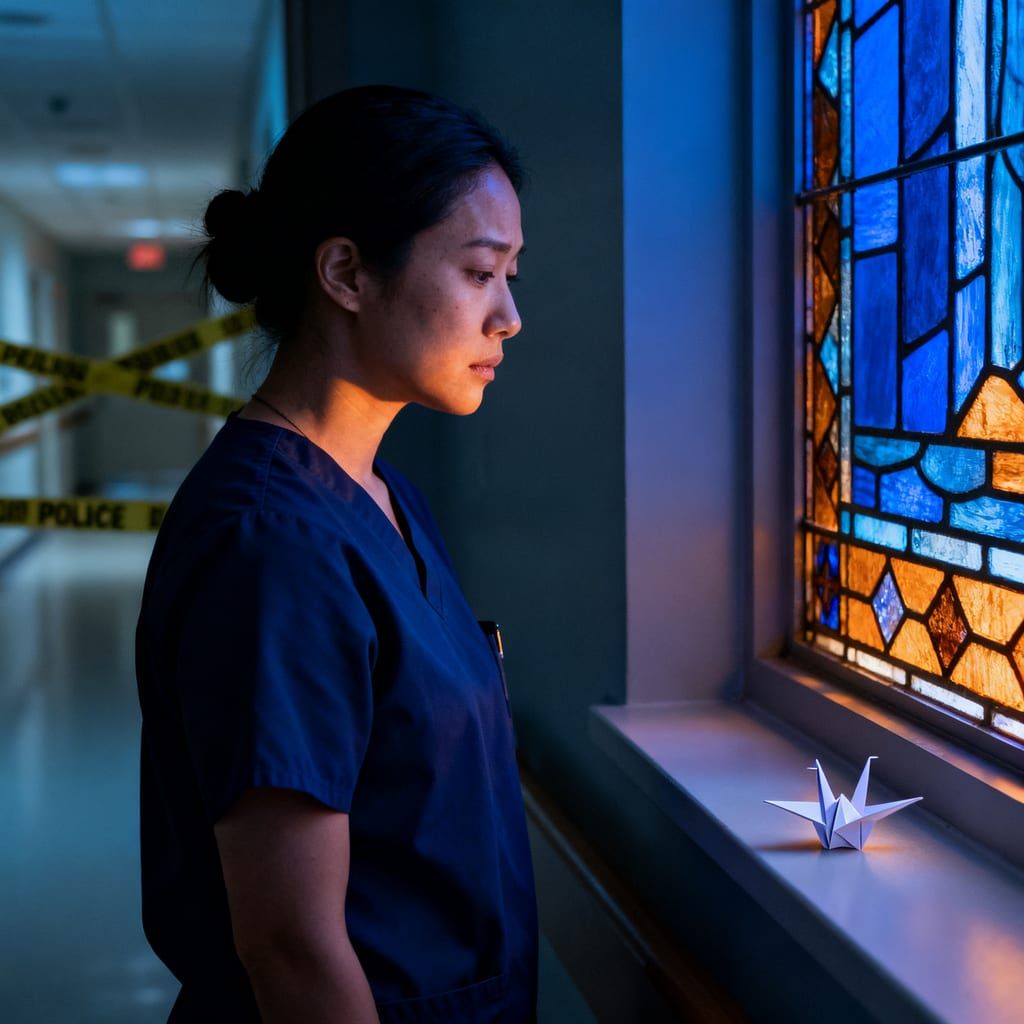
A letter on official paper, the seal indented like a thumbprint. A faded photograph: a young woman with hair pulled back, eyes steady, a newborn folded against her chest. Behind them, a hospital hallway striped in police tape. A nurse's shoe, half-caught in the frame, froze mid-step.
Nora pressed the heel of her hand to her sternum. She wanted to know what the woman smelled like-shampoo, antiseptic, the sour-sweet of milk.
The judge's letter was measured and human in the spaces between the law.
"Ms. Ishikawa,
Years ago, I presided over a case that touched you without your consent. Your birth mother, Hana, served as a key witness in a stalking case implicating a decorated police sergeant. After her testimony, the windows of her world did not behave like windows. She lived in sightlines and shadows.
When you were born, I sealed the records and authorized a closed adoption at her request, for your protection. She asked me to convey, in time, that protection sometimes looks like absence. The sergeant is deceased. Your mother died last month. I have lifted the order in full.
Included: your mother's note. An item she wished you to have. A name."
In the bottom of the box, a paper crane the color of old bone. Its wings softened by being handled too carefully. A letter in tidy script, stubbornly unadorned.
"Dear Nora,
If you are reading this, my hands have done all they can. I learned early that telling the truth can put a person in a small room with a bright light and a door you don't control. I told it anyway. After, I breathed with my back to a wall for a long time.
I placed you in the only room I knew where the door would not betray you.
Protection is not love's only shape, but it is one of them. I did not expect your forgiveness. I did not stop wanting it.
There is a man you can ask. Mr. Doyle.
I left a crane each year in the chapel to prove I was still here. If you never found them, perhaps someone kinder did.
When you stand, stand well.
Nora's fingers trembled the way they did after too much adrenaline. Mr. Doyle. The name fell into place like a puzzle piece she'd been using as a coaster.
She found him in the supply closet that always smelled like lemon cleanser and bandaids-bright, fake citrus over something tired. He was restocking gloves, the blue boxes sliding into place like hymnals.
"Mr. Doyle," Nora said. Her voice sounded like it belonged to a quieter person. "Do you have a minute?"
His eyebrows lifted, an old man's semaphore. "For you, nurse."
She held up the crane. It made no sound. "I found this. And-" she swallowed-"a letter. It said to ask you."
He leaned against the cart and exhaled, the sound a long-sliding drawer. He reached into his wallet and pulled out a photo so worn it was more rumor than image: a young woman's profile, strong. The edge of police tape again. A hospital corridor.
"Hana," he said. The name steadied something in the room. "I was assigned to her after the first incident. Somebody else should've been. Nobody else would. The man who made it necessary wore ribbons and shook hands on camera. He liked women who said no. He didn't like the word witness."
Nora's throat stung. "You were a cop."
"Once," he said. "Retired early when 'once' got loud. After the trial, when your mother was learning how to sleep with the lamp on, she asked me for one last kindness. Keep an eye on her girl. Not the kind that breathes down a neck. The kind that notices if the ground goes out from under her." His mouth tilted. "I'm better with mops than goodbyes. This place needed someone to make floors reflect light. I could make sure you had tea on the nights you looked like you hadn't remembered you had a throat."
"The cranes?" Nora asked.
He nodded toward the chapel. "She folded the first one the night before she surrendered the name you carry to paper. Left it at the back, under the stained glass where it leaks blue. Every year on that same night, she left another. When she moved finally-new name, new bus line-she mailed them to me and asked me to deliver. Said a promise can travel better if it hides in something that knows how." He slid a rubber-banded bundle across the cart: seven thin cranes, each with a penciled date inside a wing. The numbers were upright and stubborn, like the handwriting in the letter.
Nora pinched one open just enough to see its hollow shape, the marks of a finger's pressure. July 14. July 14. July 14.
"She wanted to be certain you knew she hadn't vanished because of you," Doyle said. "Only for you."
Nora braced a hand on the shelves. The lemon cleanser smell sharpened until it felt like standing in winter. "Why didn't you tell me?"
"I'm not the one who could. Not while it would've put you back under that light she wrote about." His voice softened. "I figured you'd find the door when it opened."
Something in Nora's chest-tight for years without her noticing-unclenched. "Thank you," she said, the two words a shift of gravity.
He shrugged, almost embarrassed. "You stand well."
At her parents' apartment, the kettle clicked like a metronome. The place smelled like miso and the lemon plant on the window that refused to fruit. Her mother touched the crane with a fingertip the way she'd touched Nora's fevered forehead at nine, at twelve, at flu season after flu season.
"We got a card once," her father said, disappearing into the hall and returning with a shoebox of elastic bands and old birthday candles. He produced a cream envelope, the kind stationers still dream about. Inside: a note with no return address-Thank you for making a room for her that wasn't afraid-and a pressed ginkgo leaf the color of late afternoon.
Nora slid the leaf from between the paper. The same fan shape lay under Hana's signature in the judge's letter, its veins like small maps. She set it on the table and watched it not move. Her mother's eyes shone without spilling. "We didn't tell you," she said carefully, "because we didn't know if it would open old wounds or keep them from healing. We trusted you'd open what was yours when you were ready."
Nora nodded. Words felt clumsy. She reached for her mother's hand, for her father's, and held on as if the room might tilt, which it always did, somewhere eventually.
Before her next shift, Nora walked to the chapel. The stained-glass window bled cobalt and honey onto empty chairs. The room smelled like wax and old carpet and the sharp clean of whoever had just been there and had to leave fast.
She took the newest crane from her pocket-the paper warm from her palm-and set it on the back ledge beneath the blue. "Thank you," she whispered, not sure which direction she was speaking to. Maybe gratitude didn't need a compass.
She imagined a young woman in a hallway with tape and men with clipboards, a judge with an exhausted kindness, an older man whose eyebrows made whole conversations, two parents at a table with a leaf between them. She imagined the absences they had chosen and the ways those absences had held.
When the bay doors coughed open with a fresh arrival, she tucked one crane into the corner of her scrubs pocket. It sat against her hipbone, a quiet weight.
"Ma'am," Nora said two hours later to a woman who clutched her cardigan like armor. The woman's breath chased itself. "Can you look at me?" Nora pitched her voice to the register that always found people when alarms couldn't. "You're safe. I've got you."
The woman's knuckles loosened one notch. Nora felt the small triangle of paper through cloth, a reminder of hands she'd never held and hands she had. She wrapped the blood pressure cuff with a tenderness that didn't announce itself. She handed over water and her steadiness together.
"Thank you," the woman said, bewildered by needing to say it to a stranger.
"Of course." Nora smiled without performing it. "I stand right here."
Outside the bay, Doyle's cart drifted by like a slow boat. He didn't look in, and she didn't wave, and both of those things were their own kind of acknowledgment. Jorge slid a chart her way. The monitors hiccuped and carried on. Somewhere, a vending machine whirred.
Nora thought of seals and keys, of doors and the hands that know when to open them. In her pocket, the crane shifted as she moved, not a secret this time, but a small evidence-sharp-creased and stubborn-that love, when it has to, learns the hard language of distance and still manages to arrive.
Story audiobooks for children of all ages — a new one every day on Smarter Way Stories.