Two Houses and One Quiet Heart
A daughter learns to read between the lines of a life split in two
Read more →
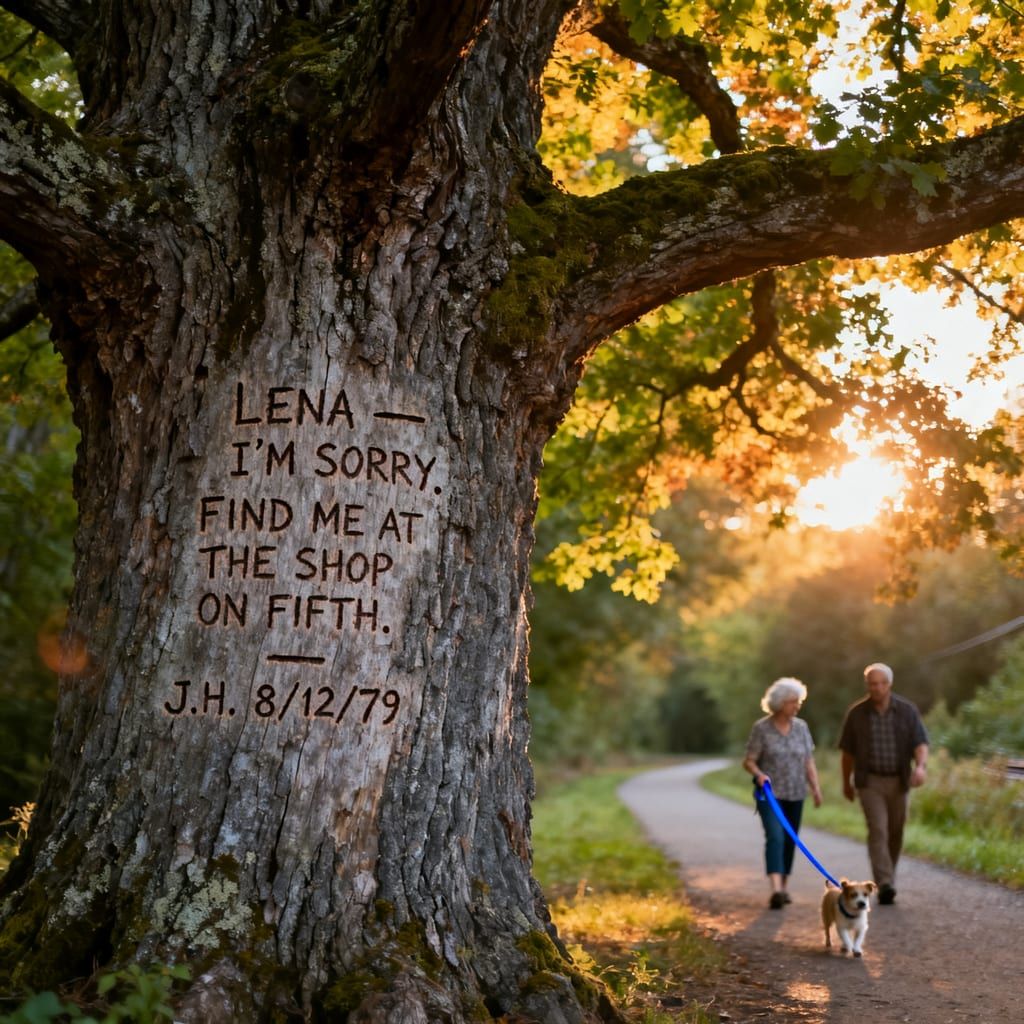
By the fourth day of dog-sitting, Evan clocked the way the late sun threw itself low across the rail trail-coins of light scattered through oak leaves, the dog's leash a bright blue line against his hand. The air smelled like hot stones and cut grass. His inbox was a quiet room he no longer entered.
Cricket, a willful terrier with opinions about squirrels, tugged him toward the big oak that watched over the bend. Evan glanced up, mid-podcast, and the sun snagged on a lighter seam in the bark-gray-brown, then a pale wound of letters. He paused the murmur in his ear. The carved words came forward as if clearing their throat.
LENA - I'M SORRY. FIND ME AT THE SHOP ON FIFTH. - J.H. 8/12/79.
He reached out, fingertips tracing the grooves, the bark cool and stubborn under his hand. The apology felt unfinished, still trying. He took a photo. Cricket sneezed at a clump of moss. Evan stood a moment longer, feeling the small, useless heat of wanting to fix something forty-seven years old.
He told himself it was just curiosity as he walked into town the next morning, heat already building over the river. Fifth Street, when he was a kid, had a knickknack store that sold marbles in netted bags. Now it was a pharmacy with automatic doors that whooshed like a sigh.
"Did there used to be a shop here?" he asked the clerk, a teen with chipped black nail polish and a name tag that read EZRA.
"Before my time," Ezra said, glancing at the line of greeting cards. "Try the historical society? My grandma volunteers. They know where everyone used to buy their screws."
The historical society lived in a former train depot, one room humming with the low electricity of refrigerators and memories. The volunteer behind the desk-white hair in a loose bun, pencil tucked behind her ear-looked up when Evan pushed the photo across the counter.
"Oh," she said softly. "Old Jacob."
"You know him?" Evan asked.
"Jacob Haller. Fixed radios, guitars, your mom's blender if she asked nice. Sweet man. Laughed like a kettle when it just hits the note. My husband used to take his RCA to him. The shop was right where the photo counter is now." She squinted. "Lena." The name hung there, a string someone was still holding.
They crossed to a bank of file drawers with brass pulls. The volunteer-"Mara," she said, offering her hand-slid out a folder that smelled like basements and gum erasers. They read a clipping: SHOP OWNER KEEPS TOWN IN TUNE. A black-and-white photo of a man with a moustache, sleeves rolled, his palm on a guitar amp like a benediction.
"Do you know what happened to him?" Evan asked.
"Died in 2001," Mara said, and her face did the math that turned years into weather. "Cancer. I remember the guitars lined up at the funeral like tall wooden ghosts." She pointed to a single line in an obituary, clipped neat: survived by his cherished friend, Elena Rojas.
The name opened inside Evan like a door you didn't realize was unlocked until your hand was already on it. Elena. Lena. He felt a tiny, ridiculous surge-like finding proof that a stranger had once loved, and had said so in a language trees could keep.
He told himself it was a project. Something to occupy the hours that used to be eaten by stand-ups and slides with cheerful fonts. Cricket napped under the table while Evan phoned a church, then another. He typed "Rojas + Hudson Valley + assisted living" into the search bar and braced against the flood of the internet. He posted a photo of the carving in a local nostalgia group-Do you remember Jacob Haller?-and watched the comments bloom: He fixed my Dad's amp. He was kind. He always had a peppermint by the register.
By the third day, when the voices in his head that said get a plan quieted under the repetitive dignity of dialing and waiting, a woman from St. Mary's called him back. "Elena Rojas is at Maple Creek," she said. "Two towns over. Sweet lady. Likes to sit by the fish tank."
He didn't tell himself any story about what he was doing on the drive there. The road curled along the river. He passed hay bales wrapped in white plastic like sleeping whales. He felt-if not purpose-then the absence of aimless floating.
Maple Creek smelled like lemon cleaner and something floral that had chosen cheerfulness as a dare. A television murmured about weather. A woman in a magenta sweater sat with her hands folded, watching a neon tetra pulse past a plastic castle.
"Ms. Rojas?" Evan asked, standing awkwardly at the edge of the room. He felt like a child at show-and-tell without the object.
She turned, eyes bright in that way some older faces keep-light from deeper in. "Do I know you?"
"No," he said. "But I think I know someone who once wanted you to find him." He showed her the photo of the tree.
Her hand flew to her mouth. She made a sound that could have been a laugh or a sob, a caught bird. "He... he carved that?"
"August 12, 1979," Evan said. "J.H."
She closed her eyes. "I stopped walking the trail that week," she said, voice as steady as she could make it. "We fought, and I said, You don't look for me even when I'm right there. I was young and proud and pregnant and sure of everything except the thing I needed to be sure of." She took the phone as if it were delicate china and traced the letters on glass. "I thought he'd chosen not to look. I thought-I told myself a story that made surviving possible.
"I raised my son. Mateo. He took my last name. I didn't push him toward Jacob's memory because every time I tried, it hurt like putting your hand back in a fire you already escaped." She blinked a few times. "I stopped walking the trail. I bought groceries on the other side of town. I got small to fit the life I could carry."
Evan nodded, the complicated ache of that settling in his ribs. "He died in 2001," he said gently.
"I know," she said. "Someone told me. I sent flowers and didn't sign the card." She smiled without humor. "I thought-what good would names do then?"
He hesitated, then asked, "Would you want to talk to Mateo about this? I can look for him."
Her hands trembled in her lap. "He teaches guitar now," she said softly, pride threading the words. "Of course he does. I'll give you his number. I never told him that Jacob asked me to find him. Because I didn't know." She touched the photo again, as if blessing it. "Maybe it matters, even now."
Mateo met Evan at a coffee shop where the barista drew hearts in milk and the radio played a song that had been old when they were born. He was forty, maybe, with a teacher's patience in the way he waited for the whole story, not just the headline.
Evan slid his phone across. "The tree kept his apology," he said. "He told you to find him. He carved the date."
Mateo read the words as if reading a chord chart-for structure, for feeling. "I grew up thinking he didn't want us," he said after a while. "My mother didn't say that, exactly. But when something is missing, your body fills the space with stories. Indifference is a cold story. You can hold it without burning your hands."
He laughed, a small, incredulous sound. "He ran a shop on Fifth. I walk by there every week. I never knew I was walking by my own question." He put his palm flat on the table as if centering himself. "I want to show this to my mother."
They drove to Maple Creek together. Evan sat in the waiting room pretending to read a magazine with a pumpkin pie on the cover while he listened to a son and a mother in the next room begin threading a new line through the old fabric.
"I'm sorry," Mateo said, clearly enough that the word moved through drywall. "For the things you held alone."
"I'm sorry, too," Lena said, the words careful, precious. "For the story I chose because it was easier to carry than hope."
They cried, and then they laughed in the bright, ordinary room where the fish swam without knowing what history was being rearranged in the air over their tank.
A week later, they walked back to the oak. The trail had shifted seasons a little-gold hinting at the edges of green, the smell of apples beginning to find them on the wind. Cricket announced their party to chipmunks with unnecessary fervor.
Lena reached the tree first. She placed her hand on the thick bark, the old letters sunken and softened. "You kept it," she whispered. "You stubborn thing." She laughed, wiped at her eyes. "We were so young."
Mateo stepped forward. He pressed his palm to the carving the way you might read braille, letting knowledge come through touch. He didn't say anything for a long moment. The sun slid a little further down its golden angle. A cyclist passed, called out, "On your left," and they moved without really moving.
"Hi, Dad," Mateo said finally, very quietly, to the tree, to the years, to the apology that had waited on a living wall. He didn't look at Evan, but later he would squeeze his shoulder in the parking lot, a small, grateful weight.
Evan stood a step back, feeling the strange peace of having carried something that was not his, and of setting it down where it belonged. The dog sat in the dust and leaned into his shin as if to agree.
On the walk back, the light thinning into that blue that makes porch lights brave, Evan took out his phone. His sister's name hovered at the top of a thread gone quiet. The last message from months ago was a picture of a birthday cake with too many candles crammed into too tight a circle.
He typed, erased, typed again. The dog nosed his calf like a metronome.
Hey. I'm sorry. Can we talk?
He didn't hit send right away. He let the words sit under his thumb, the way you can hold a note just behind the beat so it lands right where it needs to. Then he sent it into the invisible air between them, where so many messages go to wait.
A breeze came up the river and the leaves said yes, yes, yes without words. Behind him, the tree kept its carved name, the apology weathered but legible. Ahead, the path wagged through the darkening, the dog's leash a bright blue line, his hand steady on it.
He didn't know what would happen next. But the message had moved.
And sometimes that is what keeps a thing alive long enough to be found.
A daughter learns to read between the lines of a life split in two
Read more →
A fog-draped night, two souls found, and the quiet shape of a life
Read more →
Story audiobooks for children of all ages — a new one every day on Smarter Way Stories.