Two Houses and One Quiet Heart
A daughter learns to read between the lines of a life split in two
Read more →
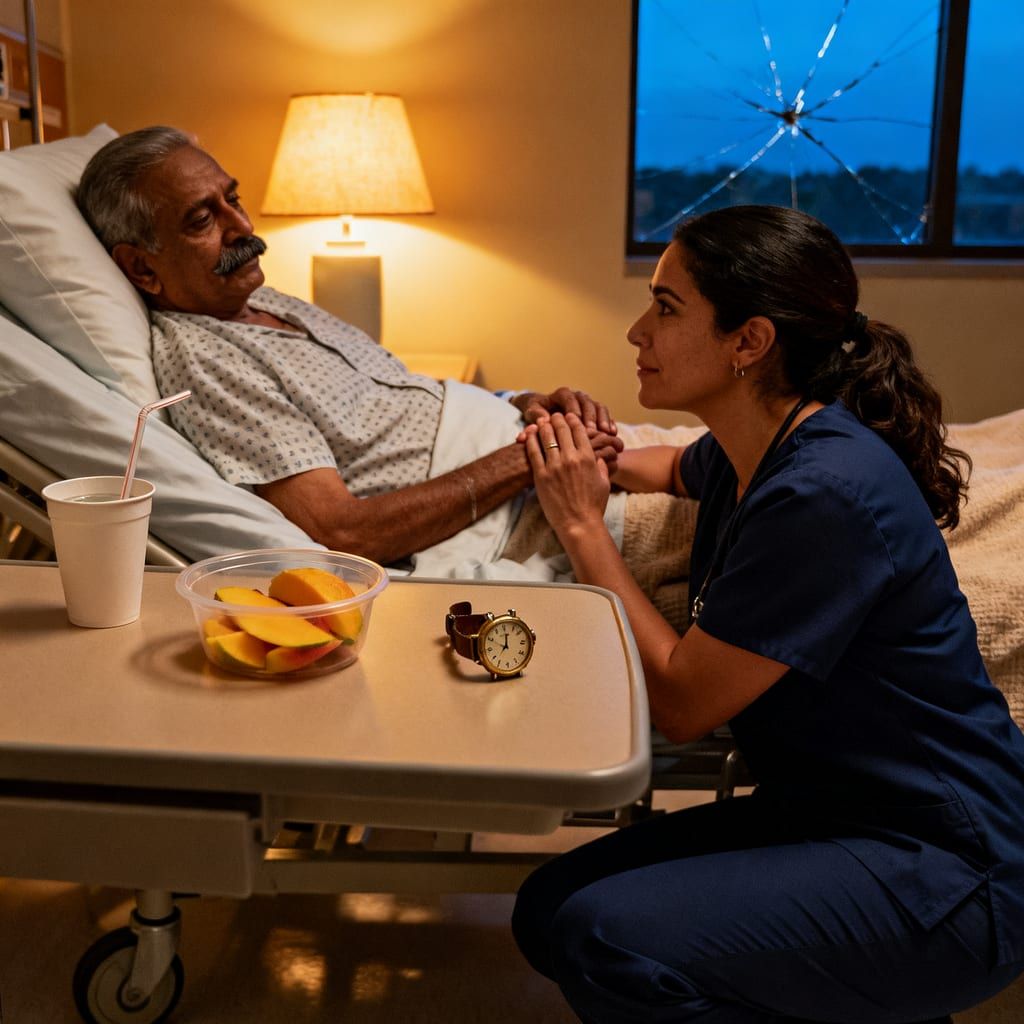
The beeps on the west wing had learned to soften at night, a lullaby of machines that tried, politely, not to wake the ones who were leaving.
Amara's glove snapped around her wrist and turned her skin into quiet. She checked drips and wheels, whispered goodnights to people whose eyes were oceans and whose breaths came like small surf. On her own wrist, her father's watch held its breath at 6:17, hands forever pressed together like it was praying.
She wore it anyway-like a sentence she hadn't decided whether to finish.
"Mr. Patel?" she said, leaning into the doorway.
He sat propped with an extra pillow, mustache clipped so evenly it seemed threaded. His room held the smell of antiseptic and cardamom. A small cardboard box rested on his lap, edges taped and retaped, as if it had also been learning to stay.
"You must be Amara," he said. "Come in. Close the door against the hallway pretenders."
She smiled. "Pretenders?"
"The ones who walk by and don't look in. It's a complicated choreography, ignoring." He lifted the box as if presenting evidence. "I have things to finish. They keep rearranging themselves whenever I blink."
Amara washed her hands in the tiny sink, the water coughing warm, the dispenser sighing soap. "What can I help with?"
He tapped the taped lid. "Cataloging. And one... small digital errand." His eyes flicked to her wrist. "You trust broken clocks?"
"I like the company," she said, before she could corral it back. She busied herself with the vitals monitor so he wouldn't see the heat rise in her throat.
In her pocket, her phone dozed with a row of unanswered text bubbles like bite marks. Her brother's contact sat at the top of her favorites-and stayed there, like a book turned face down and never reopened.
"Later," Mr. Patel said, as if the word itself were a glass he had been saving. "That is what my emails call themselves. Would you delete them with me? I am done with Later."
His laptop was older than her scrubs. The fan hummed when she opened the mail app, a mechanical breath. Drafts bloomed: the subject line was the same on each.
"Do you want me to read?" she asked.
He nodded, a shy bob. "Softly, like secrets that don't need scolding."
She read the first one. To his daughter, Meera: an apology for missing a parent-teacher conference in 1998. He had been in a gymnasium counting folding chairs for the school fete when the time got away.
"Delete," he said, wincing and smiling in the same movement. "I called her after that one. Fifteen years late. It counts."
The next: a neighbor, Mrs. Lopez, to whom he'd been unkind about hedge clippings. Delete. Another: to himself, for not taking his wife to the sea. Delete.
Between deletions, they ate mango slices from a plastic tub he'd labeled with his tidy math-teacher print: MANGO, 2/3 FULL. Juice slicked their fingertips; the room smelled like summer. He told her a joke about long division that looped around on itself until they were both laughing in the fragile way that makes your ribs feel newly made.
"Never trust a remainder," he said through a grin-wet mustache. "It stays to haunt you."
She wiped her eyes. "Remainders are honest. They say, this didn't fit."
He looked at her as if she'd solved something.
On the screen, his daughter's name threaded through the drafts like a stitch pulled too tight. "Help me write?" he asked, finally. "Before the math changes."
She opened a new message. The subject line blinked, patient.
"To Meera," he said, testing her name in the air. "I want-no. I have wanted. No. Let me try again." He touched the box on his lap like a talisman. "We keep things for so long that we forget why. My stubbornness is dusty."
Amara typed as he reached for words. Between clauses, the machines breathed. Outside, someone wheeled a cart past and the rattle sounded like a memory trying to move forward.
"I said awful things to her when she married," he said, "because it did not look like the picture I had painted in my head. I taught children for thirty-four years to find more than one solution. And then I wanted only one for my own." He took a slow inhale. "Tell her I repaired the wrong things."
She typed. The cursor waited, a pulsing rib. "How do you want to end it?" she asked.
He smiled at the ceiling tile as if it held an answer. "Tell her I left the porch light on. Tell her I am sorry for being a small window when she needed a door."
Amara wrote. She didn't ask to send it. He nodded, pinched the bridge of his nose, and said, "Tomorrow. Let me look with morning eyes."
On the third night, his breathing began to change-as if the metronome in his chest had learned a new song. The necklace of IV tubing tugged weight against his skin. He kept touching the cardboard box.
"When the clock feels honest," he said, voice a paper whisper, "open it." He tilted his head toward the watch on her arm. "You will know when."
She sat with him through the long hours that make a week blur. The TV in the family lounge murmured through a baseball game; distant applause rose and fell without a face. She adjusted his blankets. She cracked the window an inch and let in hum and heat.
"What time is it?" he asked, at one point.
"Six-seventeen," she said, reflex, before glancing down. The hands on her watch were exactly where they always were. She checked the wall clock: 9:42.
He smiled like he'd caught her stealing biscuits. "Honest enough," he said, and closed his eyes.
She opened the box. Instead of forms or keys, there was a sealed envelope, slanted ink on the front: For opening when the clock behaves.
Her gloves squeaked against the paper as she slid a finger under the seal. Inside, a list, the handwriting tidy but leaning-like it couldn't wait to tell.
What I kept when I thought I was losing everything:
She pressed the paper flat against her thigh. The line bent as if bowing. Mr. Patel slept with his mouth open just enough to show the bird-bone fragility of the moment.
"Thank you," she whispered, to the room, to the list, to her own hands for not shaking.
On the sixth night, a thunderhead muscled the sky purple. Lightning flickered behind the blinds like an indecisive photographer. Mr. Patel's daughter arrived-Meera, hair pulled back with the urgency of someone who didn't know if she was too late.
Amara had printed the email and left it on the bedside table. Mr. Patel had wanted to read it with morning eyes, but the morning kept rearranging itself. Meera touched the paper. Her thumb left an oval of heat on the corner.
"Hi, Dad," she said. The word Dad made a sudden room of the air.
They held each other with their breathing. Amara adjusted the straw in his water cup until the bend sat just right. She pretended to check a monitor while they practiced their quiet words.
After midnight, he went like the power had gently been unplugged. No panic, only the soft decrescendo of a song ending where it needed to. The sky exhaled rain.
Amara stood with Meera and counted the seconds between the last breath and the next that never came, not because seconds mattered, but because attention did. When she finally closed his eyes, she thought, briefly, of 6:17-the wristbone under her sleeve, steady as a metronome no longer conducting anything.
Her break was at 3 a.m., the hour when vending machines look confessional. She slid into a plastic chair that warmed under her waiting and opened her phone to a subject line that made her throat go rope-tight.
From: Ravi Patel. Subject: Thank you for the room where I stayed.
She clicked. The email had stepped out of the future wearing his voice.
Amara,
The day will already have decided to rain or not. Thank you for staying in the room with me. You could have done the tasks and left, and instead, you listened to the drafts I was too late to send. You knew what mattered because you were already doing it-choosing to be there.
P.S. A note about watches. Mine stopped at 4:12 p.m. on June 9, 1970. That was the minute my wife said yes in her mother's parlor with a fan turning the air into slow math. I wore it stopped for fifty-two years. Not because I forgot to fix it-but because sometimes time is best kept by moments, not minutes.
With gratitude,
Ravi
Tears came quick and clean. She wiped them with the back of her glove and then, remembering, ungloved so she could feel her own face with skin.
When the shift door sighed her into the morning, she didn't open her ex's texts or scroll herself numb. She called her voicemail to hear the blank space and the polite click-the way absence ends a sentence.
At home, she recorded a two-minute voice memo for her brother. No prologues, no performative jokes. "It's me," she said. "I love you. I'm sorry for making our last conversation into a wall. I miss how you hum when you cook. That's it. I don't need a reply." She sent it before she could engineer it into something prettier and thinner.
She stood at her sink and ate a peach. Juice rolled down her wrist into the cuff of her scrubs, a bright wound of sweetness. She let it stain, then wiped it on a towel that already knew her.
She took her father's watch to a little place squeezed between a check-cashing window and a laundromat. A man with magnifiers on his glasses replaced the battery. The hands flicked, dizzy with work, then found their old discipline.
Outside, beneath a sky that felt scrubbed, she watched the second hand move. It was a relief and also a small betrayal.
She went home, took the battery out again, and pressed the crown back to fix the moment where it was. 6:17. A private vow, a permission slip.
The next night, a new patient arrived. Mrs. Green had hair that used to be red and hands that telegraphed hope and surrender on alternating beats. Amara went in without the clipboard halo. She knelt by the bed so her eyes were level.
"What did you love that you almost forgot?" she asked.
The woman blinked, startled, like someone had asked for her middle name decades after anyone used it. Then her mouth made a soft O. "The way the night insects sing to each other," she said. "I forgot to listen."
Amara cracked the window. The chorus floated in-whirr and chirr and the muffled broom of far traffic. They sat in it like bathwater.
She bent the straw just right. She adjusted a blanket that had bunched at the corner, a small rescue. She didn't fill the silence with weather or schedules. Presence has a sound, she thought. Today, it was the hospital humming and the summer insects negotiating darkness.
In the hall, a cart rattled on a loose wheel. A TV somewhere argued about baseball. A mango, left in her bag, perfumed her locker with its sun.
The watch on her wrist held the minute of something said long ago and still true. She rubbed her thumb over the glass. The room kept time with breath and cricket song.
She sat, and then stayed.

A daughter learns to read between the lines of a life split in two
Read more →
A fog-draped night, two souls found, and the quiet shape of a life
Read more →
Story audiobooks for children of all ages — a new one every day on Smarter Way Stories.