Two Houses and One Quiet Heart
A daughter learns to read between the lines of a life split in two
Read more →
The February wind came straight off the river and through the gaps in the garage like it had keys. Jordan stood in his uncle's old workcoat anyway, hands deep in the pockets, watching his breath turn to smoke. The garage smelled like oil and sawdust and old winters.
On the far wall, a neat grid of pegboard listed its vocabulary: chisels, clamps, auger bits. His uncle's labels were thick in blue marker-his block letters steady as a chalk line. A life of fixing things arranged like a sentence he needed to finish.
He propped the door open with a cinder block and a crooked, hopeful sign: TOOL LIBRARY - SATURDAYS. BRING IT BACK WHEN YOU CAN.
He had made a spreadsheet the way he used to make product briefs-columns, dates, notes like breadcrumbs. There was a thrift-store date stamp that thunked pleasantly against masking tape as he pressed return dates onto the handles of drills and sanders, red numbers bleeding slightly into the grain.
At ten on the first Saturday, the block looked the other way. Plows groaned past. A dog barked into its own halo of steam.
At ten-forty, the widowed neighbor crossed the street. Evelyn, he would learn later. She wore her grief like a tidy scarf, tucked in at the neck. She pointed to a hand saw without looking at the bigger blades.
"Just a little limb," she said, and her voice tried for Saturday-casual and didn't quite make it. "It's dragging the driveway like it's tired."
"Name?" he asked, then winced at the bureaucracy of it. "Or-just tell me what you want me to call you."
"Evelyn's good," she said, warming her palms over the ceramic travel mug she'd brought him like it was an old ritual. "You're Jordan? Manny's nephew?"
He nodded. The coat still held the ghost of his uncle: coffee and pine.
By the second Saturday, a single mom borrowed a cordless drill to fix a sagging cabinet. She wrestled a toddler in a dinosaur hat while he showed her how to thumb the chuck tight. "It's Mia," she said, and smiled at the way the drill woke with a whir. "Feels like driving lightning."
A grad student came next, apologizing to his own breath. "I just need a level. For one picture," he said, as if justifying a splurge instead of avoiding one. He took the tool like it might scold him. "First thing I've put on the wall since-well. Since." He shrugged. The word hung level or not, neither of them checking.
Names started to stick. The spreadsheet filled. Jordan learned the sound of a stranger becoming a neighbor-how a 'hey' softened on the edges when it passed through a story.
The first tool out had been a twenty-ounce framing hammer with a blue rubber grip and a chip at the claw. Someone had taken it when Jordan was in the house looking for pens, or maybe for courage. He logged it anyway-NUMBER 001-and waited for it to return like a borrowed book.
It didn't. Weeks went by. He printed polite reminder slips on his old inkjet, the ones he used to leave on his own desk when procrastination hardened into habit. He held them up, squinting at the tone. Please return Tool #001 at your earliest convenience.
He slid the slips into a drawer and closed it softly. He wrote stricter rules in a draft email to no one in particular. He didn't send them.
The hammer became a weather system. He could feel it when he was stamping dates-how it tugged the edges of his generous plan toward fray. He pictured the city's many porches, their eyes averting, their packages taken in quick as apologies. He pictured the hammer in a basement somewhere, unlabeled, growing colder.
Still, the garage filled on Saturdays. The spreadsheet lines sounded like a poem if you read them right:
Devon came back with brownies that tasted like relief. Evelyn left a bag of rock salt by the door when a late snow made the stoop slick. Mia sent a photo of the cabinet, exactly level, her son cheering at a spirit level bubble like a tiny universe finally centered between its lines.
April warmed by rumor before it actually did. Jordan left the garage door open wider. He learned the names of the maples on the block by the shape of the buds. He ran an orange extension cord over the threshold and watched it bright as a tongue across the still-cool concrete.
There was a man who walked past every week without looking, a landlord by the rumors that travel in thin weather. He wore the permanent frown of a person who had learned how to look busy at not caring. Once, he paused long enough to say, "You got a permit for this?"
Jordan said he didn't. The man sniffed and walked on. His black truck idled at the curb like a comma that didn't know what it was holding back.
The missing hammer didn't come. Jordan measured the hollow it left by the way he thought of it as a test he was failing.
The storm came on a Wednesday, the kind that drops its shoulder into a city and shoves. Rain hammered the roofs like a thousand small hearts. Then the wind ripped branches and strewn fences into the street as if rearranging furniture no one liked.
On Thursday morning, the block was a tangle: limbs in the ruts of parked cars, gutters gurgling, one ancient elm holding its last brave angle over a mailbox.
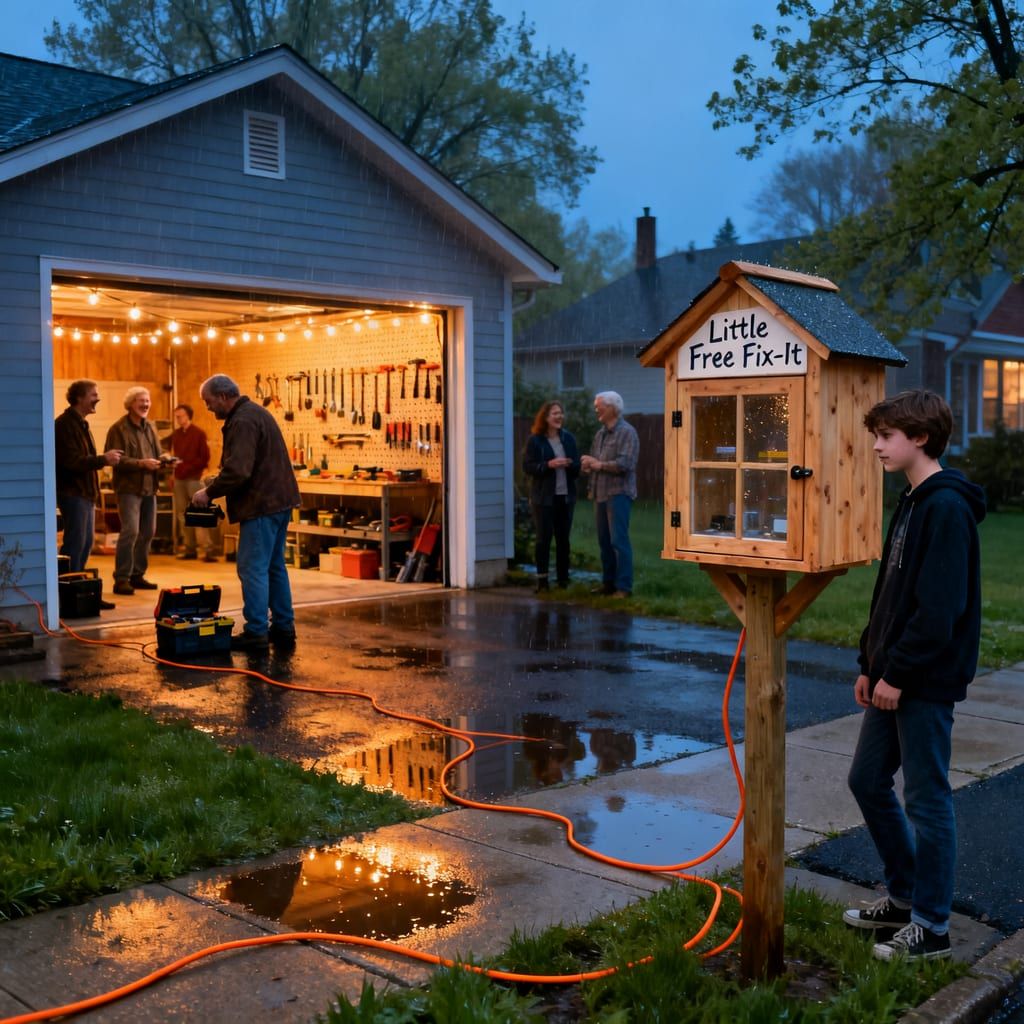
Before Jordan could think of rules or disclaimers, the garage became a throat clearing into purpose. He rolled open the door and the smell of wet cedar and mud came through like a song. Orange extension cords snaked over the sidewalks. He handed out saws and safety goggles and didn't ask for names.
Mia showed up with a shop-vac and a thermos tucked under her arm like a child. Devon brought his roommate and a playlist that made even the sawdust dance. Evelyn stood in the rain in a transparent poncho, directing traffic like a saint with a whistle.
The landlord arrived with a stump grinder in the bed of his truck and a face that tried to arrange itself into something other than suspicion. He didn't look at Jordan when he said, "Could use another pair of hands." Then, lower, almost private: "Sorry about that permit crack."
They worked until their fingers went pruny. The grinder chuffed and snarled and threw up a hot, sweet spray of shredded roots. The extension cords braided bright across puddles, everyone careful the way people are when care means more than caution. Ladders leaned into trees like prayers. Between passes, someone showed up with a pot of chili that blew steam under the garage light; bowls formed in a stack from nowhere; spoons clinked like applause.
By dusk, the street had its shape back. Piles of brush waited in neat, defiant cones. The garage floor was a fresco of muddy footprints that didn't bother anyone. The air held the sound of laughter gone a little hoarse and the smell of wet denim warming as people stood too close, talking like they had wanted to all along.
The landlord turned his cap backward to wipe his forehead and laughed once, surprised at himself. He didn't stay for chili but left a coil of rope on the bench without mentioning it.
Jordan lay in bed with the storm's lullaby yawning into quiet, the missing hammer quieter than it had been in months. He fell asleep with his hands open.
On Friday morning, the hammer sat on the workbench like it had been practicing patience. It was wrapped in butcher paper tied with neon surveyor's twine. His name was scrawled on top, the handwriting nervous at the edges.
Next to it stood a small cedar pantry on four stout legs, sanded smooth, bolted to a post near the sidewalk. Its glass door winked under the first real sun of spring. Someone had lettered the sign with careful permanence: LITTLE FREE FIX-IT - TAKE WHAT YOU NEED.
He unwrapped the hammer and found a note folded small: Sorry I kept it. I built this with my dad's old plans.
Across the street, the teen who avoided eye contact like it burned stood on his porch, hands jammed in the sweatshirt pocket, pretending the day had nothing to do with him. He had one of those faces that made you think of summers at baseball diamonds whether you'd had any or not.
"You did this?" Jordan asked, lifting the pantry's door. Inside were zip ties, a mending kit, a tiny jar of wood putty, the quiet civilization of small fixes.
The kid shrugged. "I didn't mean to keep it. The hammer. It just-once I started, I couldn't stop. My dad and I-" He let the sentence walk itself off.
The landlord appeared at the edge of the driveway like a punctuation mark changing its mind. He looked older in the good light. His eyes had the sheen of someone caught middecision between swallowing and speaking.
"I recognized those plans," he said, voice low. "They were my son's. In his journal. He used to draw up things like this. We... he passed two years ago." He put a palm flat on the pantry's top like stabilizing a heartbeat. "The tools in my truck-last things of his I hadn't been able to let go."
No one spoke for a beat that felt longer than a beat. The street noticed its own quiet.
"I've been meaning to-" He swallowed; his jaw worked. "I want to donate them. All of them. For this. For whatever this is."
The shy teen's neck went the color of new brick. He stared at his shoes, then at the pantry like it could answer an algebra problem for him.
Jordan felt the old plan-the one with clean returns and neatly stamped dates-loosen its collar. He imagined a new column on the spreadsheet called Happened and another called Because. He imagined the hammer's line amended to read: 001-Gone awhile-Came back with a door that opens.
By June, the garage hummed a soft, steady frequency. Saturdays weren't so much an event as a heartbeat. People moved through like weather patterns and left traces-baked goods and stories, screws in a jar, a child's drawing of a ladder on notebook paper taped to the pegboard like a flag.
The landlord-Carlos, as it turned out-began to show up early and stay late, his hands learning the new work of handing things over. He positioned his son's chisels on the pegboard with a reverence that made Jordan step aside. Sometimes, when a teen wandered in with the face of leaving, Carlos would be the one to say, "What are you building?" like a person asking, Who are you becoming?
The pantry filled and emptied in a rhythm no one bothered to formalize. A woman took a hinge and returned a jar of screws with a note that said, For the next unhinged thing. Someone left a pack of felt pads and the suggestion that the world could be quieter without scraping chairs.
Evelyn still borrowed the hand saw on Saturdays even when she didn't need it, just to walk across the street and sit on the workbench and talk about tomatoes. Mia set a shelf straight in the pantry and left a tiny hammer with a red heart sticker on the handle because why not. Devon brought a level and hung a picture of the block on the garage wall-branches, light poles, people the size of hope.
Jordan kept stamping dates because he liked the sound-because he wanted to honor the lines that held the looseness together. But he found that when something went missing, it had a way of returning with an extra screw, a story, or a stain you didn't mind not scrubbing out.
On a heat-drunk evening, with the garage door rolled high and the sky the color of a bruise fading, Jordan looked up from the spreadsheet. The column of names was long now, but what he saw were not numbers. He saw Evelyn passing a plate of watermelon to the teen whose name he finally knew-Noah-saw Carlos showing a kid how to check a drill battery by weight, saw Mia leaning in the doorway, the dinosaur-hatted boy asleep on her shoulder, his damp curls drawn tight to her neck.
The air hummed. Somewhere, a mower started, then figured it could wait, and stopped.
Jordan picked up the blue-handled hammer and felt its familiar pull. The chip in its claw fit his thumb like a decision. He tapped a small nail into the pantry's side and hung a key on it-a key to nothing in particular, just a piece of brass that looked like it could open something if you wanted it to.
"It's good," Carlos said, standing beside him without announcement.
"What is?"
"This." Carlos nodded at the whole arrangement-garage, pantry, people making themselves useful to one another. He squinted at the sky as if reading weather or luck. "It's loud in the best way."
Jordan smiled. The city's porches no longer seemed like faces turned away. The street, which he had walked a thousand times without noticing, had a new sound-like someone testing a drill, someone laughing into a borrowed hammer's return. Like a neighborhood clearing its throat and remembering the words.
He slid the ledger closed and let the door stay open a little longer than usual. The evening drifted in, and with it, the knowledge that what mattered had never been perfect returns. It was the way things found their way back changed-the way hands reached and were met, one borrowed thing at a time.
A daughter learns to read between the lines of a life split in two
Read more →
A fog-draped night, two souls found, and the quiet shape of a life
Read more →
Story audiobooks for children of all ages — a new one every day on Smarter Way Stories.