Circles We Draw in Winter
A Tuesday night for unsent goodbyes
Read more →
The city at 2 a.m. is a low hum pressing at the hospital windows. Fluorescents quiet the dark, flattening color, sharpening edges. The clock in the crisis room ticks with a throat-clearing regularity-old brass hands doing what they were made to do.
On Lina's desk: a chipped mug, a tangle of phone cords, and a small ceramic bowl of river stones. Smooth, thumb-sized, river-cool even after decades on a shelf. She likes their honest weight. Each one has been held by someone who needed something solid to keep them here.
The phone rings as if the rain has started: a college student whispering from a dorm bathroom-tile echo, hand over the mouth, I don't want to report, I just need to say it out loud. A nurse calling about her friend in radiology-what should I say when she says it was nothing? A man who hesitates, breath snagging on certain words, finally asking if it counts when you never fought back.
Lina's voice is unhurried. "We can talk. Or breathe. Or both. You choose." She has learned that quiet is an answer.
Priya sits beside her, new volunteer badge bright against a navy cardigan. She keeps straightening the stack of safety plans and resource lists, fingers itching for usefulness. She watches Lina like they're learning a duet: when to enter, when to fall away.
"How do you know what to say?" Priya asks between calls, keeping her voice a whisper as if the building is sleeping.
"I don't," Lina says, dry smile. "I know how to stay."
The line blinks again. No caller ID. No name. Only breath-the soft push and pull of someone keeping time with the old clock.
Lina leans closer, not to pry the quiet open but to rest against it. "I'm here," she says. "We can just share the room. I'll tell you what it looks like, in case that helps."
She tells E-she's started calling the caller that in her head, a vowel as open as an exhale-about the window above the radiator where a smear of city fog makes its own small moon. About the vending machine in the hall that glows a martyr's blue. About how the night nurse down the corridor laughs like a bell wrapped in cloth.
The breath holds, then evens. Priya's eyes flick to the line counter, to Lina's hands, to the bowl of stones.
"It's okay to be quiet," Lina adds. "Quiet is still a way of saying yes to being here."
By three o'clock, the hospital has its own weather. Mufflers exhale ghosts. Elevators ding like patient metronomes. The ER pager vibrates at Lina's elbow-two quick pulses. A survivor is on the way in, walking in herself with a friend.
"I'll be back," Lina tells Priya. "Phones on the slow setting. Ask the smallest possible question. Make space for the answer to be silence."
In triage, the fluorescent light is unkind, but the nurse's hands are not. The survivor sits on the edge of the chair, ankles pressed together, jacket damp at the cuffs. Her friend hovers, a wide-shouldered man with a delivery company logo on his shirt, a coffee lid worrying a groove in his thumb. His eyes do not leave her except when he reads the forms turned sideways for him, lips moving along the lines like a prayer.
"I can sit with you," Lina tells her softly. "At your pace. You get to choose each next thing."
She translates options into words that aren't a maze: exam or no exam, police or not, medications now or later, water, blanket, a pause. She names the room-chair, sink, the slow-moving second hand on the wall-as if architecture could be a rope.
The friend steps out when asked, stands sentry in the waiting room with two Styrofoam cups cooling in his hands. Lina catches glimpses of him through the swinging door-calling his supervisor to say he's going to be late, arranging a ride home for the cousin who had his car, feeding a five-dollar bill to the vending machine until it gives up a fleece blanket rolled hard as a baton. He folds it open, tucks it around the survivor like a question that doesn't demand an answer.
In the exam room, the survivor looks at the ceiling tile with the water stain that resembles a continent. She breathes with her lips pursed as if drinking from the air. Lina matches the pace. "If you want, we can count," she says, and they count light fixtures and cracks and the number of times the heater knocks, not because numbers are magic but because they are something to hold.
When it's done, Lina walks them as far as the threshold-the friend's hand hovering near, not touching unless invited. He is weeping without moving his face. The survivor nods once, the smallest of nods that still manages to be a victory. The automatic doors whisper shut behind them. The smell of antiseptic dissolves back into the general night.
Back at the desk, the clock clears its throat. Priya's eyes are rimmed pink but steady. "You were right about asking less," she says. "It felt... wrong not to fix it. But it worked."
"We don't fix," Lina says. "We witness. We offer. We stay."
The line glows again. E.
Lina answers, breath meeting breath. "Let's try something together," she suggests. "Grounding. It's simple. Five things you can see. Four you can touch. Three you can hear. Two you can smell. One you can taste. You can say them, or I can."
She doesn't wait for words. "I can see the plant in the corner-the leaves are dusty and still trying. The exit sign that insists on being red. The crack in the window like a river on a map. The scuff on my shoe. Your line glowing." Her voice breaks on that, a small, good breaking, and she lets the silence hold it.
"To touch," she continues, fingers moving to demonstrate although no one is watching, "the smooth of a stone. The cool edge of the desk. The paper rough as a dry tongue. My own sleeve."
Priya watches a tear gather without falling and looks, for once, away-learning when not to witness is part of witnessing too. The breath on the line deepens, stretches like someone stepping onto steadier ground.
"To hear: the clock. The elevator a floor below. Your breathing."
They sit with that. Outside, a siren threads itself thinner and thinner, then lets go.
"Smell: coffee gone to bark. The ghost of rain when the doors open."
A pause so long Lina imagines E naming, somewhere not so far away, the scent of cleaning solvent, the lemon pith of it. A trill of static like thought clearing its throat.
"Taste: mint from a long-ago gum. Or just... the inside of your mouth. That counts."
E's breath organizes itself into something that sounds almost like speech, then chooses, instead, calm. The line clicks-not a hang-up so much as a closing of a door in a quiet house.
Priya exhales like she'd been holding it for the both of them. "How do you not take this home and shatter under it?"
Lina turns the bowl of stones so the light collects on their backs. She palms one, thumb finding the groove where other thumbs have learned a path. "One story at a time," she says. "We don't carry what isn't asked of us. But we don't set down what someone has placed in our hands. We hold it until they're ready."
Shift-change light is different. It arrives as a pale permission at the horizon, a suggestion more than a glow. Lina shrugs into her coat in the locker room, shoulders sore from stillness. Priya yawns and thanks her and rushes to catch the bus that will turn her, for a few hours, back into a graduate student with a paper due.
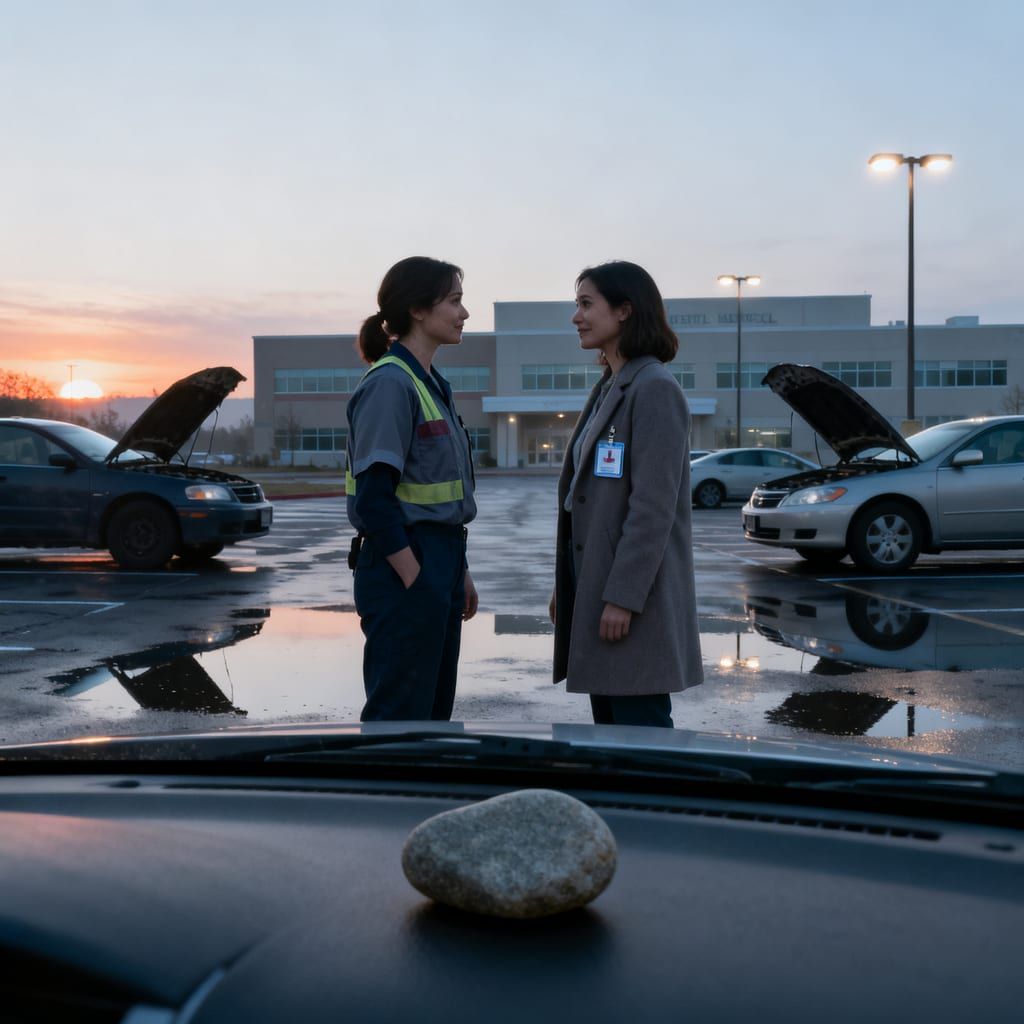
The parking lot holds puddles that mirror the world with some distortion-the sky upended, the hospital stretched into a watercolor smear. Lina slides into the driver's seat and turns the key. The engine coughs once, then makes a sound like refusal.
She laughs, a sound without humor. "Okay," she tells the car, "I hear you."
A woman in a maintenance uniform is making her way between lampposts, rolling a yellow cart whose wheels complain. Her hair is tucked under a cap. Lina has seen her face in slices of night-the reflection in a wet floor sign, the brief meeting of eyes in a corridor. Mop handle upright like a flagpole.
The woman lifts a hand, a question. "Jumper cables?"
"I have some," Lina says, already popping the hood just to do something, the metal releasing with a sigh.
They stand facing each other across the open mouths of cars. The woman clips the red and the black with muscle memory. Her hands are steady. The morning is the soft gray of an unlined page.
"You sound like the voice on the line," the woman says, not looking up at first. Her voice is careful, a foot testing a step.
Lina's breath stalls. There are a hundred possible answers, none of which are better than waiting.
The woman reaches into her pocket and places something on Lina's dashboard. A river stone. Smooth, familiar. There's the faintest groove worn into it, the path of a thumb.
"I've been calling from the east stairwell," she says. "Couldn't come in. I can now."
The space between them rearranges itself, not shrinking or widening so much as becoming more true. The breath on the line has been a person in this same building, some flights of stairs and several brave inches away.
Lina does what she knows-doesn't rush. Doesn't fix. She stands with her in the tender light of almost-morning, engines silent, cables slack like jump ropes between sleeping children. The woman's eyes shine but nothing spills. They let the quiet make room.
A bird tries out a few notes. Somewhere, a coffee machine grinds the day awake. The hospital doors breathe in and out as night shift trades its secrets with the day.
"When you're ready," Lina says softly.
The woman nods, then nods again, as if translating the motion from the inside out. Lina turns the key and the engine catches-first surprised, then sure. The sound is a warm animal settling.
They close the hoods. The woman touches the stone, now clearly a bridge with weight. She looks at the hospital the way someone looks at a body of water they are about to enter-gauging temperature, current, self.
They walk. Not fast. The gravel under their shoes ticking like a second, like a breath. The automatic doors part, the lemon-tinged air meeting the cold with a brief, invisible fog. Side by side, they step inside.
Behind them, the light keeps coming on.
Story audiobooks for children of all ages — a new one every day on Smarter Way Stories.