Two Houses and One Quiet Heart
A daughter learns to read between the lines of a life split in two
Read more →
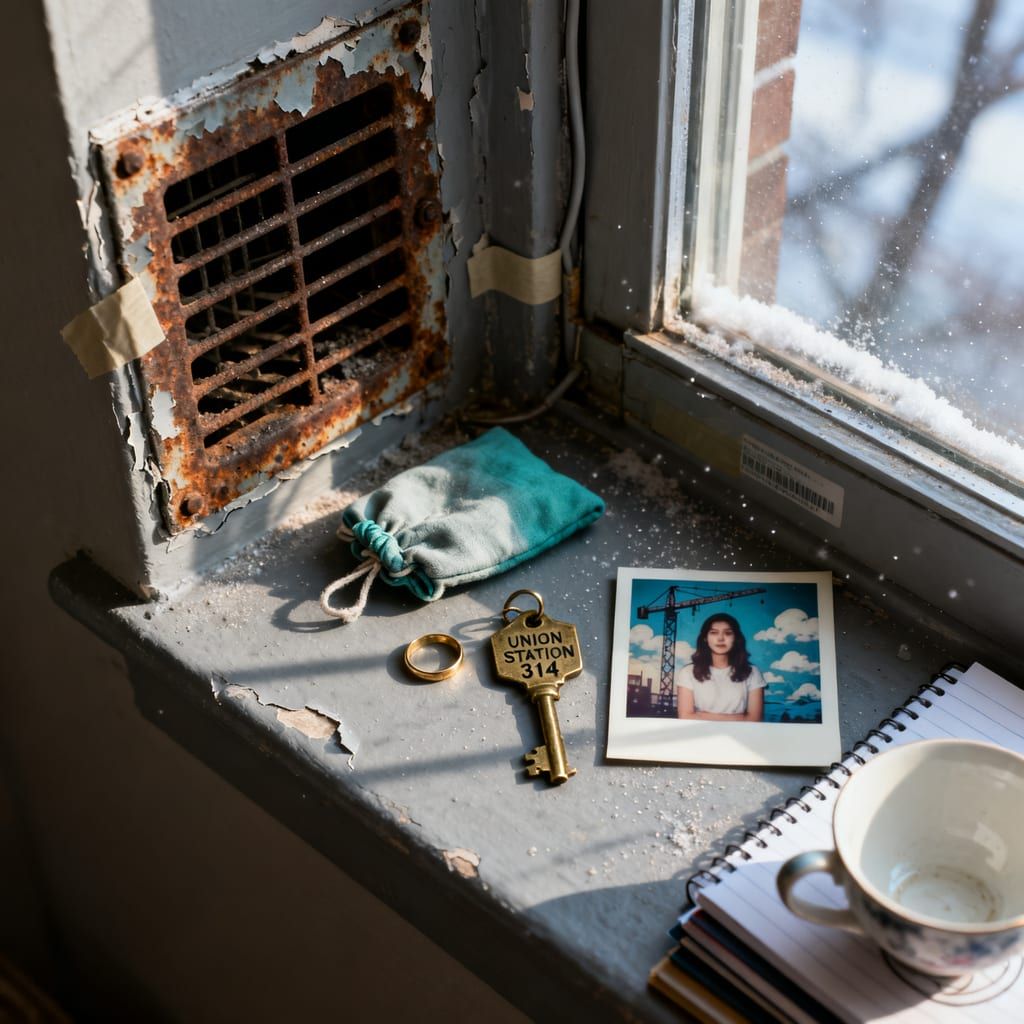
The radiator hissed like a sleeper with bad dreams. Lena Ortiz slipped her gloved hand over the sill, lifting a swath of blind that had been dressed in dust long enough to learn patience. Outside, late winter pressed its gray face against the glass. Inside, the apartment held its breath-grocery lists with items struck through in neat pen lines, a folded sweater waiting by a chair, one teacup in the sink with a ring of light where hot water once was.
She had seen worse. She had seen endings announce themselves with sirens and spatter. This one coughed softly in the night and went quiet. Ordinary in the way grief often is.
Her mask fogged at the edges when she leaned toward the wall vent. A whisper of cold threaded through. Draft, she thought, and then she felt it-something whistling a secret. She unscrewed the rusted grate. The screw heads surrendered with a powdery sigh. Behind it: a strip of electrical tape gone the color of old teeth, pinning a small cloth pouch like a talisman.
The tape disintegrated at her tug, a brittle crumble gathering on her glove. The pouch fell into her palm with the weight of a bird's heart.
Inside: a tarnished brass locker key with a tag stamped UNION STATION 314. A thin gold ring, its inside lip engraved L+M. A Polaroid: a young woman smiling against a mural of cranes and clouds that had been painted over years ago. Lena knew that face-had known it from the bus stop poster on Western, fine print aging under weather. Mara Lin, missing eleven years.
Lena turned the photograph until the light caught on the sheen of the instant-film border. In the image, Mara's hair kicked up at the ends, winter-bright. The place behind her was long gone. What remained fit in Lena's hand.
On other jobs, she had practiced the discipline of looking away. Order restored, door closed. It was how you made a life out of other people's endings without letting them pile up inside you.
She dialed the cold case line before she could persuade herself that calling wouldn't matter. The dispatcher took her name and a flurry of details. Twenty minutes later, Alvarez knocked.
He had the careful posture of someone who spent years in rooms like this and learned to leave the air undisturbed. "Ortiz," he said, nodding at her mask. "You always find the vents."
"It found me," she said, and handed him the pouch.
He thumbed the key tag and studied the ring. "L plus M," he read. His voice didn't rise, but something in his eyes did. "And this-" He slid the Polaroid from its sleeve. The mural had been a familiar corner once, bright against brick. "Haven't seen her smile in a long time."
"Me neither," Lena said. Ask the question, she told herself. She had been avoiding those since her mother's hospital room, when the nurse offered the clipboard and Lena nodded and signed, as if paperwork were a blanket you could pull to your chin. "Do you think-" she began.
"That it's real?" He shrugged. "Real enough to chase."
He stayed longer than protocol asked. He checked the vents, the baseboards, beneath the sink. In a kitchen drawer, they found a stack of small spiral notebooks-Mr. Hart's neat, insect-like handwriting charting groceries and appointments and movies on TV. Dates circled in January. Same day, every year.
"Wasn't he the anonymous caller?" she asked. The rumor had drifted with the steam from coffee lines-someone had called 911 the night a scream cut the alley behind the shuttered museum, then hung up.
Alvarez nodded once. "We thought so. Never proved it. He lived alone. Kept bills on time. No priors. The quiet kind of suspect-the one you don't know how to push."
They looked at each other over the smallness of the kitchen. Lena's gloves creaked. A life made of routines could still hold an earthquake.
"Union Station?" she said.
"Union Station," he said.
The lost-property office breathed recycled heat and old stories. Fluorescent lights buzzed at a high pitch, the sound of a mosquito sealed in a jar. An elderly clerk in a cardigan the color of oatmeal peered over glasses that had lived many lives.
"Locker tags changed about a decade back," the clerk said, rolling the brass key between his fingers. "These are from the old bank. They pulled them when the modernization came through. Boxes in the back from the units we emptied." He said it like a bedtime tale he'd told a hundred times and had never been believed.
He led them through a narrow corridor stacked with parcels labeled in slanted hands. Dust motes lit up in the fluorescents like a constellation that hadn't decided its shape. Box 314 was small, dented at one corner, and tied with twine that had solved for patience.
Alvarez cut the twine with his pocketknife-a clean blade, familiar fold-and lifted the lid.
Inside: a metal lunchbox freckled with aqua paint. Lena could smell the dim ghost of something industrial, like a summer morning in a garage. Alvarez unlatched the lunchbox. Nestled on a folded bandana, a utility knife gleamed. Near the base of the blade: a distinctive serrated nick.
Alvarez didn't speak. He didn't have to. She had read the leak to the press back then. Everyone who took the Western bus had. The nick was the shape of a city's held breath.
Beside it lay a ring twin to the one in Lena's pocket. Gold, thin, engraved. Two halves that could make a circle. Ticket stubs stamped the night Mara disappeared, the ink bled slightly at the edges.
The clerk, hovering with the air of a man at a threshold he hadn't meant to cross, said, "You need me to step out?"
"Please," Alvarez said, and when the door clicked shut, he let out the breath.
"Why keep it?" Lena asked. The question escaped before she could make it tidy. "Why keep all of it?"
Alvarez turned the utility knife in his palm, careful not to smudge the steel. "Some people put their sins on a shelf to see if the light changes them," he said softly. "They never do."
He set the knife down. From the box, beneath the bandana, he lifted a snippet of paper, a corner torn from a flyer. A phone number in a trembling hand. The area code was local. "Hart's?" he said. "Maybe he meant to call one day and didn't."
Lena pictured Mr. Hart in the modest kitchen, circling a date, making tea, laying a sugar packet on the counter like a note to himself. The radiator mumbling in the corner, the television whispering to an empty room. Courage pacing the hallway and not finding the knob.
The paperwork swelled, as it does when a long-tight knot begins to loosen. Alvarez called it in. Photographs were taken. Boxes were logged and relogged. A haze of relief passed through someone's voice on the other end of the line when he said the words "the knife" and "ring."
"Lionel," Alvarez said, half to himself. "He can breathe."
Lena remembered Lionel's face from the articles-a boy wearing a man's expression too soon. The kind of suspect no one could prove guilty, but whose neighbors learned to lower their conversations when he passed.
"I'll need your statement," Alvarez told Lena outside the station. The wind licked at their sleeves. Above them, the cathedral of trains sang metal against metal. "Then you can go back and finish. If you want."
"I want," she said. It surprised her, how much she did. To tend a place in the wake of this, to arrange things into a shape that meant gentleness. To show the room she had heard it.
Back at the apartment, the afternoon had shifted. Shadows moved like careful dancers. She washed the single teacup and dried it with the least threadbare towel from the cabinet. She set it in the cupboard, rim angled just so, a private grammar of order.
She gathered Mr. Hart's notebooks into a stack, lined the pencil on top as if laying down a version of prayer. She left a sugar packet on the counter the way it was in the photograph someone had taken-Mr. Hart, younger, a party hat sagging on his head, that same small habit visible in the background. She opened a window to let the steam of bleach unwind into the February air. Somewhere, a church bell counted the hour in real time. She peeled her gloves and flattened the crumpled electrical tape on the trash bag with a ruefulness that felt like respect.
Before she left, she slid a photocopy of the Polaroid into the space where the grate had been. Not to hide it. To mark a place that had been a mouth for secrets and had finally spoken.
On her way to the bus, a tier of clouds broke and the evening bent toward gold. A small knot of people gathered outside a bakery, breath making pale balloons in the air. In the middle stood a man with shoulders slightly hunched, as if the weather belonged to him and he didn't want to make a scene.
"Lionel," someone whispered near her, and she followed the turn of heads. A woman held his arm-not dragging him, not restraining him, simply holding, as if he might forget gravity in the relief and float.
Lena could have kept walking. She could have let the city do what it does-erase the line between one life and the next until only the trains remember who crossed where. Instead, she stepped closer and slid the copy of the Polaroid from her bag.
"Excuse me," she said.
Lionel looked up. His eyes were the color of the lake when the sky can't decide. She offered the photograph.
"Mara," he said, not quite to her. His thumb skimmed the edge, not touching the image. He studied the mural behind Mara-the cranes mid-flight, clouds like paper lanterns. He smiled the way people smile when a muscle remembers an old choreography. "Thank you." The words fell out of him like something he'd been carrying with his teeth.
"She liked the cranes," the sister said. "She used to say they looked like a sentence almost finished."
Lena nodded. She didn't say the rest. At her side, the wind got colder, then changed its mind.
That night, Lena stood in her own kitchen and listened to her walls. The radiator complained in a language she had learned to understand in Chicago. The refrigerator coughed like a man trying not to cry at a wedding. She left the plates in the drainer to dry on their own and set one sugar packet on the counter next to the kettle. It felt foolish and necessary at once.
Her phone buzzed with a message from Alvarez: "Clears him. We'll brief the family tomorrow. Thanks for listening to a vent. -A"
She typed, then deleted. Typed again. "Sometimes rooms tell you the truth," she wrote finally. "I'm going to believe them when they do."
In the quiet, she pulled one of her own spiral notebooks from a drawer-the kind she bought in threes and left blank. She wrote a date at the top of a page and circled it. No reasons, no names. Just the small promise of a circle.
Outside, the city turned toward dawn very slowly, as if it were afraid to wake someone. Lena closed her eyes and pictured a bank of lockers waiting in a back room, boxes paired with numbers, debts paired with small mercies. A man who kept everything he should have given away. A boy-now-man waiting a decade to exhale. A mural that no longer existed, cranes still aloft in the air of a photograph.
She could not rewrite a night behind a shuttered museum. But she could take a key from a wall, walk to a counter, and ask. She could wash a teacup and set it where it belonged. She could hand a stranger a picture of the person he loved. The next small thing, then the next-until what once felt fixed loosened, if only a notch.
When the first pale seam of morning stitched the buildings together, Lena made tea. She sweetened it out of habit she did not own and waited by the window. The heat rose through the vent. The walls said nothing. They didn't need to.

A daughter learns to read between the lines of a life split in two
Read more →
A fog-draped night, two souls found, and the quiet shape of a life
Read more →
Story audiobooks for children of all ages — a new one every day on Smarter Way Stories.