Two Houses and One Quiet Heart
A daughter learns to read between the lines of a life split in two
Read more →
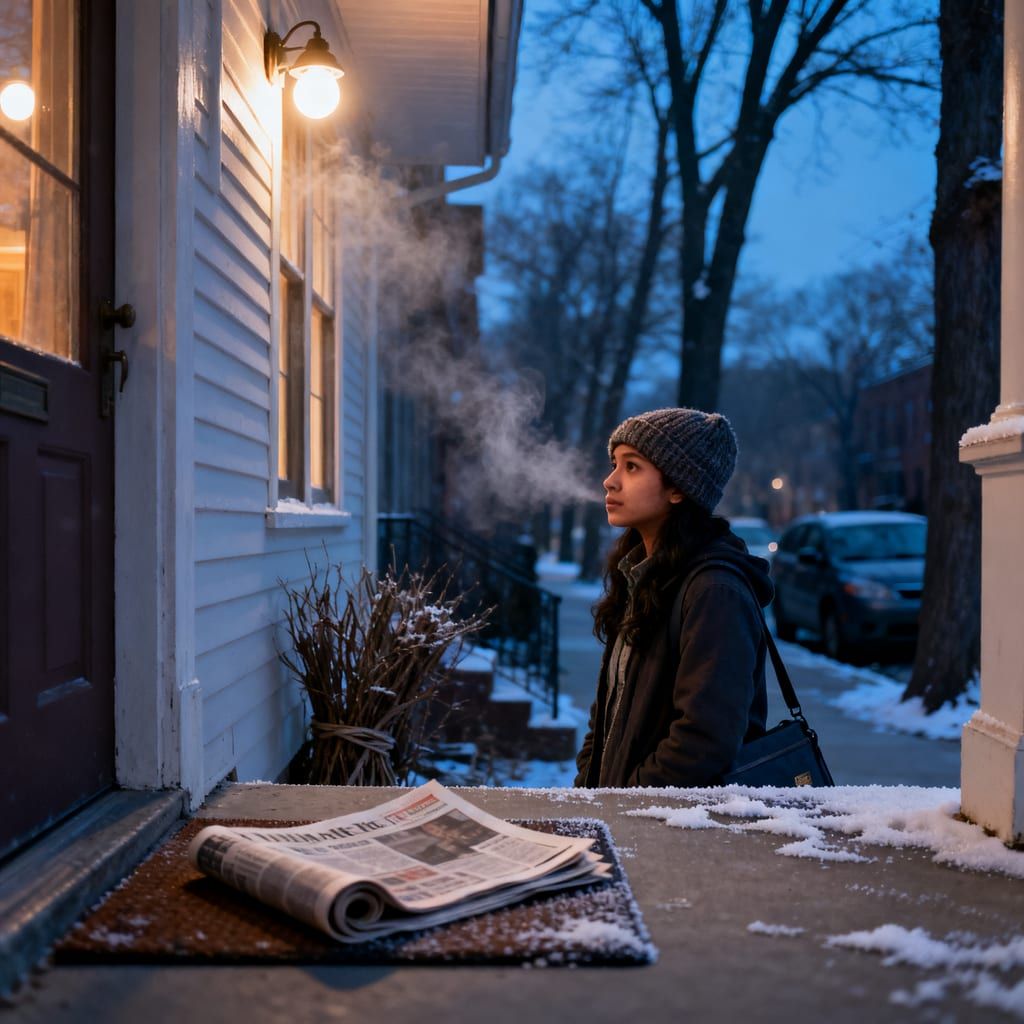
At 5:06, the dog at 3B thumps its tail against the frosted glass, a metronome I could set my life to. My breath ghosts as I jog the stoop, drop the rolled news, and skip the loose step I learned the hard way during a slush storm in January. Three blocks yet to go. The sky hasn't made up its mind about morning.
Most days I'm a rumor sliding through these pre-sunrise hours-Lina, twenty-nine, barista by night, courier by habit. I know which mail slot refuses a second try, which wind chime thinks it's a philosopher. I like that none of it needs me to talk. I like being a hinge in other people's days.
At 5:12, like always, Mr. Dempsey's porch light blinks twice. It's the smallest semaphore. He opens his door in a sweater the color of oatmeal, waves a hand, says a quiet, barely-there thank you. I nod, a lighthouse of one, and keep moving.
Late winter rearranged the rules. The air had a blade to it. The snow curdled along the curb like gray meringue. Monday passed. Tuesday. On Wednesday, three damp papers hunched under Mr. Dempsey's mat, edges wicking up the week. The light stayed dark. The porch looked like a mouth closed too long.
I squatted to slide the new roll into the fold. My glove scraped sand grit and salt. In my chest, a small rattle-familiar, the one that arrives when I suspect I'm about to be responsible for something I can't name.
Maybe he's away. Maybe his niece visited. Maybe the bulb's blown. Maybe I am inventing a crisis because it's easier than thinking about the rent due Friday.
I stood there, the street making its tinny morning music-radiators, a bus groaning, the soft complaint of a bike chain-and decided that noticing could be generous or cruel; sometimes it's just a feeling you're not sure where to put.
I wrote a Post-it with my blunt pencil and stuck it to the glass: "Hi-it's Lina with the paper. Noticed a few are here. Everything okay?" The note looked too yellow against all that winter. I imagined it flapping, ignored, until the glue gave out.
I walked back to the car. Put the key in the ignition. Pulled it out.
The dog at 3B thumped again, slower this time, as if to say, decide.
I knocked.
Nothing, at first-no shuffle, no clearance of an old man's throat. I knocked again, louder, and felt like I was breaking some agreement I'd signed with the block to stay invisible.
I tried the super anyway. His number was on a faded sticker by the buzzer. I didn't know his name, just the immovable capital letters: SUPER. He answered on the fourth ring, voice gray with sleep.
"Hi, this is Lina. I deliver the papers. Mr. Dempsey at 5-he hasn't picked up in three days. His light hasn't blinked. Sorry to-"
"You're sure?" A pause. "All right. Stay there."
The hallway lights sputtered on in sequence, a clumsy runway. The super, a stocky man in a flannel robe, arrived with a ring of keys that chimed like an accusation. He called through the door first. When there was no response, he glanced at me-the sort of look that said, you'll own this if it's nothing-and turned the key.
The air inside was stale and warm. Somewhere, water tapped the floor like a metronome gone wrong. Mr. Dempsey lay on the rug halfway between the parlor and the kitchen, his body arranged at an angle that made my stomach go bright. His glasses were on the coffee table; a mug had rolled under the couch and nestled like it had found a home.
"Sir?" The super knelt, fingers at a wrist. Then a relief: a swallow, a slow turn of the head. A whisper, a scrape of voice. Alive.
The paramedics threaded into the room with their clipped tenderness-their own ritual-and I stood on the porch watching my clouded breath and thinking of lights that should have blinked. When they wheeled him out, he reached for someone and his hand closed on air. I stepped forward without deciding to.
"It's Lina," I said. "With the paper."
His fingers folded over mine for a second. Dry. Warm. Then he was carried off in a rush of buckles and wool, the house exhaling into silence.
Back in the car, my hands shook too much to drive. I cupped a gas-station coffee between my knees and watched the steam drift out the window. So this is how a day reshapes itself-by the smallest decision, the weight of a call.
It felt like too much and exactly enough.
I still ran the rest of the route, a little late and aware of each porch like a heartbeat. The block seemed to lean toward me as I passed, the way city blocks do when winter makes them intimate. The dog at 3B thumped on schedule. The wind shelved its howl for a calmer whine. I put papers where they belonged and tried not to rewrite the morning in my head to make it neater.
The next day, the next, I kept delivering. Other doors opened and closed, other coffee steamed behind glass. The porches didn't know to applaud-why should they?-and I didn't want them to. I wanted the ritual back.
On Friday, a classified ad bloomed in the bottom corner of page D6, between a piano for sale and a woman offering to hem drapes. "To the one who noticed the quiet-thank you." No name. No building. Just that.
I cut it out with my keys in the driver's seat and slid it into the visor, the ink smudging my thumb. It felt like someone had answered an old letter I didn't remember mailing.
Three weeks later, early light tinning the roofs, a speck of movement at 5:12 caught my eye. The porch light blinked once-then again. I stopped so fast my tires chirped.
Mr. Dempsey eased open the door with a cane and a sweater that looked more deliberate now, a cable knit with a stubborn collar. He was a little narrower around the face, his voice a little more bell-shaped.
"I owe you," he said, then smiled like he meant something different. "I have something for you."
He handed me a brown envelope softened at the corners by years. Inside, a neat stack of paper, newsprint margins penciled with slanted script. Little notations, dates, weather. A bird's nest in a downspout. The time a kid on a scooter lost a shoe and laughed the whole block awake.
"Mornings I Borrowed," the first page was titled, in his upright hand.
"I used to sit and write what I saw," he said. "Borrowed them, like library books, then put them back by lunchtime. I didn't think-well. When the porch went quiet, I learned who was watching with me." He lifted the cane a fraction, a salute. "Thought you might like to borrow my borrowings."
In the car, between stops, I read them. His notes held the ordinary by its edges, tender without worship. He had a line about the way my taillights smudged in the damp like two red thumbs pressed to glass. He'd noticed the day I started wearing a blue knit hat with a picked thread. He knew the dog at 3B's tail thumped three times, then rested, then twice, then stop-a rhythm he'd named, in pencil, mercy.
I folded the envelope closed and set it on the passenger seat like a passenger.
One morning I overslept by thirty-nine minutes. My alarms had conspired against me-silent at my bedside like conspirators who'd already confessed. Panic rose in my throat like carbonated water. I drove too fast. I cut a route to make up time and told myself I'd circle back.
When I did, there on my dashboard was a thermos I didn't own, hugging the base of the windshield. A note was tucked beneath its cap, blue ink tidy: "We noticed. Hope you're okay." No signature.
The thermos steamed when I twisted it open. Tea-ginger and honey, the kind someone hands you after a cough. I laughed in a way that released something tight. My car smelled like a bakery for a mile.
I had wanted invisibility because it felt safer. It turns out you can want safety and still be known. The street had eyes that didn't feel like judgment so much as a shared ledger-small withdrawals and deposits of care.
I started adding to Mr. Dempsey's margins, at first in my head, then in pencil for real. The lamppost that always hummed a B-flat. The way Mrs. Kline's robe matched the azalea mug she carried even in winter. The bus driver who saluted each cyclist with two fingers off the wheel. I titled my entries nothing-just tucked them beside his-as if I were making a palimpsest of a block, layering witness upon witness.
The week warmed, then thought better of it and snapped back cold. The porch light at 5:12 returned to its ritual-once, twice-small moons in a glass dome winking that the world was still arranged in some particular way.
I still deliver in the half-wet dark. I still skip the loose step on 3B. The dog still thumps. The envelopes ride with me now, seat-belted by habit under my bag, and each morning I slide a pencil into the spine like a promise.
Sometimes I think about the days I almost chose silence-the key half-turned, the posture of leaving a problem to someone more authorized. I let the thought hover and then set it down. Not because I am brave, but because the porch lights of the block have learned a language, and I am trying to be fluent.
At 5:12, I look up. The light blinks twice. I wave without looking to see if anyone is watching me wave. My hands don't shake anymore; the coffee cools slow between my knees, the way it does when a morning has room in it.
I tuck another note into the envelope-three words about the way the frost on the trash can lid fractured into lace when the sun hit, like winter admitting an apology-and run to the next stoop. A rumor, still, but one that sometimes answers back.
A daughter learns to read between the lines of a life split in two
Read more →
A fog-draped night, two souls found, and the quiet shape of a life
Read more →
Story audiobooks for children of all ages — a new one every day on Smarter Way Stories.