Two Houses and One Quiet Heart
A daughter learns to read between the lines of a life split in two
Read more →
Jonah practiced joy by candlelight.
On Sundays, when the city went winter-blue and the storefronts on Nicollet flicked off one by one, he stood alone in the bakery with the lights low and a single taper burning on a scrap of iced foam. He cupped his hands like he'd seen in photos, felt the warm breath gather in his chest, then let it go-soft, so the flame bent, not snuffed. Too quick, he'd think. He'd relight and try again, leaning closer, learning the tempo between hope and air.
The spreadsheet lived under "Vendors" on his laptop because he didn't know what else to call it. Columns held children's names, spellings double-checked with the social worker, pronouns, colors, allergies. He wrote every name three times on parchment before he piped it, listening to the letters in his mouth. S-o-ph-i-a. Ja-vale. Emersyn (with a y). The muscle memory of care.
He worked nights because dough doesn't ask for conversation. Flour, water, time: no small talk, no flinching if you got it wrong. Minneapolis wore winter heavy that year, the kind that pressed its forehead against the windows and fogged the panes in patient exhales. Jonah rolled butter into pastry and watched the city blur to a watercolor of brake lights.
Sundays belonged to the cakes that weren't on the menu. First birthdays, by someone else's calendar. Some of the kids had turned seven or ten without candles, without anyone saying their names into sugar and light. He made buttercream that tasted like summer in the dead of January, piped scallops and stars with a steadiness that surprised him.
He left each cake with a handwritten note on thick stock he bought in bulk: "You are worth celebrating. -J."
He taped the notes to bakery boxes, lined them on the front counter as if they were little boats headed out. By morning a rotation of foster parents and social workers would drift in, shoulders hunched against the cold, cheeks pinked. He would slide the boxes across as if he were dealing a card that might win someone's day.
"Thank you," a man with kind eyes said once, stuffing his gloved hands into his coat like they might fly open from the gratitude. "We-uh-never baked. We do Hamburger Helper like it's a food group. But she asked for purple. And sprinkles."
"Purple, extra," Jonah said, pointing to the top of the box where a violet sugar galaxy swirled. He wanted to say more but didn't have a place to put the words. He got away with a smile.
He never signed the return address with more than J. He declined interviews, gently, in emails that looked the same. He refused the woman from the morning show with her bright vowels. "Just drop off eggs," he typed to the stranger who offered gift cards. When an elderly couple pushed a donation jar across the counter while buying rugelach, he nudged it back with both palms and said, "Fresh eggs. Grade A or whatever you can get."
In February, Zadie found him.
The email arrived at 2:07 a.m., subject line: Sky Blue. The body was a single sentence, a wish lodged like a pebble in a shoe: "Could you make it blue like the sky when you've been inside all day? -Z."
He read it twice, three times. He pictured a window with condensation on the corners, a girl with a book in her lap waiting for April. He wrote back before he could second-guess. "I can try," he typed. "Pick-up Sunday. -J"
He spent the afternoon tinkering. His first batch was pool blue, chlorinated and flat. He added a breath of violet, a fingertip of gray. He took the iced dummy outside during a streak of sun and held it up, comparing the shade to that thin slice of winter sky that looks like torn paper. When he got it right, a quiet clicked inside him, the way a lock sounds from the other side.
Zadie showed up in a coat too big for her and a knit hat that had lost its pompoms. She leaned over the box the way you'd lean over a sleeping thing.
"That's it," she said, more to the cake than to him. "That's the outside."
Jonah lifted one corner of the lid with a finger so she could inhale. The room smelled of vanilla and lemon zest and heat loosening its grip. Somewhere a radiator ticked like cooling metal.
"You're J," she said. It wasn't a question.
He nodded. "You're Z."
She hooked a thumb in her backpack strap. "Thanks," she said, and he watched the thanks land, something with real weight to it. It tucked itself under his ribs and chose a chair.
Word spread, as it does when something needed finds a voice. The spreadsheet grew, cells blooming with dates and names, little notes in the margins: likes trains, hates loud noises, wants dinosaurs, no dairy. Jonah started arranging his week around oven rack space like it was Tetris. The walk-in filled with circles wrapped in plastic like moons in storage.
Requests he couldn't meet sat in his chest like unbaked loaves, heavy and impatient. When he missed a Sunday because a pipe burst and froze, he lay awake with the drip-drip-drip in the walls, counting kids he'd let down. He shook off two radio interviews, a feature in the local daily, a church group who wanted to throw him a fundraiser called Candles for Care with clap-on lightbulbs centerpieces. The phrase made him itch.
"Just eggs," he kept saying. People brought them by the dozen, then by the crate-brown-shelled, duck eggs, a woman's backyard clutch with a note tucked under the carton hinge: For whoever wants strawberry.
He told himself he wasn't a story; he was a conduit. Get the cake to the kid. Don't make a mess of it with noise. But sometimes, after the bakery was washed and sleeping, he found himself holding one of those practice candles, feeling how small a flame really is, how it still manages to warm your face when you lean in.
One Sunday, a new entry landed on his spreadsheet from the social worker's email, same format as always. Name: Jonah. Age: 36. Notes: vanilla, sky-blue icing. He blinked at it. His stomach did an unhelpful somersault.
He checked for duplication. He searched his inbox for another Jonah, any Jonah, because names repeat. The note line, though, felt like someone had reached around him to read the thing taped to the wall behind his heart. The breath went out of him like he'd stepped into wind.
"Nope," he said to no one. He hit delete and watched the message disappear, as if you can ever do that with certain requests.
The week that followed ran like usual but felt off-key. He misjudged proofing once and had to start a batch over. He wrote Levi with the i backwards, then scraped it and tried again. At night, the practice taper hissed where he'd blown too wet.
On a Tuesday in March, late light smeared on the street and the bakery closed at six, he went to lock the front door and found a strip of crepe paper stuck to the handle like a flag that had lost its pole. He looked through the glass. The room behind him had changed while he was sifting sugar.
Streamers strung themselves in awkward diagonals from the ceiling fans. Dollar-store balloons clung to corners as if they were unsure whether to float. On the center worktable sat a cake box he didn't recognize. Around it-a circle of bodies, fidgeting, smiling like they'd been caught. Kids of various heights and histories. Teens with pierced cartilage, littles in dinosaur pajamas tucked under coats, parents with elbows pressed to ribs to make room for nerves.
Zadie popped up from behind the espresso machine, her hat off, her hair pulled into a stubby ponytail. She motioned behind her like a magician revealing nothing. "Surprise?"
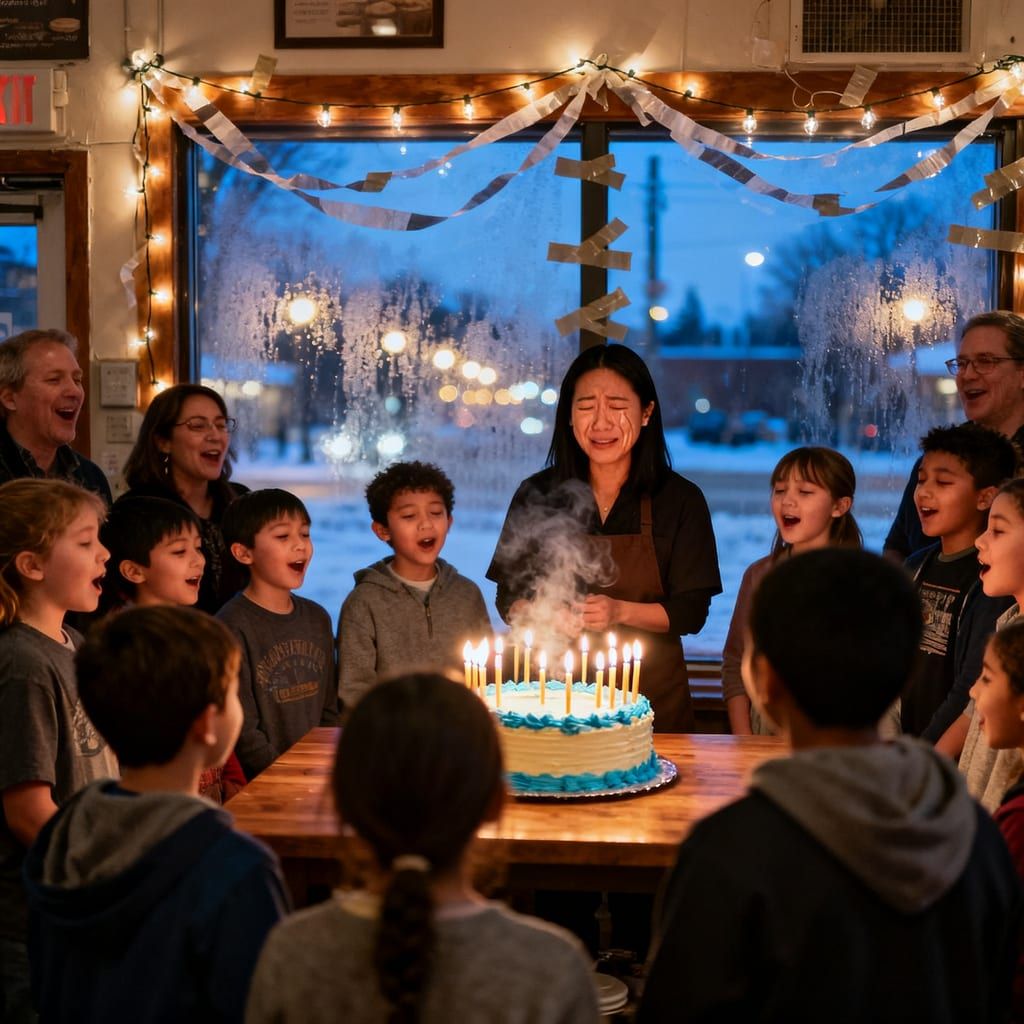
The chorus arrived in pieces. Someone hit play on a tinny phone speaker and then abandoned it as the room realized it didn't need background music. The song staggered into itself-sharp, soft, three different keys climbing the same hill. Names are cliffs; they took his together. "Dear Jonah," said in a dozen voices, his name extending into a shape he didn't recognize at first because he'd never heard it sung that way. His vision went glassy around the edges.
Zadie lifted the lid off the box. The cake was vanilla with sky-blue icing, the exact shade he'd carried outside two months before. His name sat in the center in careful loops, practiced but human-an EKG of a hand.
"We, um." Zadie glanced at the others and then back at him, the bravest cashier at the counter of an impossible purchase. "We pooled. Like, allowances. Chore money. Mr. Thomas did the delivery route. Mrs. Ibanez lent us her kitchen. I found your name in the donor list for-" She winced slightly, adjusting mid-sentence to spare him the full reveal. "I realized maybe no one did this. Not for you."
Jonah laughed, which came out as a choke. He put both hands flat on the counter because the floor had learned a trick where it tilted. "Why-" He swallowed. "Why blue?"
Zadie's smile crept slow and sideways. "Because sometimes you've been inside all day."
The small kids gathered near the edge of the table, eyes wide as ponds. One boy held a fistful of unlit candles, sticky with handling. "How many?" he whispered, urgent with rule-following.
"Just-" Jonah took the box into his arms. It was heavy the way good things are heavy. He set it down in the circle of their height.
"All," he said, which made the adults laugh, and then nod as if yes, exactly.
They pushed the candles in, a lopsided constellation. Twenty? Thirty? It didn't matter. Someone struck a match. The flames licked up in quick succession, making a crown out of heat and intention. The room glowed.
"Make a wish," said the smallest child, who had purple frosting on her sleeve from some other Sunday.
Jonah felt twelve, and eight, and maybe one. He counted the rhythm in his head the way he did when learning a new recipe's patience. He heard the song end and then begin again as someone came in late. He could have made a joke about the sprinkler system. He didn't.
"Ready?" Zadie asked, not in the way people ask children to perform but in the way friends ask each other at a cliff's edge.
He nodded. He let the candles burn a second longer, soaking up the warmth on his face, the smell of sugar going dark at the tips, the thready, mismatched sound of voices making room for his name. He filled his lungs, not with hesitance but with the air of a room that had adjusted to fit him.
He made a wish out loud because he finally understood how. "For more of this," he said, and then he blew.
The flames wavered together, a field under wind, then went out in a hush that left its own small echo. Smoke curled like question marks that didn't need answers. In the quiet after, someone clapped, which let everyone else off the hook. The noise rose and fell. He laughed properly this time, the kind that catches and rolls. Zadie slid a knife into his hand. He cut into his own sky and it didn't collapse; it yielded.
They ate standing up, with forks borrowed from the takeout drawer and paper plates caving in the middle. Crumbs found their ways to chins. Jonah learned names he'd spelled, watched them attach to moving mouths. A boy named Xavier held his slice with two hands like a sandwich and whispered, as if to the cake, "I wished for a dog." A girl he recognized from a photo-shy smile, unicorn shirt-said, "My brother wished for two dogs," and then elbowed him out of the way with practiced affection.
A foster dad asked about the secret to his buttercream. Jonah said, "Butter," and the dad laughed. "Huh. Guess we should've thought of that."
Zadie hovered beside him as the room thinned, her glance restless, protective. "We didn't, like, blow up your spot," she said, hands jammed in the front pocket of her hoodie. "I told people not to tag you."
"You coordinated a small army," he said. "You could run a country."
She shrugged a shoulder. "I can't even run win sprints. But-" She took a breath, the kind you take before you don't look away. "You gave us the words. That thing on the notes. We wanted to say it back."
He thought of the ledger he'd kept in his head, the one that could never close, numbers a blur of need and sugar. How he'd been stealing hours from the left side to feed the right, convinced that giving only deepened a debt. The room looked different now, not balanced exactly but whole-circles doubling back, lines meeting their own tails.
He washed the knife. He stacked plates. He let people press his shoulder in passing. Every now and then someone started humming the song again, and he didn't flinch.
After midnight, when the last of the balloons sagged and the radiator clicked in its sleep, he turned off the main lights. The bakery slid back into its pool of quiet. He reached for the matchbox.
He lit a single candle and set it on the clean stainless table. He leaned in-not to practice, not this time. He waited until he could feel the heat on his bottom lip. He inhaled. The air tasted like sugar and smoke and something else-something he'd baked but hadn't named.
Then he blew, soft, and the room, as if agreeing, went gently dark.
A daughter learns to read between the lines of a life split in two
Read more →
A fog-draped night, two souls found, and the quiet shape of a life
Read more →
Story audiobooks for children of all ages — a new one every day on Smarter Way Stories.