Two Houses and One Quiet Heart
A daughter learns to read between the lines of a life split in two
Read more →
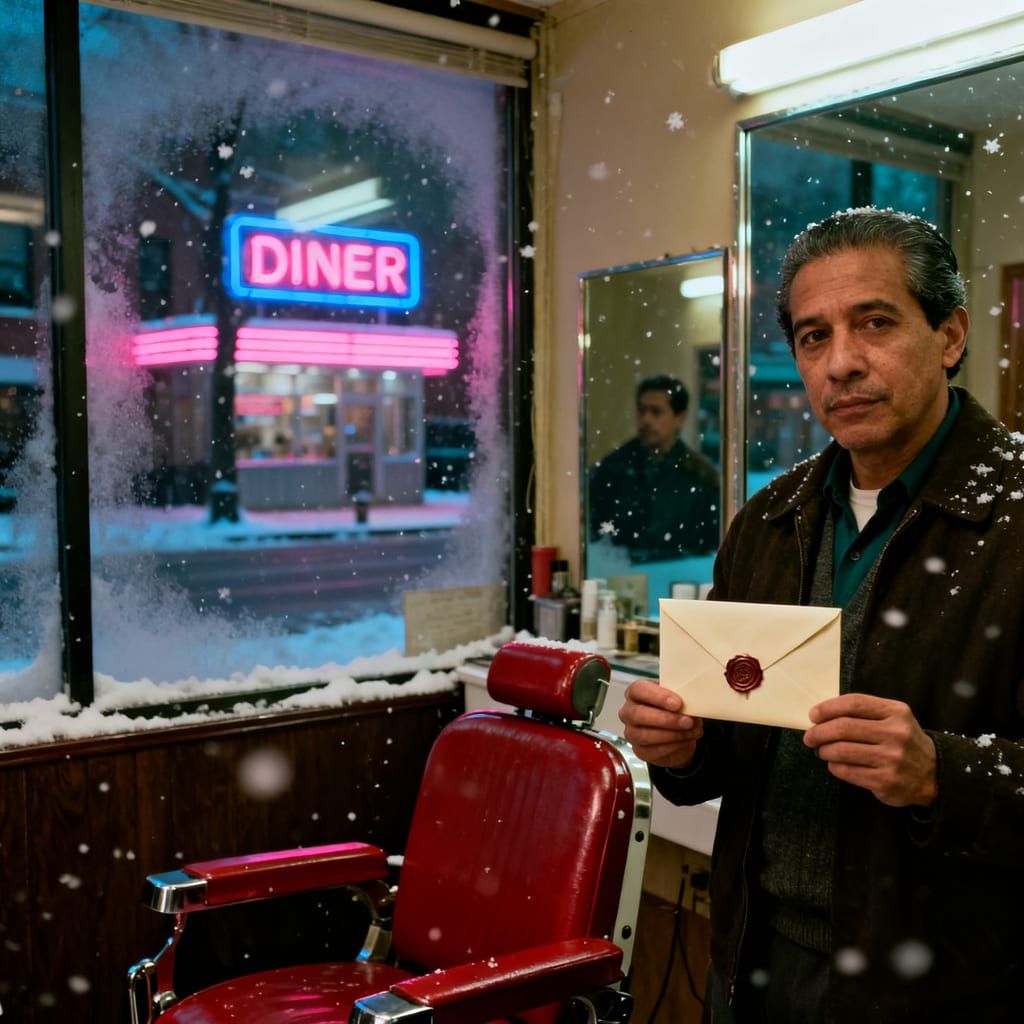
The man came in with rain stitched to his coat hem and turpentine ghosting off his hands.
Eli had just swept the last crescent of hair toward the dustpan when the bell chimed and the stranger-thin, hatless, pulse like a bird under the jaw-stepped over the black rubber mat and held out a sealed envelope as if it were a hot thing.
"Please," the man said. The window rattled with a bus screaming through a red light. "Keep this safe. Give it only to the person who asks for... August. After the first snowfall."
He did not offer a name. His eyes skimmed the rows of photos taped to the mirror-fades and line-ups, children in capes grinning with gummy teeth-and settled on Eli's face, waiting.
Eli took the envelope. It was heavier than it looked, wax seal blood-dark and crazed at the edges. "Most people ask for a two on the sides," he said, because jokes keep the room level. His heart studied the stranger like a second mirror.
"Barbers listen," the man said, voice thinning. "And you-" He lifted one paint-flecked finger. "You'll stay put."
He left to the scrape of the door, the bell coughing once. He was gone before his damp footmarks vanished.
Eli taped the envelope behind the long mirror where glass met wall, a sliver above the outlet where clippers drank all day. He slid the cape, he brushed necks with talc, he listened. The envelope rested there like an extra breath in the room.
When the landlord sold the building, he peeled it off carefully with painter's tape, pressed it to the new drywall at the shop around the corner. During the summer blackout, he tucked it into his drawer with the scissors wrapped like silver fish in chamois. After the break-in-register flipped, glass glittering like a spilled constellation-he got a cheap wall safe and laid the envelope inside, on a folded towel, as if providing a bed.
Seasons weren't a backdrop so much as a metronome. He learned the angle of the sun that made the chrome chair arms burn in July and the particular gray of February when flurries stuck to beards like lint. Babies who'd howled at the buzzer became boys comparing fades. Lydia stopped wearing her ring and brought her toddler in on Thursdays with animal crackers smearing the cape. Mr. Finn put his cane where the mop bucket went and talked about winters that had real snow, not this powdered-sugar business.
In the shop's nap-time hush-between a leave-in conditioner and a goodbye-Eli's gaze climbed to the corner where the envelope slept. Not once did he lift the flap. He tried not to let his mind write scripts. Every time, he failed a little. He pictured wills and apologies, a stack of old Polaroids, a single train ticket. Once, ambitiously, a key.
He told no one. Not even his sister, who had opinions the size of trains and a way of climbing into your business with love like a crowbar.
When customers asked what kept him here when everyone else was moving out past the last cheap stop, he'd nod at the mirror. "This is a view," he'd say. "You get attached."
The envelope yellowed. The wax frost-webbed. It became a fixture you no longer see until you do, the way you notice the clock only when you're late.
Eight winters later, the snow began like ash, light and undecided. It thickened toward evening until the street softened to a hush that was almost a kindness. Eli was turning the sign to CLOSED when the bell chimed and a girl blew in the way a flame darts sideways in a draft.
Paint held tight to her knuckles and along the cuticles, little commas of blue and umber. Her hair was pinned back the way you do when you work and forget to unwork later. She smelled faintly of wet wool and coffee gone cold.
"We're closing," Eli said, halfway, already reaching for the cape because sometimes the way a person enters the room tells you they need tending more than they need rules.
She sat. Her eyes were somewhere not in the shop, a long seeing. When he flicked the cape over her shoulders and the world narrowed to mirror and face, she said, very softly, "Is August ready?"
Eli's breath hitched hard enough to catch hair on his tongue. He didn't ask how she knew. He didn't ask who told her, or how the world had kept this appointment without him.
He wiped his hands, though they were already clean. He bent at the safe set low behind the chair and spun the dial, numbers remembered the way you remember the way someone laughs. The envelope lay inside, wax like an old bruise.
He brought it out two-handed, as if weight could shift unexpectedly. He looked at her in the mirror. She was looking at the envelope.
"I'm Eli," he said, because names do a small honest thing to a moment.
"Mara," she said. Her mouth pressed a note between her teeth as if tasting a sound. "Would you-" She glanced toward the window where the snow feathered the glass. "There's a diner. Across the street. He would have wanted a witness."
The diner had a row of booths that pretended at privacy and a curated indifference to the weather. They took a corner booth under a photograph of the Brooklyn Bridge in winter from a year it always seems to have been more itself.
Steam lifted from coffee and fogged the glass. Mara held the envelope like an animal that might startle.
"You held this for a long time," she said, not asking. A kind of respect made her voice round.
"Eight winters," Eli said. He didn't say he'd learned the hum of it in the room.
She slid a thumbnail under the wax, a careful tear. The seal gave with a small pop, a cherry pit freed from its grip. Paper sighed. She spread the sheets and read under her breath as if the words could be bruised.
Eli watched the way her face changed-a set of tiny storms-without reading the words themselves. He watched her eyes, how they softened and then didn't.
She reached one page toward him, not to give, but to share the scent of ink and time. "He signed everything he ever made with one word," she said. "AUGUST."
"The month?" Eli asked.
"The name." She smiled with half her mouth. "It wasn't his. It was his on walls."
On the paper, a hand that had known both spray can and brush had written dense and clear. Not apologies. Not quite. A confession that reached backward and then forward like a hand across a table.
He had taken the blame for a friend's theft-the way the friend's daughter's lungs had whistled, the way the rent had rotated like a red needle. A gallery backroom, a painting slid where it shouldn't be. August had stepped into the silhouette of guilt because he measured the rest of a life against a sentence and found the math intolerable.
The city had dutifully done what it does-turn. He vanished from walls, then from talk, and then from habit. Years brushed over the place where his name had been stenciled. He scraped meals together painting backdrops no one signed. He learned anonymity as a language.
A key fell from the last page and skated on the diner's slick table toward the ketchup. Mara caught it. Her breath made a cloud in the cold between them.
"Storage unit," she read. "Twenty-two B."
She turned the next page and the next. In the margins, ink leaned into intimacy. Why a barber. Why this barber. "Barbers," the line ran, "hold other people's faces and do not flinch. Their rooms are anchors in vanishing neighborhoods. They learn to keep, not spill."
Eli felt heat lift in his chest, an embarrassable tenderness, like someone had praised his handwriting when he had only been copying down what was already there.
Mara's eyes were bright and not empty. She swallowed. Her knuckles tightened on the key's little brightness.
"He was my father," she said, and now the word sat between the salt and napkin holder with a gravity its size didn't predict. "When I was fourteen I told him he made us a target. That every time I saw his name on a wall I saw trouble. He said he would disappear until his name couldn't poison us anymore."
Outside, the snow deepened until the street had no edges.
"He died in July," she said, the injustice almost funny-August missing his own month. "Hospice over the river. He told a social worker to send me the date of the first snowfall. To come here. To ask for August."
She looked at Eli, the way you look at someone who has accidentally witnessed a tender family grief and yet made it less alone. "He said to find the barber who stays."
Eli wrapped both hands around the coffee cup as if molding something to keep. He thought of all the sentences he'd stored in the shop's air that didn't belong to him. He thought of the envelope, quiet like a sleeping animal in a storm.
"I can come with you," he said. It was not a rescue. It was inventory. He had two hands and a van and a set of shoulders for lifting frames.
Mara nodded, the way you nod when a door opens in a room you didn't know had doors.
The storage facility had that anonymizing hum-fluorescents and distant wheels-and a caretaker who raised an eyebrow at the snow in their hair. Mara's key turned with a closet cough. The corrugated door rolled up like a breath held too long, then loosed.
Canvas smell met them-a vegetal rot of old turpentine and something like dust remembering rain. A thin lamp flickered as if deciding how much of this it wanted to see.
Rows of canvases leaned like people in conversation. Not just walls writ small but rooms the world had mislaid. Rivers with names only locals used, faces turned half away as if mid-thought. A corner of sky repeated in a dozen variations until it became a thesis on hope.
Mara stepped in and then stopped, because entering is also a reading. She reached out-the museum distance collapsing to daughter distance-and let two fingers hover a polite inch off the paint. Tears found her jaw line with a patience that made them seem less urgent and more inevitable.
"Not from loss," she said, as if telling the room, not Eli. "From the timing being... kind, just this once."
Eli leaned a shoulder to the cold metal of the door and let his breath fog. He recognized something of his own craft-the way the small accumulates into the whole. Clip by clip. Stroke by stroke. The heroics of repetition.
He helped Mara lift canvases, the old wood complaining amiably. They made stacks: things the world might be ready for, things that needed mending, things that were private. There were notebooks, too, spines cracked from being opened without theatre. Lists of colors in a hand that looked like it could have also done the books at a bodega-cerulean 3, raw sienna 1/2, midnight + milk.
At the bottom of a box, a tin held crisp bills-nothing to buy a view, something to buy time. Eli felt the oldest texture of trust roll through his fingers. Money marked for a future someone else would build.
They worked until their breath made long pewter ropes in the air. When they were done not-done, Mara sat on the concrete lip and dangled her feet like a child who's held something heavier than her age suggested.
"Why did he pick you?" she asked, not doubting, only assembling a story until it made sense even in the middle of the night.
Eli looked at his hands, at the faint pale marks from a lifetime of blades and hot combs, the crescent nicks that had sweetened and disappeared. He thought of the line in the margin about barbers and anchors. He thought of the thing that had lodged in him when he took the envelope-a weight that had been less paper than promise.
"Because I was here," he said, simple as that. "And I would still be."
Mara laughed, the kind that presses its palms to its mouth, and then lowered her hands. "That sounds like nothing until it's everything."
They locked the unit and stood for a minute under the awning while the snow recommitted itself to the idea. Eli could feel the day in his shoulders, the way work lives in the body longer than the calendar keeps it.
Back at the shop, he turned the key and clicked on the lights. The room flashed to its old self, all chrome and glass and the echo of a day's talk. The corner behind the mirror felt lighter by an ounce that had shaped his posture without him knowing.
He took the broom from its hook. The floor had gathered a last polite scatter of hair-the daily fossils of impatience, vanity, grief, and fresh starts. He swept. He always swept.
In the mirror, he saw Mara's reflection sitting where a thousand stories had opened and closed. She watched him with that attention that feels like respect.
"He was right about barbers," she said. "You hold faces and don't flinch."
Eli shrugged, a gesture that tried to hide pride and failed. "People come in already brave," he said. "I just make sure they leave looking like it."
They smiled into the same mirror, two weathered strangers stitched for a night to a shared inheritance.
When she left, snow loosened her hair. She waved with the hand that held the key, small bright thing against the dark. Eli watched her cross to the train, the street briefly erasing her footprints and then, because this is how it goes, accepting them again.
He turned the sign to CLOSED and stood in the new quiet, ears ringing with the day. The mirror held his face the way it had always held it: familiarly, without verdict. Behind it, there was space where the envelope had been-a vacancy that wasn't loss so much as room.
Outside, the neighborhood took back its night. Within the hum of the shop's old neon, Eli felt the secret unwind into air, not gone, only shared.
He swept one last time, even though there was almost nothing left.
Snow ticked at the glass like a clock he could finally hear.

A daughter learns to read between the lines of a life split in two
Read more →
A fog-draped night, two souls found, and the quiet shape of a life
Read more →
Story audiobooks for children of all ages — a new one every day on Smarter Way Stories.