Two Houses and One Quiet Heart
A daughter learns to read between the lines of a life split in two
Read more →
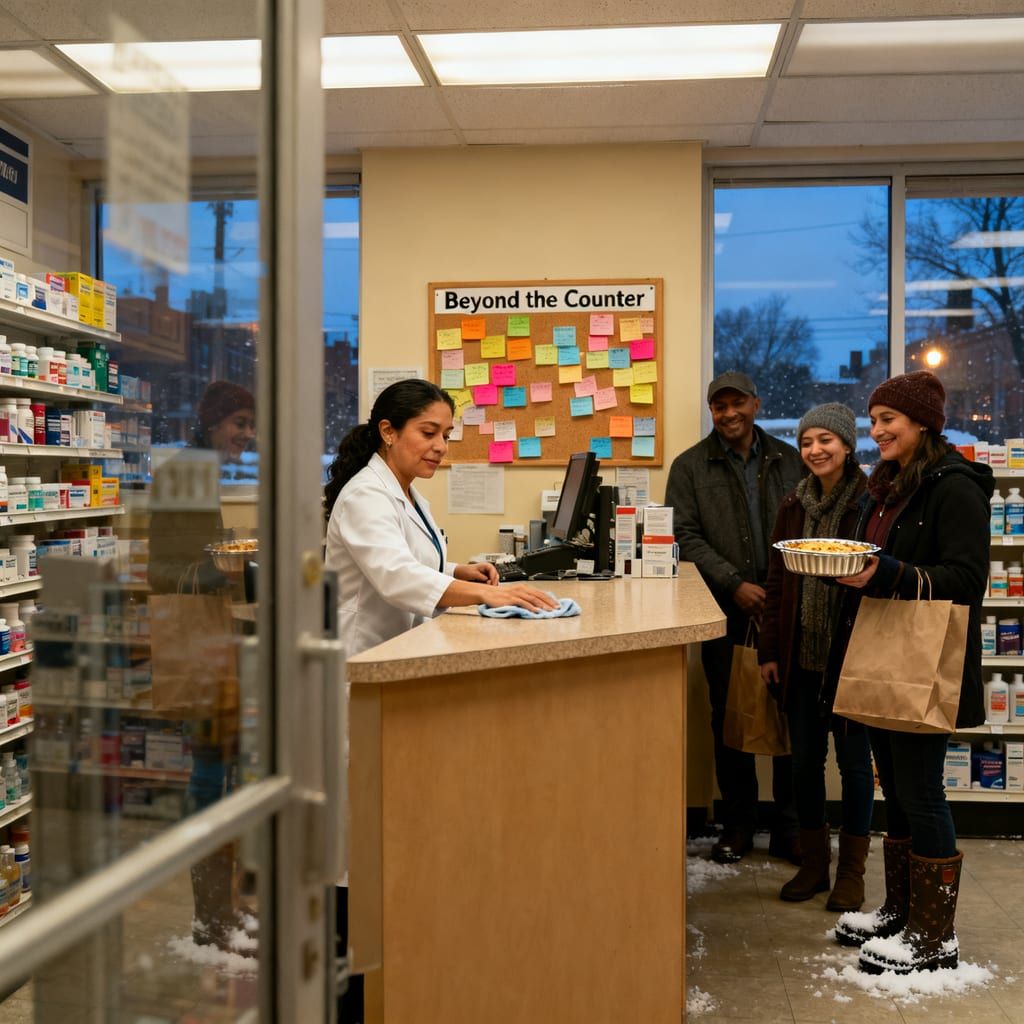
At 9 a.m., the pharmacy opens like a throat clearing-metal gate rattling up, heating vents coughing warm breath, the bell above the door finding its voice. Lena Alvarez slides into her place behind the counter, palms a sleeve of child-proof caps, and starts her day in clicks.
She has learned to count by sound. The pill counter's soft metronome, the terminal's small sigh as it approves a card, the way a name-Rah-ma-rez-bounces on the air before someone claims it. What she really tallies, though, are the pauses. The split-second before I'm fine. The breath held as a card slides again. The flinch when a name lands like a pebble on water, sending circles wider than anyone sees.
Mr. Dorsey arrives in a cap that reads CROSSWORD KING, his laugh snagging on the edges. He used to collect his antidepressants like clockwork, tapping the white bottle twice before tucking it into his coat. Now he rolls by the sleep aids, fingers hesitating on a blue box that promises stars.
"Night's gone long," he says, eyes somewhere near the anti-itch creams.
Lena doesn't cross lines. She makes bridges.
She slips a folded, generic sleep hygiene printout into his paper bag-dim lights, no screens, same bedtime-and adds in her small, reliable hand: If the nights feel heavier than the days, we can talk. She meets his eyes just long enough to let the ink carry what her job description doesn't.
Mrs. Kline comes next, exact change in a coin purse stitched with violets. Her blood pressure meds are lined up at home like choir members. Lately, her pickups stretch thin, days two-stepping into weeks. Her gaze keeps catching on the price display as if it were a cliff's edge.
"Sometimes," Lena says, sliding a manufacturer assistance form under the glass, circling the number with steady loops, "some hoops are worth asking for help jumping through."
Mrs. Kline nods without looking up, a single sigh escaping as if it had waited seasons.
A young teacher with a voice rasped down to a whisper appears monthly, scarf doubled tight, chalk-dust air clinging to her like perfume. Lena slides a bag of lemon tea across the counter with instructions in warm Sharpie scrawl, not medical advice, just human ones: Steep. Breathe. Repeat. The teacher's smile is small and bright, a candle cupped against wind.
One afternoon, a man she hasn't seen before plants both palms on the counter as if steadying a ship. Salt from winter streets crusts his cuffs; tattoos braid up his forearms and vanish under a hoodie dark with thawed snow.
"Something to stop thinking," he says, not quite looking at her. The cash register's green light flickers on his jaw.
Lena hears the tremor. It's in the way his eyes keep counting some invisible shelf.
"For thoughts," she says, keeping her voice the even hum of a heater, "the aisle is people, not pills." She turns and points to the corkboard on the wall: a quilt of flyers for free clinics, a support group at the church on Fifteenth, Thursday-night meetings in the library's quiet room. She doesn't push a brochure across the counter. She leaves the space open between them.
He shakes his head, mouth crooked like a half-finished line. "Thanks anyway."
"Anytime," she says, and means it.
He leaves salt footprints that glitter as they dry.
Weeks layer like sweaters. The windows hold a permanent frost bloom. Lena knows down to the minute when the streetlights will shrug on.
Then her mother's mouth pulls to one side over breakfast, words stumbling the way a record needle skitters across a groove. The ambulance is a red parenthesis. The hospital smells like lemon and metal. Stroke, the neurologist says. The word sits too heavy and too light all at once.
Lena prints her schedule and tapes it on the refrigerator beside a magneted photo of a beach they have not seen in ten years. She keeps her shift because insurance is a promise she can't afford to test and because the pharmacy is a routine with edges she knows by touch. But her hands forget the rhythm. She is short on sleep, short on meals, long on fear.
She forgets her lunch. She rings up an item twice. Names scatter like birds when she calls them; she has to coax each one back, once, twice, before it lands. The light above the consultation window flickers and seems to keep time with her pulse.
On a Wednesday, Mr. Dorsey leaves a crossword folded open to nineteen-down, highlighted in yellow. The clue reads Anchor. The answer box is too long for a word. He slides it across the counter without comment, the corners gone soft from pocket travel.
On Thursday, Mrs. Kline returns at a strangely early hour with a tin of soup heavy and warm. "Staff tasting," she says, cheeks pinked by wind. "Strictly for, you know, morale."
On Friday afternoon, the teacher plucks a box of chamomile instead of lemon, flips the bag so Lena can see the handwritten Sharpie she's added: Steep. Breathe. Repeat. The ink is thicker, the letters rounder, but the instruction feels like an echo handed back.
Saturday brings the delivery driver. Theo, she learns when the manifest prints his name. He waits at the counter, a small envelope hanging from his fingers.
"I didn't take the brochure," he says, not quite meeting her eyes. "I went anyway." He slides the envelope over. Inside is a neatly folded receipt from a counseling center, the ink still new-ink blue. A note, small as a fortune slip: Aisle found. Thanks for pointing.
Lena feels something uncoil in her chest, not relief, precisely, but a loosening, as if a knot has discovered it doesn't have to be perfect to be strong.
The days start to rearrange themselves around small emergencies. A frantic mother arrives with a child wheezing thin as paper and a prescription clutched like a passport. The insurance company refuses the early refill; the words print out cold on white paper. Lena talks her through the appeal steps-who to call, what to say-her voice a thread steady enough to guide by. Then she walks around the counter the way she seldom does and offers a chair, a glass of water that is exactly as cold as it should be. She sits on the arm of no one but her own resolve until the breath in the child's chest finds room again.
The card reader beeps decline for Mrs. Kline on a day the sky has gone gunmetal and the floor smells faintly of wet wool. Before Lena can say, We'll figure it out, a younger customer-a man in a paint-splattered jacket-slides his card, eyes on the receipt as if it were just any paper. He disappears before thanks can stick.
Lena realizes, with the quiet shock of someone who has been staring at a painting and suddenly sees the bird she'd missed, that the pharmacy has not become kinder. It has become visible. People are noticing what she has been noticing in them. The act is not hers alone; it is a language anyone can learn if they commit to listening for the pauses.
So she mounts a new corkboard by the register, right where the eye goes while waiting for a total. She prints a paper heading in block letters: BEYOND THE COUNTER. Underneath, she leaves pushpins and blank index cards like snow waiting for first tracks.
The first note reads: Ride to late appointments, Tuesdays after six. The second: Spare stroller, gently used. Then: Twenty minutes of Spanish translation-call Nora. A retired barber offers haircuts before interviews. Someone simply writes: Porch. Listening chair. Hot coffee after eight.
The notes multiply. They flutter when the door opens, soft prescriptions for needs that have no brand name, that never came in a foil pack. People linger longer by the board than by the candy aisle. Sometimes a hand reaches up to add, sometimes to tear a small slip along the perforation and tuck it into a pocket like hope.
On a Tuesday much like other Tuesdays-street salt crusting tires, daylight already thinning at five-Lena calls a name and finds herself called instead.
"Lena," a voice says. Then another. Then a small chorus.
She looks up from the scanner's red line and sees them gathered awkwardly in the waiting area: Mr. Dorsey with his cap off, smoothing his hair. Mrs. Kline stiff with a secret. The young teacher. Theo, hood pulled low, a smile flickering in the beard he's let grow. Behind them, two faces Lena knows only by medication and co-pay but not by name.
"We brought dinner," Mrs. Kline announces, lifting a casserole like a trophy. "Strictly for, you know, morale." Laughter scatters, easy and uncoordinated.
Someone's holding a loaf of bread wrapped in a dish towel. Someone else has a paper bag that clinks softly-ginger ale, Lena guesses; she is always guessing right about small things. There's a stack of paper plates, a roll of plastic forks, a Tupperware army.
The pharmacist-John, kind, perpetually overwhelmed-looks up from the compounding bench, eyes rounding like someone who has discovered his store has a living room.
"I-" Lena starts, and then doesn't. Words, for once in this fluorescent square, can rest.
They stand in the space between the counters, between the signs that say No Checks and Please Have ID Ready. Someone leans across and flips the little sign to Consult; Back Soon though no one leaves.
Theo clears his throat. "You know how you said the aisle for thoughts is people?" He juts his chin at the corkboard, stuffed now with cards and hope. "Turns out, yeah. You're an aisle, too."
Lena feels it then, the collection of pauses she has kept like rainwater for years finally poured back into her. She thinks of her mother's hand on hers in the hospital, squeezing three times the way they used to on walks: I. Love. You. She thinks of refills and their predictable mercy, of labels that say Take with food, Avoid sunlight, Do not operate heavy machinery-as if anyone gets to avoid weight these days.
She cries, which is less dramatic than she feared and more human than she expected. The tears are ordinary; the relief is not. She laughs through them when Mr. Dorsey produces a folded crossword and asks casually, "Eleven-across: eight letters for stays steady despite all evidence?"
"Alvarez?" someone offers to general delight.
They eat in the break between calls. They bring plates to the back for the pharmacist and the cashier from greeting cards. A teenager offers to sweep. The bell above the door keeps chattering. Life, unspooling, doesn't stop because kindness paused it. Maybe the trick is learning to do both.
Later, Lena wipes the counter with a lemon-scented cloth, the sharpness of the smell familiar enough to be home. The casserole dish goes back with Mrs. Kline's careful hands. The notes on the corkboard have shifted as if moved by wind.
She flips the sign back to Open and calls the next name on the label, her voice steady.
Locking up that night, Lena lingers at the glass, watching the reflection of the pharmacy's aisles line up with the street's. Bottles and boxes make their quiet city. Beyond them, the real one waits with bus stops and brownstones, with a library's light on in a second-floor window.
She understands something so simple it keeps needing to be relearned: refills are sometimes measured in people. Not counted, exactly-counting implies an end-but felt in how a room shifts when someone says your name. She presses her palm briefly to the glass. Outside, her breath feathers, then clears.
Tomorrow the caps will click again, the pill counter will keep time, and names will land like stones and like seeds. And in the pauses-the places no medicine reaches-there will be a chair, a card, a casserole, a chorus.
She tucks the key in her pocket and heads toward the hospital, toward the bed where her mother sleeps. The night isn't lighter. It is simply shared.

A daughter learns to read between the lines of a life split in two
Read more →
A fog-draped night, two souls found, and the quiet shape of a life
Read more →
Story audiobooks for children of all ages — a new one every day on Smarter Way Stories.