Two Houses and One Quiet Heart
A daughter learns to read between the lines of a life split in two
Read more →
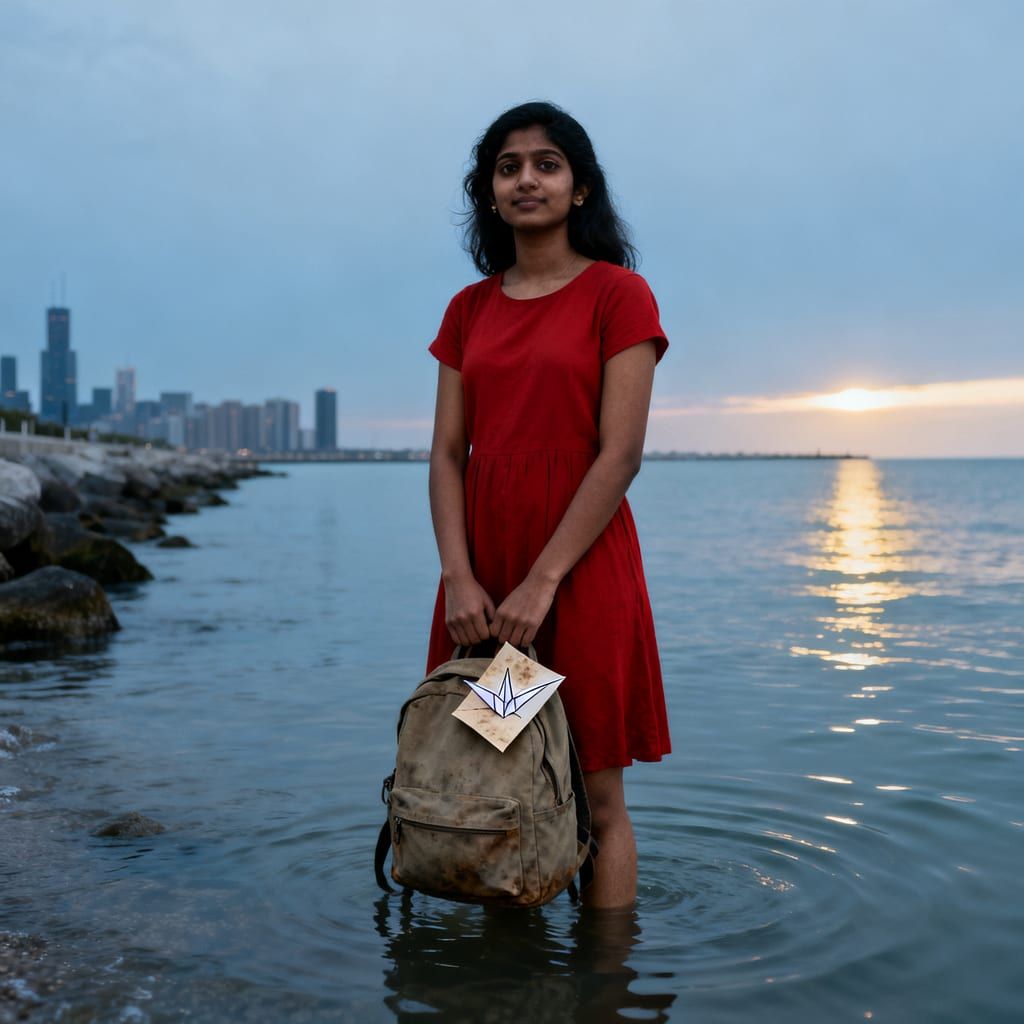
The backpack smells like sun-warmed canvas and old library books. I bought it because it fit-my shoulders, my budget, the idea that a different bag might carry me into different days.
At home, I shake it out over my rug. A folded sheet slips from the inner pocket and flutters onto my ankle like a moth.
The paper is soft with handling, coffee smeared into one corner like a thumbprint. Across the top, in pressed, deliberate handwriting: When I'm Brave Again. Below it, a ladder of small intentions: swim at sunrise. Sing in public. Apologize to D.K. Plant a fig tree. Wear the red dress. Say my name out loud. At the bottom, a doodle of a paper crane, wings open, the lines dark as if the pen had to insist.
There's a phone number half torn away. It feels like standing on a train platform reading only half of a map.
I mean to post about it. I really do. Then I close my laptop and put on water for tea and forget until the kettle screams.
The days since the layoff stack like plates I never bothered to dry. Half-finished to-dos: clean out the spice cabinet, update my portfolio, call my mother back, start running again, maybe. I walk past my own projects like a museum visitor with low blood sugar.
Every time I pass the paper, left on the counter by the fruit bowl, I feel watched by a future that doesn't belong to me. When I'm brave again. Again implies a return. I can't tell if I've ever been there.
A week in, the guilt makes its way under my shirt collar. I set my alarm for 5:12, an unholy hour. If I can't find the owner yet, maybe I can keep one promise breathing on their behalf.
Dawn at Montrose Harbor has the color of cold glass. Gulls skim the water like phrases that don't need punctuation. The city behind me is a patient machine.
There's no ceremony to it-just jeans rolled, socks stuffed in my shoes, and the stupid bravery of stepping into Lake Michigan in October. The shock is immediate, bite-to-bone. I gasp loudly enough to startle an old man with a thermos.
Ridiculous. Electrified. My laugh lifts out of me and floats over the water, thin and real. I don't go deep. I go enough.
After, fingers shaking, I prop my phone on my shoe and record a small video, the wind in my hair, breath making clouds. I hold up the list. "Does anyone recognize this handwriting?" I ask, voice gravel-thin. "I found it in a thrift store backpack in Logan Square. I... borrowed an item. If it's yours, if it's your sister's or your friend's, I want to give it back. Or finish it with you."
I post it while my toes are still numb.
The internet, which usually feels like a warehouse with too many fluorescent lights, answers with something warmer. A florist DM's me a photo of wild asters. Pickup only-no payment-if I'm doing the "give these away to people who look like they need them" square that someone in the comments swears they see between lines if you tilt your head.
I didn't, but now I do. I scribble it into the margin with a borrowed pen.
I borrow a ukulele from my neighbor Matteo, who claims it's mostly decorative. On the Blue Line, I stand near the doors and sing the only three chords I can remember from YouTube. My voice wobbles. The train sways. A teenage girl across the car films me, then, when I falter, holds up her phone with the lyrics to Stand By Me. I catch the words and carry them two more stops. No one claps. An older woman in a navy coat nods once in that quiet way that feels bigger than applause.
At a corner bodega on Diversey with sun-faded cereal boxes, I buy a fig sapling, a thin green wand in a black pot that looks like a promise written too small. The owner-Rafi, according to his name tag-watches me hover by the register. "If I buy this," I ask, "and I don't have a yard... would you let me plant it out front? In the triangle of dirt by the stop sign?"
He tilts his head. "How tall does it get?"
"Tall enough to make shade for people waiting on bad news?" I don't know why I say that until I hear it.
He rubs his jaw, then shrugs. "Bring a trowel."
We plant it in the brown cutout the city forgot. Dirt under my nails feels like a password. A woman waiting for the bus asks what it is, and when I tell her, she says, "Figs take time," and smiles as if that's a blessing.
At the open mic at the cafe on Fullerton, the barista slides a mic toward me like a dare. The red dress from my closet-the one I bought for a promotion party that never happened-feels like an apology I finally mail. My palms sweat. The room smells like espresso and fallen leaves tracked in on boots. I sing a verse and stop. "I'm not very good," I confess into the mic, "but someone asked me to be brave."
Someone in the dark says, "Us too."
I don't expect the DM from a man named Leon, because every story I tell myself stars me as someone left on read. His message is precise, spare. I think I know that handwriting. Come by tomorrow? He sends the address of a cafe on Milwaukee where the tables wobble unless you hunt for the right chair.
Leon has kind eyes bracketed by laugh lines that look earned. He unfolds the list and glances down the columns the way you'd read an old song. "Alma," he says, the name shaped like a memory he doesn't want to bite.
"Do you know her?" I ask.
"Knew," he says, then corrects himself. "Know. She was in almost every morning last winter. Talked about waiting to feel brave enough to be herself. Then one day in March she was gone. I thought she'd moved." He looks up. "I called a couple mutuals. She didn't move."
He texts while I'm still holding my coffee. Two minutes later: She's at a hospice in Uptown. He looks at me like a door we didn't expect to be unlocked.
Hospice is a human word for something unspeakable. The building is brick, flowers painting themselves against a small courtyard, a place where family members take calls they pretend not to take.
Alma S. is younger than I pictured and older in the eyes. Her hair has grown back into soft fuzz. The room is sunlit in the careful way nurses are good at. A paper crane dangles from the curtain rod, folded with sure fingers.
Leon introduces me. "This is Nora," he says, gentle. "She found your list."
Alma's smile lands like a feather. "You," she breathes, as if naming me summons courage. Her hand is warm, then tired. I sit, my heart behaving badly in my chest.
I pull out my phone and hand it to her like a reliquary. Video after video, photo after photo-my wet hair against a gray lake, a blurry train window reflecting a small person with a big instrument; the fig sapling in its new square of city; an elderly man taking a wildflower as if it were the first good thing he'd been handed all week; me in the red dress, voice shaking, eyes bright.
She laughs softly at the ukulele. She presses her knuckles to her mouth when the fig tree appears on the screen. When I show her the first flurry of the season-we all got it wrong, early November, delicate as breath-she reaches toward the pixels as if the snow could land on her palm.
My voice drops to a whisper. "I couldn't find 'D.K.' yet," I say. "I'm looking."
Her eyes flick to the last line, bottom right, where the words sit a little apart: Help a stranger be brave. No check beside it.
"I left it," she says. Her voice is paper-thin, but the words are heavy. "The backpack. I left it at the thrift place. My mom was a nurse. When she couldn't carry courage, she left it in drawers. On buses. In her coat pockets. Breadcrumbs, she'd call them." Alma smiles. "I thought-if I couldn't finish, maybe the list could find someone who would. Or someone who needed a start."
Leon wipes at his cheek and pretends it's a sneeze.
"D.K. is my brother," she adds after a moment. "Daniel Kim. We stopped talking. Not because of anything worth the years it cost."
My fingers are already moving. City directories, old comments on old photos, a friend of a friend. Courage is less a leap than a series of reachable rungs.
He meets me outside the hospice in a blue jacket his mother probably bought him on sale. He's taller than Alma, same mouth. He carries flowers wrapped in bodega paper, the stems wet against the sleeve where he holds them too tight.
"I wasn't..." He stops. "I didn't know how to come back."
"Me neither," I say, and buzz him in.
What belongs to them belongs to them. I wait in the hallway by a cart of towels and a bulletin board with volunteers' names pinned like stars. Their voices rise and fall, and sometimes stop. Once, Alma laughs so hard I hear the nurse laugh too. I watch the afternoon tilt itself into something golden and then gray.
When the door opens again, Daniel's face is wet. He mouths thank you like a prayer he hasn't said in a while.
I go in last. Alma's hand finds mine without looking. "You kept the promises," she says. "And then you made more."
I want to argue, to point to all the ways I didn't. I nod instead.
Light thins. Breath does what breath does. The paper crane turns slightly in whatever breeze you believe in.
In the evening, the city is a constellation of kitchens. I sit at my kitchen table with the list and a pen that writes too dark.
Every square we filled together I mark with a small check. My handwriting looks like someone learning to be certain.
At the bottom, under the crane, I draw one more square. Start your own. I write my name beside it, small but there.
The backpack hangs on its hook by the door like a throat clearing. In the morning, I'll post the last video, Alma's hand on mine and Daniel's flowers in the corner of the frame. I won't say goodbye. I'll say: If you have a square, I'll stand beside you at the first flurry. I'll sing the wrong chords and bring the trowel.
Outside my window, the fig sapling at the bodega is only a line against the night, but I can feel it doing what it knows-rooting without spectacle, converting light I can't even see yet into something sweet.
I fold the list along its old creases. I put it back in the backpack's inner pocket where I found it, words pressing into canvas, staying put even when the train sways.
I turn off the kitchen light and catch my reflection-a woman in a red dress she keeps by the door now, just in case-and in the dark, my name sounds like someone I'm almost ready to introduce.
A daughter learns to read between the lines of a life split in two
Read more →
A fog-draped night, two souls found, and the quiet shape of a life
Read more →
Story audiobooks for children of all ages — a new one every day on Smarter Way Stories.