The Reason the Records Stayed Silent
How a sealed birth became a quiet covenant
Read more →
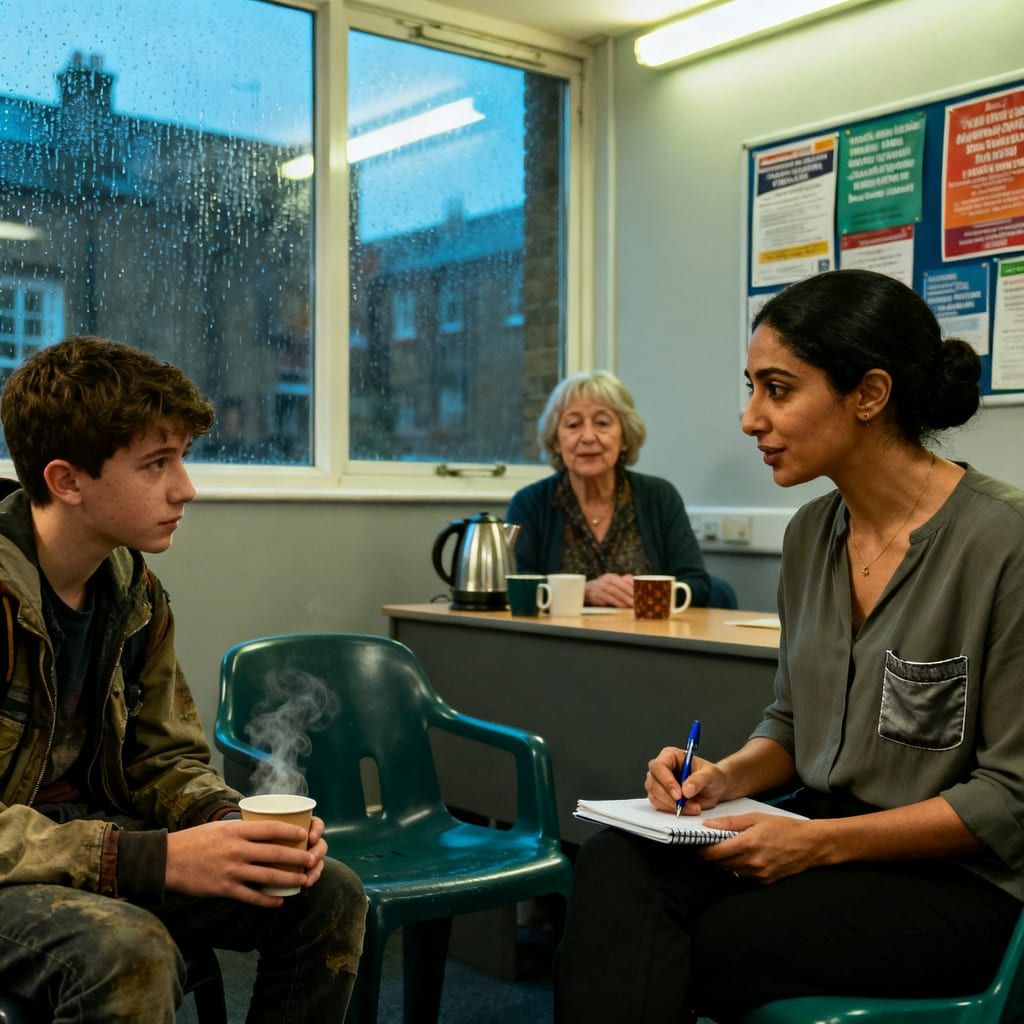
By noon the clinic had taken on the weather of its lights-perpetual, humming, a thin film of white over everything. The waiting room breathed in languages the posters couldn't speak. A printer coughed. A baby argued with the dust.
Leila moved through it with the clipped grace of someone used to folding herself small. Tablet tucked against her hip, pocket notebook in her back pocket, she slipped from one cramped interview room to the next, translating nights on rubber boats, names learned by the sound of a mother's panic, the pale of a checkpoint morning where boots had brands, not faces.
"Ready?" the caseworker asked, not looking up. He had a pen he liked to twirl. It clicked too often.
Leila took the chair against the wall, facing the boy who had signed in as Sami and then smiled at the floor as if the floor had saved him once. Seventeen, if the birth year was true. Shoulders like brackets. An apple bruise fading at the cheekbone.
"We'll need a simple account," the caseworker said, pen poised. "Dates, routes, reasons for fear."
Leila turned to Sami in his dialect, whose nasal vowels nested in her mouth like birds trying to stay. She felt the familiar cleave inside-her voice splitting into mine and yours, the bridge she could walk blindfolded.
He told it the way they all learned to tell it. Short. Spare. But grief kept catching the hem of his words, a snag he could not smooth. He said the men at the second border called them "cargo" and laughed at the rain. He named the boat like a person already dead. He described the night they drew lots for the corner with least wind and ended up deciding to stay awake in shifts, to keep each other.
And then he used it-a word Leila couldn't place. It came quick, hot, like a match struck on bone.
He saw her pause. "You don't say this?" he asked softly, trying on standard terms that didn't fit. He cupped his hands, as if holding breath he could pass to another.
"What does it mean-literally?" Leila asked, the pen in her pocket suddenly heavy.
He searched for a way to say it. "To keep one another alive by trading names in the dark," he whispered. "Because names are the only heat you can give without losing any."
The room had no space for it. The caseworker cleared his throat. Leila felt the border of the form, its edges too hard for anything that rounded like that.
She wrote, in careful English: We took turns saying who we were so we would not disappear. She added the word-phonetic, bracketed-in the margin of her notebook. Underlined twice.
Between interviews, Soraya appeared in the doorway with a tray of tea and a look that folded people back into themselves. Older than Leila by a generation, her hands bore the memory of warm weights-babies, pots, shoulders. She hummed when air got tight, a song that seemed to wipe a window open in the room.
"Drink," Soraya told Sami, nudging the cup nearer. "Your tongue will move better if it believes you will live."
Leila smiled despite herself. "Where is that from?" she asked, nodding toward the melody that threaded through Soraya's breath.
Soraya's eyes flicked up, surprised. "From everywhere and nowhere," she said. "Women carry it in their sleeves. We lend it when there is night." She turned back to Sami, and the tune rose again, a hammock of sound.
The caseworker's pen had stopped clicking.
At the bus stop after her shift, London pressed its cheek against the glass and fogged it. A siren smeared the street. Leila's hands ached. She took out her notebook, flipped to the back. Untranslatables lived there-salted syllables, thumb-worn, words that did not survive shipping without bruising.
She wrote Sami's word again, tasting it without saying it. She could not place the root. Not Levantine. Not even the coastal dialects her father's friends bantered in across barbecues. Something older, or younger, or simply from a place her map didn't label.
And Soraya's tune-why had it sat so primly on Leila's ribs, like a guest who recognized the house?
The bus came stuttering, somebody's music bleeding through headphones. Leila rode standing, forehead to window, the city a filmstrip of wet light.
Later, in the small geometry of her kitchen, she boiled pasta and threw in a handful of spinach and ate leaning against the counter. The window showed her a dark square of neighbor brick. She dialed her mother before she could talk herself away from it.
"Mama," she said when the line clicked open. "Do you know a song-like this?" And she hummed, feeling foolish, her voice thin in the tile echo.
There was a silence at the other end, a shift of breath Leila had learned to read as memory's hand on a shoulder.
"Who sang that to you?" her mother asked finally.
"An older woman at work. Soraya. It's... it felt like I knew it."
Her mother's laugh was not a laugh. "Your teta sang that when you were born, habibti, until the nurses told her to stop, that it was keeping the other babies awake. She said, 'Good. Then they will not be alone.'"
Leila braced one palm against the counter, the night changing temperature around her. "Teta?" Her grandmother who died when Leila was six, who lived in photos with sepia corners and a scarf tied like a promise.
"She came through the old city in seventy-six," her mother said, the story unspooling as if it had been waiting behind a door with its coat on. "There was a winter. Papers borrowed, not quite right. A church with bad heating. A choir of women-different countries, some with the headscarves, some with the hairspray-you would have liked them. They traded lullabies so that when words failed at the clinic, or on the bus, or in the shop, they still had something to give one another. Your teta had a word for it. I have not thought of it in years."
Leila's heart hit the table once and kept going. "A word?"
"From her village. Your jiddo said it meant-what?-to feed each other's breath with names. In the nights when men with boots had their own names-their mothers did name them, you know-but would not use them. So the women used theirs. Passed them around like coals that didn't burn the hands." Her mother's voice thinned. "We didn't talk, then, about how we got here. It felt safer to become only weather reports and groceries and school forms. Maybe we were wrong."
Leila closed her eyes. On the counter, the pasta cooled, a small defeat she did not mind. The word was the same shape as Sami's. The same heat. It lived inside that old refrain, tucked like a note in a seam.
She saw it then-the line she had convinced herself was professionalism, the careful invisibility, the way she calibrated voice and volume to leave no trace. It had not been only ethics. It had been inheritance. Someone else's fear, stitched snugly into the way she wore her work.
The next morning the clinic breathed the same thin light. Soraya waved from the kettle, a question in her eyes that Leila answered with a nod. The caseworker-different one, younger, hair like a punctuation mark-sat across from Sami with the file open like a mouth.
"We'll need a simple account," he said. It was always a prayer and a threat.
Leila felt the word humming in her pocket, alive now not just from yesterday but from a winter before she was born. When Sami's voice trembled toward it, she did not steer him around. She did not sand the corner down.
He said the syllables. Leila let them land. Then she translated-not the nearest true, but the widest. "We kept each other alive by saying our names in the dark."
The caseworker looked up as if the ceiling had shifted. The pen stayed still. Outside, a siren went by and did not enter the room.
Sami exhaled. His shoulders unbracketed by a whisper. He added, in his own tongue, "We didn't know if the sea knew us. So we told it."
Leila carried that, too. Into English. Clean, not diluted. The air held it without breaking.
Small things began to change, the way cities do-at the edges, overnight. A volunteer wrote "Story Circle" on a flyer in three scripts, and Soraya tacked it up crooked on purpose so people would have to stop and fix it, which meant they would have to read it. Thursday evenings, the plastic chairs made a ring and voices took turns opening the door.
They spoke first in their own languages, eyes finding the floor or the sky, then in the borrowed English that made the room nod. "Say it both ways," Soraya told them, beaming. "Let us hear its original clothes before you put on the clinic jacket." Someone snorted. Someone cried quietly and then laughed.
A man who had only ever offered bullet points breathed in paragraphs. A woman once listed as "housewife" recounted delivering twins during a curfew and the way snow takes applause when it falls on tin. The caseworkers-some skeptical, some arterial with paperwork-sat and learned how to hold a story without poking holes for data to drain.
Leila moved through it without attempting to disappear. Her notes grew messier, wilder. She put quotation marks around the words that needed protection. She began to say the untranslatables out loud before she translated them, letting their sound be a kind of visa.
Her mother came once, coat still damp with rain, and found a chair at the edge, hands folded in her lap like a prayer she didn't yet know how to say. When Soraya hummed, her mother hummed too. Across the circle, Sami's mouth tilted up, the kind of smile that happens only when someone recognizes shore.
On a Friday that smelled like photocopiers and wet wool, Sami's file moved to the pile that meant: more likely than not. The ink looked almost gentle. He brought pastries nobody could pronounce and placed the box like an offering on the table between the stapler and a jar of pens that never worked.
"Thank you," he told the room, and the thank-you braided three languages together. "For not shortening me."
Leila met his eyes. "For teaching us your word." She didn't say which word. They both knew.
Later, on her way out, the rain had paused to breathe. London made itself new on the pavement-reflections of buses, a pigeon with one foot, a child counting puddles as if they were coins. Leila waited at the crossing and took out her notebook. On the back page, underlined words gathered like people at a border. She added another: not a mystic syllable this time, but a phrase, plain as bread.
We kept each other alive by saying our names in the dark.
She could hear it set to her grandmother's song, names passed hand to hand without burning, the chorus widening to include whoever had come in from weather they did not choose. She could hear it in Soraya's hum, in her mother's stitched-quiet, in the caseworker's pen momentarily, blessedly still.
When the light changed, Leila stepped off the curb, feeling the bridge and not minding that she could see it. Traffic moved like a tide that had learned manners. Somewhere a bus driver sang to himself and missed the note but didn't care.
She walked toward the clinic-toward the room where tonight the chairs would make a circle and stories would carry their own heat-and thought: some roads don't end. They only widen enough for us to walk side by side, trading names against the dark until morning makes itself known.
Story audiobooks for children of all ages — a new one every day on Smarter Way Stories.