Two Houses and One Quiet Heart
A daughter learns to read between the lines of a life split in two
Read more →
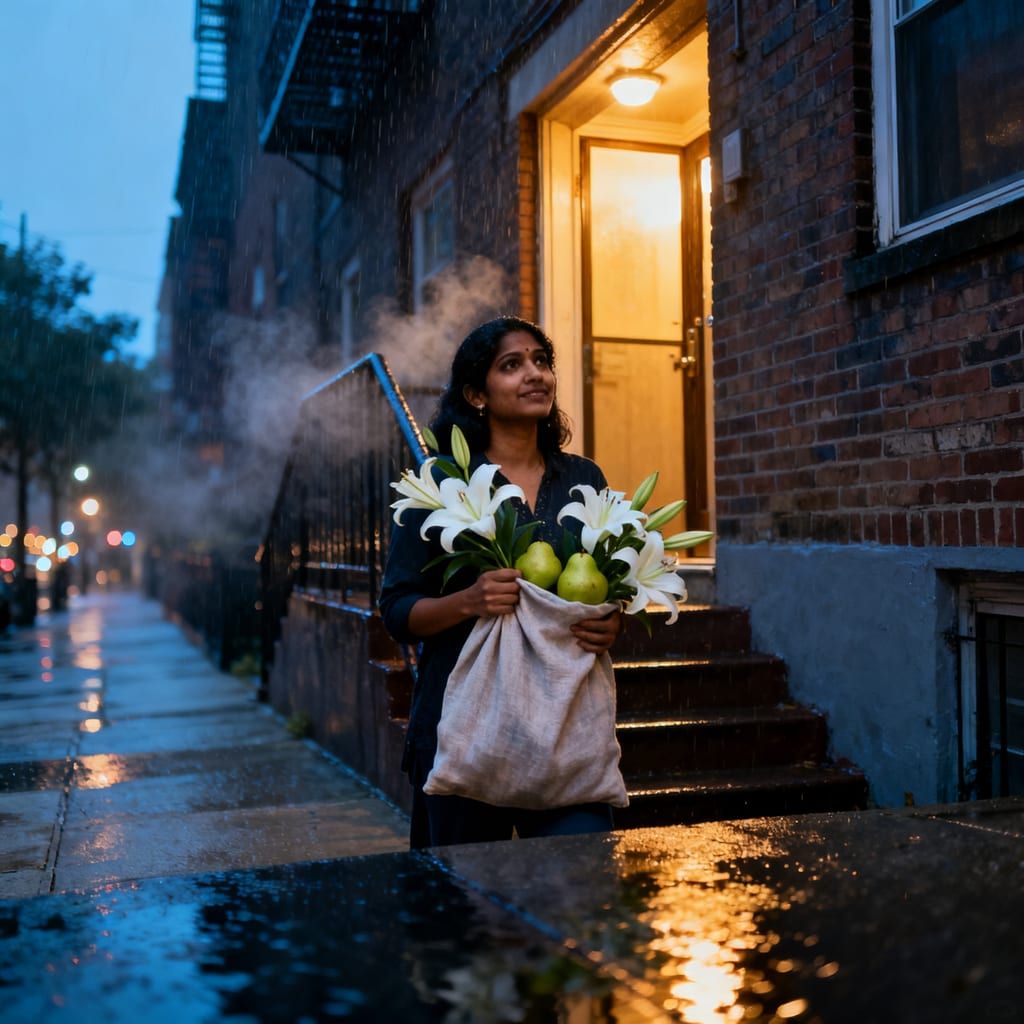
The rain makes a sound like frying-soft hiss, steady sizzle-on the supermarket awning. I push a cart with one wobbly wheel through the puddled entry and find it there, caught in the wire grid by a bead of water: a grocery list in looping blue ink, the paper swollen at the edges, the top corner smudged into a watery bruise.
Cilantro (the kind that smells like rain). Three green pears (firm, but not stubborn). Jasmine rice (the one in the cloth bag). Lilies.
Above that: ERNESTO - Apt 3B. The name glows through the smudge like a shiplight under fog.
I look around as if the owner might step out of an aisle any second, sheepish and relieved. The carts squeal, the automatic doors flap, people shake off umbrellas and keep moving. The rain keeps cooking on the awning. No one reaches for the paper in my hand.
I haven't cooked for anyone in months. My dinners have been microwaved miso soup, spooned over a laptop glow. My company went remote in February, and the days smear-Slack pings, tabs, more pings, a silence that clicks like a metronome in the walls. I tell myself it's fine. That's the lie that gets me to bedtime.
I hold the list. I imagine a kitchen that knows these specifics by heart.
I circle back through the produce. I lift bunches of cilantro, nose almost in the leaves. One smells like a parking lot after sun, another like nothing at all, and then-there it is-the one that opens a small green door in the air. I smell rain in it, the iron and tender green of it. Pears: I thumb along their shoulders, stop shy of bruising. I find the jasmine rice I've always skipped because the paper sack seems like an indulgence; I pick the lilies with their long green ribs, buds closed like kept secrets.
At the register, the cashier raises her eyebrows at my armful of Thursday night plans and says, "Someone's got a date with a vase."
"Something like that," I say, and pay. Outside, the rain has paused and the city smells rinsed, like the inside of a seashell.
Queens is a patchwork wet and reflective, neon and eavestrough drip. My rideshare slips off the bridge and into streets that tighten and soften by turn, a geography of stoops and laundromats and a woman on a balcony shaking out a towel as if shaking off a thought.
The address is a modest brick walk-up with a maple tree out front shedding tiny helicopters into the gutter. I climb past doors chalked with children's drawings and an apartment that smells like cumin and long stories. The lilies knock their stems against my wrist like impatient horses.
I knock. The door opens on the chain and a man in his late sixties-hair mostly silver, eyebrows assertive-peers out. His shirt is buttoned wrong at the throat.
"Yes?" he says, wary but not unfriendly.
I hold up the list, which has become a little flag of my own foolishness. "I found this at the Fairway on Steinway. I think it's yours. I-" I lift the bags, ridiculous, damp at the bottom from the walk. "I brought the things."
His face sorts through surprise, skepticism, a flicker of hope that he tries to press flat. He removes the chain. Up close, his eyes are brown with the depth of old lacquer and a little red at the rims.
"You... brought my groceries?" he asks, tasting the strangeness of the sentence.
"I don't know why. It just seemed-" I stop. There's no good end to that thought.
He looks at the lilies and something loosens in his shoulders. "I am Ernesto. Please-come in for a minute."
The apartment is small and attentive. The floors glow with the quiet shine of hands, the walls are a museum of kitchens: photos of people leaning into one another over birthday cakes, women with their arms in pots up to the elbow, a boy with missing front teeth holding a wooden spoon like a baton.
The air smells like old wood and something faintly lemon. A radio hums in the other room-fuzzy jazz like rain wearing shoes.
"My wife is resting," Ernesto says. "Sometimes the afternoons are... confusing. She stays close." He rubs a thumb along the edge of the list as if testing its truth. "I dropped this? Ay, dios. I wrote it and then the phone-then Pilar called me, and-" He shakes his head. "You are very kind."
I put the bags on the counter. He watches me unpack like a man watching a bridge being built plank by plank. When I lift the rice, he makes a small, involuntary sound.
"This one," he says, touching the cloth bag. "The one that makes the house smell like my mother's kitchen when I was little and the window was open and the rain came in anyway."
"Do you want me to...?" I lift the cilantro, water beading on my wrist. "We could make something."
He hesitates, proud and tired in equal measure. "Only if you have time," he says, which we both understand means, If you can bear it.
I spread the cilantro in the sink and let the cold water run over it, brightening the leaves until the whole kitchen smells like a clean storm. Ernesto finds a pot, a knife with the handle taped. He hands me pears like he's handing me delicate news.
"Pilar likes them a little hard," he says. "They remind her to wait."
"For what?"
He smiles, rueful. "For the taste to come."
The rice goes into the pot with a rinse, the water turning cloudy with history. I slice pears thin-little moons, little boats. The radio leans into a saxophone. Ernesto moves carefully, checking the flame twice, the way people do when the stakes are unnameable.
"You wrote the pears should be firm, but not stubborn," I say. "That's a good line."
He huffs a laugh. "It is not poetry. It is engineering." He taps his forehead, gently. "When her memory began..." His hand describes the loosening of a knot. "We found that some things bring her back for a moment, like putting your hand on a rail in a dark stairwell. Thursday nights were always when we went to the market. So now-cilantro, because she says it smells like the rain on the stoop in Guayaquil. Pears because she would test them and declare them rude or polite." He gestures at the lilies on the table, their long throats inching toward bloom. "And lilies because they do not whisper. They insist."
I think of my own Thursdays, indistinguishable from their neighbors. I think of all the small brave things I haven't done because no one is watching.
"Does it help?" I ask.
"Sometimes," he says, not pretending. "But sometimes is a country you learn to love."
He looks at my face a moment, as if checking whether I am the kind of person who can hold a sentence like that without dropping it.
The steam climbs the kitchen and softens the edges of everything. I set the lilies in a chipped blue vase and feel like I am bringing a lighthouse indoors. Ernesto pinches the cilantro and tears it by hand over the pot, green confetti, scent rising like a memory shouted up the stairs.
A shuffle of slippers in the hall. We look up.
She appears in the doorway, hair in soft grey plumes, cardigan buttoned with one missed and none of it detracting from her neatness. Her eyes are two different kinds of weather. She stops when she sees the lilies. The room narrows to the stem of her breath.
"Oh," she says, voice small and clear. She steps forward, lifts the vase with both hands. Brings the lilies to her face and inhales, slow and ceremonial.
Her eyelids drop. In the quiet, the pot gives a wet sigh. She opens her eyes and turns toward Ernesto, and for an instant, the confusion slides from her face as if a hand had wiped the fog from a mirror.
"Ernesto," she says, the name soft and whole in her mouth. "You... you got the good ones." The way she says it is the way a door says Home when the key turns.
Ernesto's hands go to his face. He does not cry. He just stands there, as if a weight has flown off one shoulder and landed for a second on the other in recognition.
"Yes, mi amor," he says, steady. "We got the good ones."
He introduces me. Pilar's gaze slips across my face like a polite visitor scanning a painting they don't understand. Then she smiles, impulse or reflex, who could say, and rests her palm on the table as if feeling the grain of the years.
We eat the soup in small bowls. The jasmine rice hums under the pears' quiet sweetness; the cilantro is a green exclamation. Ernesto tells a story about their first apartment and a stove that needed to be lit with a match, how he scorched his eyebrows and she laughed for three days. Pilar laughs now too, briefly, a blossom open and closed.
"The windows were always stuck," she says, almost to herself. "And you would thump them with your hand."
"Yes," Ernesto says, voice breaking into a smile. "Yes, exactly."
For ten minutes, we sit in a room where time behaves.
After, Ernesto washes the bowls though I protest. He moves in the rhythm of a life he refuses to give up. He dries his hands and tucks a spare cloth bag into mine-the same kind that held the rice. The logo is faded, the handles soft with use.
"Keep it," he says, when I try to refuse. "To remember that sometimes a list is not only a list."
Pilar touches the lilies each time she passes them, as if petting a cat.
At the door, Ernesto holds my gaze with a frankness I have rarely found in a day. "You were part of our Thursday," he says. "You may think it was nothing. But it is the kind of nothing that holds the world together."
On the stairs, the building seems to breathe. The rain has returned, a light wash against the windows. Outside, the maple has flung its helicopters everywhere. They congregate in little armies along the curb.
In the rideshare back, my phone lights my hands ghostly blue. I copy the list, thumb moving, letters making tracks:
Cilantro (the kind that smells like rain). Three green pears (firm, but not stubborn). Jasmine rice (the one in the cloth bag). Lilies.
I add two items that have no aisle.
Noticing.
Showing up.
I tuck the cloth bag by my desk when I get home, where I will see it the next morning when I open my laptop to a day I might choose to make less silent.
Thursday comes around anyway. The week turns like a page. I close my computer at six with a firmness that surprises me and walk out into a city rinsed in a new kind of rain.
I don't bring a list. My feet learn a route. At the corner stand, I pick lilies with their green fists ready to open. The vendor nods, the way someone nods to a regular in the first chapter of becoming one.
I climb the familiar stairs. The helicopters are dry now, light as words you haven't said yet. I knock. The chain slides. Ernesto opens the door with his eyebrows already surprised upward.
I hold up the lilies. "The good ones," I say.
He laughs, a sound that makes room for itself in the hall. He waves me in. From the kitchen comes the first clean cut of cilantro in water, and for a moment the whole building smells like rain exactly where you need it.
I step inside.
And somehow, from that small door, the apartment-with its old wood shine and its museum of kitchens and its insistence on Thursdays-feels like a map I have decided to follow.

A daughter learns to read between the lines of a life split in two
Read more →
A fog-draped night, two souls found, and the quiet shape of a life
Read more →
Story audiobooks for children of all ages — a new one every day on Smarter Way Stories.