Two Houses and One Quiet Heart
A daughter learns to read between the lines of a life split in two
Read more →
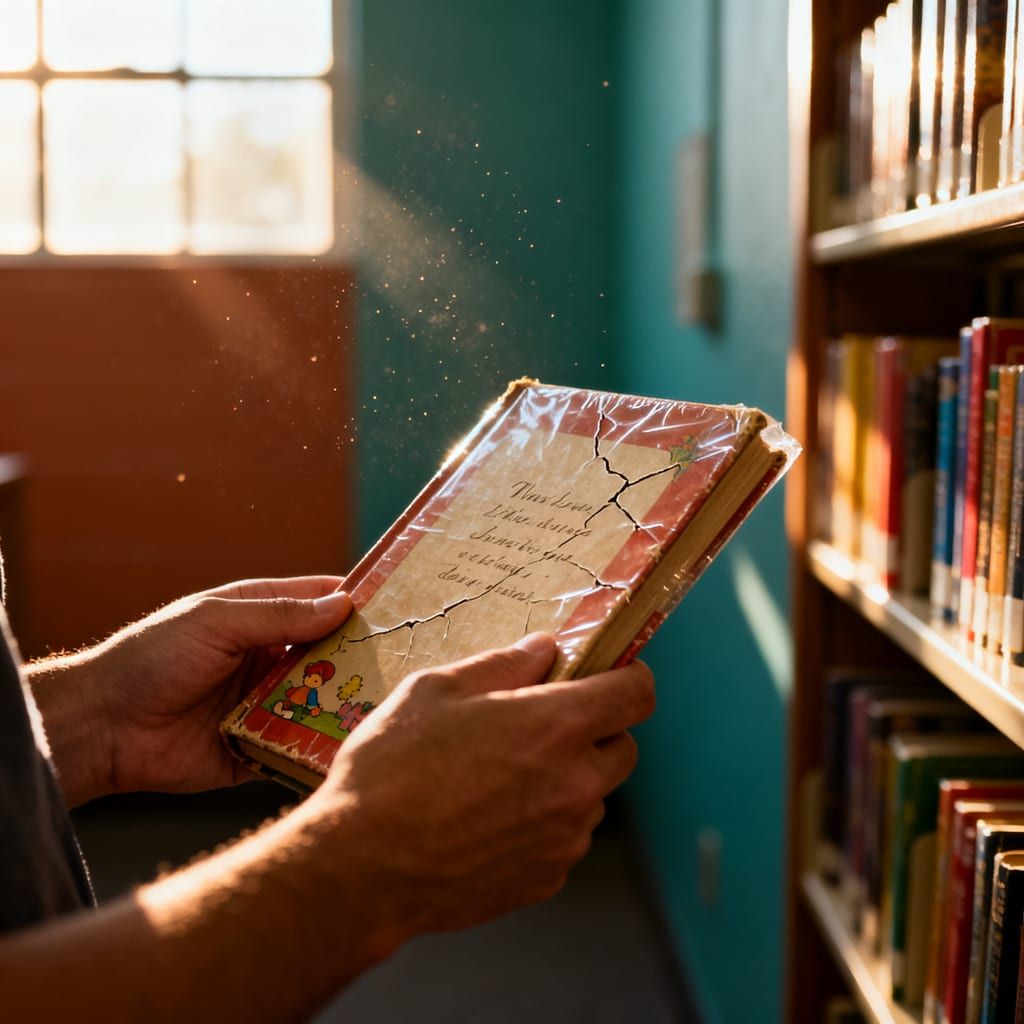
The old branch on the Southside still smelled like pencil shavings and lemon cleaner, like binding glue softening in the heat. Lena walked in stripped down to the rhythm she'd learned here as a kid-quiet feet, eyes up, mouth closed-even though she was thirty-three now and wore a blazer that made strangers ask her opinion about fonts.
She had come back to help her mother sort casseroles of memory into boxes: church programs her mother couldn't throw away, a drawer of rubber bands that had outlived the newspapers they'd hugged. She needed air. The library was muscle memory, a place that had held her steady before she knew what steady meant.
The children's section overflowed with covers that had learned a new grammar of color since she was small, but the low shelf by the back window was exactly the same-the one you had to kneel to see properly. Dust moats floated through a column of afternoon light. The hum of the vent had a tired rattle, like an old man clearing his throat.
Her hand found it without looking: the fat paperback with the moon on the cover, still wrapped in that cloudy protective jacket that never quite lay flat. The plastic was cracked at the corners, like river ice in a shallow winter. She slid a finger under the jacket the way she had as a child, testing the lip where the glue loosened.
She opened to the back cover. Some hinge in her chest remembered before her eyes did. Etched into the cardboard, crooked and furious as a secret scratched into skin, was a sentence she knew in her bones: "You are allowed to leave and you are allowed to stay. -L.O., 1999."
Beneath it, careful and faint, a reply: "I stayed. It was hard. I'm proud of you. -M., 2001."
Heat flushed her neck. L.O.-her initials, thirteen years old, the summer the air in their house felt like it carried knives. She could hear doors slamming-their cheap, hollow ones that made a sound like a coughing animal-her mother's voice sharpened to a point, her father's silence like a third participant pressing the walls inward.
M. Who was M.? Her heart offered and withdrew guesses so fast it felt like a trick. Mario from ninth grade? Mrs. Maldonado? Someone else she'd wanted to save? She pressed the book to her chest and sat on the carpet where her knees remembered the scratch of synthetic fibers. The present thinned enough for the past to breathe in it.
"Can I help you find something?" The voice was gentle, a soft knock. The clerk at the desk couldn't have been more than twenty, hair in a coil piled high, a chipped enamel pin that read ASK ME ABOUT FINE FORGIVENESS.
"I think I already found it," Lena said, turning the book so the girl could see. "Do you know who keeps track of... of things like this?"
The clerk winced at the carved letters. "We don't, uh, encourage... but Miss Marin might remember. She retired last year-children's librarian forever, basically. Lives over at San Juan Gardens. I can call?"
"Please," Lena said, too quickly. "If she's up for company."
They walked in the late sun under the jacaranda that never used to be there, its purple blossoms like dropped handkerchiefs. The senior complex smelled of laundry powder and coffee. In the lobby, a television murmured a game show to no one. A woman with pale-blue hair and a walker with tennis balls for feet directed them down the hall like a traffic cop.
Miss Marin opened her door to a drift of cool air and a smile that made the years between now and then fold like a map. Her hair was white, her eyebrows still fierce.
"My favorite aisle prowler," she said to Lena, as if no time had passed. "You grew into those eyes." Then, to the clerk: "You've fetched me trouble on a Sunday?"
"We found something in a book," Lena said, holding it up, feeling sheepish and electrified at once. "From a long time ago."
Miss Marin adjusted her glasses, the old-lady kind on a chain. She ran a thumb over the plastic, the way you do with a scar you've learned to accept. Her mouth tightened. "I scolded the child who did this," she said softly. "Then I kept the book near me for weeks and didn't know why."
She nodded them inside. The small apartment was tidy in the way of people who have learned that objects can be loud. A plant hunched in a bright corner. On the table sat a shoebox with a rubber band around it, because of course there was a shoebox.
"I used to save what the books brought home," she said, easing the band off. "Grocery lists, detention slips, a love note that started with 'yo' and ended with a cloud of perfume." Papers whispered as she parted them. She pulled out a piece of ruled notebook paper, edges frilled where it had been torn from a spiral.
In pencil, each letter pressed like it might fail: You are allowed to leave and you are allowed to stay. Under it, a name cramped into the bottom corner: Miguel O.
The room tilted. Not M as in Mario. Not Mrs. Maldonado. Miguel as in the hands that smelled like soap and engine grease. Miguel as in Papi. The man whose English had hung around their house like thin curtains that never quite closed.
"He came to the night ESL," Miss Marin said, her voice the soft kind you use at a bedside. "Always right from work. He checked out the same children's books his daughter took. He said they were easier to understand together." She held the paper as if it might quiver free. "One night he showed me that carving in the book and asked if it was wrong to answer a child he didn't know. 'It felt like she wrote to me,' he said. I told him he shouldn't write in the book. I gave him this instead." She tapped the page. "He practiced every letter. He asked if the girl was okay."
"Did you tell him?" Lena's voice came out thinner than she meant.
"I didn't know," Miss Marin said. "I kept the note. I don't know why. Maybe I was waiting."
Lena held the paper and felt heat and cold at once, like when you open an oven and the kitchen air tries to run out of itself. Her anger-the long, smooth stone she'd carried, warmed by her hand until she forgot it had an edge-shifted. It didn't vanish. It turned to something with texture and air in it. He saw me. In the most sideways way. He saw me.
Back outside, the jacaranda bells clung to their stems, too purple to be real. The sky leaned toward evening the way a body leans toward a chair. Lena sat on the curb and pulled her phone from her pocket.
She had his number like you keep a bandage in a wallet-old, sticky on the edges, never used. She typed and erased twice. Then: "Did you ever write in a library book? L.O."
Three dots. Gone. Three dots again. She realized she was holding her breath like a child playing dead in a pool.
Her phone rang. The name-Miguel O.-lit a line across the glass.
"Hi," she said, and it came out like she'd run a mile.
"Lena?" His voice was older, a gravel road now, cautious. "Mija?"
"I found something," she said. "At the library. The moon book."
Silence, close enough to hear his breath. Then: "I saw what you wrote, once. Long time. I-I write back. I should not write in book. The lady said. I write on paper." His syllables were careful, as always, as if the language might break and cut him.
"Was that you?" she asked, though she knew. "The M?"
"Yes," he said. A rustle, as if he were turning his cap in his hands the way he always did when he didn't know where to put his eyes. "I stay. It was hard. I wanted-" He stopped. "I wanted to tell you I see you. I did not know how. Your mamá... we-" He let the air swallow the rest.
She closed her eyes. The curb pressed a thin line into the back of her calf. "I was so mad," she said. "For a long time."
"I know," he said simply. "I am sorry."
They met the next day at the library because it felt like a fair witness. The automatic doors sighed them in. The hum of the vent greeted them like a long, unexciting friend.
He looked thinner, the way men get when their labor leaves them. The brim of his cap threw a small harbor of shadow over his eyes. He stood in the aisle, hands at his sides as if they might be taken.
"Hi, Papi," she said, and hugged him before she could think better of it. He startled, then folded in like someone dropping into a chair after standing too long.
"I am proud," he said into her hair. "Even if far." He pulled back and tried to find the rest of the sentence. "I didn't know the right talking. I try with working. I think working is the word. But maybe not."
"It was a word," she said, and felt something let go of its fist in her chest. "It wasn't the only one."
They stood with the book between them like a small country, both citizens and neither. Nearby, a boy tugged his mother's sleeve and whispered, "Look at this one, with the truck." Life continued its quiet, thudding proof all around them.
Miss Marin appeared as if summoned by need. "I've been thinking," she said, setting a clear plastic stand on the counter like a cake display. Inside, a card read, in block letters: NOTES FOR THE NEXT READER. Beside it, a small stack of index cards and a dull pencil in a jar that had once held pickles.
"We can't carve into the books," she said, and raised an eyebrow at Lena, who felt a blush heat her neck. "But we can make room for what the books pull out of us."
People paused. A woman in scrubs wrote, after a long stillness, "It's okay to ask for the good shift." A teenager with chipped black nail polish printed, "You don't have to be interesting to be worth loving." A man in a work shirt wrote slow, careful letters that left tiny moons where the pencil bit the paper: "Learn one new word. Use it on yourself."
Lena didn't write yet. She lifted the old book gently, peeled off the crackled plastic with the librarian's blessing, and slid on a new jacket that lay smooth as a new sheet on a made bed. She slipped a pocket card inside the back cover and wrote, in ink that didn't shout: "For whoever needs this next: You're allowed to leave. You're allowed to stay. Either way, you belong."
Her father stood by the display, watching people write as if they were making fire. He touched the glass once, the way you touch a picture you're not supposed to touch. "I write too?" he asked.
"Of course," Lena said. She handed him a card. He bent over it, shoulders tense in the old way. He wrote slowly, silently pronouncing each shape with his mouth. When he was done, he didn't show her. He slipped it quietly under the others, a tile in a mosaic no one would ever finish.
They walked out into the evening. The heat had softened its hand. Someone in the parking lot practiced accordion, the melody turning familiar and then new again.
"Do you want to see the house?" she asked. "Before we pack the last box?"
He considered. His face went through the old seasons-careful, worried, willing. "Yes," he said. "If you are there."
She laughed, surprised by the lightness in it. "I'll be there."
Back in the children's aisle, a girl in purple sneakers knelt where Lena had knelt and pulled the moon book from the shelf. The plastic whispered. She turned it over, thumbed the pocket card. Her lips moved as she read. She traced the letters through the jacket with one finger and didn't know she was doing it. She looked up at her mother and said, "Can we take this one?"
They checked it out and left their fingerprints pale in the dust that would settle again by morning. The display by the desk waited with its small pile of messages for whoever needed them next. The hum of the vent held steady. Outside, jacaranda blossoms fell and kept falling, making a soft mess of the concrete-the kind you step through without looking down, the kind you carry away on your shoes without knowing, leaving a faint trail behind you.

A daughter learns to read between the lines of a life split in two
Read more →
A fog-draped night, two souls found, and the quiet shape of a life
Read more →
Story audiobooks for children of all ages — a new one every day on Smarter Way Stories.