We Move Slow Enough to Stay
On a hospital rooftop, a class learns a new kind of balance
Read more →
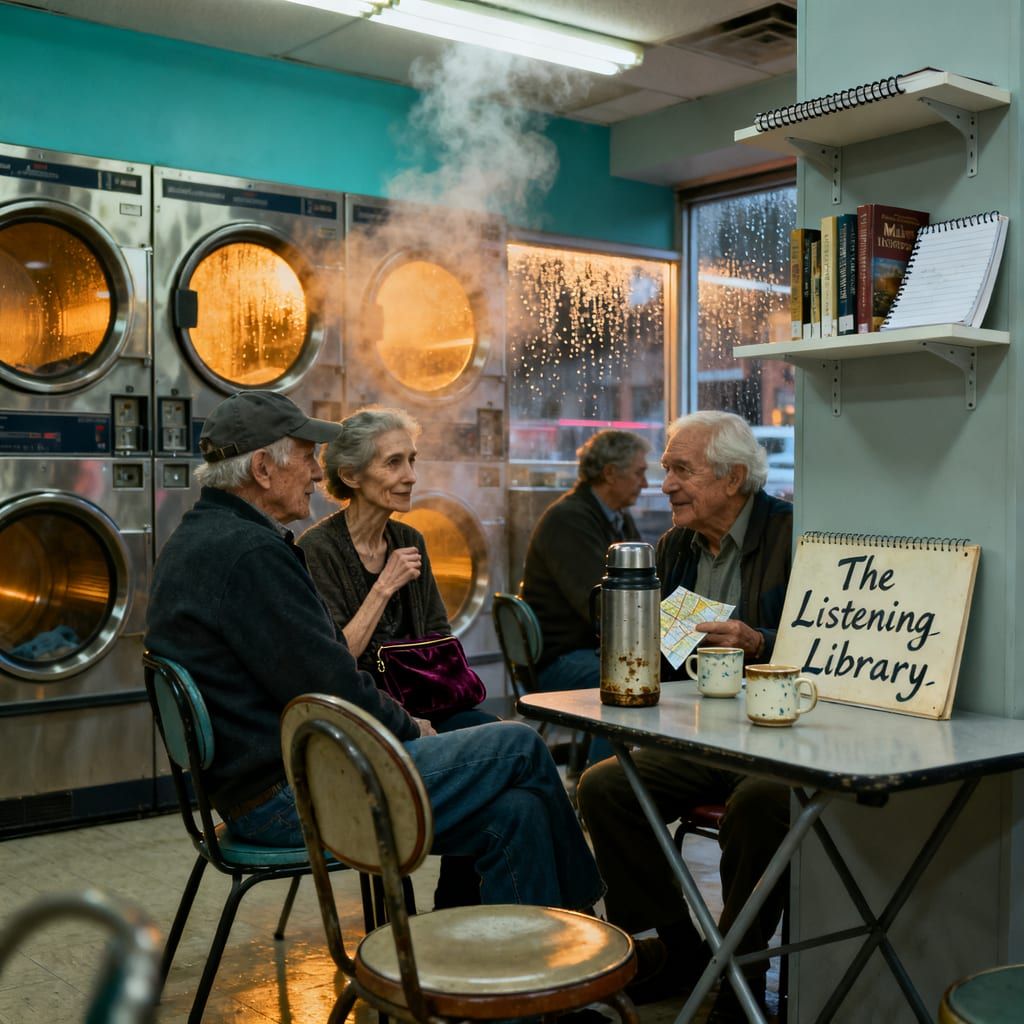
The dryers on Willow Street made a low ocean, a steady hush that smoothed the edges of everyone inside. Socks orbited in glass portholes. A woman read a grocery circular twice. Two old men traded one chair back and forth like a hot skillet so neither had to stand too long.
On a Tuesday when the city felt like a room with every door closed, Nila taped a sheet of printer paper to the bulletin board between lost-dog photos and a Spanish tutor's tear-off tabs. Conversation Circle-Thursdays, free tea, no small talk required, she had typed in Calibri at 1:13 a.m. Her hands had trembled a little not from nerves but from too much cold pizza and the blue light of a laptop she couldn't stop opening.
She pressed the tape hard and made herself look at it. You'll get the bonus, she thought. You'll log the hours, you'll get the payout, and next quarter you can say you tried.
A sock thumped the glass. Someone coughed. Nothing changed. The washers kept their private tides.
The first Thursday, Nila arrived too early with a thermos of mint tea and a cardboard box of ceramic mugs she'd collected from thrift stores, each with a chipped lip like an old story. She set them on a folding table by the singles machine and laid out index cards she'd cut the night before. Her questions sat like face-down birds.
Three people came. Arturo, who wore a cap that once might have said HEAVEN'S SIGNS but now only read HEAVEN, and moved like paint still drying. Esther, thin as a bookmark with a velvet drawstring bag she kept in her lap like a small sleeping animal. And a former mail carrier who refused to sit until he'd done two slow circuits of the room as if reading routes off the tile.
"Tea?" Nila asked.
Arturo stared at the thermos. "Is it free if I like you?"
"It's free if you like tea," she said, and something in his mouth softened.
They tried to talk. The laundromat hummed and the air filled the space words might. Esther sipped then placed her mug at perfect right angles to the grout. The mail carrier studied the dryer timers as if he could memorize their end times and save someone trouble.
Nila flipped an index card over. "What did you carry too long?" she read, and immediately wished she hadn't.
Arturo scratched his cheek. The mail carrier set his hands on his knees. Esther touched the velvet bag. A silent minute unreeled like ribbon.
"My father's toolbox," the mail carrier said finally. "After he died. I moved it three apartments and never opened it. Sold it for twenty bucks last year. Felt like a crime and a release." He shrugged once. "He'd have told me to let it go sooner."
Esther nodded without looking up. "My mother's button jar," she murmured. "It looked like a storm in there. I brought it everywhere like a talisman. Do you know how heavy thirty years of fasteners is?" She lifted her bag partway, and the rings inside chimed.
Arturo looked at his hands. "I carried the way I thought we were," he said quietly. "My wife and me. Carried it even when it changed shape."
Words began to arrive after that, cautious birds fluttering down to the edge of a palm.
By week three, Nila had to borrow chairs from the nail salon next door. The therapist in the upstairs office pretended not to know why her end table was missing. Teenagers came twice, herded by a girl with a tiny silver key hanging at her throat.
The questions multiplied. Paper squares bore her late-night handwriting: What did you set down too soon? Where do you keep your fiercest softness? Who reminds you you're still here?
Arturo confessed he hadn't had a real conversation since his wife died. "Cashier talk doesn't count," he said. "Weather's not a person." He had a way of resting his fingers on the rim of his mug so steady you could almost imagine a brush still there.
Esther, it turned out, kept buttons from coats she'd long since given away. She pulled out a mother-of-pearl disc, a knotted wood toggle, a cobalt circle bright as a candy. "People want to be kept by something," she said. "A coat, a letter, a name somebody doesn't forget."
The former mail carrier-his name was Del, as in deliver, he said with a grin-mapped the neighborhood on two paper napkins in pen, twenty years of footsteps poured onto cheap pulp. "That's where Mr. Shah feeds the alley cats. If the gate's chained he's in the hospital," he said. "That fence lost a board in '09; kids kept squeezing through. This laundromat's had six owners. This one's the only one who fixed the door spring."
Nila poured more tea, grateful for something to do with her hands. She had started this to make her spreadsheet happy. That fact lived in her like a blister she didn't want to show. But the laundromat had started to imprint itself on her like a palm on a fogged window. She found herself checking the time on Thursdays the way you check cookies in the oven-nervous, hopeful, impatient.
Mid-October, between the spin cycle and a story about a walnut tree that fruited after forty years, someone said they should start a phone tree. "No pressure," Del said. "Just a check-in for those who want it."
Nila took out her phone without thinking and watched names become numbers, numbers become small squares she could press to make a voice appear. Arturo handed over a spare key in a small brown envelope, apologizing for the brass tarnish. "Just in case," he said. "The light switch in the hall sticks."
Esther slipped her name in, too. "I don't pick up after nine," she said. "But I call back at nine-oh-one." Her laugh showed a tooth she'd stopped bothering to hide.
Work still lived on Nila's screen like a restless pet. Tabs bloomed like algae. The volunteer-hours portal had a blue button that pulsed gently, eager for a click. She tried to count. "Forty-five minutes setting up," she typed, then deleted it. "Two hours conversation." Deleted again. Quantify impact, read the field beneath.
The nights she couldn't sleep, Nila heard the drum of dryers like weather coming through the window of her rented studio. She scrolled up to an old photo in her phone-her mother's fridge years and states away. Dear June clippings, a row of them tacked under a cat magnet. "You can live without the apology you never get," one read. Another: "Practice not disappearing." Their corners had curled like leaves.
She surprised herself by texting Esther on a Monday afternoon: Are you making soup? It's going to rain. Esther sent back a photograph of carrots lined like soldiers. "Lentil," she wrote. "Come by if you want a jar. Bring me a story."
The Thursday the storm came, the sky went the wrong kind of green by lunch. By three, power peeled away from the block like tape. The laundromat's tide went still. No hum. No neon. Just the smell of damp, and people saying, "Huh," as if surprised electricity could ever leave.
The phone tree lit up. Names rolled down screens. Nila called Del-he was fine, had a candle from '98 he swore was charmed. She tried Esther-busy signal, then a text: Phone line only. Okay. Warm. Buttons accounted for. She smiled despite herself.
Arturo didn't answer the first call. Or the second. The third was Nila's without her quite deciding. She pictured the hall with the sticky switch. She pictured his paint-still hands feeling for something in the dark.
The key in the envelope felt indecent in her palm, like being trusted more than she deserved. Rain ticked her hood as she ran, water slipping into the cuffs of her coat. Arturo's building smelled like frying onions and wet wool. She called his name and the hall swallowed it. "Arturo?" she said again, softer. A scuff answered from somewhere off the kitchen.
She found him on the floor, his back against the cabinet where the mugs were. One knee stuck out like a broken promise. His breath came in short sips.
"Not broken," he said before she could ask. "Just mad at the tile."
"I'll be mad with you," she said, kneeling, surprised at how her voice landed steady. "Can I touch you?"
He nodded. The light from her phone made a small bright island. They stayed there while the storm splayed the city outside and the fridge ticked a tired rhythm. When he tried to stand, she didn't let him rush. She'd learned something about pace from the machines.
"You're good at this," he said as she helped him to the chair. "Listening."
"I used to be good at logging activity," she said, before she could stop herself. "Turns out there's a difference."
Two Thursdays later the lights were back, the dryers again a gray sea. The circle met with a pot of cinnamon tea and a plate of store-bought cookies no one pretended were homemade. When the talk turned to secrets-another card, another small risk-Esther reached into her velvet bag as if it were a well.
"I was 'Dear June' for thirty years," she said to her knees. "The one in the paper. People wrote me things they couldn't say out loud. I answered in... shorter words than I wanted." She looked up, eyes bright with mischief and regret. "Editors like tidy advice. Life doesn't."
Nila laughed before she could be proper about it. "My mother cut those out," she said. "Taped them to our fridge. 'Practice not disappearing'-I lived with that sentence for years."
Esther let out the breath she'd been holding. "I remember writing that," she said. "I was lonely, too. The column taught me to listen without showing my face. This-" she gestured at the circle, the chipped mugs, the uneven chairs, "this is letting me be seen while I listen."
The spin cycle thundered. Someone's sock thumped. Del traced routes on the napkin Esther had smoothed flat. The owner-a woman with a braid long as a rope, whose name tag always said LAUNDRY as if she herself were a task-pretended to compare detergent caps and pretended not to watch them as they talked. She was always pretending something, Nila had noticed, the way people do when they care and aren't sure who gave them permission to show it.
That night, Nila opened the volunteer-hours portal and stared at the blue button until it looked nervous. She typed: I can't quantify Thursdays anymore. She hovered. Then she added: Declining the bonus. Please reassign the requirement.
She read it out loud, softly, to her empty apartment. It sounded like someone else-someone she wanted to be caught being. She hit send and the room didn't explode. The city kept being a city. The dryers on Willow Street kept their small ocean going two blocks away.
Her phone lit with a message from an unknown number. A photograph: a bookshelf newly bolted to a laundromat wall, plywood wearing a coat of glossy paint. A scrap of paper taped to the shelf read THE LISTENING LIBRARY in block letters so determined they looked hand-painted. In the photo, three paperbacks leaned like old friends and a spiral notebook lay open to a blank page, its first line waiting for a hand.
Under the photo, a text from a contact she didn't have saved. The laundromat owner, maybe, or someone else who'd been pretending not to see them all this time. It said: Thought this might help with the long pockets of silence.
They started tucking stories into the spiral. Dates and names if people wanted them. Sometimes just "Today I remembered the smell of my sister's hair when we ran past lilacs." Sometimes a diagram of a route with a star where a neighbor kept apples on a stoop for anyone who walked by. A teenager wrote a poem about the sound of socks clapping glass. Arturo drew a hand steadying a teacup, the tremor only visible if you looked hard.
On a Thursday in early December, Nila arrived late carrying oranges and an apology that stuck in her throat. Esther waved her in with a button like a coin. Del had found an extra chair somewhere and scratched a heart into the underside so only the gum knew it was there.
"Card?" someone asked. Nila pulled one from the stack. What keeps you from slipping out of the world unnoticed? Her fingers knew she hadn't written that one. The handwriting slanted different, familiar. Esther smiled like she'd been found out.
Nila raised her mug, felt the heat travel into her palms. The dryers murmured their tide. Outside, the city clattered and honked and did not know their names. Inside, they said them out loud until they sounded like something you could sit inside and rest.
Later, walking home, Nila passed the bulletin board where her flyer had begun to curl. She paused and smoothed the corners. The tape released its small sigh. In the glass, she saw her face, and behind it, a shelf with a sign that wasn't pretending at all.
She thought of the first week's silence, the way it had once seemed like failure, and how now it felt like a room being careful with its breath while a flock decided where to land. She pictured the phone tree, the way it unfurled like a vine in the dark, found a window, and reached.
Her inbox would be there in the morning. The blue buttons would pulse forever. But Thursday had become a doorway with the light left on. She could find it even when the power went out.


A daughter learns to read between the lines of a life split in two
Read more →
A fog-draped night, two souls found, and the quiet shape of a life
Read more →Story audiobooks for children of all ages — a new one every day on Smarter Way Stories.