Clean Needles, Quiet Acts of Grace
Winter light, a humming sign, and the breath between
Read more →
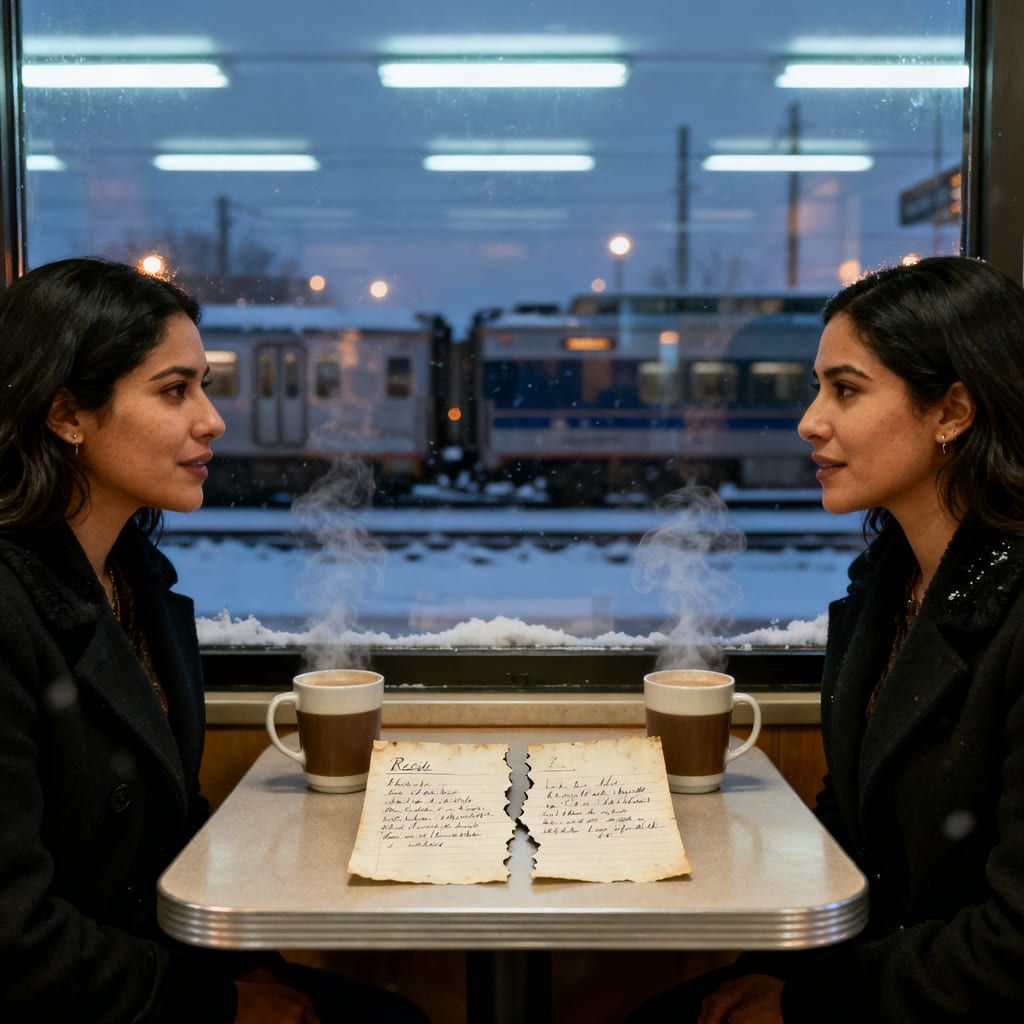
The tape snagged my thumbnail first-just a rough edge under the café table, the kind your brain files as nothing until your hand is already picking. I was counting sips of coffee like a metronome, stretching out what I couldn't replace when the corner of paper freed itself with a soft sigh.
It unfolded in my lap: a heavy sheet gone velvety with years, creased until the fibers remembered the folds better than they remembered being whole. Thick crayon lines ran bold and certain. A child's city: sidewalks made of blue ladders, trees like green suns, and blocky names that weren't names. The Big Blue Giant. The Sleepy Lion. The Singing Bridge. An X sat smug in a smudge of yellow near a crooked patch labeled "garden."
I stared at it until the coffee went cold. I was between jobs and, if I was being honest, between versions of myself. The map made the neighborhood look like a place you could enter with a password instead of a résumé.
I slipped the paper under my hoodie and walked out to the glare of late morning. South Philly was doing its choral thing-trash trucks wheezing, a dog chorus two streets over, someone banging spice jars against a counter like cymbals. I held the map up and let its language translate the familiar.
The Big Blue Giant turned out to be a mural I'd passed a hundred times without seeing-the one of the woman with indigo hair braided into constellations, her palms open as if to scoop the street. Her paint had flaked near the elbow; it looked like scales. A man sweeping in front of the laundromat glanced at my paper and grinned. "You lost or on a quest?"
"Something like a quest," I said, surprising myself with how good the word felt in my mouth.
The Singing Bridge was the pedestrian overpass that always hummed under the highway's breath. I walked it slow, hand on the cold rail, and the cars thrummed a low note through my bones. Past the bridge, the air got sweeter-cantaloupe from the fruit stand, onions browning in someone's kitchen.
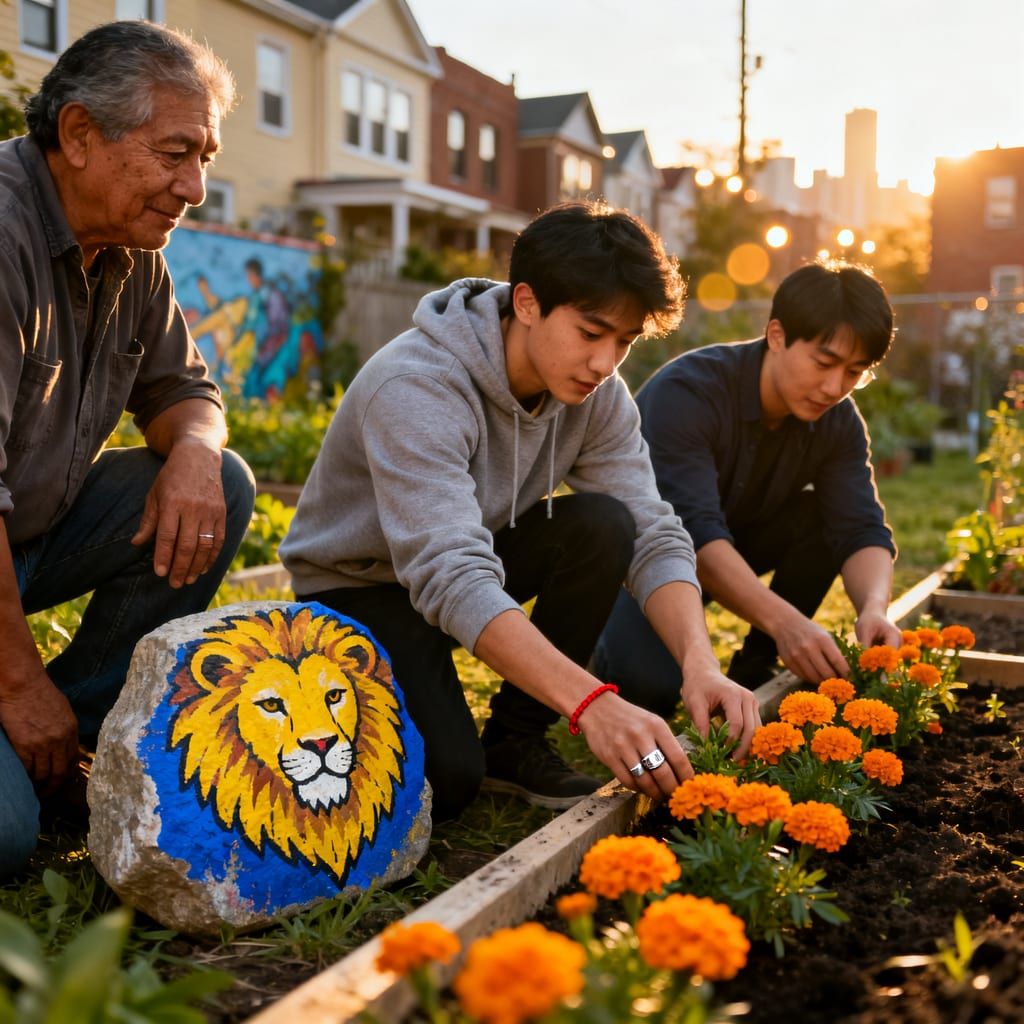
When I reached the community garden, everything gentled. Bees fussed like tiny tailors. A cat threaded itself through a tomato cage, eyes level, as if it had clocked the map and made peace with the absurdity of people. There, near the center path, sat a flat stone painted into a lion's face-uvulas of orange and yellow petals around a sleepy grin. The Sleepy Lion.
The X glowed on the map's page like a well-loved bruise.
I crouched. Dirt whispered against my jeans. "Excuse me," I said to no one, then to an actual someone-an older woman in a floppy hat misting her basil like it was a violin she'd paid dearly for. "Do you happen to have a trowel I could borrow?"
She pointed with her chin. "Tool bin by the shed. Put it back clean."
The trowel's blade went in like a letter opener, small, neat, nothing dramatic. The first scrape brought ants that reorganized themselves with admirable professionalism. A few inches down, I hit metal.
My heart stuttered hard enough to make me feel foolish. I dug careful until a dented lunchbox shouldered up through the soil, its superhero sticker bubbled and sun-exhausted. It came wrapped in a grocery bag, the thin plastic fused to one corner.
There was a moment-stupid, childish-when I looked around to see if anyone would blow a whistle and tell me the grown-up rules. No one looked. The garden breathed. I opened the box.
Inside: a tight rubber-banded stack of worn bills, a silver ring threaded on a piece of red yarn, a Polaroid bleached at the corners, two faces leaning into each other the way light leans in at golden hour-a boy missing a front tooth, a woman with a scarf over what I knew was a skull shaved not by fashion. Under those, a folded letter, the lines of careful printing marching without slant.
"For Mr. Alvarez at the corner store," the first page said in thick, determined letters. "If you find this because I was too scared, please take it for me. -Mateo, 7."
The second page was a different hand-rounded, tidy, the ink blotched in places where a pen must have paused to catch breath.
Mr. Alvarez,
I'm sorry about the tab. I thought my hair would be the last thing I lost. If I can't make it right, please take the ring. It was my mother's. Tell Mateo what I told him: courage is returning what isn't yours even when you want to keep it. Thank you for the oranges. Please forgive me if I can't pay you back any other way.
-L.
I read it twice. The garden pivoted around me like a slow carousel. My stomach did the thing it had done during layoffs-drop, hover, pretend to be fine.
The Alvarez bodega had been my hangover haven for a summer; I'd bought empanadas and lottery tickets there, the greasy comfort of routine. But when I walked to the corner, the metal shutter was down, the sign's red letters sun-faded to an old blush. Someone had spray-painted a heart with wings across the steel ribs.
A neighbor in a tank top hosing his steps watched me read the ghost of the menu painted on the glass. "He closed last year," the man said, the hose making rainbows out of nothing. "Health stuff. Too much grief on the shelves. He's over on Tasker now, top floor of the green walk-up with the busted mailbox."
The hallway smelled like cabbage and Old Spice. I knocked until the lock slid back with a sound like a throat clearing. Mr. Alvarez was smaller than memory-his chest had caved inward a bit, like someone had pressed a thumb into soft bread-but his eyes were the same warm brown that had sold me more plátanos than any one person needed.
"Can I help you?" he asked. His voice had the sand in it that comes from days without using it much.
"I think this belongs to you," I said, and set the lunchbox on his narrow table. The apartment's one window did that old-city trick of catching only a slice of sky; light fell onto the box with intention.
He opened it the way one opens a photo album: reverent, wary. When he got to the letter, his hands shook. He pressed the Polaroid to his chest for a second, an automatic blessing. "I remember them," he whispered. "The boy with the eyebrows that made him look mad even when he laughed. His mother with the pretty scarves. She used to say, 'Save me two oranges, Mr. A.' I saved four."
"They owed you?" I asked, hearing how small my voice went around the word.
He shook his head. "Everyone owed me something, and I owed everyone something. That's a store. I forgave it a long time ago." He smiled without his mouth moving much. "He gave me a drawing once. Crayon. A map, I think." His eyes pushed past me to his bookshelf where, between cookbooks and a cracked vase, a slip of construction paper peeked out. He slid it free: a blue ladder street, a lopsided sun. "I kept it in my register. Put it beside the quarters. Never knew where they went after she..." He didn't finish. He didn't need to.
He closed the lunchbox, palm flat on the superhero's face. "You did a good thing," he said. Then, before I could argue, he slid the cash back toward me. "Keep this. I won't take money from a grave. But one favor-post the photo, write a note online. Someone will know a Mateo with a mother named L. Maybe the city remembers better than I do."
I wanted to refuse. It felt wrong to take anything. But his eyes held me. There was kindness there that had heft-you didn't argue with that kind of gravity. I nodded. "I'll try."
Days are long when you're mostly keeping your own company. I took pictures of the Polaroid and the letter, the curve of the mother's capital L like a river bend. I posted them with the plainest words I could find.
The neighborhood did what neighborhoods do now-copied, pasted, layered their memories on top. Someone remembered a little boy skating in too-big sneakers by the Singing Bridge. Someone else swore they still had a scarf from a cancer fundraiser with an L stitched at the edge.
Three days later, at 2:13 a.m., my email chimed. The subject line was tentative as a toe in cold water: I think that's my map.
I read it in the kitchen light, the hum of the fridge the only thing keeping the apartment from floating off.
I drew that map. I never went back because I thought I'd be told I was too late. My name's Mateo Rivera. I work nights-don't get off till seven. If Mr. Alvarez is still here, and if it isn't too weird, I'd like to come to the garden.
We met at dusk, when the garden softened into itself. The Sleepy Lion watched with a smug kind of encouragement. I stood with Mr. Alvarez by the gate, the ring on its red thread in his palm like a drop of sunset.
A young man in a gray hoodie came down the path, shoulders tight, eyes scanning the way you do when you want to recognize something that once was you. His eyebrows made him look a little mad even when he tried not to.
"Mr. A?" he said, voice catching on the consonant.
"Mateito," Mr. Alvarez said, the diminutive falling out like a benediction. They folded into each other the way certain hugs do-you don't remember getting ready for them; you're just there.
We sat on the low stone wall. Cicadas tuned up. Mr. Alvarez put the ring in Mateo's hand. "Not a payment," he said. "An inheritance."
Mateo turned it over. "She wanted to be brave," he said. "So did I. The map was supposed to make me brave enough to go alone. I got brave too late."
"It's a funny thing," Mr. Alvarez said. "Late has a way of arriving right on time for what matters." He cleared his throat, pulled a folded paper from his pocket. "Years back, after your mother-after-" He steadied himself. "The garden committee dedicated a bed to her. Quietly. I paid for the little deed slip thing they print out and pretended it was a raffle prize I'd won. I watered it while I waited, like a promise without an address."
He handed Mateo the paper. The typed name blurred on my tongue before I could form it. Mateo's face did the thing I have no words for-the way grief and gratitude braid into something that hurts and helps at once.
"I stocked your tab with extra oranges," Mr. Alvarez added, almost shyly. "Like I did for all the hungry kids. Your mother knew. She used to smuggle them into your backpack like contraband."
Mateo laughed then, water-beaded. "I knew. I let her think I didn't." He slid the ring onto the red yarn, then looped it around his wrist. "I don't know what to say."
"Come back," Mr. Alvarez said. "That's all."
He looked at me, and I realized I'd been holding my breath. "You too," he said. "Maps don't land on people by accident."
I started showing up with my hands empty and left with them dirty. Mateo taught me the garden's calendar-when to tuck lettuce in early, when to risk tomatoes after the last frost, how marigolds guard roots with a stubborn joy. Mr. Alvarez brought a folding chair, a thermos of cinnamon tea, stories that unspooled and doubled back.
The city stayed the same where it never would. The Big Blue Giant earned a fresh coat of indigo. The Singing Bridge kept up its bass line. I got interviews and didn't get offers. I said yes to small work that fit between afternoons at the garden. People started knowing my name. They said, "Elias, could you help me stake these beans?" or "Elias, take some cilantro," like the word belonged to me.
Sometimes I walked past the spot under the Sleepy Lion and felt an urge to kneel. Not to dig-just to touch the ground that had made a new map of my days.
On a soft evening when summer had finally decided to stop being coy, we planted marigolds along the edge of Mateo's mother's bed. Their petals bunched like skirts, little suns crowding for attention. The same fierce yellow as the map's smudged X.
I pressed a small plant into the soil, my fingers stained the color of late light. Mateo patted the earth beside mine, the red thread bright at his wrist. Mr. Alvarez poured water slowly, making circles that sank and sank.
A breeze tugged the crayon map where I'd tucked it into my pocket, its edges gone softer still. I smoothed it with my palm, felt the wax ridges of a child's certainty.
It hadn't just led me to a lunchbox or a ledger cleared. It had handed me a reason-loamy, ordinary, alive-to stay.
Story audiobooks for children of all ages — a new one every day on Smarter Way Stories.