Two Houses and One Quiet Heart
A daughter learns to read between the lines of a life split in two
Read more →
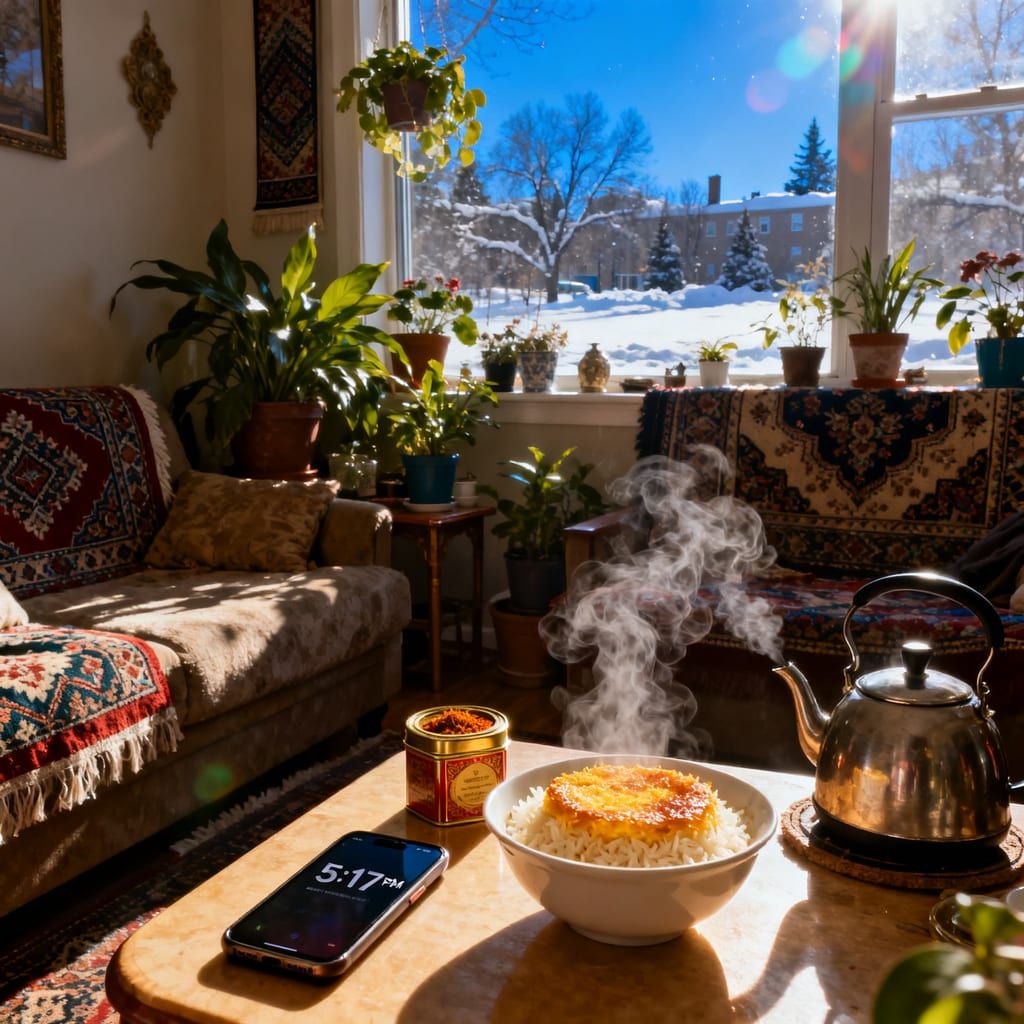
At 5:16, Noor stands barefoot on cold tile and watches the microwave countdown in blue digits, the hum filling her small Minneapolis kitchen like a held note. Snow webs the window screen. A kettle sighs into steam. Somewhere in the building a neighbor laughs too loudly, too long.
At 5:17, right on the dot, her phone trills with the old ringtone she never changes. She answers with the same smile she can feel even when she's too tired to form it.
"Salam, Nana."
On the other end, plants shiver against glass in a sunlit living room three miles away. She can hear the soft clink of porcelain, the huff of the heater, the scratch of a pencil Nana keeps by the phone to circle grocery coupons she will never redeem. The ritual is a narrow bridge over a wide day. They cross it together.
"Nooru joon," Laleh says, as if tasting the name. "Did you see? The neighbor's cat climb onto my windowsill like a king. He thinks the spider plant is his throne."
Noor rests a hip against the counter. "If he starts issuing decrees, tell him the people demand more naps."
They talk about the weather-their two skies-and the rice in the pot that turned out like clouds. They talk about the new bus schedule and the way the winter light makes the rug's reds bloom. They say everything that is small and ordinary because it is an honest way of saying: I am here. Are you?
A minute of quiet drapes itself between them. On the far end, a teaspoon touches ceramic. Then, slow as careful feet on wet stones, Laleh drifts.
"Setareh," she says, not quite an accident. "Azizam."
The name steps into Noor's kitchen like a stranger wearing a coat that's somehow hers.
"What did you say?" Noor's voice is steady with the reflex of a product manager who can steer a meeting through a down server and a missing deck.
"Setareh," Laleh repeats, the word round and luminous. "Star."
The hum in Noor's kitchen clicks off. The silence after is bright and thin.
"Nana?"
"I will tell you a story," Laleh says in Farsi first, then English. Her words come small and sure, like seeds placed exactly where they need to be. "And then you come tomorrow. On the top shelf of my closet-sewing box. You will open it."
Noor presses the phone tighter to her ear, as if to catch whatever might fall.
"Okay," she says, though she doesn't yet know what she's agreeing to. Only that at 5:17 the lighthouse swings its beam and shows a different coastline.
She skips the last meeting of the day and emails an apology that uses the word bandwidth twice. Her boots chew at the crusted snow as she hurries the three blocks from the bus stop to Laleh's building, breath a tiny engine in the blue air. She keys in the code-one, nine, seven, nine, the year Laleh came to Minnesota-and climbs.
In the living room the plants are as she imagined: rubbery leaves glossy in the winter sun, a tendril of pothos like a green rope across the bookshelf. The usual two cups are set out, one for chai, one for tap water "to be sensible". On the arm of the couch, Laleh's folded cardigan holds the dent of her elbow.
"You came quick," Laleh says, opening her arms as if to catch a child running downhill.
"You called me a star. I wanted to see which sky you were looking at." Noor laughs because she doesn't know what else to do. They hold each other longer than usual, then step back to share the same space they always have.
The closet yields the sewing box, tin lid scratched, a faded rose pressed flat forever by time and sweaters. Noor carries it to the kitchen table as if it might unspool thread across the floor and trip her.
Inside: neatly nested spools, a thimble, a tomato pincushion bristling like a field of flags. Under that, paper. Old like thin bread. Names typed, stamped, inked.
A Polaroid: a girl with a scarf tied at the nape of her neck, cheeks too smooth to have made so many meals. She holds a bundle with the worried pride people reserve for babies and fresh cakes. Beside her stands a woman in lipstick, older by a decade and by armor.
Noor picks up the certificate. The language is official, a voice that wears a tie. Her own birthday curls up from the page like steam, like a song she knows by heart even as new instruments join.
"Noor," she says, trying to make her breath serve as anchor. "This says..."
"It says what it says," Laleh answers, setting a saucer down with a whisper. "When I was sixteen, I was foolish and then I was scared. Your aunt-" she grimaces at the word out of habit-"your mother, she was married. They could give you... what I did not have."
The room tilts slightly. The radiator clanks as if clearing its throat. Noor puts a palm flat on the table and stares at the slope of Laleh's handwriting on the back of the Polaroid: Setareh, 2 weeks. Love will make you brave.
"You... you are my-"
"Your mother," Laleh says, and for a blinking, breathless moment Noor watches the word land like snow-soft, unstoppable, changing the shape of every familiar thing.
Laleh's hands are steady around her cup, but the saucer bears two small crescents of tea, sloshed by nerves. "We pruned the tree, azizam," she says, voice dropping. "We made it pretty for the neighbors. And it grew, yes? It grew. But this limb-I could not cut it from myself."
Noor thinks of all the years of five-seventeen. The way Laleh corrected her salt with a kind voice, the way she said "Sleep, sleep" when she had to be up at four for a deploy, the way she told stories that never owned their sharpest edges. She thinks of her mother-her aunt-slicing cake, correcting scarf colors, filing her nails before bed, always careful, always urgent.
Something inside Noor loosens, another thing clenches. Both are true. The knowledge rearranges the furniture of the room in an instant, and yet the couch is still the couch. The plant still drinks the same light.
"Why now?" she asks.
Laleh looks at the window where afternoon throws itself thinly over the neighbor's brick. "I am tired of being tidy," she says. "And because I trust you."
Noor calls the woman she has always called Mom from the balcony, where the neighbor's barbecue sits knee-deep in snow like an anchor from a different season.
"Hi, Ma. Are you home?"
"I'm chopping onions. What's wrong-are you okay?"
Noor tells her. Not with a knife, not brandishing. With the careful sentences Laleh used, laid down like stepping stones across water. There are pauses that feel like crevices you might disappear into if you look too long. On the other end, her mother breathes and breathes.
"I thought-" her mother's voice cracks into a younger pitch. "Your father and I, we wanted-" She stops. The onions must be strong. Or the past is finally reaching the eyes it was meant to sting. "I should have told you. I am sorry. I am... not sorry. Both are true."
"Both are true," Noor repeats, and taste returns to her mouth. "Can we talk? Not tonight. But soon."
"Soon," her mother says, fastening that word to something sturdy. "I love you, my girl. Even before we signed anything, I loved you."
Noor stands in the ozone of cold until her fingers go numb and the phone warms her cheek like a small animal. She goes back inside and lets Laleh rinse the basmati until the water runs clear, both of them grateful to do something that makes sense of their hands.
They say very little. The steam does the talking. The kettle whistles again. The sun leans away from the building as if there's another appointment it cannot miss.
At 5:17 the next day, Noor is at her own stove. The tin of saffron waits like a secret luxury. Laleh's call comes on time, their clock more accurate than any satellite.
"Ready?" Laleh asks, the bright of it back in her voice, thin seams of grief stitched into the lining.
"Ready."
They measure water by the first knuckle. Salt drifts from Noor's fingers like snow over a dark road. They grind saffron threads with sugar-"for color and for sweetness," Laleh says-and dissolve the powder in a spoon of hot water until it blooms so intensely it seems alive.
"Listen," Laleh says as the pot simmers. "The rice talks."
Noor tips her head. The bubbling is steady, soft, like the murmur of strangers on a bus seat over. She feels something loosen in her ribcage, a knot untying by being looked at.
"I used to be afraid," Laleh continues. "Of the way a small truth can drag a big truth behind it like a train. But the train comes whether you are on the platform or not."
"You put me on the train," Noor says.
"You built the platform," Laleh replies. "With your calls. With your eyes that always see me."
Noor laughs, small, because crying feels too extravagant for a weekday. "We are such a dramatic pair for two people making rice."
"Eh," Laleh sniffs. "Rice is drama. Timing, heat, hope."
They wait the ten minutes. Then the towel goes over the lid. Then the heat goes low. Then they wait some more, both kitchens fogging their windows in mirrored halos. When they turn the pot and the tahdig releases with a buttery sigh, Noor thinks of photographs developed in chemical trays, familiar faces rising out of blankness not newly made but newly seen.
They eat on the phone. Noor sits on the chewed edge of her dishwasher. Laleh sits on the chair that protests every time and will not be replaced. The rice is perfect enough to forgive the day its shape.
The next week is not a montage. It is calls missed and calls made, a meeting where Noor hears herself say "ship it" while imagining two girls in a Polaroid taking turns holding a baby and a future. It is her mother texting a photo of an old recipe card in her grandmother's loops and then, an hour later, a long message that reads like a confession and a lullaby braided together.
It is a Sunday where they all sit at Laleh's table-three women who have been four names to each other-and pass bowls and stories like salt. Someone laughs too loud at nothing. Someone cries at the right time. The family tree is not so much redrawn as allowed to grow in the direction it was always reaching.
At 5:17, always, the phone rings. Noor picks up whether she's in a rideshare or on the sidewalk or standing in her kitchen watching hard, dry snow fall with the particular stubbornness of March. They talk about the neighbor's cat, who has demoted himself from king to court jester. They talk about the treacherous parking lot ice and which floor plant has decided to be dramatic. They talk about the kind of day that doesn't ask for much-only for you to show up and say your name into it.
"Nooru joon," Laleh says one evening when the sun is no more than a rumor. "Are you okay?"
Noor looks around at the life she built inside a story that has stretched to hold one more truth. There are sticky notes on the fridge and a scarf drying over the radiator and a tin of saffron tucked behind the salt. There is a voicemail from her mother she is ready to hear again. There is steam beading the window like a constellation.
"I am," she says. "I am okay."
She hears the smile arrive on the other end. "Good. Then tomorrow we try dolmeh. You bring grape leaves; I bring scandal."
Noor rolls her eyes at the ceiling, grinning. "Deal."
After they hang up, she watches the blue light of the microwave blink 5:18, 5:19, onward. The ritual does not feel like a small circle keeping her in; it feels like the tether that lets a kite find sky without fear of floating away. Outside, a plow scrapes the street clean. Inside, the towel over the pot catches one last breath of steam and goes still.
The phone rests, quiet now, honest as a lighthouse between flashes. Tomorrow it will ring again. Not to make anything tidy. Better-to light the way for the whole of it.

A daughter learns to read between the lines of a life split in two
Read more →
A fog-draped night, two souls found, and the quiet shape of a life
Read more →
Story audiobooks for children of all ages — a new one every day on Smarter Way Stories.