Two Houses and One Quiet Heart
A daughter learns to read between the lines of a life split in two
Read more →
The doors sealed on a breath of cold air and his stomach dropped. Arjun slapped his pockets, patted his messenger bag, stared at his empty palm as if the screen might conjure itself. No phone. The A train lunged forward anyway, indifferent.
He thought about prying the doors open, imagined himself wedged between the metal jaws while the conductor droned about service delays. A woman with a stroller raised an eyebrow as he planted himself in the car, hand gripping the pole hard enough to make the tendons in his wrist stand out. Calendar, calls, demo, slides. You beautiful idiot. His breath came fast, fogging the window. The black rectangle of his morning-charging by the counter, just out of reach-occupied an entire universe of panic.
Then the car swayed, and the conductor's mic crackled. "Folks, we're making all local stops because my horoscope said I should take things slow." A ripple of reluctant laughter traveled like radio static. Arjun's mouth did something it hadn't done before ten a.m. in weeks. It tilted.
He looked down to steady himself and a chipped tile near his sneaker winked up-a swirl of white in blue, a little galaxy ground into the station floor. A violinist at the far end of the car sawed a thin thread of sound into the air. The bow hair had frayed into white grass, a field waving with each tremor of his wrist. The melody skated along the fluorescent buzz and found a clear pocket in Arjun's chest.
He was unreachable. For the first time in what felt like a year, no banner would slice across his attention. The idea scraped at him and then, strange as it was, smoothed into something like relief.
At street level, heat clung to brick and hung off the backs of buses. He went to the cafe he only ever ordered from in an app and stood in a line that smelled like nutmeg and wet pavement.
"Name?" the barista asked, pen hovering.
"Arjun."
"Spell it for me?"
He did, and watched the way her hand made block letters, careful as scaffolding. For the dot on the j, she drew a tiny sun.
"Is that standard?" he asked, because jokes were what he had when he had nothing else. "Company policy to solarize the vowels?"
She smiled without checking a screen. "A reminder," she said, caps clicking down over the cup, "that names deserve a little light."
"Thanks," he said, and meant all four letters of it.
He bought coffee with cash, the bills soft from the dark of his wallet, and the metal clatter of change felt like a tiny parade. He carried the cup past the corner where tourists pointed their phones at brownstones and felt not unlike a tourist himself.
In the lobby, an elderly neighbor he knew only as the woman with the floral visor struggled with the door. He lunged, held it, and she stepped into the hallway's cool like someone being ceremoniously admitted.
"Rosa," she said, when he said good morning. She pressed something warm and downy into his hand. A peach, the size of his palm, smelling like July.
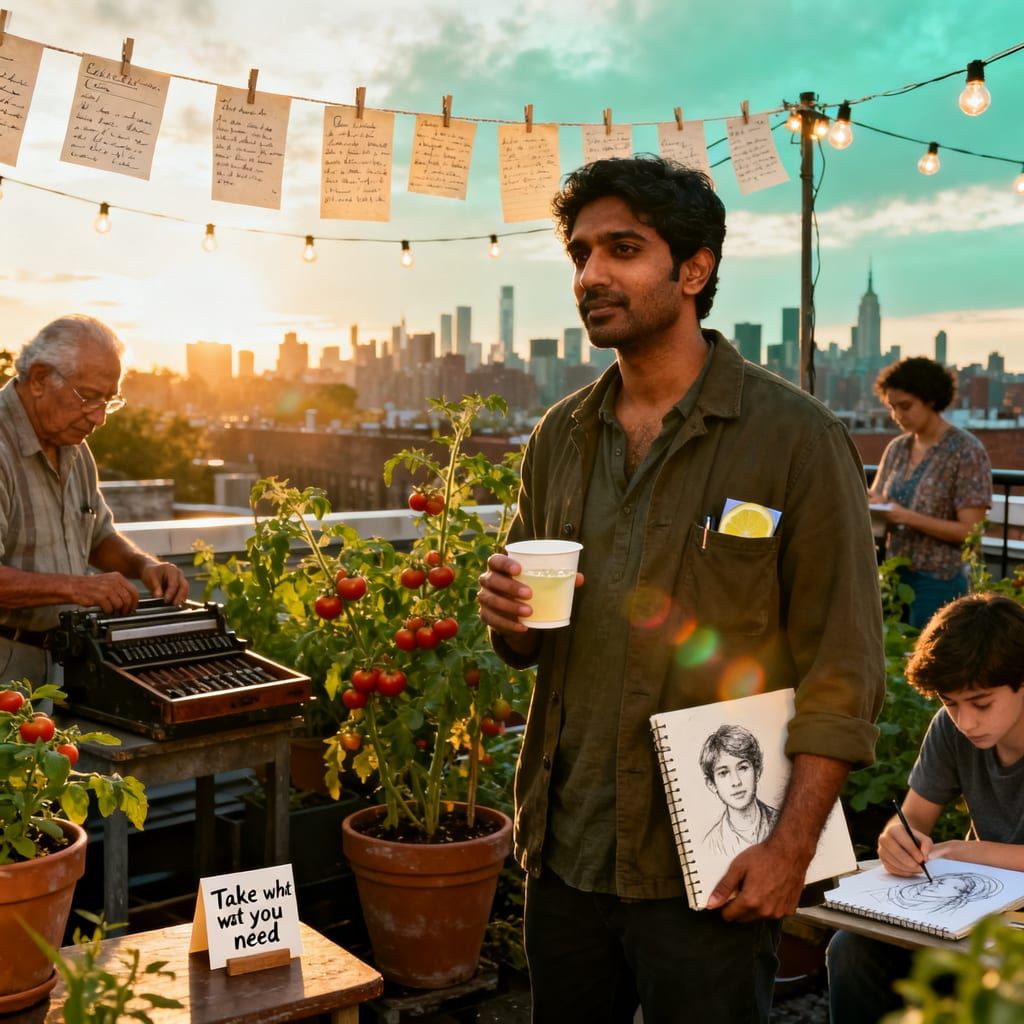
"For the gentleman," she said. "Come to the roof sometime around sunset. We water the tomatoes and tell lies. You don't need a number to find us." She tapped her temple lightly, as if memory itself were a map.
He nodded, surprised by the sweetness bleeding through his fingers. "I-thank you."
She held up a finger. "And bring nothing but your story."
He laughed, not because it was absurd, but because of how right it sounded rolling through the echoing lobby.
On his lunch break-what was a lunch break, really, but an hour he swallowed between emails-he stepped into the park and immediately a gust made a skipping thing out of a sketchbook on the bench. The paper slapped against the path. He ran, caught it, felt the teeth of spiral binding bite his fingers.
A teenager with a denim jacket patched like a quilt jogged breathlessly toward him. "Oh my God, thank you. That would've been my whole brain scattered to the pigeons."
"You draw," Arjun said-obvious, and yet.
"I try." The kid tucked a blade of hair behind one ear and flipped the book open to check for damage. "Let me-hold still."
"What?"
"Payment." A pencil shivered to life. In less than a minute he watched himself appear-shoulders pitched slightly forward, as if he were always getting ready to stand without ever fully standing. A messy, tender outline that caught a tilt he didn't know he had.
"That's me?" he said, embarrassed and moved like they were cousins.
"That's you today." The kid tore the page with a practiced tug. "Keep it."
He slid the portrait into his jacket, as if it were a ticket he didn't know if he'd need.
Borrowing a stranger's newspaper to check the time-a corner fold of the Metro section, smudged black onto his fingertips-he found the owner watching him over reading glasses. "You can keep it," the man said. "I already read the obits. Luis."
"Arjun."
"You look like a man without a watch and without haste." Luis folded the rest of the paper into a ship and set it on the bench between them. Ink ghosted the creases. "I used to run a letterpress shop. Retired. Still mess around. If you got a minute, come by. It's a few blocks. Smells like oil and old poems."
Arjun felt something in him stir, the part that liked the sound of rollers and type, though he'd never met either. "After my-" He didn't know what to call it, this day without his tether. "After I handle some things."
Luis tipped him a salute with the newspaper boat. "Things handle you or you handle them, either way they get handled."
Outside, heat pressed a palm against his chest. He slipped his hand into his jacket-maybe just to feel the paper edges-and his fingers met something dog-eared and thick as a breath. An index card, warped at one corner, his cramped handwriting diagonalling across it.
Notice five blue things, ask one real question, give something away, follow a sound.
The therapist's homework from six months ago. He'd slipped it in and then, apparently, built a life around ignoring it.
He stood in the shade of a plane tree and read the sentences twice. The card smelled faintly of the citrus cleaner from her office. The instructions were so simple they were cruel.
"Okay," he said to no one, to everyone. "Okay."
Blue ran like a quiet current through the block. A child's shoelaces knotted into saucers. A mailbox dented into a smile. The cobalt stripe on a bike that flashed past like a fish. A cracked flowerpot in a bodega window, cobalt bleeding into terracotta. And above it all, the sky-smeared with August heat, a blue you had to squint to believe.
Each thing tugged his pulse down from its ladder.
He walked back to the cafe. Ava-her name tag said so in hand-lettered marker-was rinsing a metal pitcher at the sink.
"Hey," he said, and the greeting felt serious. "That tiny sun on the j. What does it mean to you?"
She looked at him, water beading the tendons in her wrist. "My brother forgets names. He had a head injury. So I started drawing little suns to remind myself that names deserve a little light. A little patience." She shrugged, embarrassed by her own suddenness. "Helps me slow down."
He swallowed. "Thank you for... telling me." The way her story slid into his day felt like a piece clicking into a place he didn't know was empty.
"Anytime, Arjun-with-a-sun," she said, and when she said his name it warmed him clean through.
On the train back uptown he stood without thinking when a woman with a sleeping toddler swayed into the car. His hand found the pole; hers found the curve of her child's head.
At his stop, a tap at his elbow. The teenager from the park, eyebrows lifted. "I'm two dollars short," they said, showing him a MetroCard balance like a sad fortune.
He pressed his own card-a last ride left-into their palm. "Artist discount," he said. "You already paid me."
They flashed him a grin, then glanced at the pocket where he'd slipped the portrait. "You'll come to the roof?"
"How do you-"
"Rosa invites everyone," they said, as if gravity needed endorsing.
Back on the sidewalk, bells sounded somewhere to the west. Not church bells exactly-lighter, as if made of glass. He turned toward them without meaning to. The tone drew him down a block he'd crossed a hundred times without seeing.
Up a narrow stairwell, the air shifted cooler. A fiddle and an accordion braided a song he half-knew from somebody's wedding. Laughter pinged off concrete.
On the rooftop, pots of tomatoes leaned red shoulders into the evening. A clothesline flickered with index cards and recipe cards and postcards, clipped by wooden pegs, a paper river of handwriting. Neighbors stood in small knots, passing a bowl of olives, a plate of cut cucumbers, a bottle sweating with condensation. The sky did that Brooklyn magic trick where it turned the water behind buildings into a band of hammered silver.
"Ah! The gentleman with the door," Rosa said, materializing with a paper cup of lemonade, tart enough to set his teeth singing. "You found the sky."
A table near the parapet held a scattering of small, perfect things: buttons like planets, folded cranes, letterpressed place cards arranged in a fan. Luis leaned beside it, his forearms inked with old work. The cards said, in grave old type: Take what you need.
"You came," he said, as if they'd agreed on it. "Pick a word."
Arjun's finger landed on one without reading. When he turned it over, he found: Patience.
"Fitting," Luis said, amused, and tucked another word, Light, into Arjun's shirt pocket as if it might keep.
The teenager sat cross-legged on the tar, sketching the skyline, tongue tucked into a corner of their mouth. "Do you want to sit like you?" they asked without looking up.
He didn't know what that meant until he noticed his shoulders, the way they'd already lowered.
The song stopped not at its end but in a wrong note that tripped everyone into laughter. A toddler waltzed seriously with a terracotta watering can while three adults made room for him like tide around a rock. The precise angle of light on a jar of wooden spoons turned the glass into a lantern. Someone asked, "Where'd you go when you were little?" as if childhood were a place and not a weather.
"Nowhere," Arjun heard himself say before courtesy could edit him. "We stayed. We learned the names of trees." The words rose as if lifted by a warm current, and when they left his mouth, he felt lighter. A man in a paint-splattered shirt nodded like he knew the curriculum.
Conversation braided around him. No one asked for his handle. No one glanced down in the middle of his sentence. He felt the part of himself that had been tightening all year-tight as a knot you worry when you worry-unspool into something with give.
Rosa raised a paper cup. "To whoever remembered the sky today." The toast sent a small, agreeable hush around the roof. Then everything-music, clinking, the lazy saw of evening-started again.
He walked home under a linen-soft twilight. The block wore its day lightly now: a sprinkler sighing in a front yard, someone on a stoop humming without consequence, a child chalking a blue horizon onto the sidewalk with both hands. He passed the community board he'd hurried by a thousand times and stopped.
There, among dog-walker ads, cello lessons, lost mittens tacked like small flags of winter, a faded index card announced in tidy, looping script: Thursday Night Dinners-Come Hungry. The thumbtacks had rusted into punctuation. He ran a finger over the loops as if they were braille and felt, absurdly, seen by paper.
His apartment door stuck a little in the humidity. When it gave, a paper rectangle skidded forward from the threshold, as if it had been holding its breath. We've seen you around-join us tonight? Rooftop, 7 pm. Bring nothing but your story. -Rosa.
He laughed. Something like gratitude thickened his throat in a way that wasn't uncomfortable. The kitchen counter held the black mirror of his phone, flat and full of thirty-eight somethings. He didn't touch it.
Instead he took out the portrait, found a pen by muscle memory, and wrote on the back in the same cramped hand that had once bossed him from an index card: On my way.
He slid the drawing into his pocket again-not as a ticket this time, but as proof that a day could choose you back-and stepped into the hall, where the elevator started up like a throat clearing before a song.
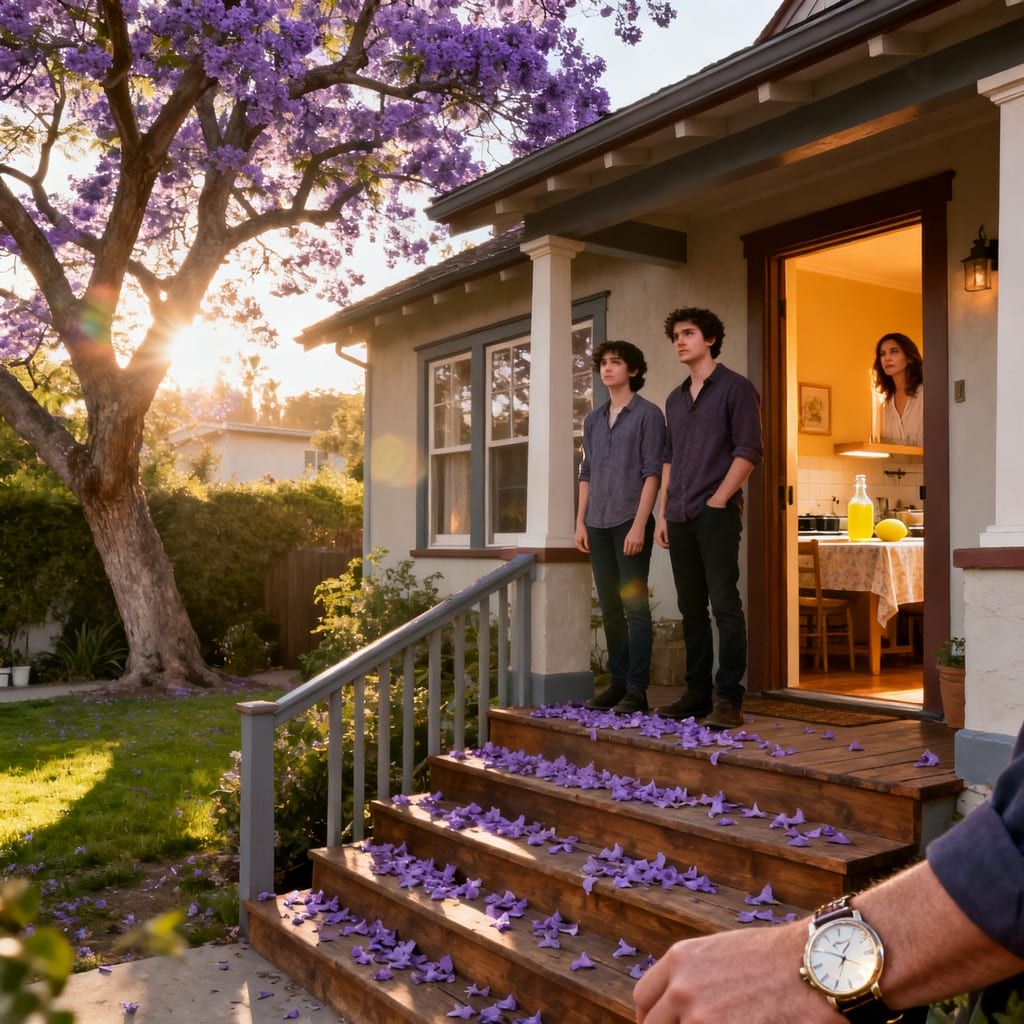
A daughter learns to read between the lines of a life split in two
Read more →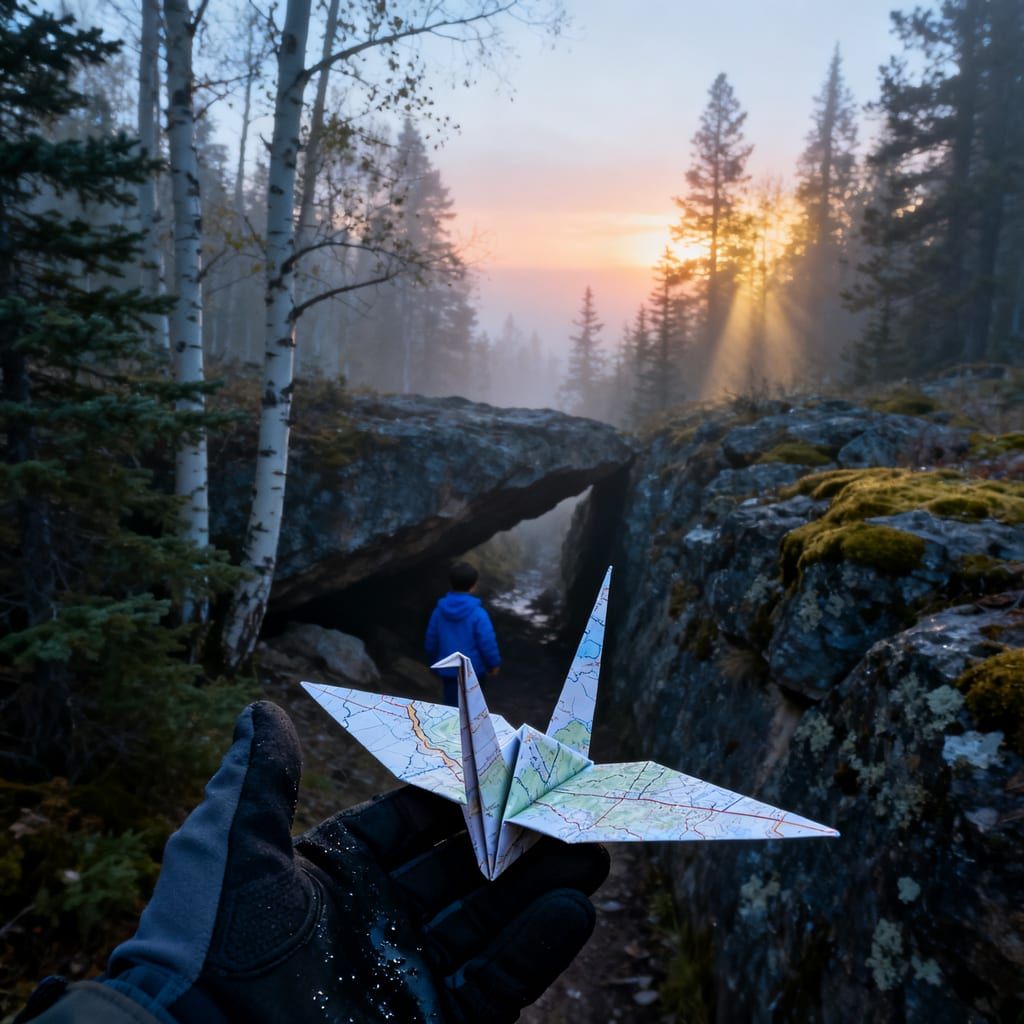
A fog-draped night, two souls found, and the quiet shape of a life
Read more →
Story audiobooks for children of all ages — a new one every day on Smarter Way Stories.