Two Houses and One Quiet Heart
A daughter learns to read between the lines of a life split in two
Read more →
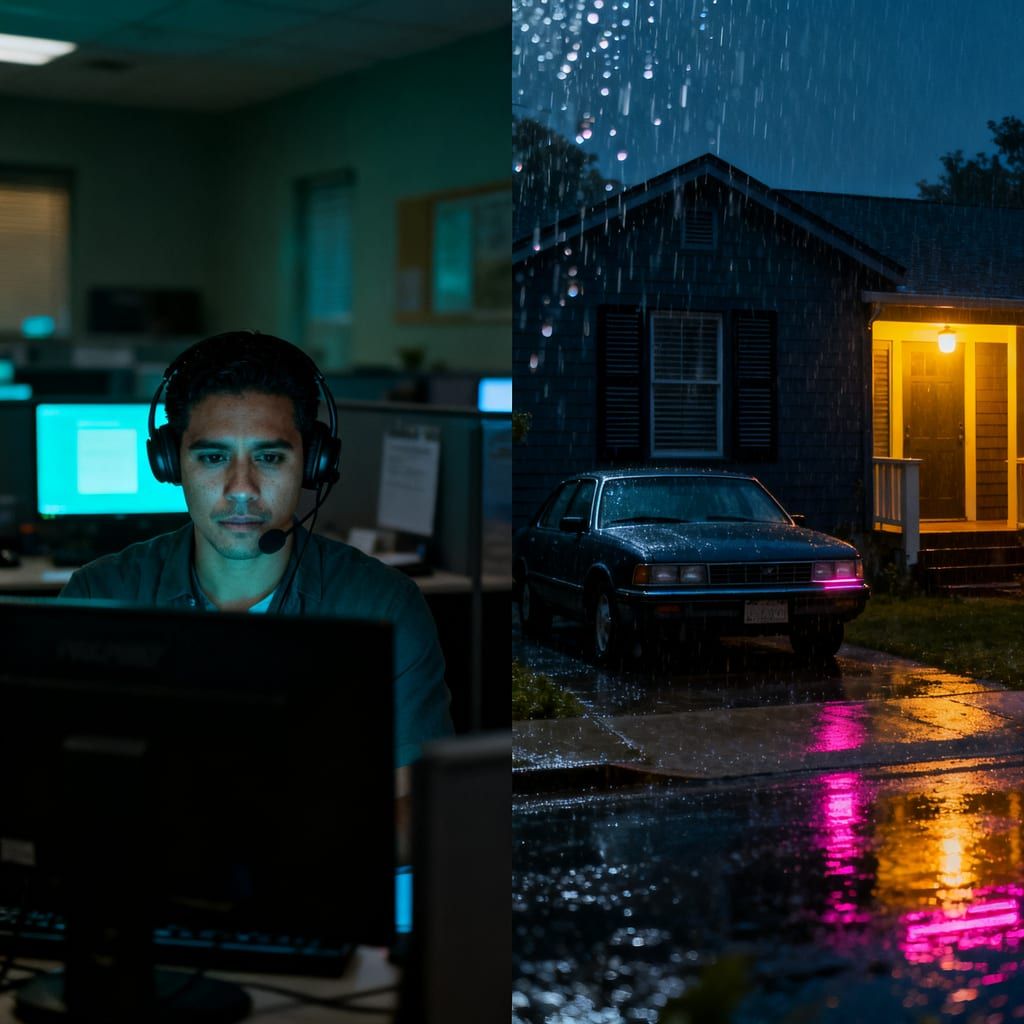
The call center breathed like a sleeping animal-monitors low-lit in blues and greens, the quiet rasp of the HVAC, rain threading the windows into a blurred city. Jonah sat with his headset askew, neck aching, counting his own breaths the way he'd been taught to teach others.
The line clicked open.
"Hi," a voice said, thin as a paper cut. Beneath it, buried like a secret, was a three-note hum. Not a melody you could name-more the idea of one, a lullaby snagged mid-throat, three notes repeated as if rocking something to sleep.
Jonah's chest tightened before he could talk himself out of it. He knew that hum. He knew it like he'd known the sound of their mother's keys in the lock, like he'd known which stair creaked third from the top. He knew it like muscle memory.
He kept his face still. He didn't say her name.
"Welcome. I'm here," he said, voice even, only that. The rule warmed like a stone in his palm: do not identify, do not lead. Offer a raft, not a map.
On screen, his notes became a careful lattice: caller sounds adult, feminine, distressed; external stressors: rain, car, darkness. He typed like he thought-precise, neutral. His training lived in him like a second spine.
Outside, the rain deepened, a soak that turned sidewalks into mirrors. He pictured, unhelpfully, the house on Alvarado, its porch light forever yellow in his memory, the ghost of damp sneakers in the entryway. He hadn't been back since they'd emptied it out, since the bitter last day when the key scraped the lock and he didn't look back.
"My name is-" she started, something false and soft. She offered it like a decoy.
He let it drift. "You can call yourself whatever feels okay," he said, mirroring her pause, holding the silence open like a door.
She exhaled into the receiver. The hum threaded in, then out. "I'm in my car. Outside a place I shouldn't be."
"Okay." He matched the pace of her breath. "What are three things you notice right now?"
A beat. "Rain. The way it...drums."
He heard it-on her roof, on the hood. A metronome. "Good."
"My hands. They're...cold."
"On the wheel?"
"Yes."
"What else?"
"The streetlight flickers like it's trying to decide." Her voice shook on decide.
He rolled his shoulders back, imagined her skin pulling gooseflesh. "You're doing a good job naming things," he said. He wasn't supposed to praise, exactly, but sometimes a truth was a buoy.
She made a sound like she'd swallow and couldn't. "I took something from a friend's bathroom. I thought I might. I thought I'd just...stop the noise."
The word stop landed heavy. He tracked the distance between syllables, the way they slid. He made his voice a steady step. "You're in your car. It's raining. Your hands are cold on the wheel. The light is flickering. You have something with you."
He did not ask for the brand, the count. He did not ask for her last name. He asked for the world inside the car.
"Tell me about your feet," he said.
There was a thin, startled laugh. "My feet?"
"They matter. Are they on the mat?"
A rustle. "Yeah. They're...wet. I think I tracked water in."
"You feel that?"
"Yes."
"Okay," he said, and listened to his own voice as if from across a room. "What about your back. Can you press it into the seat? Feel the support?"
A silence bloomed. He let it. Somewhere, a colleague down the row coughed into a sleeve. The rain kept grinding down.
She hummed-three notes, then three notes again-and it almost undid him.
"They sold it," she said. "Or I did. Or we did. We-" The word snagged. "I'm parked outside like someone breaking and entering their own life."
His fingertips cooled against the desk. The house had never been big; it had been abundant with arguments, light, the smell of onions and cumin when their mother was hungry for a different place. He saw the curtains Leena had sewn from a thrift-store sheet in eighth grade, green with daisies. The dent in the banister from when he'd flung a backpack, late for band.
He made a tiny nudge in his notes: caller at location linked to prior grief.
"People say houses don't hold you," she went on, talking around her pain like it might lunge if she looked it in the eyes. "But I think I bought those cheap curtains so the house would stop looking like a stage after the show. I think I slept on the floor the night after she died because I didn't want the bed to know first."
He didn't say, I remember. He didn't say, Leena, we were both so bad at soft things then. He said, "It sounded like that was a hard night."
Silence curled, then unfurled. "We shouldn't have sold it. Or maybe we should have. I-I kept a ledger. You know? Not in a notebook, but in my head. Every time I cooked, every drive I made to the doctor, every electric bill I paid. I told myself I wasn't keeping score. But I was."
His throat tightened. The invisible math of love. He had, he knew, balanced his columns too-long nights at the startup, checks written like apologies, the belief that solving counted as loving.
"I shouldn't be talking about this to a stranger," she said, which was a kind of apology aimed at the wrong decade.
"I'm here to listen," he said. "We can keep it right here, between the rain and this line."
She inhaled. The hum steadied. "He...my brother, he wanted to sell. He said he couldn't breathe in that house. He said he'd cover the realtor fee, like money was a broom."
Jonah kept his hands flat on the desk. He watched the cursor blink like a heartbeat. Don't fix, he told himself. Make space.
"What would feel like breathing right now?" he asked.
"I don't know." The paper-cut voice stiffened. "I asked someone for pills last month. She didn't ask why. They're in the glove compartment. I thought tonight I'd be brave and not...ask anyone, not explain. Just do it in the car with the rain loud."
A thin shiver ran up his arms. He counted a breath, then the next. "It took courage to call," he said. "We can decide what today looks like together."
"What if I've already decided?"
He heard the hum coil. He met it. "Then let's decide what today looks like together."
Words returned to him from training, from nights of finding a railing in the dark. "Would it be okay if we made a plan for the next few hours?" he asked. "Just tonight. No big promises."
A small exhale. "Okay."
Jonah softened his voice, not the content. "On a scale of one to ten, where's your urge right now?" He offered the scale like a ruler, not a verdict.
"Seven," she said. "No, six. It dips when you talk. That's embarrassing."
"It's information," he said.
They collected more. What's nearby. What's open. He did not ask where exactly. He did not ask who are you really, are you Leena, did you sleep with the hallway light on for three months after Mom's first biopsy.
"There's an urgent care," she said. "They don't ask questions except the ones they have to. It's bright. I hate it."
"Do you feel okay walking into bright?"
"I could." The word hovered, then landed. "Or I could go to my friend's. She's five minutes. She works nights; she's almost always up. Her name-" A pause. "It doesn't matter."
"It matters that you thought of her." He tapped into the script of safety, letting it be a path. "Would you be willing to call her?"
A beat. Then, "On speaker?"
"If that feels okay."
He heard the glove compartment thunk. A bottle chattered-plastic against plastic-then stilled. Rain insisted on the roof. The hum returned, now like a measured tide.
"Okay," she said, throat rough. "Coffee, then urgent care if I can't stop shaking. Friend's house if the coffee is closed. I can throw the pills away at her place. I don't want to do it alone."
He wrote it down as she spoke, the plan unfolding like lines connected by gentle arrows. Coffee instead of pills. Light instead of dark. A person instead of a box of silence.
"Will you stay while I call?"
"I'm here," he said.
She dialed. The ring tone felt too cheerful, like laughter at a wake. They waited together in the wet lull of the night.
When the friend answered on the fourth ring-sleep-soaked, surprised, immediate-Leena's voice softened in a way he hadn't heard since they were small, when trust was the air.
"I'm outside," she said. "Can I come by?"
"Of course," the friend said, no questions like a warm coat.
The hum steadied, three notes like rails.
"Thank you for staying," she whispered when they'd hung up.
"I'm here," he said, and meant it in every direction-here on this line, here in this chair, here in the lattice of their life where names bent rulebooks and rulebooks kept people alive.
They let the goodbye be plain. No acknowledgment. The shape of what they hadn't said curved between them like the underside of a boat, holding.
The next day the city dried in patches, puddles rimmed with gasoline rainbows. Jonah stood in his kitchen staring at his phone, the tile cold under his heels, the smell of stale coffee insisting on one more swallow. Leena's contact hovered-her photo taken two summers ago, hair wild from the beach, eyes narrowed at the sun.
He pressed call before he could rehearse what he wouldn't say.
She answered on the second ring. The scrape in her throat sounded like sleep interrupted by light.
"I knew it was you last night," she said, not sharp, just true. "You whistle on your 's' sounds when you're tired."
He touched his mouth, startled by how seen he felt. A laugh, soft and unbelieving, broke free. "And you hum when you're thinking."
Silence, then the smile inside it. "Yeah."
"I didn't-" He stopped. Don't fix. Don't defend. "I was glad you called," he said instead.
"Me too." A rustle, like she was moving from window to window. "I threw them out. At her place. We made fun of the urgent care posters. We cried at the dumbest commercial."
He felt the chair behind his knees. He sat.
"Do you want coffee?" he asked, unadorned. "Not right now. Later. Somewhere with bad lighting."
She breathed. He pictured the porch light, how it used to pool yellow on their faces when they were late. "There's that diner by the car wash," she said. "They make pancakes that taste like regret."
"Perfect."
They met in a booth that had trapped a thousand awkward apologies into its vinyl seams. The overhead fluorescents hummed like distant bees. The pancakes arrived the way they always did-flat, too big for their plates, more promise than payoff. The coffee was the color of old river water and perfect in its own right.
They didn't re-litigate the past. The ledger in her head, in his, remained, but the columns stopped shouting for a moment. He watched her hands wrap the mug, the tendons he knew under the skin. She watched the way he worried the sugar packet without opening it, the habit of a man looking for edges he could fold down.
He took a pen from his pocket-the one he used to wireframe products no one needed-and clicked it open. "Let's make a list," he said. "Small appointments."
Her mouth quirked. "With the future?"
"Yeah." He smiled, brief. "Tiny things. Easy to keep."
They wrote: call the plumber about the pipe in her apartment that hiccuped at night; bring the juicer from his back cabinet to her place because she actually used it; meet Thursdays after his shift for a walk even if it rained; go through two boxes of their mother's recipes together and pick five to cook badly; replace the batteries in the smoke detector at his place because the chirp made him want to throw it out a window.
They added: one movie they both pretended not to care about; one plant they'd split into two smaller ones; a task they'd been avoiding that would take less than five minutes; one silence they'd allow on the phone without filling it.
The list inked itself into being, not a treaty, not an absolution, just proof of breath over time. Rain began again, a light patter. The window beside them fogged at the edges.
Leena took the check, then set it back down. "We could split it," she said-half joke, half reflex.
Jonah nudged the pen toward her. "We can start new math," he said. "It can be stupid math. Pancake math."
She snorted into her coffee. The hum was there, low and content, three notes not needing an end.
Outside, the diner's neon sign fluttered between Open and O-en, a light deciding. They sat under it a moment longer, not hurrying, the list between them catching the grease-sparkle of the overhead light.
He thought of the call center's quiet machines, of the rules that held, of the way you could stay without fixing anything, your presence the softest kind of tool. He thought of the night's three-note hum and how it had found a way to be heard.
When they stood, the paper slipped into her pocket like a talisman. Their shoulders knocked on accident, then on purpose.
In the parking lot the rain lifted to a mist. They didn't say forgive me or I forgive you. They said, "Text me when you get home," and "Send me that picture of the curtains if you find it," and "Thursday?"
"Thursday," she said, a whistle catch on the s turning into a smile.
They walked to their separate cars under the indecisive neon. The hum stretched after them-three notes, then three-steady as a second spine.
A daughter learns to read between the lines of a life split in two
Read more →
A fog-draped night, two souls found, and the quiet shape of a life
Read more →
Story audiobooks for children of all ages — a new one every day on Smarter Way Stories.