Two Houses and One Quiet Heart
A daughter learns to read between the lines of a life split in two
Read more →
The paperback barely holds together. Its spine is cracked like a small road with frost heaves, the cover is a washed-out blue that wasn't cool even when he was nine. Leo slides it from the shelf and feels, with a faint jolt, the crease his mother made with her thumbnail. The book smells like an old library coat closet-dust, citrus cleaner, a winter that never quite aired out.
He reads standing up, because that's how he read as a kid when his mother's voice started to float. A laundromat in New Haven. A pier in Kingston. A diner off Route 1. A church basement in Baltimore. Ordinary scenes that used to seem like furniture in the background of a story. Tonight, they look like pins stuck into a map.
He hasn't been good with maps lately. Not since the startup sliced his team like a deck of cards-every third gone-then his girlfriend packed the apartment with silence and left with what fit in her hatchback. Days collapsed into a sleek rectangle of screen and the clink of spoon against mug. He shrank his life to what he could rinse and hang.
On a Sunday that looks borrowed from March, Leo steps off a bus in New Haven with the paperback zipped into his jacket. The laundromat is narrower than on the page. The floor is a chessboard of cracked tile; the machines are pale green and hum like a low, contented animal.
"You from the college?" the attendant asks, not looking up. Her nails are a glossy plum.
"No. Visiting," Leo says. "From a book." He lifts it by reflex, as if it's identification.
She squints at the cover. "Haven't seen that one in a while." Then, unexpectedly, she slides a chipped plastic token across the counter. It's the kind you jam into a stubborn vending machine. "People forget more than coins here," she says. "Take it. For the soda that won't take your dollar."
He snaps a photo of a row of turning shirts, the token anchoring the corner of the frame, and posts it with a line from the chapter: "Even the washers make their own weather." The caption: Here, where shirts whirl like a small storm. New Haven, stop one.
Within minutes, strangers float in: hearts, thumbs, a "my grandma used to go there!" and then a username he doesn't recognize: Northing72. Their comment is plain: Order the orange soda. Second machine from the door.
He buys the orange soda. The second machine eats his dollar, gives him the can anyway.
The sugar tastes like a summer you barely remember. He laughs alone and, for the first time in months, doesn't hear it sound wrong.
Kingston is gray water under low sky. The pier boards flex like old ribs. A fisherman with a face weathered into parentheses glances at Leo's book, then at his city coat.
"You reading or waiting?" he asks.
"Both," Leo says.
The man shows him a knot he swears by. His fingers work with automatic kindness, pulling the line through itself until it looks impossible and certain. "If it holds through the tide, I'll quit drinking," he says, so matter-of-fact that Leo looks up from the knot and into his eyes.
"Deal," Leo says, because it's not for him, not really, but saying it feels like putting a palm under the weight.
He posts a photo of the line braided against a piling. The quote: "Tie it so you can trust your own hand." The comments climb. Among them: Check the bucket by the bait fridge, Northing72 writes.
He finds a pack of hand warmers, still sealed. No note. Just heat waiting.
The diner off Route 1 hums like a neon beehive. Vinyl cracks sigh under you. A girl with a geometry book shoves fries into her mouth without looking, one hand penciling angles at the speed of someone learning how to escape.
"Lemon pie," the server says when Leo sits. "You look like lemon pie."
He blinks. "I-okay."
"Trust me," she says. When she sets it down-glossy curd under a meringue clinging to its peaks-he tastes tart bright as a peeled bell.
He takes a photo of the reflection of neon in the chrome napkin holder. The quote: "Counters remember more than we do." He writes: Off Route 1, where the pie is brighter than the lights.
The server returns with checks. She slides his toward him, then intercepts her own gesture and tucks another under his plate. "For him," she says, jerking her chin at the geometry book. "Someone taught me how to leave things better than I found them."
He hesitates. She only lifts a brow. He nods, tucks cash under the kid's check. When the kid discovers it, his mouth makes a small O he tries to hide, like a fish who'd rather not be caught grateful.
On his post, the usual chorus. Then: Ask the librarian for the gray box, writes Northing72.
The church basement in Baltimore smells like wet stone and Mr. Clean. Folding chairs cling to each other in shivering rows. A woman with a key ring grins when he asks to see the sanctuary.
"Under the third pew?" she says when he blurts the words before shyness can stop him.
"You one of his?"
"I don't know what I am," Leo says, then, stronger: "I'm following a book."
She lets him into the cool dim of the church proper. He slides his hand under the third pew and retrieves a small envelope the color of old oatmeal. Inside: a photo of a bake sale table from years ago-paper labels looped with blue pen, lemon bars dusted like first snow. On the back, a handwriting he knows: his mother's, looping and certain. "Bake sales are just kindness with a sugar crust," it says.
He sits down hard. His breath makes a bright white sound.
He doesn't post the photo, just the quote from the book about a staircase that "turned you whether you wanted to turn or not," and a picture of his shoes lined up with a crack in the tile.
The comment arrives anyway: Look up. He does. The stained glass doesn't depict a saint, not really-just a field, an ordinary one, with a footpath cut thin as a vein.
A coastal town catches a storm like a shirt on a nail. Buses suspend service. The inn says no vacancy and means it kindly. Leo stands under an awning with the paperback tucked under his arm like a bird he promised to keep dry.
"Is that-" a woman says, her hair a riot of silver coils escaping a scarf. "You're the one posting the quotes."
He admits it.
"My dad taught the author," she says. "Said he never did readings. Said the places were the readings."
"Was he kind?" Leo asks. He doesn't know why it matters.
"The kind that sounds like teasing," she says. "You hungry? I have soup. And a pullout couch with a grudge."
At her place, everything smells like turmeric and boiled chicken and the plastic of raincoats drying near a radiator. The couch does groan like a ship, obstinate and loyal. Leo sleeps listening to the storm talk to the windows, the book on the floor within easy reach.
He dreams of a dozen rooms: tile slick with bleach, a wharf with its ribs showing, a counter that has forgiven more elbows than he can count. He wakes with a feeling like someone's palm on his back.
He rides trains, buses, the lurching stomach of a Lyft taken too late at night. He sees a library where the desk clerk knows the smell of fear and offers a tissue anyway, a barber who keeps cutting through the tremor of his client's hand, a cemetery caretaker who leaves stones on top of headstones like punctuation that says we were here. He eats egg salad so bland it tastes like mercy. He listens more than he talks.
At every stop, expectation fails and something human stands there anyway-uncertain, sure-footed, shy, generous. He lets strangers press small things into his hands: a MetroCard with two rides on it, a tulip bulb the color of butter, a note that only says "call if you want to hear a friendly voice" with a number he never dials and still keeps.
And always, the nudges from Northing72, oddly precise: The neon hums loudest at dinner. Ask about the blue mug. The gray box. The third pew.
By the eleventh place, the suspicion rips a seam inside him. Who else would know how the grout smells under the church basement sink? Who else would know the diner's sign hums higher when it rains? The author, he thinks, a little giddy, a little defensive-like someone in love who has already rehearsed the lines.
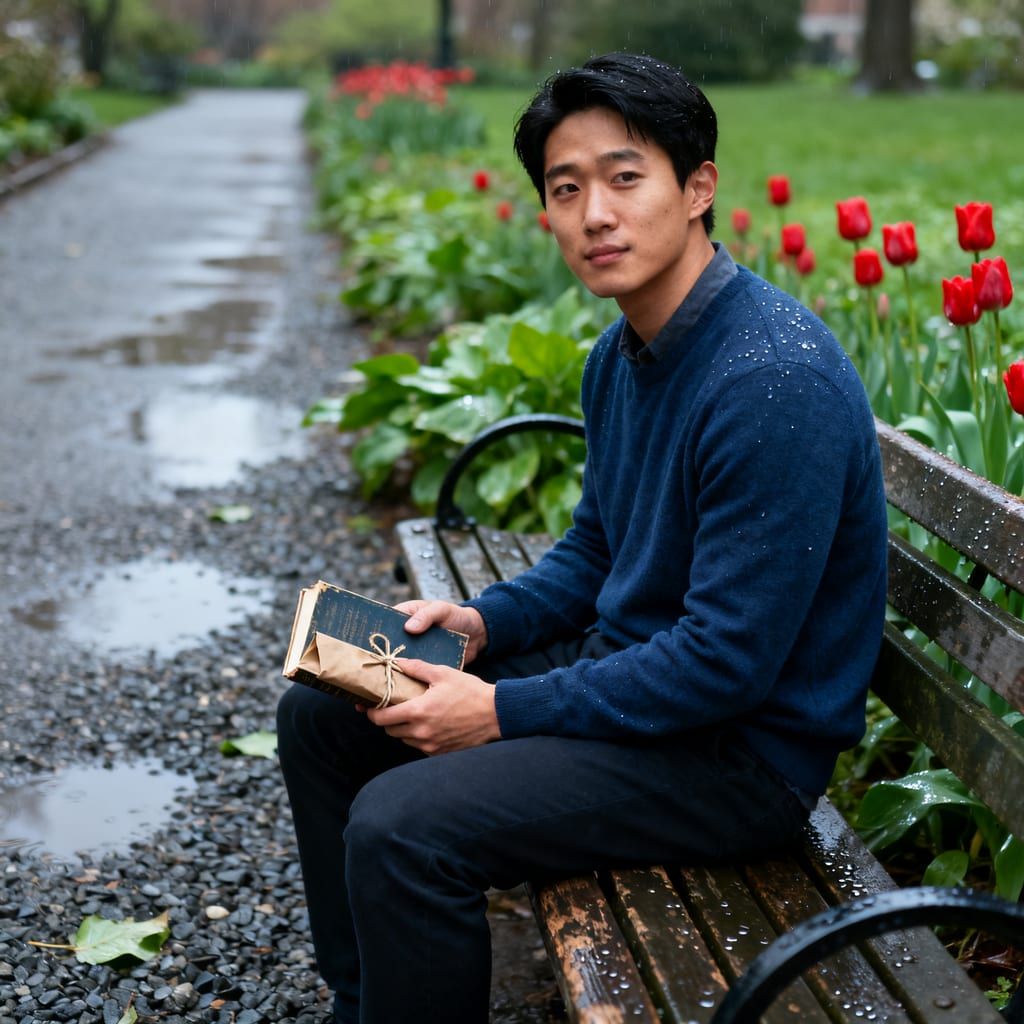
Philadelphia greets him with tulips holding their red like breath. The public garden-the one mentioned in a single sentence he skimmed as a kid-has benches worn shiny by the work of waiting. He sits. The bench is colder than he expects.
At his hip: a brown paper packet bound with kitchen twine, as if groceries had decided to be intimate. He looks around. Nobody watches. He unties the twine because there's no way not to.
Inside: photocopied letters in his mother's looping hand. "To my traveling boy," they begin. The dates are balled up and nonsense-she was sick then, months counting like jump rope-chemo at 10, radiation at 2, then a list of errands like talismans: pick up milk, return the book before Friday.
She writes of the paperback. How she read it in waiting rooms where the clocks looked bored. How the places held her together between appointments. How she whispered the names of gas stations and piers like beads on a rosary. How she hoped one day one of them-him or Mina-would stand in the places and feel less alone.
Leo's hands tremble. The paper makes a sound like a tent settling in wind.
Footsteps soften toward him. A woman pauses in that space people leave when they aren't sure if you want to be seen.
"Mina," Leo says before his eyes catch up. His sister's hair is longer, cut blunt, the way you do when you're starting fresh with old things. Her mouth is the same tired bravery it was at the funeral.
"Hey," she says. A whole apology lives in the word.
"Northing?" He tries to smile and almost makes it. "Seventy-two?"
"I was born in seventy-two," she says. "I called ahead. Asked people to look out for you. Not to control anything. Just to-" She lifts one hand, helpless. "Mom used to call it scaffolding. Gentle enough that you can't lean on it forever."
He looks at the letters again. Traveling boy. He sees her calling the laundromat, hears her voice when the attendant says take the token, people forget more than coins here. He sees her speaking to the server at the diner-Order the lemon pie-and to the librarian-gray box-hears the hush at the end of the line when she hangs up.
"Why not tell me?" Leo asks.
"You were moving again," she says. "I didn't want to be the reason you stopped."
They sit. The garden goes about its work: a bee nudges a flower like a friend, a jogger huffs past, a stroller wheel squeaks in a way that would drive you mad if you let it. Leo reads his mother's words aloud until they blur. Mina finishes the sentences without theatrics, just the practiced cadence of someone who has been pretending to be strong for so long that it became a dialect.
In one letter, his mother writes: "If you're at the diner, leave a tip big enough that someone else won't have to count their change to the penny. It's how we keep a road warm."
They sit until the bench takes their shape.
"Thirteen?" Mina says, half-joking. "Unlucky."
"Superstitions are just maps somebody forgot to label," Leo says. He surprises himself.
"Dinner at the diner?" she says.
"At the same table," he says. "We'll leave enough to keep someone else's journey warm."
He takes one last photo for the account: the packet on the bench, the twine curled like a question mark. He quotes: "The places were the readings." His caption is only: Philadelphia. Final stop.
The comments are a crowded hallway. Thank you. This made me call my sister. I left a token at my laundromat. And among them, from an account that has posted exactly twelve times and will post no more: You did good, traveling boy.
Leo switches his phone off. The paperback is light in his hands, which makes what it carried seem all the more a magic trick.
He stands. Mina stands with him. The path out of the garden is gravel underfoot, an ordinary sound that feels like a drumroll if you're paying attention. They don't hurry. The map isn't a page anymore. It's a street they already know how to walk.
On Route 1, the neon will hum at dinner. The geometry kid will be taller someday. The server will make a joke about lemon pie before pouring coffee into blue mugs. Leo will lay a bill under the check, and another beside it, and he and Mina will hold the door a few seconds longer for the next person through. And when the door swings shut, the bell will ring the way it always has-small, bright, and enough.
A daughter learns to read between the lines of a life split in two
Read more →
A fog-draped night, two souls found, and the quiet shape of a life
Read more →
Story audiobooks for children of all ages — a new one every day on Smarter Way Stories.