Two Houses and One Quiet Heart
A daughter learns to read between the lines of a life split in two
Read more →
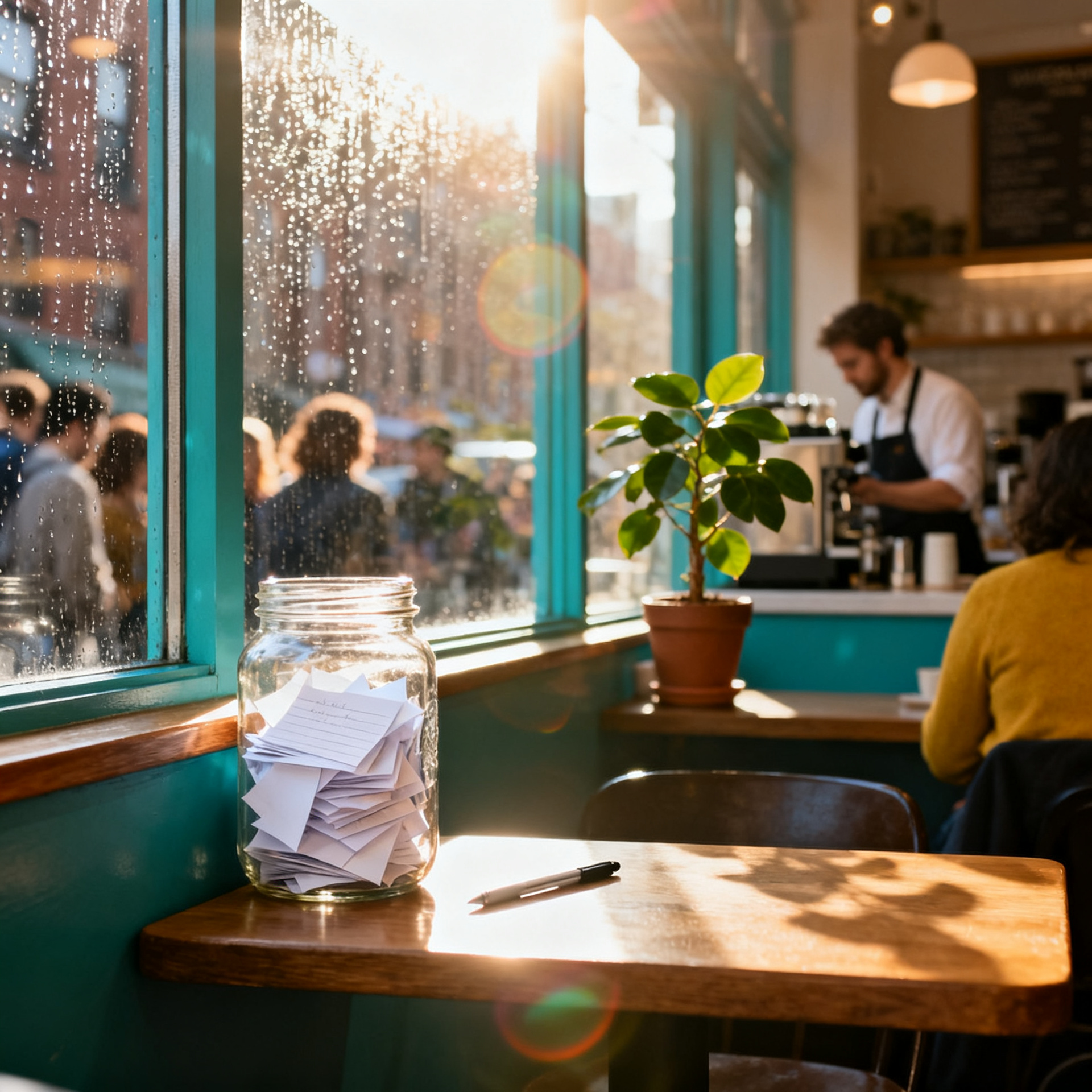
On a Tuesday that tasted like metal-rain in the air, old coins on her tongue-Nina Alvarez peeled an orange in a single ribbon and wrote it down.
"Orange that peeled in one ribbon," she printed, block letters, like a child still learning where the edges of words should be. She folded the paper and fed it to the glass jar that had once held pasta sauce and now sat, rinsed and repurposed, on her kitchen counter.
Her therapist had said, One small acknowledgment a day. Fold it. Let it be enough. Nina had nodded, then cried in the hallway by the elevator because the word enough felt like a door she couldn't find.
The next day, she wrote, "Bus that arrived while it rained," and the day after that, "Barista spelled my name right." She was forty-eight hours into being a woman who kept a gratitude jar. It felt performative and private, like humming a hymn in the wrong key when no one else is listening.
At the cafe on the corner-bell that chimed old-fashioned, walls the color of a good bruise-Nina took to bringing the jar with her. She set it on the corner of her table beside her laptop, beside the coffee she pretended to sip while her inbox grew teeth. The jar was a small column of quiet. She liked it there, its dumb, hopeful presence.
On a morning when the espresso machine wheezed like a train and the windows sweated, she taped a note to the glass, more out of mischief than faith: "What went right today?" She left a pen. She told herself it was accountability-if the jar had to look useful in public, she would at least keep writing.
She did. She added, "Sun on the fire escape for exactly five minutes," and, "Found a seat on the G," and, "Neighbor's dog didn't bark at me today." She still woke before her alarm with a rock on her chest-breakup raw as a skinned knee, the office suddenly reorganized until her job felt like a chair someone else had already sat in-but the slips softened the edges of hours the way steam softens a mirror.
Jamal, the barista with a crescent moon scar near his jaw and a ficus at the register that he watered like it was a dog, nodded at the jar when he cleared her mug. "Looks official," he said.
"I'm trying something," she said, embarrassed and defiant in the same breath.
"We're all trying something," he said, and pressed his thumb to the ficus soil as if to check its pulse.
Two weeks later, when she tipped the jar to make room for another slip, a second note rustled inside that she hadn't written. The paper was yellow, the handwriting loopy.
"Kindness of a woman who made room for my stroller."
Nina blinked at it. The ink had bled a little. She hadn't seen anyone write it. The next week, there was another: "Bluejay on the wire-reminded me of my dad." Then, "Finally called the dentist." Then: "Found the courage to sit alone and it wasn't terrible."
The jar, without making a sound, had become plural. She kept adding her own. She did not read the others, not on purpose. The point-she told herself-was to keep going, not to nosedive into strangers' tender moments like a raccoon into a picnic basket.
But she noticed herself looking differently. She thanked the bus driver. She picked up a scarf at the edge of a booth and chased it to its owner without making a fuss. She returned a stranger's dropped MetroCard at the turnstile with a soft, Sorry, you dropped this. In the mornings, she asked Jamal about the plant.
"It's a rubber tree," he said, proud as if he'd invented it. "When my mom FaceTimes, I show her the new leaves. She names them. This one's Dolores." He pointed to a leaf unfurling like a wet green tongue.
After that, Nina added, "Dolores the leaf finally opened," to the jar.
At her apartment, she let the practice creep into the rooms. She wrote, "Hot water on the first try," and, "Neighbor's radio caught the last chorus," and, on a Tuesday night when the loneliness hit like a low ceiling, "Texted my little cousin a meme and she snorted."
Her days stopped feeling like long hallways with locked doors. They were still hard-the reorg at work had turned status meetings into grenade fields, her ex's hoodie sat on the chair like a ghost who refused to leave-but there was also the small physics of noticing. The jar, ridiculous as it was, made her look for names of mercies already happening.
The email landed like a cold stone in a glass of water. Subject: Contract Update. She clicked and read: not renewed. Two weeks. We appreciate your contributions.
For a moment she couldn't hear. Then her ears roared. She shut her laptop because the light felt personal. She wanted to throw something, and the jar was nearest. It caught a shaft of winter sun and looked like a snow globe of paper, a child's toy for a grown woman's wreckage.
"God, this is stupid," she hissed to no one. She gathered it, pen clacking against glass, and wove through the cafe toward the trash bins. Her face had the heat of a sudden fever.
Jamal stepped from behind the counter, wiping his hands on a towel. "Whoa, whoa," he said, palm out in a gentle traffic-stop. "Hey, hey. That jar didn't do anything."
"It's silly," she said, ugly-tear-angry now, the kind that made her see in knife-edges. "I-it's not-what's the point of writing 'the bus came' when-"
"Maybe today's the day you read," he said, and put the jar back on her table with a firmness that felt like care.
She stared at it. The taped note-What went right today?-tilted, the tape losing its stick. She wanted to be mean to something. Instead, she unscrewed the lid.
It was the sound of a creek, of pamphlets being handed out, of patient wings. She unfolded the first slip on top.
"My kid ate the broccoli for the first time."
Then, "Saw the sky in a puddle and it looked like an oil painting."
Her own slipped in: "Ladybug on the Q seat." Her penmanship like she was pretending not to care. Then a crisper note: "Someone returned my scarf without making a fuss-thank you." She froze.
Another: "To the person who brings her own mug and reminds me to breathe-you're part of my morning."
She pressed her thumb to the paper as if to stop it from turning into smoke. Her breath went high in her chest.
"For the one who asked my mom's name and remembered it-she cried happy tears later."
She had. She had asked Jamal, What's your mom's name? And the next morning had said, How's Ava doing? And Jamal had startled, then smiled in a way that made his scar flash like a comet.
She read them sitting and then standing, stomach a fist, then a palm. There were thank-yous to the woman who held the door with her foot when both hands were full, to the person who said nice hat, to whoever put extra napkins by the tea because the dispenser jammed. There were notes that were little prayers to no one: "Pain was a four instead of an eight today." "The song in the cafe made me cry in a way I needed to." "Bluejay again; Dad says hi." Someone had written, in tiny careful print, "Saw a therapist. Not as bad as I feared."
At the bottom, among glossy chocolate foils and a gum wrapper someone had mistaken for a paper, there was a small, silver square folded into a tight seed. She recognized the foil. Day one. Her hands shook. She opened it carefully, chocolate ghosting her fingers.
"If you ever forget, read this. You are here. That is enough.-N."
Her own handwriting, her own early, stubborn tenderness. The enough again, but now it didn't feel like a door she couldn't find. It felt like a light somebody had left on for her.
Across the room, a woman bounced a baby and mouthed, Thank you, over the baby's head. Jamal polished a mug, pretending not to watch. The jar had not just tallied individual mercies. It had stitched quiet threads between people who would never know each other's last names.
Nina sat back down. The chair was wood and it held her. She breathed like a person who'd been underwater and found the surface by accident.
That night, in her little apartment with the radiator clanking like a distant train, she poured the slips onto her kitchen table. They slid across the surface like fish. She didn't try to sort them by handwriting or sentiment. She didn't try to curate. She found an envelope, the kind meant for rent checks, and wrote "January" across the front in her neatest letters.
She pushed every slip into the envelope, even the anonymous ones that made her throat ache, even the one in all caps that simply said, "COFFEE."
She washed the jar, the glue from the old label peeling under her sponge like a healed scab. She dried it upside down on a dish towel with little lemons printed on it, then righted it and felt the simple satisfaction of glass against palm.
In the morning, she carried it back to the cafe. The bell chimed its brass hello. The tables wore their ring stains like constellations. She set the jar on the corner of her usual table and taped a new note on the glass.
"Take one if you need. Leave one if you can."
Jamal came over with a coffee he didn't charge her for. "New rules?" he asked.
"No rules," she said, and smiled in a way she hadn't in a while, a way that revealed an old dimple she'd been stingy with. "Just... a circle."
He touched the jar the way he tapped the rubber tree's soil, checking the invisible.
She opened her notebook instead of her inbox and wrote, "Light on Dolores," because the morning had caught the leaf at an angle that made it look lit from inside. Then she wrote, smaller, because it was fragile and hers, "Told the truth to myself without flinching."
Around her, the room did what rooms do when they have been quietly arranged toward kindness. The door opened and closed. Shoes squeaked. Steam rose. A stranger asked another stranger if they could share the table, and the stranger said, Of course, and meant it. Someone slipped a note into the jar with the practiced secrecy of a person who has finally decided to tell the world a small good thing.
Nina reached to steady the jar as it accepted the new weight. It was only glass. It was also something else. She didn't have a title for it. She didn't need one.
Outside, the bluejay was back on the wire. Or maybe it was a pigeon with a trick of light. Either way, she looked up. Either way, she noticed.
And when the bell chimed again, it echoed in the jar-a soft, affirmation-sized sound-and this time she heard it.

A daughter learns to read between the lines of a life split in two
Read more →
A fog-draped night, two souls found, and the quiet shape of a life
Read more →
Story audiobooks for children of all ages — a new one every day on Smarter Way Stories.