Two Houses and One Quiet Heart
A daughter learns to read between the lines of a life split in two
Read more →
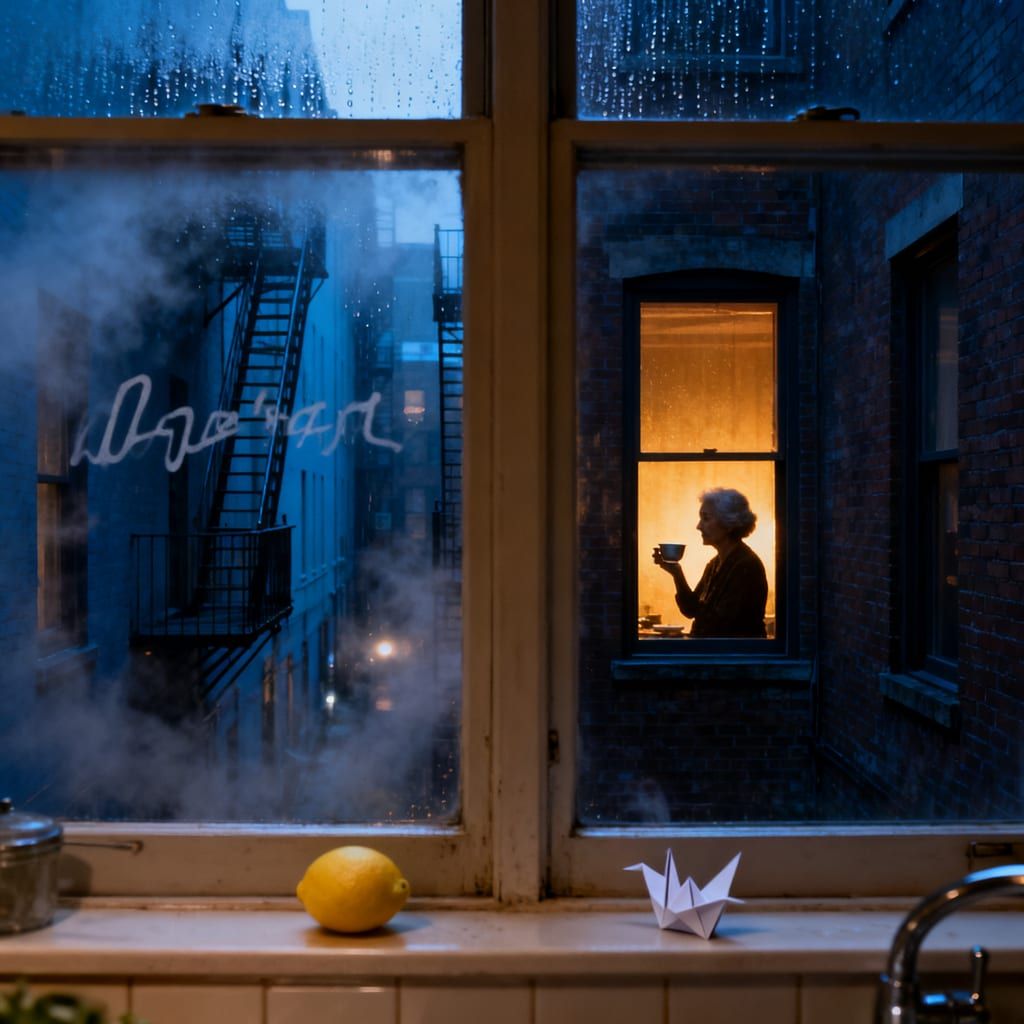
The first time the window spoke to her, Nora thought it was a trick of light.
Steam uncoiled from the kettle and licked the cold pane. On the glass, a sentence bloomed in ghostly strokes as if lifted from the past and pressed here again: Do you see me?
Her apartment was new to her in the way a coat is new-stiff, smelling faintly of someone else. Third-floor walk-up, a narrow kitchen, the sort of sink that sighed when you leaned on it. Outside, the alley ran like a vein between buildings, a slit of sky, brick shoulders hunched.
Do you see me?
It felt like a dare. Or an invitation.
On impulse, she pressed her fingertip to the misted glass and wrote, small and careful: I do now.
She stood there with her breath fogging the E, the kettle rattling to a quiet. Somewhere in the building, a dog barked and was shushed. When the words faded, she half-convinced herself she'd imagined all of it. Grief and moving boxes could make a person read messages into anything-the pattern of a tea stain, a fortune stuck to her shoe.
But the next night, when the heat rose and the glass went soft again, there it was-her answer reappearing pale as a bruise: I do now.
Across the narrow gap, another kitchen window fogged to opaque. A shape passed behind it, then stilled. Slowly, clumsy letters wrote themselves onto the other pane, reversed as if the alley were a mirror.
Is it you? J.
Nora laughed, a small startled bell. She found herself arranging her letters so they'd read correctly from across the way. Her fingertip, pink and cold, wrote: It's Nora. New here. Third floor. Tea addict.
A beat. Then, from the other side: Black tea. Milk. Insomniac. City feels like a bus you can't catch.
It went on like that for a week of damp evenings, the temperatures dipping low enough to make the window's breath visible. Their sentences were brief, the sort you could write with a single exhale.
She learned J liked their tea strong and the radio low. That they preferred old movies, the ones where no one held a phone. Once, J drew a wobbly skyline with a heart hovering above it, then crossed it out and wrote: Too much?
Nora drew a tiny umbrella. She had a way with icons after a decade in UX-when your day job is translating confusion into buttons, you get good at shorthand. She was recently unemployed by choice, she told anyone who asked, including herself. The layoffs had come and she'd said, finally. Two weeks later, the echo of her bravado became a hollow that rattled when she moved.
You new to the city? J wrote one night, letters elongating with the drip of condensation.
Sort of. New to living alone. New to the quiet.
Hate the quiet, J scribbled. Love it, too.
They never tried to see each other's faces. There was something about the ritual-sentence for sentence, steamed into being and then lost-that made hiding feel like a kind of respect, as if both of them were holding a thin thread between sills and didn't want to snap it by tugging too hard.
On the seventh night, the alley stunk of rain in metal. Nora had boiled the kettle again even though she'd already had tea, for the company of its sound. The words lifted up on the pane like a message being developed in a darkroom.
Thank you for answering. He loved this trick. I'm June. Sixty-eight. My wife used to write here when the kettle sang.
Nora felt the floor tip. She leaned on the counter, finger damp and hovering.
Your wife? she wrote. And-he?
The reply came in a slow, careful line.
He was our neighbor, years ago, who told us about residue stories-how oil from your finger can live on glass. My wife wrote Do you see me? the first winter here. It comes back when it's cold enough. J was her first initial. June is me.
Nora watched the letters bead and weep. The sentence she had seen that first night wasn't a fresh dare. It was a visitation.
I'm sorry, Nora wrote, though the words felt small, like whispers in a cathedral.
June pressed both palms to the glass. Even reversed, the gesture translated. Then the next fogging brought: No need to be sorry for this part. Seeing your answer felt like permission. I had stopped boiling water at night.
The kettle on Nora's stove clicked and settled. She pressed her own palm to the pane. They stood there like that, two women with a narrow slice of air and years between them, the alley a channel and a moat.
After that, their conversation became less strictly about tea. June wrote about the people in the photographs that lined her kitchen walls-Nora could only glimpse frames, oval shadows with faces tucked inside. She learned June had once taught music to teenagers, that she still played scales sometimes when the afternoon light hit the piano just so. Nora sketched tiny eighth notes the size of freckles.
June asked what it was Nora had done for work. Nora typed and erased three times before writing: I made screens you can use with your thumbs. Now I'm making dinners for one and getting dangerously good at solitaire.
June's answer: Solitaire can be a duet, you know. Or at least you can pretend.
Nora laughed into her sleeve. The sound surprised her enough that she held it in her mouth like a cough drop.
On the sill's cold lip the next evening, Nora left a paper crane folded from a grocery receipt. It was lopsided, the kind a bored child might make in the backseat of a car. Across the alley, a lemon appeared on June's sill, bright as a small sun. The night after that, a sprig of rosemary from Nora, resinous and elastic. June taped a cookie to her window in wax paper and wrote: Best dipped.
It felt like a child's trading game made sacred-this for that, you for me. The alley, with its gutters and rusted fire escapes, became a kind of mantel where they placed their offerings. They were careful not to drop anything. The wind made them careful.
There were no grand confessions. Nora told June she'd pretended to want the layoff because wanting felt like control. June wrote, delicately: We told everyone we liked sleeping with the window open because it was romantic. Truth: we couldn't bear to close it in case the house lost her scent.
When June finally drew a small heart, she did not cross it out.
A week into their exchange, Nora did a braver thing. She made tea at nine as usual and, while the kettle sang, she rapped a rhythm on the wall to the right of her window-three short knocks, pause, three again. It felt absurd. It felt essential.
Across the alley, there was the softest answering thrum. June's shadow moved into the square of light. A hand lifted-wavering, then sure.
Nora swallowed and gestured, awkwardly pantomiming stairs with her finger-down, across, up. June laughed, the sound carried weakly by the cold but distinct enough to travel. She pointed down and made a circle with her hand. Come.
Nora pulled on boots and her coat and, without pausing to invent a reason not to, took the stairs two at a time. The alley was a mouth of air. Up close, the bricks wore their years like freckles. She found the other building's buzzer and pressed. A beat. Then another. The door opened on a wash of warm light.
June was smaller than Nora had pictured and somehow larger. White hair in a loose bun that had yielded to gravity, eyes bright behind glasses that caught the hall fixture's glare. She wore a cardigan the color of tarnished coins and thick socks.
"Hello," June said, as if they'd been saying it all along.
"Hi," Nora said, breathless from stairs and the feeling of having stepped into an old photograph.
Inside, June's kitchen was tidy in the way of rooms that have been loved, not starched. A radio sat like a visitor on a shelf. The kettle was already on the flame, humming as if introduced to an old story.
"Teach me the song," Nora said, without planning to.
June smiled. "She used to say the kettle had three verses," she said, hands moving without consulting memory-lid off, water in, flame adjusted low. "First, the murmur. Then the gossip. Then the call."
They waited together. Through the window, the alley translated itself back into a view: fire escapes like skeletal ribs, a cat stepping along a railing with the arrogance of kings. On the sill, the lemon and the rosemary looked like they were having a conversation of their own.
The kettle's murmur grew to gossip. June turned the flame a whisper higher. Nora thought of all the times she'd filled a silence with words that didn't mean anything because she feared the next moment might never come. She let the sound fill her ribcage.
The call came-clear, insistent. June took it off the heat with a practiced small tilt, taming it into a sustained note. "If you listen," she said, "you can hear it soften. Like it forgives you for being impatient."
They poured. Tea, two cups, milk for June, lemon for Nora because it felt like a benediction to use what had crossed the alley. They sat and looked at the photographs on the wall. Four decades of laughter pulled taut into frames. Two women in raincoats. Two women in silly hats. Two women on a sofa, one asleep in the other's lap, a book tented on her chest.
"I pretended," Nora said, thumb circling her cup, "that I wanted to be let go."
June nodded. "I pretended sleeping alone was bravery, not necessity."
The kettle clicked as it cooled. Nora felt heat in her throat that wasn't the tea.
"Maybe pretending is a way through," June said. "Until it isn't."
Days lengthened in the sly way late winter permits. The alley's icicles thinned, then vanished. Their messages grew shorter as the window's breath abandoned them. It was almost a loss, almost a relief.
They switched to notes pushed beneath doors, to quick knocks, to cups of tea shared at a table rather than on panes of glass. Nora found work she could do without holding her breath-a small studio that designed wayfinding for gardens and museums. June brought out a recipe card for lemon cookies in a hand that belonged to someone not here and set it down between them like a treaty.
On a morning when the air finally warmed and the pane refused to fog, Nora stood at the window anyway. The glass was obstinately clear, reflecting her face and the narrow alley and a sliver of sky she was learning by heart.
She pressed her fingertip to the dry surface and wrote, invisible to anyone but her.
I see you.
She held the words there not for June, not for a vanished hand, but for whoever would stand in this kitchen someday and boil water and look out and question who they were without others to answer.
Across the alley, a figure moved into June's square of light. June lifted a cup and Nora did, too, an old salute learning a new language.
The kettle on Nora's stove murmured. Then gossiped. Then called.
She let it sing a little longer than before. Then she softened it, patient now with the time in between.

A daughter learns to read between the lines of a life split in two
Read more →
A fog-draped night, two souls found, and the quiet shape of a life
Read more →
Story audiobooks for children of all ages — a new one every day on Smarter Way Stories.