Two Houses and One Quiet Heart
A daughter learns to read between the lines of a life split in two
Read more →
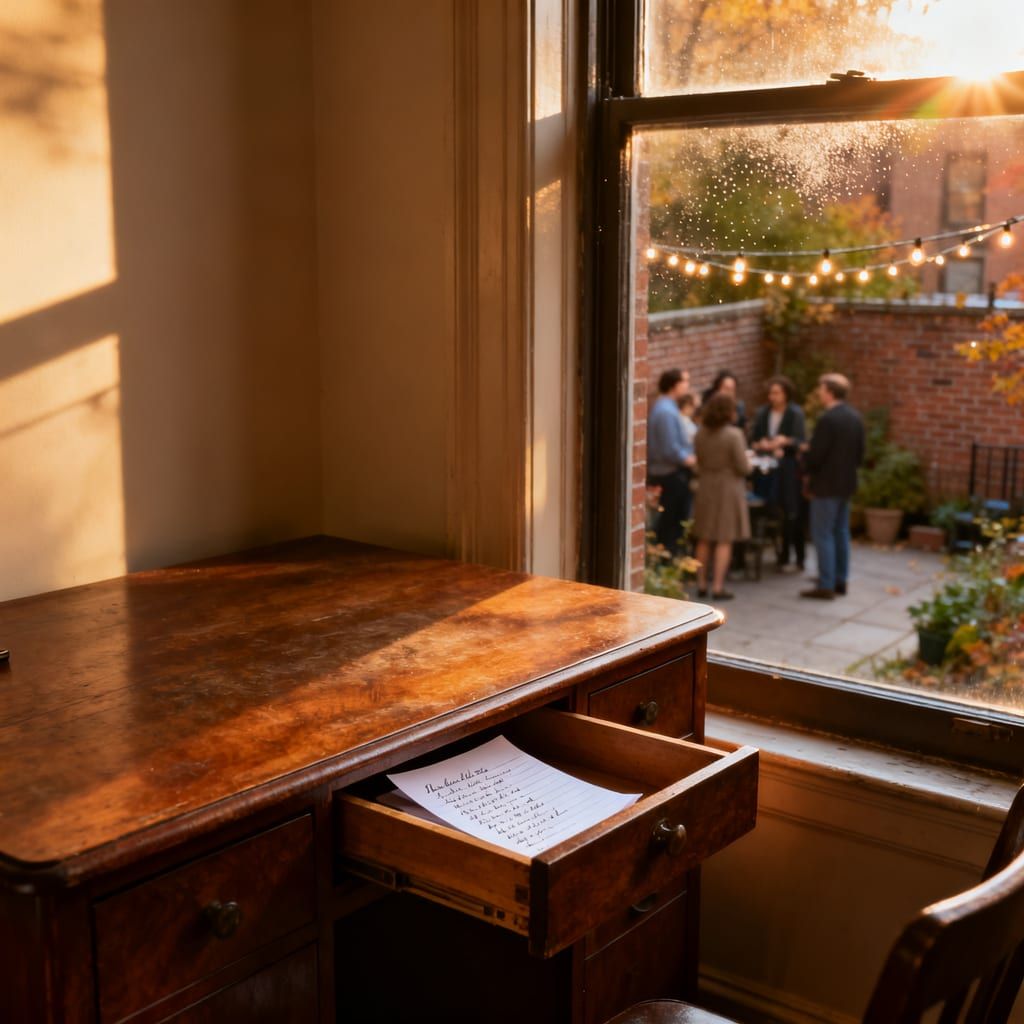
The desk came bareback on a dolly, rattling over Brooklyn cracks like an old suitcase that had insisted on making one more trip. Lina held the door with her hip and the delivery guy backed into her prewar building's foyer, both of them panting in the April-turned-to-October heat.
"Free is a good price," he said, eyeing the dovetail joints, the way the legs bowed like polite knees.
"It was a bidding war of 'I can pick up now,'" Lina said. "I won by unemployment of spirit."
He grinned without understanding. He left her with a nod and a hand truck squeal, and Lina slid the desk against her living room wall. It smelled like lemon oil and something faintly sweet, like page edges left in sun. The Buy Nothing post had called it vintage; it had the decency to look tired.
Her phone buzzed with Slack notifications she'd snoozed and then un-snoozed on a loop. The promo that hadn't come sat on her chest like a wet towel. She tucked her phone under a folded kitchen towel-ridiculous, like covering a birdcage so the bird would calm down-and pulled open the top drawer.
It stuck on something.
There was a false floor at the back. She pressed a knuckle into the oak and felt it give. A shallow compartment sighed open, exhaling dust and a single folded sheet.
The paper had creases like a well-loved map. At the top: "Practice Notes" in tidy block letters. Not scales. Not arpeggios. A litany of small imperatives.
Lina read it again, amused and a little pierced, as if a stranger had leaned over and guessed her coffee order and the secret fear she refused to say aloud. Practice? She pictured herself in a stadium for retired hopes, blowing a whistle.
Beneath the list, tucked in the corner, was an old repair receipt from a shop on Smith Street. "Owner: Evan Reyes."
"Hi, Evan," she said to the empty room. "Nice desk."
Outside, a kid yelled from a scooter. Somewhere, a radio kicked into a bass line. Lina's mouth tasted like old coffee and mint gum. She looked at the towel-draped phone. She thought of her half-made resignation letter, of midnight screens casting her in submarine light. She laughed once, short and brittle.
"Fine," she told the desk. "Let's practice."
Her mother picked up on the second ring, the background filled with the staccato of a cleaver against a board and a Korean soap opera everyone seemed to be crying through.
"Are you eating?" her mother said. "You sound thin."
"Sound thin?"
"I can hear your bones, Lina-yah."
Lina leaned against the new old desk and slid down to sit on the floor, the receiver warm against her ear. She could smell gochujang and sesame oil through memory. "I got a desk for free," she said, because big things lodged like stones.
"Free is good," her mother said. "Bring it upstairs so I can see."
"I don't live upstairs, Umma."
"You know what I mean."
They talked about small things, which is to say nothing and everything: the weather on both ends of the Q train; which aunt had offended which cousin; whether Lina had eaten enough protein to keep her hair from falling out. At the end, before she could lose her nerve, Lina said, "I love you," and her mother said it back like a sigh and a blessing.
The next morning Lina left ten minutes early for the bus and felt like she had cheated the day. She climbed the steps, MetroCard in a swoop, and said, "Thanks for waiting," to a driver with gold hoops and a jawline that suggested nothing had ever surprised her.
The driver blinked, then smiled from the corner of her mouth. "Yeah, well. We all have places to not be late to." When Lina got off on Court Street, she waved at the driver through the glass. The driver lifted two fingers in a small salute. The gesture rode with Lina longer than the bus had.
In the lobby, the super had propped the front door open with a milk crate. Mailboxes lined the wall like brass mouths. A tiny woman with a cane wrestled a grocery bag down the steps. Lina scooped it with a "May I?" before the woman's protest could gather.
"You are strong," the woman said, approving. "Apartment 2C. I am Mrs. Alvarez. My daughter says to let people help, but then they help too much."
"Lina. 3A. I'll aim for just enough."
Mrs. Alvarez's apartment smelled of bay leaves and old furniture polish. On her dining table was a stack of library books and, sticking out from one, a faded date slip stamped in purple with years Lina's brain didn't want to count.
"I keep forgetting to return that." Mrs. Alvarez tapped the stack. "This one is about birds. I like birds. They don't ask for anything and still they sing."
"Blackbirds?" The word leapt without permission.
"Starlings, mostly. Nasty little gangs." She peered at Lina. "You have a look. Like a person who has made a list."
Lina laughed, guilty. "Maybe."
"Good. Lists are for people who intend to stay."
On the way out, Lina slipped the overdue book into her tote.
The librarian at Carroll Gardens had a sharp bob and a tattoo of a fern curling behind her ear. She scanned the book-Paul Theroux's essays, thumbed to beach-salted pages-and frowned. "This is-wow. Pre-digital system. No fines, don't worry. But we'll toast its homecoming."
"I found it in a desk," Lina said, and the story unspooled because once she started saying it out loud it insisted on being spoken: the drawer, the list, the name on the receipt.
The librarian, whose name tag said MARGOT, tapped Evan's name thoughtfully. "I know a Reyes who used to come to guitar night. He played 'Blackbird' and made it not annoying." She hesitated. "Try Red Note on Smith. Lou teaches there. He knows everyone like a bartender."
Red Note was a narrow storefront stuffed with instruments in various states of hope. A man in his fifties with a salt-and-pepper beard sat behind the counter restringing a battered acoustic. He had teacher hands-capable, nicked, patient.
"Looking for a miracle," Lina said, and lifted the list like a dare.
Lou read it and made a soft sound. He flipped the paper and pointed at the back, where Lina hadn't looked. In tiny cursive: "Homework-daily practice. Start small. Evidence of life."
"That's Reyes," Lou said. "Evan used to come by after-" He glanced at her, recalibrating. "After a rough patch. Good kid. He'd count victories on his fingers like he was measuring chords."
"Do you-" The question felt like stepping into water you can't tell the depth of. "Do you know where he is now?"
Lou's face changed. His thumb rested on the guitar's neck. "He had an accident last year. Bike. Atlantic Avenue. His dad still checks his mail sometimes. The super lets him in. 4B."
Lina thought of the back of the list, of the tiny letters pressed like prayer. Her throat went hot and then cooled.
"Teach me 'Blackbird'?" she asked.
He handed her a guitar with the tenderness of someone returning a baby. "We'll take the slow street."
The community garden lived behind a chain-link fence softened by vines. The sign read MEMBERS ONLY but everyone inside looked like they had become members by slowing down and making eye contact. A young woman with dirt half-moons under her nails waved from a patch bursting with tomatoes.
"Plot envy is encouraged," she said. "You new?"
"I need to plant basil," Lina said. "For medical reasons."
They found her a windowsill pot and three hopeful starters. The dirt shocked Lina's fingers with coolness. She pressed basil into a little grave, covered it, and patted the mound as if apologizing. The air smelled like damp earth and the promise of something edible. A man in overalls debated marigolds with a child in heart-shaped sunglasses. A wind chime tattled on a breeze.
On the way home, Lina walked a parallel block she usually skipped-one with fewer delis and more stoops. On this slower street, a woman on a third-floor balcony hung white sheets with the focus of a surgeon. A dog decided the sun was a mandate. Lina felt the city's pulse drop, the way a song slows when you lift the needle.
Forgive yourself for 2013.
The year in question was a mess of job changes and a breakup so spectacular it wrote its own weather. She had said things with the sharpened precision of a person aiming to be understood at any cost. She had broken someone's favorite mug and left the shards for later. She had taken a promotion out of spite and then resented the view.
In her apartment, Lina sat at the desk and wrote the worst of it on a napkin from a taco truck. She lit a match over her kitchen sink and watched ash float like new snow. She turned on the fan. She opened a window. She wiped the counter. She drank a glass of water. No choir broke into song, but the room felt slightly larger, as if someone had moved the furniture while she wasn't looking.
She brought muffins because that's what people bring to the doorways of others when the words are too heavy to carry alone. Blueberry, store-bought, plucked from a box and re-homed in a paper bag to pretend at domesticity.
The door to 4B opened before she could knock the second time. A man in his sixties stood there with Evan's eyes described to her by strangers-curious, brown, a little wary. He wore a Mets cap and a grief that had learned to sit without interrupting.
"Can I help you?"
"I found something of your son's," she said, the word son asking to be allowed. "In a desk from the Buy Nothing group."
They stood in the hall with the radiator clanking like an old man clearing his throat. She showed him the list. His knuckles went white on the paper bag.
"Practice notes," he read. He smiled and it cracked at the edges. "He used to leave voice memos to himself. 'Practice being human,' he'd say, and I'd tell him he was very good at it already."
"I've been doing them," Lina said. "The notes." She tried to explain the bus driver and the basil and the slowed-down street, how a librarian recognized him and a guitar teacher missed him. "It felt like-" She gestured at the air, at the shape of a map only she could see. "Like he was practicing in plain sight. And then I was, too."
Evan's father lifted the list to his chest. When he looked back up, he had that stunned expression of someone realizing that a closed door opens onto another room, not a wall.
"There's a courtyard," he said. "The super's grilling later. You should come."
The building's courtyard had pavers that tried their best and a string of bulb lights softening the brick. Someone had balanced a Bluetooth speaker on a windowsill. Children ran in figure eights that made sense only to them. Smoke scribbled lazy lines in the October dusk.
Mrs. Alvarez patted the chair next to hers. "You came. Good. Sit. Eat. Be seen."
Margot the librarian arrived with a Tupperware of brownies and a boyfriend who could not stop asking who had made the potato salad. Lou ambled in with a guitar and the privacy of someone who had changed many strings and many lives. Evan's dad hovered by the grill turning corn as if it might confess.
When it was time, Lou pressed the guitar into Lina's hands. Her fingers were new; they ached like a good hurt. The courtyard quieted in the slow, respectful way that says this is a thing we will hold together.
She began. The notes of "Blackbird" are deceptively simple until you ask them to stay. Her thumb missed a string and her ring finger cramped and, somehow, the melody threaded through anyway. Her voice, when it joined, wasn't pretty, but it was hers and it didn't crack where it had in practice. She sang about broken wings and the audacity of learning to fly in the dead of night, and air gathered under her like a promise.
When she finished, there was a breath of silence, and then the courtyard applauded like rain on a roof.
Evan's father stepped toward her. He had tears, yes, but they had room around them. "He loved that song," he said, and his voice wasn't only sad. "Thank you for... keeping at it."
Lina handed him the folded list. It had become soft in her handling, the edges rounded by pocket and palm. "I thought you should have it," she said. "But I wanted you to know-he helped me. He helped a lot of us without knowing."
He held the paper carefully, like you hold an infant or a living thing. "Maybe that's the trick," he said, almost to himself. "You practice for yourself, and some of it escapes and does the work anyway."
Back upstairs, the apartment smelled like charcoal and basil. The plant on her windowsill was improbably upright, the first leaves green like a decision.
Lina slid the desk's secret panel open and tucked a new sheet of paper into the shallow space. Her handwriting had always felt too tidy for her life; tonight, it looked right.
She left the drawer slightly ajar-the faintest opening, enough to suggest there might be something worth finding.
Her phone, uncovered now, blinked a small galaxy of messages. She let them be. In the courtyard below, someone laughed the kind of laugh that bends you in half. A blackbird-not a blackbird, probably a pushy starling-landed on the fire escape railing and scolded the whole evening on general principle.
Lina pressed her palm flat on the desk. The wood was warm. The apartment felt less like a place to endure and more like a place that noticed when she entered.
She thought of Evan counting victories on his fingers. Lina curled her own, one by one, into a hand that could hold on without clenching. She didn't say it out loud, but it sounded like thanks.
A daughter learns to read between the lines of a life split in two
Read more →
A fog-draped night, two souls found, and the quiet shape of a life
Read more →
Story audiobooks for children of all ages — a new one every day on Smarter Way Stories.