Two Houses and One Quiet Heart
A daughter learns to read between the lines of a life split in two
Read more →
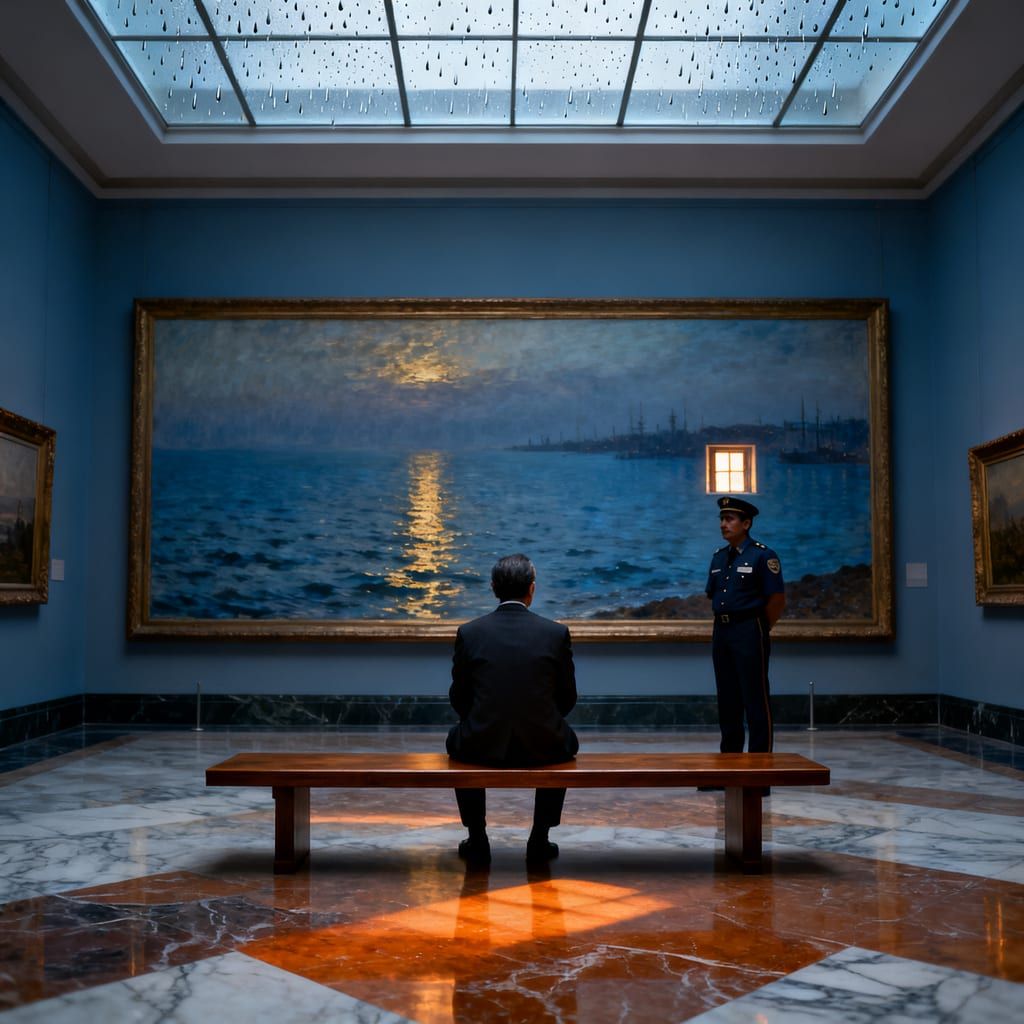
Most days, Diego Morales measured time by the scuff of his soles on marble. Ten thousand footsteps from the freight elevator to Gallery 12. Eight thousand back. Paintings kept the hours, too-lilies whispering morning light, saints scolding noon-and at three-thirty, like tide, the same man arrived.
Mid-sixties, neat in the way careful people are neat. A gray sweater folded into itself, dark trousers creased like paper. He took the third slat from the left on the oak bench and faced the oil seascape titled Harbor at Dusk. He stared as if the canvas were a clock only he could read. His lips moved. His eyes did not blink.
For three weeks Diego watched without watching. He knew the museum's hush by heart-the breathy shiver of the vents, the rain-patter of school groups drip-drying into quieter rooms, the gossip of the guards at shift-change-but the man's steadiness cut through. At five, when the lights began their polite dim, the man rose and left like a figure stepping backward into fog.
On the fourth week, the skylight worried itself with rain. Diego stationed himself near the stanchion rope and listened. The sound was there if you stood in the right pocket of air. Numbers, counted under the breath. Not prayers. Not words. The metronome of someone holding on.
Diego, who had learned the economy of silence, started counting too from across the room, syncing mouth without sound. Forty-seven. Forty-eight. Fifty, the swell of a wave caught in ochre and cobalt.
He had been trained not to ask. People brought their ghosts to art; his job was to stand gently between the living and the frame. But rain threaded the afternoon into a single gray ribbon, and curiosity sometimes outweighed training.
He stepped closer, palm grazing the walkie clipped to his belt as if to remind himself where he belonged. The man's eyes didn't flick from the painting.
Diego said, softly: "Why this one?"
The man's counting stopped. He did not turn his head. For a long beat all that breathed in the room was rain and paint.
"My wife," he said finally. His voice held no preamble, only the careful cadence of someone setting down crystal. "This was the last thing she could still name. Before the rest went." He sighed-no sound of pity in it, only weather. "She loved the fall of light on water. She called it the place where blue remembers."
The words made a hollow ring inside Diego's ribs. The place where blue remembers. He tried them on internally and felt them fit. The painting-a shore at evening, not a grand harbor but a working one-held a strip of spent gold spilling itself into slate. Far masts pricked the horizon. Sky and sea negotiated a truce in brush lines you could see, strokes definite and human.
"When she began to forget faces," the man continued, "including mine some days, I brought her to sit here. On the good days she reached for my hand. On the bad days I counted the brushstrokes out loud. Anchors. Numbers held when names got loose."
Diego looked at the slope of the man's shoulders, the straightness with which he wore his grief, or maybe its afterimage. The rain tapped harder. A couple drifted through the gallery, paused, leaned in, decided to keep their weather to themselves and moved on.
"After she died," the man said, "I gave the last of what we had to bring it here. In her name, though it's listed as 'Gift of a Friend.'" He smiled with one corner of his mouth, a small technical correction. "Grief felt too private for a plaque."
Diego had walked past that brass strip a hundred times, read the tidy letters without tasting them. Now they filled with blood.
"I come because I promised to keep counting," the man said. "Not to relive. To keep watch. To make sure the blue still holds."
He lifted a hand, finally, and pointed to a small square of paint Diego had never fully seen-a window in one of the shoreline houses, faint light tucked inside the dusk. In the bevel of glaze, a tiny silhouette suggested itself, no more than two strokes. Someone looking out.
"She put herself there," the man said. "Always did. Said she liked that the person didn't wave. Just watched. It made the watching enough."
Diego leaned, not too close, and found the figure as if the man had guided his finger to it across an invisible map. How had he missed that? He had logged this room like a surveyor, paces recorded, sightlines measured, alarms tested. He had never measured this: that someone could live inside a window on a painted shore and make a life of looking.
They stood with the rain and the blue between them. Then the man resumed: fifty-one, fifty-two, under his breath, and Diego followed silently on the far side of that ledger.
The next afternoon the man came at three-thirty, sat on the third slat, and began. Diego counted from the exit, then from the opposite wall, then beside the bench. The rhythm settled into him like steps he already knew. Somewhere above, the skylight cleared, then clouded again.
On a Wednesday the man arrived with a program folded twice, the paper softened by too much pocket. He held it a moment as if changing his mind and then pressed it into Diego's palm.
"Her memorial," he said. "I'm stopping after next week. Anniversary of the donation. Feels like a good day to let the numbers keep themselves."
Diego felt, in the boyish part of him that still believed in switches you could flip and people would stay, a small panic. "Will you be all right?" he asked, then hated the poverty of that question.
The man's mouth did the technical correction smile. "I am all right in the ways that count. But I would like to ask you something." He leaned in, not conspiratorial, just close enough to lend weight to the words. "If anyone ever asks about the blue, tell them someone loved someone here."
The line landed like a key in some old lock. Diego nodded, throat tight. The paper in his hand felt warmer than paper should feel.
When the gallery emptied toward closing, Diego stood before the seascape until his colleague coughed a gentle reminder about timers. He read the program at the guard's desk, lips moving the way his had been trained not to. A black-and-white photograph of a woman in a knit hat, hair springing from underneath like something that refused to be categorized. Under the dates, a sentence: She paid close attention to ordinary light.
He thought of his daughter the way a person thinks of a room they used to live in-housing layouts remembered by the feet. A chuckle at sixteen that turned itself sideways into a laugh; the first tattoo hidden at the edge of her sock; a fight in a kitchen about nothing important that had grown teeth; months calcified by pride.
Diego had not called in too long to count.
The day the man said goodbye, the sky had the careful look of winter holding its breath. He took his seat like an usher trusts his aisle and counted in a whisper steady as a tide chart. Diego did not interrupt. When the lights began their dimming, the man stood, touched his fingers to the railing as if it were a forehead, and left without turning.
Diego stayed with the painting until the hum of the vents threaded itself into a single chord. A woman in a red coat lingered, her bag riding too high on her shoulder as museum bags do. She glanced at the plaque, then at the window on the shoreline, blinked, blinked again.
"It's beautiful," she said to no one in particular.
Diego heard himself answer. "A friend gave it," he said, nodding toward the small brass strip. "For his wife. This was the last thing she could name. He used to count the brushstrokes to keep her from floating away. He said the blue remembers."
The woman's eyes slid to the corner where the silhouette lived. "Is that... a person in the window?"
"She always imagined herself there," Diego said. He felt, as he spoke, something loosen and not fall. "Watching. Making the watching enough."
The woman stood a little straighter, like someone had handed her a sweater without touching her. "Thank you," she said. She did not ask for names. The story was whole without them.
Diego walked his loop slow. He could not make his hand pick up the phone on the ride home, so he set it on the table and let it look at him while he microwaved soup. He ate standing up, then cleaned the bowl immediately, as if delay might give doubt a place to sit. The phone lit his palm like a small moon.
When his daughter answered-he had half-hoped for voicemail, the safety of a recording-she said his name the way a person tests ice. "Dad?"
He hadn't prepared a sentence to lay down first. He put the weather out like an offering. "It rained here," he said. "You know that sound on the skylights at the museum? Like someone clapping softly far away? They finally fixed the leak over Gallery 3."
She laughed, a tiny slide of glass against glass. "I can hear it," she said.
He told her the football score-she asked first, their old map-and then paused long enough to hear his own heart checking its measurements. "I don't want to forget us," he said, the words surprising him by how little they fought.
On the other end of the line, he could hear a dog collar shake, a kettle click. "Me neither," she said. The quiet that followed didn't lean or accuse. It held.
They spoke of next week, of dinner choices as if choosing them were a kind of prayer. When he hung up, the room felt larger by a chair.
The next afternoon, a new visitor took the bench-a teenage boy with a backpack, legs splayed in the way of people too tall for their own growth. He stared without blinking. Diego found his pocket of air and counted, not out loud, not pressing the numbers the way the man had, but letting them bead on the string of the afternoon.
Forty-seven. Forty-eight. Fifty.
A couple came in from the rainless day, damp anyway with weather they carried. They asked about the painter. They asked about the harbor. They paused at the plaque and frowned at the anonymity as if the museum had misplaced something. Diego told them-trimly, the way he'd been asked-to say that someone loved someone here. He pointed to the window no one had noticed until they did. He watched their faces arrange themselves around that small light, a new architecture.
Evening took its polite step down. The boy with the backpack shifted and stayed. Diego stood, the hush at his back like a hand between his shoulder blades. He thought of the man at home not counting, of his daughter rinsing a cup and not hanging up quickly, of a woman in a knit hat counting the sky as it poured itself over water.
He closed one eye, then the other, a guard checking a sightline. The blue held. That was the miracle and the maintenance.
He breathed, matched himself to the painting's long slow pulse, and counted into the quiet-not to keep from losing, but to share the carrying.
Fifty-one. Fifty-two.
When the lights dimmed, the window on the shoreline stayed a little brighter than it should have, as if memory had pulled up a bench and decided, for once, to rest.
A daughter learns to read between the lines of a life split in two
Read more →
A fog-draped night, two souls found, and the quiet shape of a life
Read more →
Story audiobooks for children of all ages — a new one every day on Smarter Way Stories.