The Thursday Exchange of Hands
A circle of tired people learns how to hold
Read more →
The fog lies low and wet, a ghost pulled over the foothills. Elias tastes metal in the air as he laces his boots at the trailhead, headlamp burning a pale circle on gravel. Radios crackle, zippers hiss, someone coughs into a gloved fist. It is so early the birds haven't remembered their names yet.
He shuts his trunk and finds his hands already moving-checking the trauma kit, the spare batteries, the foil blanket folded to a shining square. He tries not to think of time as a mouth that eats.
"Eight-year-old male," the incident commander says, voice steady and practiced. "Noah. Blue puffer jacket. Last seen at campsite near Mile 3. Family argument around eleven. Went to cool off, didn't come back."
Someone asks about a cell phone. Negative. Another asks about a headlamp. Negative. The commander keeps his eyes on the map. "We've got a cold, foggy night. Streams are running high. We tighten the grid and we move."
Elias pins the laminated map to his chest harness. The paper flexes against his heartbeat. No pings. Wet forest. Kid's cold. He nods once to no one in particular and steps into the line.
He works IT by day, fixing what can be fixed. Passwords, printers, frozen screens that blink sorrowfully until he unknots them. At his desk, people thank him like he's pulled a splinter. Out here, thanks are flares in the dark-bright when they come, gone at once. He did not tell his coworkers why he joined search and rescue. He did not say his sister used to fold paper cranes on long car rides, flicking them playfully into his lap until he pretended not to care.
She vanished when he was twenty-three and she was nineteen. The world removed her like a card from a deck-silence where a shape had been. Fifteen years now. He inventories his kit like an answer.
They climb into the fog, wet leaves glistening like scales. Headlamps carve shallow tunnels in a universe the color of milk. Elias takes a sweep line to the west with two others, radio set to Channel 1. Their boots sip at the mud. He lets his mind make a list he can endure: roots, rocks, thorn, creek. The list saves him from other lists.
"Elias, you good?" Marta's voice is a ribbon at his shoulder, her orange beanie a little flag in the gloom.
"Good," he says. He is always good. He learned long ago that the truth is not always an asset.
They pass the campsite-coolers like squat white animals asleep under tarps, a camp chair tipped as if knocked down mid-sentence. Beyond, the trail etches uphill in switchbacks. Ponderosas stand patient as old men.
"Take your time on these edges," Marta warns. "Streams are fat this week."
Elias nods and crouches at a scuffed patch of dirt-small prints, maybe. Hard to tell in the wet. His headlamp gleams off something on a low branch, a bluish fleck clinging to a bead of water.
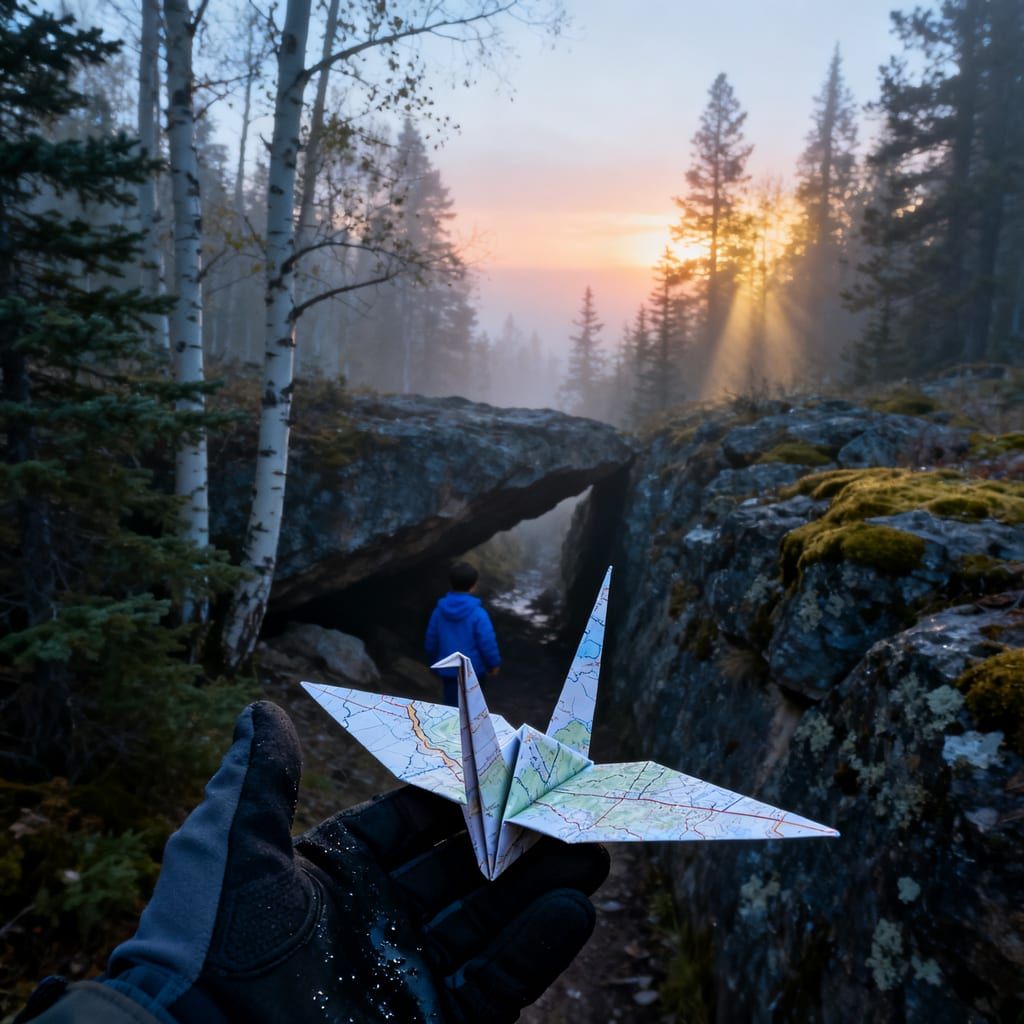
At first he thinks it's a candy wrapper, then he sees the fold. He reaches and cups a tiny paper crane in his palm, damp but still holding its bird shape. The paper is thicker than notebook stock. Tiny print smears across a wing. He flips it toward the light. A fragment of a topo line curves across the belly.
"Hey," he calls softly. "You see this?"
Marta squints, then breathes out a laugh with no humor. "Clever kid? Or trash?"
"It's from a map," Elias says, though he knows trash is what a map becomes when torn. His sister used to tear the margins of road maps, turn them into cranes that smelled faintly of gasoline and wintergreen gum. She left them in glove boxes and cup holders like small, stubborn prayers.
"Mark it," Marta says. "Could be nothing."
He logs the location, tucks the crane into the front pouch of his vest. The fog thins to a bluish gray, then thickens again, as if the mountain keeps changing its mind.
They cross a thin stream sliding over slick stones. Elias's boot slips; cold water rushes his ankle and the chill leaps to his knees. He steadies himself with a pole, breath blooming in little ghosts.
On the far bank, anchored by a damp twig, sits another crane. This one is folded from paper with a faint grid and the ghost of a scale bar. He pinches it gently, water threading down his sleeve.
"Another?" Marta says, eyebrows up.
"Another." He doesn't pocket this one. He sets it on a rock and stares the way it points-upstream, into thicker alder, the brush knitting the air into static. Standard logic says a kid wouldn't fight upstream. Standard logic says stay on trail, follow the fall line. Standard logic is a good idea until it isn't.
Elias keys his radio. "Command, this is Charlie Three. I've got two possible markers-paper cranes made from map stock. One at switchback, one at stream crossing, pointing upstream. Request permission to deviate into ravine and check."
The radio answers in a voice with too much coffee in it. "Copy, Charlie Three. Stay in voice contact with your flank. We'll shift Alpha Team to cover your lateral."
Marta looks at him. The look says: I'll go with you, but don't make me tell you not to do something you're already doing. He nods gratitude he doesn't want to say.
They move into the alder, wet leaves washing their pants, the air tasting of pennies. The ravine tightens into a thought you only have when you're tired: this might be wrong and, anyway, we're here.
Another crane waits at the mouth of a narrow gap between boulders, set neatly on a mossy shelf. It is so careful it hurts him a little.
"Kid's got hands," Marta murmurs.
"Or memory," Elias says, and then wishes he hadn't spoken.
The ravine climbs and the fog sifts out in tatters. Their headlamps dim under the pale birth of dawn. Elias kills his light and sits with the gray. A jay rasps somewhere to their right. He hears water under rock, the secret conversations brooks have with themselves.
"Charlie Three, status?" The radio again.
"Progressing upstream. Multiple origami markers. We'll need hypothermia blankets if we find him in here." Elias pauses, listening past his voice. In the thin silence, a small sound threads in-a cough, old-man thin, then a whisper of fabric on stone.
He raises a hand. Marta stills, her breath a fog lantern.
Elias follows the sound to a rock overhang where alder roots clutch the ceiling like arthritic fingers. He crouches, his knees complaining. Bright nylon winks-blue jacket, a child-sized glow in the gloom. Next to the blue is a shape in drab hospital cotton.
"Hey," Elias says softly. "Hey, buddy."
Two faces turn-one round and wind-chapped, hair pasted in damp commas to the forehead; the other mustached and gray-skinned, cheeks cavitated by the cold. The older man's wrist winks a plastic bracelet.
"Mr. Harland," the boy says quickly, as if he has been practicing the line. "He was walking in his sleep, I think. There was a place with tubes and then he wasn't there. I tried to get back to camp but it got dark like eight times. I stayed because he's shaking," he adds, as if that is a normal sentence.
Marta is already unspooling the foil blanket, her voice warm and steady. "Hi, Noah. My name's Marta. We've been looking for you. That was smart, staying together."
Elias kneels and gently cups Noah's shoulder. "Those paper birds," he says, nodding toward the ravine. "Were those yours?"
Noah's eyes brighten, a candle blooming in a paper bag. "Yeah. Ms. Wilde says if you ever get lost, leave gentle signs so you don't hurt the forest. She keeps paper in the map box at school. I tore the corner because maps are like roads but flat." He licks his cracked lips and adds, confidential, "I didn't take a whole map. Just corners. That's not stealing."
"Not stealing," Elias agrees, smiling despite the ache thawing somewhere long-frozen. "Those gentle signs really helped." He looks to the older man. "Mr. Harland? Sir? Can you tell me your name?"
The man's eyes flit and land, a moth coming to terms with a porch light. "Ed. Ed Harland," he says, and then his mouth trembles, the name unmoored. "Wife's at-" He shakes harder. "Cold in the bones," he whispers, apologetic.
"We have you," Marta says, tucking the blanket snug, thermos already in her hand. "Sip this. Small sips."
Elias keys the radio with his chin. "Command, Charlie Three. Found Noah with an elderly male, likely walkaway from care. Both alive, mild to moderate hypothermia. Location-" He reads out grid coordinates from the map, which suddenly feels nearly holy, its lines a faith someone can touch.
The radio breathes a chorus-copy, copy, med team en route, stay put, good work. The mountain's silence reconvenes after the applause.
Noah leans into Elias. He is warm through the damp. "I didn't know which way was right," he says. "I thought if I made the birds, someone would see that I was trying."
"You did exactly right," Elias says, and believes it in a place beneath words.
They wait under the rock as the light grows. The fog thins until they can see sky like a bruise healing. In the shallow bowl of morning, Elias watches Noah watch over Mr. Harland-how the boy presses the thermos to old hands, how he tucks the edges of foil like he's wrapping a present. The radio chirps occasionally, teams repositioning, a med crew thrashing nearby through the understory.
"You like birds?" Elias asks as they wait.
"Yeah," Noah says. "Cranes are good luck if you make a thousand."
"How many did you make?"
"Four," Noah says, sheepish.
"Sometimes four is enough," Elias says softly. He feels a sudden, unexpected want-no, not want, a release. How long he has been standing in a house with all the windows closed, holding his breath and calling it air.
The med team arrives in a gust of nylon and competence. Hands check pupils, skin, pulse. Numbers become sentences. Mr. Harland whispers something that might be thank you, or might be a name.
Back on the trail, the mountain seems to exhale. The fog peels back, revealing the valley sprawled like a postcard no one believes until they're holding it. Sunlight catches the wet leaves and sets them briefly on fire.
At command, a knot of people bloats the tape line-faces flushed, eyes too wide. A woman with tired glory in her features breaks into a run when she spots Noah and folds him into her, as if tucking a fledgling into a nest mid-flight. He disappears in her coat, then reemerges with his ear pressed to her heart like a stethoscope.
Across the lot, an older woman with a cane reaches toward Mr. Harland's gurney. The medics speak quietly to her, their bodies forming a small wall of kindness.
Elias takes a step back. He is suddenly shy around relief. There is an instinct to let families occupy the space of miracle without witnesses.
Marta claps his shoulder. "You saw what didn't belong," she says.
"Sometimes that's all it takes," Elias answers, and his voice is almost his.
He returns gear like a ritual: radio, harness, the trauma kit heavier by used gauze. In his vest pocket, something nags his fingers. He pulls out one of the cranes, its wings softened by fog. He sets it on the dash of his truck. It tilts toward the windshield, expectant.
He stands there a long beat, the sun just yawning over the ridge, a smear of apricot on the sky. People are crying and laughing and calling each other "sir" and "sweetheart" and "buddy." Someone hands him a paper cup of coffee that tastes like smoke and relief.
He remembers his sister on those long car rides, windows cracked to let in cold, her laugh bounced from the ceiling like a ball. She'd say, A thousand cranes and you get a wish. She left them everywhere, little birds in cap holders, jacket pockets, hiding in the glove box like tame mice. He never told her his wish. He tells it now, but only to the quiet inside him: May what I do matter to the living.
The day is bright enough to read faces without a headlamp. The world, for a rare minute, feels in focus-edges crisp, colors patient.
Elias slides behind the wheel and drives slowly out, the gravel crunching like someone chewing ice. He glances at the crane on his dash. It's absurd and perfect, a creature made of lines meant for getting unlost. He can't choose who returns. The mountain taught him that without words. But he can choose this: to keep looking, to pay that fierce attention, to leave gentle signs where he can.
The road unspools in front of him, patched and familiar. He thinks of the ravine's hush, of Noah's small, capable hands. He thinks of Mr. Harland's name arriving back to him like a bird to a sill. The sun rises, then rises again.
He reaches for the crane at a stoplight, smooths a wing with a thumb. It rustles, stubborn and delicate, and points him onward.
Story audiobooks for children of all ages — a new one every day on Smarter Way Stories.