Two Houses and One Quiet Heart
A daughter learns to read between the lines of a life split in two
Read more →
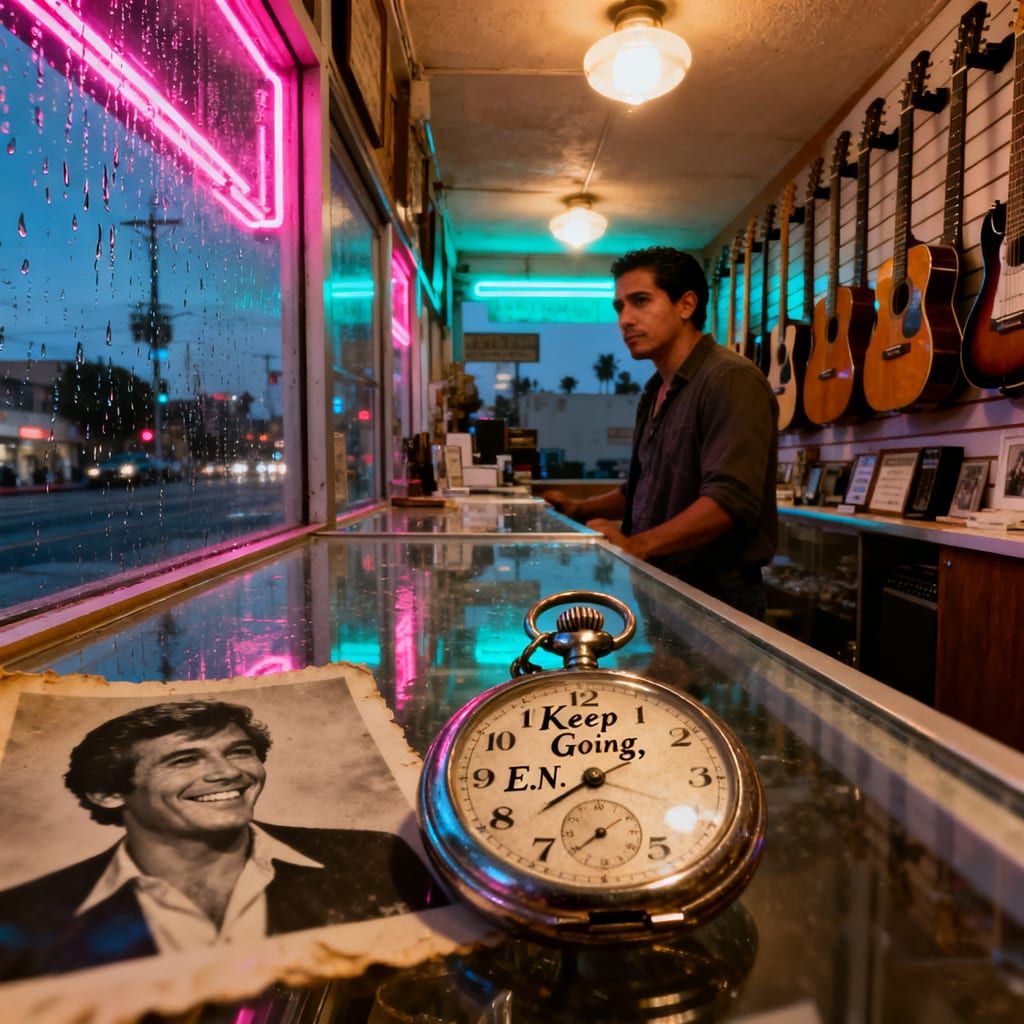
On the boulevard where new yoga studios elbowed old taquerías, the neon at Sunrise Pawn flickered like a tired eye. Eli Navarro keyed in, the doorbell chiming a thin, faithful note, and the place exhaled mothballs and metal-strings of guitars, trays of rings, glass that made everything seem one fingerprint away.
He knew the numbers. A wedding band bought you three bags of groceries and a week of fruit that wasn't bruised. A guitar, if you pretended it had never been yours, strung another rent payment together. He'd stopped making songs years ago, but he was good at counting what people could bear.
Slow afternoons arrived warm as a palm. Eli sharpened a pencil down to a nub and began asking the question he'd never asked, not out loud: "What's the story?"
A nurse slid her ring across the glass, skin indented, eyes rimmed in that permanent exhaustion he recognized from freeway brake lights. "Chemo copay," she said, mouth steady. "I'm coming back. As soon as the last one clears." She said it like a promise you'd tattoo under the skin.
A rideshare driver brought in a camera heavy with weddings it had witnessed, children it had met by accident on sidewalks. "The app's beta goes live this quarter," he said, jaw lit from the inside. "Once it finds me, that's it-seed round, salaried engineers, in-house coffee." The camera blinked at them both under fluorescent light.
An elderly man in a linen hat set down a battered chess set whose board had softened along the folds. "Park charges nothing," he said, tapping the knight. "But loneliness is expensive. This buys me Tuesdays and Thursdays." His hands trembled, not with age but with the etiquette of care.
Eli started writing in a spiral notebook because ink made everything more real. No names, only initials. Objects paired with verbs: R-ring-hold. C-camera-try. S-set-keep.
Sometimes he rounded up. Sometimes he pretended he'd misread the scale or a scratch was not quite as deep. Twice, he broke policy. The second time, a teenager in a too-large hoodie brought in a trumpet that had brass acne and a mouthpiece bitten with anxiety. "Two days," Eli said, sliding the ticket over. "Actually-four." He stuck a yellow square to a high shelf where no one looked except him: For the buyback fund, someday.
The shop had a clock by the security camera, old as an argument, ticking in honest seconds. Eli listened to it as he worked and, without deciding to, began counting differently.
People weren't selling memories. They were buying time-half a month of light, a prescription bridge to next Tuesday, a round-trip to hope. He found himself speaking quieter, as if loud words might shatter something invisible.
One afternoon the nurse returned, envelope in one hand, her other hand naked and waiting. Eli wasn't supposed to reach across like that, wasn't supposed to break the geometry of glass, but he did anyway, ring lifted, paper ticket traded for a circle that had warmed to her again by the time she crossed to the door. She slipped it on and sobbed into her palms just as the bus sighed and kneecapped the afternoon.
The trumpet kid showed up three days late with a wad of soft bills earned by busking under a billboard for a luxury condo. He pushed an invitation across: a school concert in a cafeteria with plastic chairs and flickering affection. Eli went, stood at the back with hands in his pockets, and blamed the sting in his chest on high notes that felt like they could tug stars lower by their edges.
Stories made receipts look like what they were: placeholders you could't staple your life to.
Mr. Alvarez arrived on a Wednesday that smelled like warm rubber and street tacos. His hat was gone-hair exposed, silver like tourist sand. He set a pocket watch on the glass, broken-mouthed and engraved.
"Found it in a storage unit," he said, voice sandpapered soft. "Neighbor died. No family. I don't keep watches. I keep coffee cans."
Eli turned it over. Letters curled on the back, stubborn and clean: Keep Going, E.N.
For a second the floor rippled. Those initials matched the ones he wrote inside album covers that never got pressed. They matched the torn caption under a photo he'd hidden for more than two decades, the one where a man smiled reckless at the Cuban sun, hair black as wet asphalt: Ernesto Navarro, Havana, 1968.
Eli had taken that photo out when he was ten and then pretended he had not. Fathers could be like songs, his mother once told him: catchy until you stopped listening and then only a hum that made you wonder what you'd misheard.
He faked composure the way you fake sleep when someone opens your bedroom door. "Give me a day," he told Alvarez, sliding over a claim ticket as if this were any bracelet, any chain.
Maria came in at noon with her usual show of bangles and a to-go cup sweating through a napkin. She was a widow who had no patience for pity and twice the skill of a banker without the cologne. The shop ran because she kept it humming-bulbs changed, tags legible, the small hypocrisies of survival tidy.
"Maria," he said when the bell had stopped ringing. "Do you know this watch?"
She looked at the engraving as if she'd played this hand before, then opened the drawer where the pricing gun slept. Underneath, not money-tickets. Pawn slips in tidy rows, each with a name highlighted, "Paid in full" stamped firm.
"Rainy soul fund," she said, almost embarrassed. "Started before me. I seed it with small overpays. People who make it back chip in. We don't advertise. It confuses the math."
She took the watch as if it had been whispering to her all morning. "Years ago, a man who looked like you came in with this. He said he was buying a bus ticket. Said keep it safe. Didn't leave a number. I bought it outright when his ticket expired and put it away."
Eli felt something in him recognizing itself. "You held it? For who?"
"For the person who would know what it was." She met his eyes with the softness you pull out only when it will not bruise. "Shops like ours are built on interest-but not just the money kind."
They worked the backroom bench like a small surgery. Alvarez returned because he had said he would, and because the park wasn't kind to promises you didn't keep. Eli eased open the watch, tiny gears like a city seen from far above-streets and turns and lives intersecting without knowing.
The second hand had caught on a burr that looked like nothing until you magnified it. Alvarez held a flashlight like a priest holds light. Maria breathed like a metronome. Eli closed the case gentle and set the crown clockwise.
Tick. Then-tock. The rhythm a heart makes when it recognizes its job.
Eli didn't say the name. He didn't say father. He didn't say the absence that had configured his face into caution. He only listened, the watch on his palm warming as if time could learn.
"Keep it until you know," Maria said later, when Alvarez had traded it for a handshake and a pawn ticket he would not use. "Not forever. Just until you know."
The shop made a new ritual without agreeing to it. Every time a story looped back-the nurse returned with eyelashes again; the rideshare driver bought his camera with stock options he unironically believed in; the chessboard reclaimed its squares and Tuesdays and Thursdays-Eli wound the watch. It argued faintly with the wall clock, then found the same second and walked alongside it.
The month turned like a page you'd underlined by accident. Heat backed off. The boulevard learned to hold both old men playing dominoes and a couple walking a rescue dog in a sweater.
Eli's spiral notebook thickened. H-hoodie-return. N-nurse-keep. A-Alvarez-befriend. He wrote, then he listened more. The drawer under the register held more paid-in-full slips; Maria's eyebrow said don't get sentimental, and then her hand, which had left a ring print she never wiped off, squeezed his shoulder anyway.
On a late afternoon where the sky hung around like someone not ready to say goodbye, the bell chimed. A man stepped in with a face made of familiar angles. The jaw stubborn as a promise nobody signed. In his hand, a photo faded to the color of old tea.
The neon washed him in a soft bruise. He did not look around at guitars or grief. He looked at Eli.
"Are you Eli?" he asked, voice trained to look like it didn't care who said yes.
Between the tick and the tock, Eli felt what the shop had been storing inside him-interest accruing, not the money kind. His chest widened the way doors widen when someone finally pushes instead of pulls. The air smelled like ozone, like right before rain in a city that forgets how to be wet.
He did not think of revenge or of debt. He thought of small, exact things: Maria's drawer. The teenager's concert where applause stuck to the fluorescent lights and still sounded like applause. Mr. Alvarez's flashlight steady over frail cogs. The nurse's ring swallowing her knuckle and then her tears.
He put the photo next to the watch on the counter-Ernesto in sun, the engraving catching light like a held breath. The two objects seemed to recognize each other, old friends at opposite ends of a party.
"Come on," Eli said finally, voice even, as if the question had not mattered until it did. "We close at six. Tell me a story before then."
The second hand slipped forward, uncomplicated as forgiveness, difficult as it too. Outside, the boulevard kept inventing itself-new paint over old signs, jasmine sneaking back through chain-link, the soft insistence of everything that grows between.
Eli reached under the glass and set the watch on the counter, not across the line but right at it, where two sides met. He wound it once. It kept going.
The bell above the door did not ring again. Inside the shop, receipts rustled like leaves and time made a noise you only hear when you decide to listen.
A daughter learns to read between the lines of a life split in two
Read more →
A fog-draped night, two souls found, and the quiet shape of a life
Read more →
Story audiobooks for children of all ages — a new one every day on Smarter Way Stories.