Two Houses and One Quiet Heart
A daughter learns to read between the lines of a life split in two
Read more →
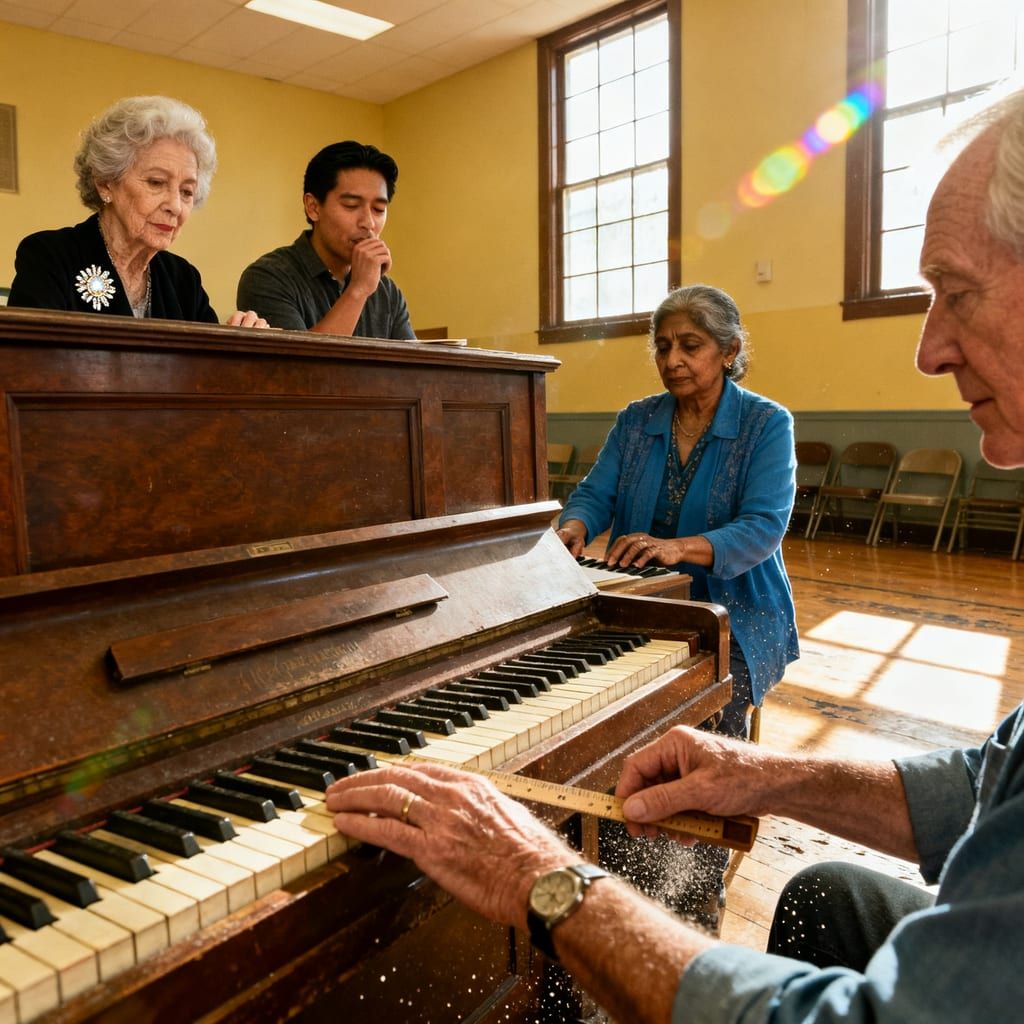
On Tuesdays, the multipurpose room smelled like coffee, furniture polish, and winter boots thawing into puddles. Sunlight from the south windows cut the floor into tidy rectangles, as if the light were measuring.
Leo set his color-coded folders on the upright, the one with the chipped middle C where a former life had taken a bite. Posture diagrams. Scale charts. Simple chord progressions highlighted like traffic lights. His breath fogged faintly on the piano's glossy lid-Minneapolis in February had a way of sneaking in at the ankles.
He told himself this gig would be gentle. He needed gentle. After the audition that had flipped his lungs inside out, after the blanking of the piece he'd rehearsed into his bones, gentleness seemed like something you could teach.
They shuffled in like different tempos finding a common beat. Ruth, eighty-six, wore a brooch shaped like a burst of snow-every beam of light in the room seemed to stop for it. Mr. Alvarez, seventy-eight, patted his hair in place and hummed under his breath, scratchy and warm, like a vinyl record aloud to itself. Gita, eighty-one, kept her hands tucked to her ribs, tremor nested but not quiet. Bernard, ninety, measured the distance from bench to keys with a carpenter's eye, thumb and pinky spread to span an octave as if confirming it in inches.
"Okay," Leo said, smoothing his lesson plan with a palm that wanted to shake. "We'll start with posture."
He demonstrated: feet grounded, wrists floating, shoulders easy. They copied, some more than others. The metronome's tick sounded like a room with a heartbeat.
"Scales," he said next, and passed out G major with his green-coded notes. "We'll go slow."
Ruth pressed a key and watched the string tremble. "G major," she said, "feels like walking home with groceries-apples and a loaf that still steams."
Mr. Alvarez nodded, humming a perfect third. "F minor is burnt toast and rain," he added, and then paused. "Toast," he repeated, as if grasping the word by its crust.
Gita's laugh shook the air. "C," she tried, and the tremor in her fingers steadied when the metronome clicked. She inhaled with it, exhaled with it, and on the third breath, her hand found the shape clean as a spoon in a drawer.
Bernard marked out keys with his fingers. "This span here," he said, "is eight and a quarter inches. Either the piano or my joints are lying."
Leo's plans, bright as traffic lights, flickered. He heard the way they felt their way in. He set the folders aside.
"New idea," he said, sliding onto the bench. "Let's map sounds to memories. No staff, no sight-reading today. Just listen, then tell me where it lives in you."
He played a two-note interval, low and close together.
"Work whistle," Bernard said without thinking. "My shop had one at noon. First note was always a hair late." He tapped his old timing on the fallboard until it settled into a steady see-saw.
A thin smile broke across Leo's face. "That's our first motif." He penciled two notes on blank paper, notating Bernard's slight delay like a wink.
He let the air lift. "Gita?"
She lifted her left hand and let it float. Her tremor wrote a small, shimmering curve in the space above the keys. "This," she said. "I want this to be music."
Leo nodded and traced her movement into sound: a delicate trill that hovered between two neighboring notes, hesitant at first, then brave. The metronome ticked in time with her breath. "Beautiful," he said. He meant it. "We'll catch that shimmer."
He looked at Mr. Alvarez. "What do you hum when you're not thinking about it?"
Mr. Alvarez hummed a fragment, rough and sure. Leo played it back, adjusted a step, tried again. The older man's face softened in recognition. "Sí," he said, and patted the piano as if it were a shoulder.
Ruth had been quiet, brooch catching every breath of light. "And you?" Leo asked.
She reached as if opening a window. Three notes climbed, easy and bright, then paused on the top like someone taking in a street. Her fingers hovered over the keys a beat longer than necessary, a reverent almost.
"Sunlight," she said.
Leo wrote it down: three notes ascending, a pause that held everything.
He titled the page in block letters: After. The word looked both like an ending and a promise.
They met twice a week. They told time with breath. They counted rhythm by tapping wrists instead of knees-less jarring, more intimate. Staff drifted through with mops and invented reasons to linger. Someone from reception wheeled a cart past more slowly than any cart had ever moved.
They built the piece like a porch. Bernard's work whistle framed the steps. Gita's delicate trill threaded through like the tremor of a leaf that wouldn't quite hold still. Mr. Alvarez's hum held the center-familiar as a song overheard from the kitchen. Ruth's sunlight arrived late in the phrase and made the air turn golden.
Leo kept his hands on the outside of the music, guiding. He promised himself he would not step into the middle. Not after Minneapolis Conservatory, that bright-lit room and the way sound had abandoned him halfway through Debussy. He could still feel the way his tongue went cotton-dry, how the keys had become a riddle. He'd smiled, polished, left. He'd quit composing that afternoon and put his notebook in the freezer like a firefly you can't bear to see go out.
"Spring recital?" Ruth said one day as if remarking on the weather. "We'll need more chairs."
"We could," Leo began, heart tripping the metronome, "aim for-"
"We'll do it," Bernard said, folding a program out of a napkin. "We're ninety, Leo. We don't aim. We build."
They did not ask. They decided. The room began to practice in ways that weren't about music: phones were silenced, doors propped, a paper was taped over the thermostat that read, in neat capital letters, DO NOT TOUCH UNTIL AFTER.
April loosened Minneapolis enough to make the sidewalks wet and forgiving. The day of the recital, a tinny microphone waited on a stand with a cord that wouldn't stop coiling itself like a lazy cat. Folding chairs multiplied. Children arrived holding juice pouches like talismans. A nurse tucked tissues into her sleeve.
Leo stood offstage-there was no stage, just a corner where the light was soft. He had planned to accompany, quiet as a coat hung on the back of a chair. His throat tasted like copper.
"We'll be fine," Gita whispered, palms open to the metronome. Her tremor, tuned to breath, looked like a flame that had learned manners.
Mr. Alvarez took the bench first. He set his fingers down the way birds land: concentrated, precise. He started Bernard's motif, the delayed second note sweet as habit. Then he stalled. The thread, suddenly invisible. His gaze went wide and wet. He pressed his lips together and searched for a noun.
A hush, like snow falling thick.
Ruth stood. She did not make a speech. She placed her fingers above the keys as if over a map she'd just learned to love. She looked at Leo, and in her eyes he saw not pity but invitation.
"Count with me," she whispered, tapping his wrist with two fingers. The pulse there answered-human metronome, old and dependable.
Leo sat, aware of the whole room watching. His audition ghost pulled at his breath like a thread snagged on a nail. The microphone crackled as if to clear its throat.
One-and-two-and-
They began.
Ruth took the sunlight and lifted it. Leo matched her climb, left hand tucking Bernard's whistle into place, giving Mr. Alvarez a path to find again. Gita's trill shimmered in the pocket of quiet between their notes. The hum rose under everything, steadying the table.
Four hands at one keyboard makes a geometry of trust. Knuckles brushing, weight shifting, the brief, necessary corners of closeness. Ruth's brooch caught a beam of light and tossed it into Leo's periphery, a tiny star insisting.
His old panic looked for a door and could not find one. Here, there was only the counting they shared, the simple arithmetic of breath: in on the pickup, out on the landing. One measure turned into many. The recital room leaned in. A nurse, who'd come for the free cookies, found herself crying in a way she did not apologize for.
They reached the last chord and held it until the sound thinned so much it could pass through a wall.
Applause gathered like rain on a roof and then spilled.
Mr. Alvarez lifted his chin. He blinked. "Elena," he said, and the name left his mouth as if it had been waiting by the door for years. He looked at his own hands as if surprised they'd known it. "Elena," he repeated, and laughed.
Bernard whooped and whistled the wrong way, teeth on lower lip, giddy as a boy. Gita wiped one eye with the heel of her hand and then bowed with both palms, tremor making a small, earnest flourish in the air.
Ruth sat, rested her hands in her lap, and looked younger than she had an hour ago.
They ate store-bought cookies that tasted like sugar and longing. Paper cups sagged under lemonade.
"Ruth," Leo said, quiet enough that it felt like a secret being tested, "who taught you to phrase like that?" He regretted the question as soon as it left his mouth-its assumption too neatly wrapped.
Her smile reached for mystery and didn't quite reach it. "No one," she said. "I started in January." She flicked the brooch with one finger and watched light rearrange itself. "I got tired of being told about too late. Turns out, I like after."
He laughed, a little brokenly, at the clean logic of it. The hum of the room rose around them: chairs scraping, wrappers crackling like tiny applause. He felt something unlatch in his ribcage, small as a hinge and just as necessary.
He excused himself and went to the coatroom that wasn't a room, just a line of hooks smelling faintly of wool and snowmelt. He pulled a notebook from his bag-the one he'd frozen and thawed and carried without opening. The paper inside had curled a bit from its long winter.
He wrote the word After on a blank page and waited. The silence that had lived there, cocky as a cat, stretched and left. A measure formed. Then another. He wrote the shimmer of a tremor, the lazy pride of a work whistle, the hum that said home in any language, the sound of sunlight on a table.
A hand appeared in the doorway holding a Styrofoam cup of coffee. Ruth. "For the teacher," she said, with none of the teasing he'd braced for.
"Thank you," he said, and the steam touched his nose like a small forgiveness.
"Count with me?" she asked, and tapped the doorframe twice, just to keep the universe honest.
He did. One-and-
Outside, April kept thawing the edges of things. Inside, the upright piano waited with its chipped middle C, imperfect and therefore a promise. Staff returned mops to closets. The paper on the thermostat was removed with ceremony. Mr. Alvarez told anyone who would listen that Elena had sent a gust of wind at the perfect moment. Bernard measured the applause in arm-spans and declared it three porches wide. Gita stood in the doorway, face to the spring light, letting her hands learn what stillness could feel like between beats.
Leo packed his folders without rushing. He slid the notebook on top, not beneath. As he left, he caught his reflection in the piano's black lid-one person among many, the ghost at his shoulder reduced to a misplaced shadow in the afternoon sun.
By the time he reached the bus stop, the rhythm of his steps had found him. He counted without thinking. One-and-two-and-then stopped, not because the count had ended but because it had begun.
He looked back once, at the building that smelled like coffee and polish and plans. In the window, light pooled on a row of folding chairs, making halos on their empty seats. He could hear, or thought he could, a faint echo-four hands, one heart, a room remembering how to breathe in time.
He opened the notebook on his lap and wrote past the old silence.
After, it turned out, was only another word for now.
A daughter learns to read between the lines of a life split in two
Read more →
A fog-draped night, two souls found, and the quiet shape of a life
Read more →
Story audiobooks for children of all ages — a new one every day on Smarter Way Stories.