Two Houses and One Quiet Heart
A daughter learns to read between the lines of a life split in two
Read more →
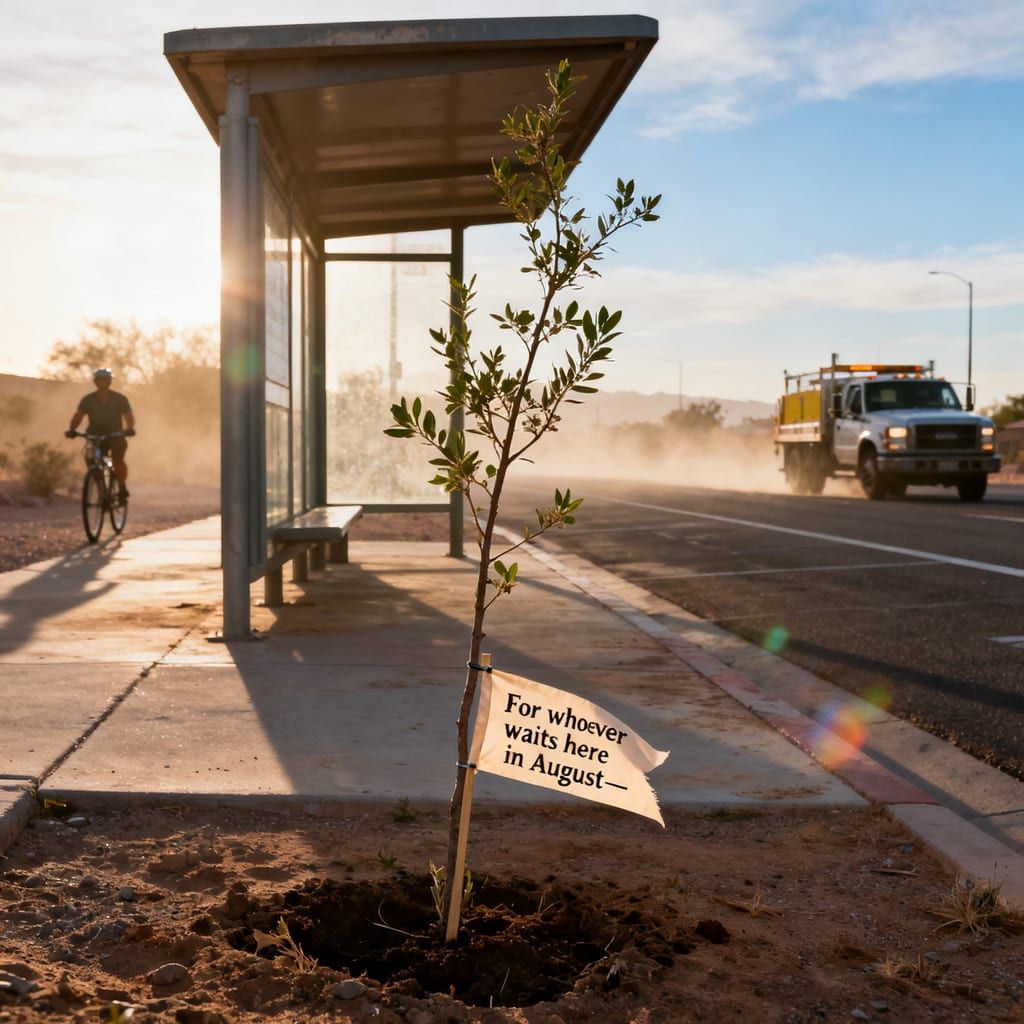
The first tag read: For whoever waits here in August-maybe you, nurse with the soft shoes and the clocked-out eyes.
Ravi tied it to a thin stake, the nylon cord biting his fingers. The new sapling tinked in the wind like glass. Heat rose from the sidewalk in patient waves, the kind that loosened bolts and curled the edges of flyers. He pressed the dirt in with his palms and let it hold the print of him.
He worked fast over lunch-thirty-seven minutes if he skipped the last emails and microwaved something at his desk later. He knelt, unshouldered a pack, measured a hole, poured water dark as tea into a shallow ring. Each movement had a hush to it, a ritual learned by repetition. Phoenix made rituals out of anything that could become shade.
He didn't sign the tags. He wrote the names he guessed in pencil, then traced them in waterproof marker. Maybe you, Arturo. Maybe you, Ms. Gonzales. Maybe you, father with the stroller, pretending not to count the minutes.
He imagined them a little selfishly-like neighbors he wanted to know but would not inconvenience. He pictured the slice of shade the sapling would cast in five summers and felt the surprising tug of relief, as if turning on a fan in an empty room.
Ravi's days were code and headsets: a sprawl of "Have you tried restarting?" and "Let's walk through your settings" and "I'm here with you." He liked the predictability. It had made him soft-spoken the way river stones were soft-rounded by current. After eight hours, he craved the other kind of yes, the one you couldn't log in a ticket.
He started with three trees by bus stops along Van Buren, near stretches of sidewalk that were already earnest with heat at dawn. The city posted signs about hydration like prayers. He dug shallow, cheated a little. The ground gave reluctantly. People waiting for buses watched with the silent attention of those conserving energy. No one asked what he was doing. A few nodded as if this were normal-someone kneeling to the dirt in business-casual slacks.
The fourth day, a white truck with a blue seal ghosted to the curb. A city code officer stepped out, mustache neat as a level line, clipboard in hand.
"You can't plant without a permit," the officer said. He didn't sound like a villain. He sounded like a man who had to repeat himself a lot.
Ravi stood, wiped his hands on his pants, and took a breath that felt like inhaling through wool. "Understood."
"Water rights, sidewalk integrity, species approved." The officer tapped his board. "Whole list."
Ravi nodded. The officer studied him for a beat longer than necessary, as if measuring a kind of harmlessness, then added, softer, "Good idea, though."
Ravi went home and could not sleep. Heat wove into the sheets. He found himself on a neighborhood forum at 2 a.m., the kind of place where posts turned into block parties or arguments. He typed: "Early mornings, planting drought-hardy saplings at bus stops. If you want to help, I'll leave a blue cooler with ice water and trowels. Wear a hat." He did not include his name. He added a picture of a tag, the words visible if you squinted.
At dawn, he returned. The city truck wasn't there. The cooler was three bottles lighter and there were extra footprints in the dirt. Someone had left a sack of mulch with a note on torn notebook paper: For whoever waits here in August-maybe my mom.
Ravi smiled without showing teeth. He tied a new tag and went to work.
The tags multiplied. They did not flutter so much as remind-bits of language catching the corner of a tired eye. Maybe you, Kelsey. Maybe you, auntie with the pink umbrella. Maybe you, kid late to class with the too-big backpack.
Scuff marks bloomed along the bench legs. Someone chalked a hopscotch grid that drifted toward a circle of mulch and stopped there, as if the rules of the game recognized a boundary worth keeping. Cigarette butts appeared, then, less often, soda caps. People were careful in small ways.
He began to see the traces of the lives he'd guessed-the night-shift nurse who folded herself into the bench like a letter, a father swaying gently with a stroller so the baby's eyes didn't crumple into cries, two teenagers who threw their shadows long and laughed at nothing in particular. He didn't speak to them. He watered the ground and let his imagination fill the rest, the way a garden fills the space between fences.
One morning, he found a hollow in the dirt basin and the imprint of a small shoe pressed and lifted, pressed and lifted, the mark of a waiting child making patterns to pass time. He smoothed it with his palm, then left a corner of it intact, a fossil of fidgeting.
Public works surprised him. He arrived early to see a supervisor he recognized from another life-same truck, different hat-walking the strip with two crew members. Without a word to him, they measured, cut rectangles from the curb, and set shallow concrete lips that would guide stormwater-when it deigned to fall-straight to the sapling basins. The supervisor looked up once. On his clipboard, the form had a new box: PILOT. He didn't wink. He just left the box unchecked and moved on.
Ravi tightened his hat and kept his head down. He was content to be the rumor.
June arrived with teeth. Air-conditioners gnashed on rooftops. The white-blue flame of noon burned away even polite shade. On certain afternoons, the heat had a pitch-high and unignorable-the electric tremor of transformers throwing their shoulders against demand. The sky bleached into a single hard tone.
Ravi left work early with a headache that felt like a slow tide against his skull. He biked to the first sapling he'd planted, partly out of loyalty, partly because the soil there dried to dust between waterings. The bus stop baked quietly. The glass shelter trapped old breaths.
He lifted the jug and poured. The water darkened the earth in a beautiful, immediate way, like ink taking to paper. The steam that rose smelled faintly of pennies.
His vision narrowed. The edges of the scene feathered and then crumpled inward. A buzzing that wasn't entirely from the transformers filled the air. He sat, then tried to stand. He thought, absently, not here, not in front of this first tree.
The ground came up steadier than he expected. He heard rubber on asphalt, the soft bookmark-flip of a bike coming to a stop.
A woman crouched in his view-a quick spill of hair dark with sweat, a messenger bag cross-body, her face the alert softness of someone who has already made the decision to help. "Hey. Hey, you with me?" Her voice had edges and care.
He blinked. The light darted.
"Okay," she said, breath fast. She tilted her water bottle-the last of it-against his lips with a firm, familiar gentleness. It tasted like a promise. "I'm calling." Her fingers found his wrist, counted. "You're cooking, man."
A siren sounded somewhere distant and then persuaded its way closer.
When the world stopped shrinking and started to allow color back in, he saw the bus stop glass, his own palm stained with damp grit, the sapling leaf trembling because his elbow brushed it.
"I'm okay," he said. The words felt like heavy shoes.
She sat back on her heels and exhaled. "You're not. But you will be." She dug into her messenger bag, pulled out a square of something sun-faded at the edges, folded into the size of a secret. "I keep this in my wallet. Figured this was the time to show you."
She unfolded the tag. The writing was familiar-his loops, his neatness made clumsy by a brick of heat: For whoever waits here in August-maybe you, Kelsey.
He looked up. She smiled, shakily, as if smiling were a muscle she hadn't worked in a while. "I kept this one. I wait under your tree between deliveries. It got me through the worst day this week, and I made it to a run where the guy I delivered to needed his meds fast. Today, I saw you fall. I figured I finally owed you shade back."
He swallowed, the salt at the back of his throat making the gesture feel like an apology. "Thank you." It was all he had.
She nudged his shoulder lightly with two fingers. "Don't thank me yet. Hydrate. And maybe write more of these." She flicked the tag, which fluttered and settled.
The EMTs made a gentle fuss, tidied his edges, and coasted him into cool air. Glass doors opened and closed. The world shrank to beeps and a cuff's regular squeeze and the sweet, artificial cold that hospitals administer like belief.
When he woke, he found the code officer in the plastic chair, legs angled, hat in his lap. It felt like a punchline.
The officer lifted a grocery bag and set it on Ravi's blanket-covered knees. Plastic clacked inside-a hundred small rectangles, smooth and blank. "We found a budget line," the officer said, eyes focused somewhere near the baseboard. "Pilot program. Look at us, piloting."
Ravi laughed once, well-behaved. "Permits?" he asked.
"A stack this thick." The officer held two fingers an inch apart. "I'll handle it. You-" He gestured vaguely to include knitting, resting, anything that would keep Ravi indoors for the rest of the century. "Maybe plant at dawn. Like you do." His mustache moved with what might have been a smile. "There are forms now for volunteers. People are asking."
Ravi touched the bag. The blanks felt like small futures.
Kelsey appeared in the doorway, helmet in hand, hair dried into something like waves by the hospital's air. She lifted a hand, then lowered it when she realized her bike gloves were still on. "Hey. You okay to have a visitor?"
He nodded. She entered, placed a bottle of coconut water on the tray like contraband, and leaned against the window ledge. Sun hammered at the glass; beyond, the parking lot shimmered. "I told some folks who wait at my routes," she said. "About the trees. About you. If you don't want-"
He shook his head. "No. They're not mine." He considered. "But the tags could be."
She smiled. "Good. They're the kind of thing that keeps your feet moving when your brain says sleep."
He looked at the bag again. "You kept one."
"I kept two," she said, admitting a small theft with a shrug. "One in my wallet. One in my glove box. For when August feels like punishment."
He swallowed. His chest felt crowded but in the right way. "I write them and hope," he said. "I didn't think-"
"You didn't think we were reading," she finished. "We were." She tapped the plastic arm of the chair twice, a shorthand for solidarity. "We are."
He returned to his routine, though he thought of it now as practice the way musicians meant it-repetition as a kind of prayer. He set his alarm earlier, measured his water like a chemist, learned the language of drought-hardy leaves: which drooped theatrically and which meant business.
Volunteers began to appear as if they'd always been there-two retirees with hats with their names stitched on, a teenager who carried a collapsible shovel like a baton, a woman who brought her toddler in a wagon loaded with mulch. Someone arrived at 5 a.m. with coffee in a thermos and cups so small they felt like thimbles of courage. They took the blank tags carefully, wrote in print or script or messy all-caps. The tags multiplied again, this time in many hands.
Ravi stood back more. He watched the way people claimed the shade before it existed-how they loitered in the idea of cool and found it enough to keep moving. He answered questions about soil and soakers and then didn't speak at all, content to water and listen.
On a morning like a quiet oven, he planted a sapling by the clinic. The building's glass made the sky sharper; he could see himself, small and hat-brimmed, in the reflection. He tied a new tag, the words neat and slow: For whoever steps out of hard news needing a gentler sky. He let his fingers rest there a beat longer than necessary.
He pictured a stranger pausing beneath the future canopy, slipping a hand to the back of their neck and feeling the sweat cool. He pictured someone crying there, or not. He pictured a breath taken all the way in.
He did not stay to be thanked. He brushed dirt from his knees, touched the leaf once in the gesture he'd learned meant grow if you can, and walked his bike toward the glare.
At the corner, a bus hissed to a stop. People lined up in the slice of morning not yet bitten by the sun. A tag flicked at the edge of vision and then came to stillness. The heat was coming back. It always did. He thought of time as elastic-how what he did in this loose, early hour might return as shade to a face he would never see.
He turned his handlebars and headed for the next strip of vacant, sunbright ground, the place where a small tree would go and the city would, eventually, tilt around it.
He had a bag of tags. He had names he had not written yet.
He had August in his pocket and a way to soften it, a little.
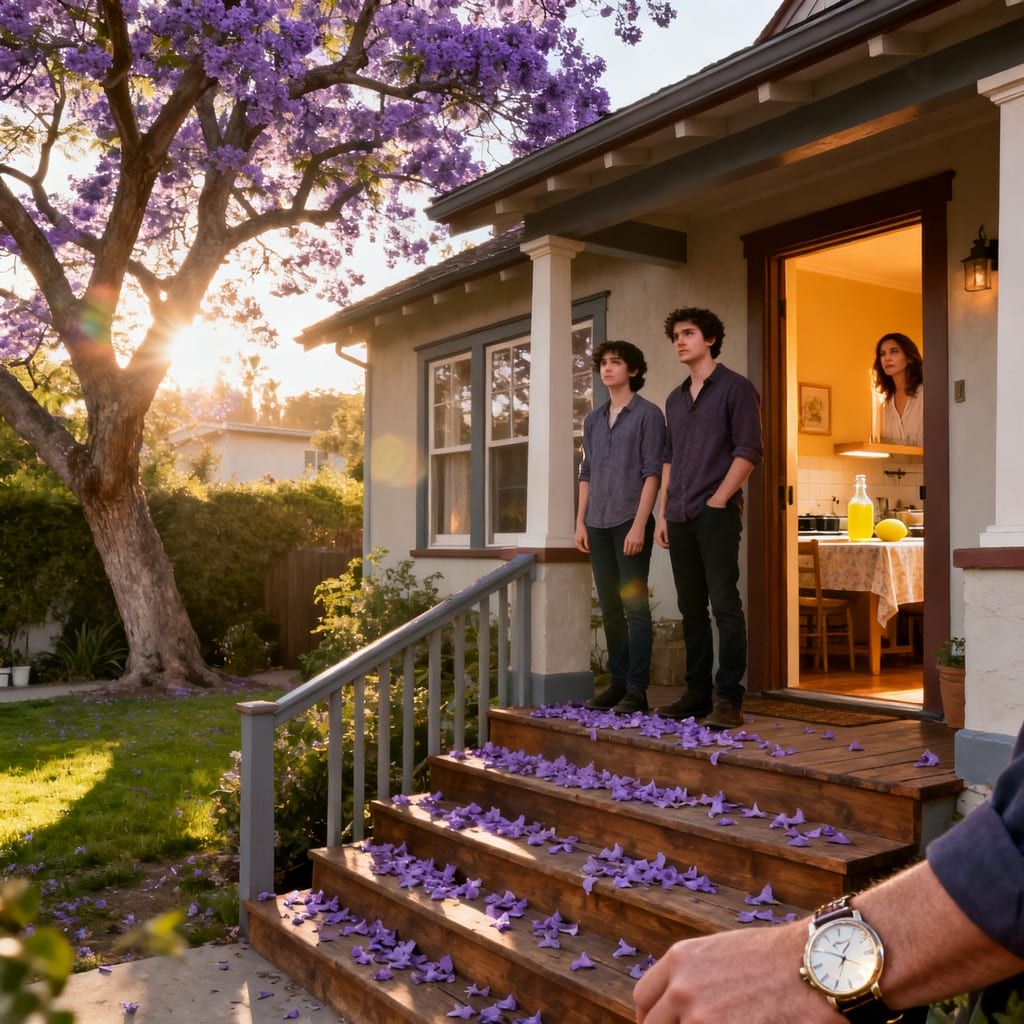
A daughter learns to read between the lines of a life split in two
Read more →
A fog-draped night, two souls found, and the quiet shape of a life
Read more →
Story audiobooks for children of all ages — a new one every day on Smarter Way Stories.