Paper Cranes at Shift Change
A winter of small mercies, folded and kept
Read more →
Lina taped the last flyer to the laundromat's bubbled glass and watched the tape fog with her breath. Thick marker letters bled a little: Saturday Porch School - teach or learn one small thing. She smoothed the paper as if that could smooth the hush of her days.
A washing machine thumped behind her like a slow heart. She folded the roll of blue tape into her pocket and walked home past stoops that knew more names than she did.
The first Saturday, she set out folding chairs on her narrow porch and a plate of store-bought cookies she didn't admit weren't hers. Three people came. It felt like a dare.
Mr. Keene from 3B arrived first, angular as a spare part, in a cap embroidered with a union she couldn't place. He cleared his throat as if the porch were court. "What is this again?"
"Small lessons," Lina said. "Five, ten minutes. Like... hacks, but kind." Her mouth ran ahead of her courage. "We just start."
Jae drifted in with a bike wheel slung over his shoulder, grease moons on his hands. A soft-eyed baker named Ananya balanced a bakery box and smelled like apricot and cardamom.
They stared at the chairs. Someone had to sit first. Lina sat.
"Darning," said Ananya, as if choosing a card in a game. She produced a wooden egg and a sock with a hurt heel. "Hold the tear like a throat." She threaded yellow like sun through gray and showed their hands the patience of small repair. Her laugh was the sugar on the cookies.
Jae knelt and spun the wheel. "You don't eyeball true," he said, "you listen." He pinged spokes and had them lean in, the click-thrum measuring a circle's honesty. The wheel stopped wobbling like a mind deciding.
When it was Lina's turn she tugged out her phone, swallowed embarrassment. "A simple email that gets read," she said, thumb hovering. "Subject lines that don't sound like a cry for help." She showed Mr. Keene how to write to his building's maintenance without apology laced into every sentence. Empathy in plain font.
Mr. Keene surprised them by teaching last. He set his cap on his knee. "Light," he said, gesturing at Ananya's phone. "Your camera isn't magic-it's a box. Boxes like light. Move to the window. Turn the subject, not the sun." He had them tilt and step until apricot jam shone.
It was awkward and it was not. They left with different hands.
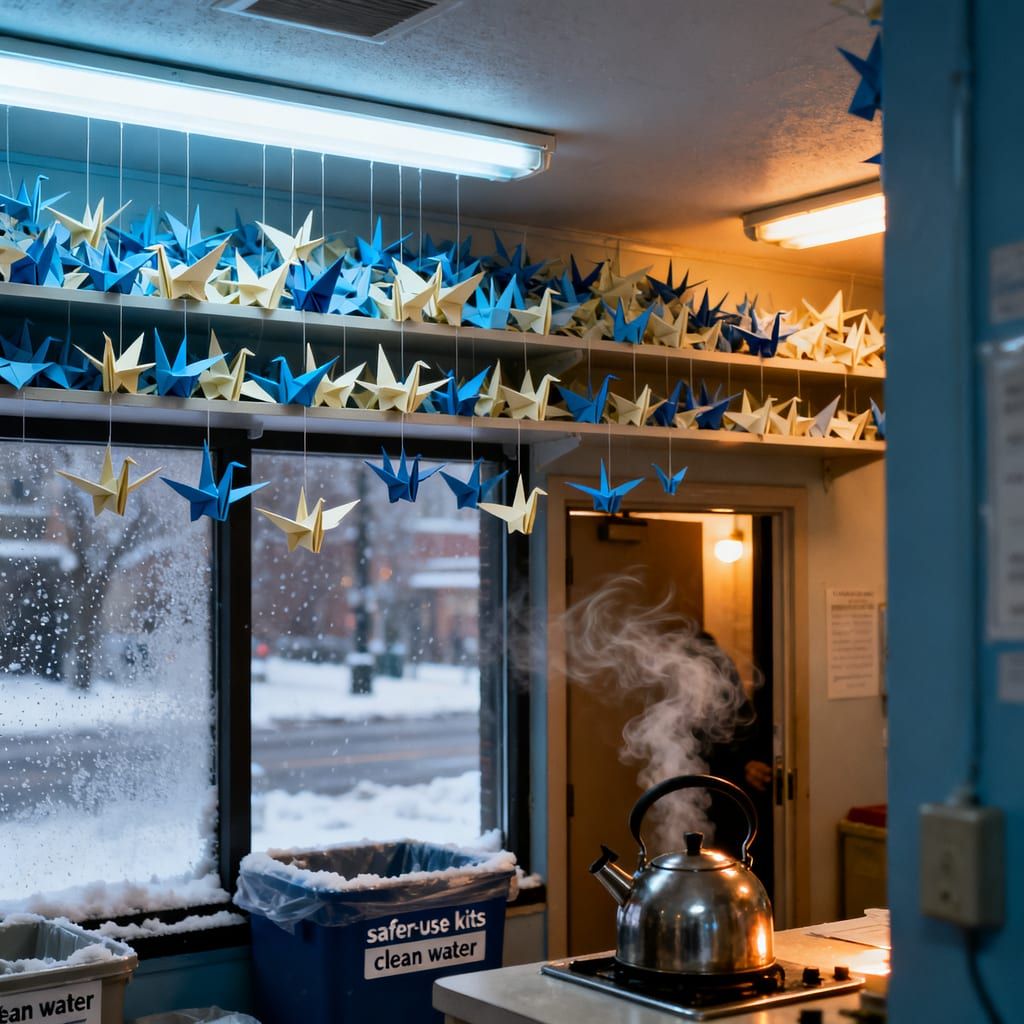
The next week, five more arrived. Then ten. A boy taught paper cranes on the handrail and left creased instructions that multiplied like birds. A nurse rolled a neighbor into the recovery position on a yoga mat. A mother counted compressions out loud while someone else, trembling, pushed. A whisper brigade traded bread starters with names-Lóló's, Walter White, Sunbeam-passed palm to palm, stained index cards sugar-dusted with inheritance.
Lina made a spreadsheet because she was good at tucking chaos into boxes. She mapped requests on a taped-together printout of the city, her living room wall becoming an atlas of wants. She handed out index cards stamped I can teach / I want to learn and watched people hesitate and then choose.
On the building forum, a screen name appeared under a thread: HexKey. Insurance nightmare, wrote HexKey. Noise. Permits. Liability. Hippie swap meet.
The HOA slid a printed warning under Lina's door the way a sword slides back into a scabbard-polite, sharp. Permits. Liability. Noise. The same words wore different suits.
"Maybe we move indoors?" someone suggested. "Community room?"
"Windows don't open," Jae said. "And it smells like carpet shampoo and regret."
"Waivers?" the nurse said.
"Lawyer?" someone joked.
Lina encouraged, cajoled, printed calmer flyers. When a child tripped over an orange extension cord and a man shouted, the sound ricocheted off the brick. Lina tasted iron. She woke that night sweating with the thought that she had built a thing with loose ends.
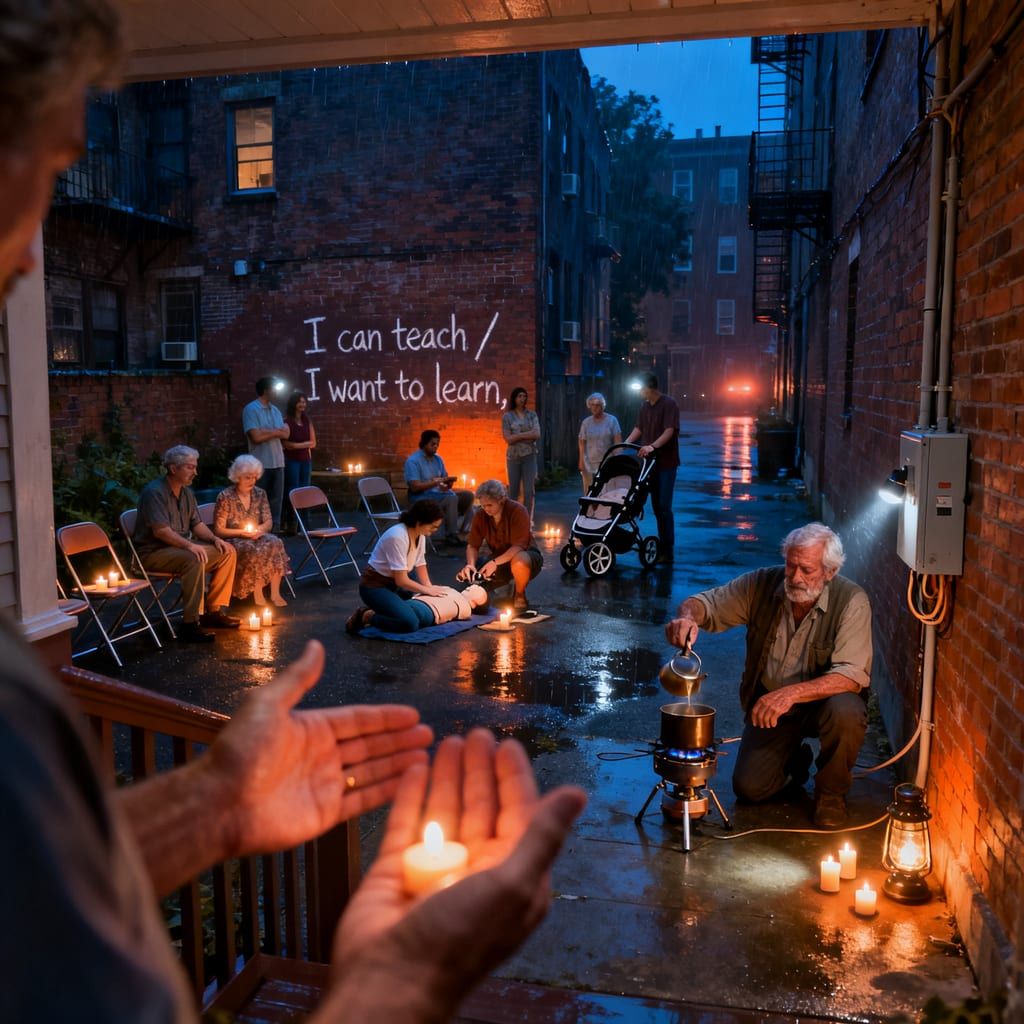
July gathered bruises. The sky went greenish and taut. Thunder elbowed the high-rises and the alley blinked once and went out-elevators stall-still, fridges unsighing, the hum of invisible systems gone. It felt like someone had taken their neighborhood by the shoulders and said, Listen.
The first to move were the kids, eyes wide as power-out stars. Doors opened. People leaned out. Tea lights bloomed under laundry lines; saucers became lanterns. Someone dragged a camp stove into the courtyard and Ananya lit a match, her face small and gold. "Chai," she said, measuring sugar by memory, cardamom pods tapped from her palm like a beat.
Jae clicked a headlamp on his forehead, its circle of light a small planet. "Bring me anything with wheels," he called. A cluster appeared with a stroller that wobbled like a drunk. "We count by feel," he said. "One, two, three," his fingers walking spokes, making a child's sleep smoother.
The nurse knelt with a teen at the lip of shadow. "Hand on ribs," she told her. "You can hear breath in your palm. Count in the dark." Their hands hovered like prayers that knew when to press.
A man arrived with a flashlight jauntily taped to a toolbox, quiet as a nod. He listened before he spoke. It was Mr. Keene, cap pulled low. He set the box down, squatted at the building's garage panel.
"Most people will just flip everything back up," he said, his voice low and even, "and then wonder why their house smells like hiss." He showed them a finger's width between off and on, the way to reset a main with a pause that felt like a blessing. He coiled cable the way you coil snakes-respected, not strangled. He listened for a click they began to hear too, the tiny handshake of current making up its mind.
"Use your nose," he said. "Electric's got a smell when it's wrong. Singed dust, a kind of coin taste at the back of the throat." They inhaled together, as if smelling were also a lesson.
Rain slicked the alley until it became a diagram of shine. Lina moved through it with a stack of index cards and a Sharpie gone soft. She pressed cards into damp hands like tickets to a movie no one had seen.
By midnight, someone chalked words up the alley wall, laddering them in a child's earnest capitals: I can teach / I want to learn. People scratched their initials below columns, white dust streaking their cheeks. A girl wrote, Tie shoes better. A man wrote, Solder copper. A grandmother wrote, Songs in Twi.
The blackout settled like a held note. The air thinned. Neighbors-people Lina had known only as doors-sat on steps and shared stories of getting locked out or stuck in an elevator, of old summers when they'd sweat and laugh and make do. The porch became a classroom and a cradle.
Dawn slid down the buildings, pale and polite. The lights twitched to life with a shivery ripple. Someone clapped, someone booed. The chalk words on the wall looked like a promise that had slept outside.
The HOA president arrived with his tie already straight and his mouth already primed. He took in the camp stove, the chairs, the chalk, the cluster of neighbors still up from the night, and inhaled the way people do when about to end a thing.
Then he saw Mr. Keene crouched beside a small girl, their heads nearly touching as they examined a match as if it were an animal. "We flick from the box," he said. "Not your thigh. Strike away from your face, little engineer. Then out." They blew together. The match made a tiny kiss and died.
The president's shoulders dipped. He cleared his throat into a different key. "We'll need... waivers," he said. "A schedule so folks know when to expect the crowd." He looked at Lina. "I can help draft. We can apply for a permit to use the courtyard on Saturdays." His tie loosened itself a fraction.
Lina's relief arrived like rain at the edge of a heatwave-smaller than it felt, and huge.
That afternoon, an envelope slid under Lina's door without a name. Inside: a photocopy of a 1979 neighborhood newsletter, the kind hand-cut and grainy, starring a younger Mr. Keene with a woman named Evie beside him. BAR TER SCHOOL ON THE BLOCK, the headline hollered in crooked type. The photo showed milk crates and chalk-stained hands, a boy holding up a perfectly folded paper boat.
Lina knocked on 3B with the photocopy held soft. Mr. Keene opened with his cap off and his hair surprising him. He wore a look like he'd been waiting to be caught.
"Come in," he said, already turned toward a closet. He brought out a weathered notebook fat with old air. Inside, carefully paper-clipped, were Evie's hand-drawn lesson cards: Seeds - soak then sow; Stitches that hold; Safety for small hands with big tools. On one card, a water stain bloomed like a second sun. Names were written in the corners, a lineage of givers and getters.
"I was HexKey," he said without performance, sliding out the confession the way you ease out a splinter. "The first time around, it was Evie's idea. We ran it for summers, then life..." The word trailed, choosing a gentle ditch. "After she died I-" He stopped, jaw working. "I didn't want a pale echo tromping around her footprints."
Lina held the cards as if catching the weight of a bird. "It isn't pale," she said, not as argument but as weather report. She was surprised to realize she meant it. "It's different. New light. Same hands."
He nodded, a small unspooling. "I was unkind," he said. "Online is easy. The porch is harder."
"Teach me how to coil a cable again," she said. It was the closest she could get to an apology for her own stiffness, her fear of needing anything.
He smiled with the side of his mouth that had been rusty.
The next Saturday, Lina set a handwritten sign at the edge of the porch: Today: How to Ask for Help.
People laughed when they read it, then stood closer than usual. Lina gestured them to sit. Her palms were damp and she didn't hide it. I am not an expert. She let the sentence sit on her tongue, a new flavor.
"We're going to practice," she said, heart thudding like the laundromat machine. "We're going to say what we need without adding thirty disclaimers."
A woman with a grocery cart raised her hand. "My freezer leaks," she said. "I keep towels on the floor."
"Who can help?" Lina asked, not looking at Mr. Keene. Two hands went up-one belonged to a man she'd only ever known by his terrier. The other was Mr. Keene's, steady as a level.
A teen in a hoodie cleared his throat. "I got into a community college but I don't know how to fill the form for... money." The word snagged.
"Financial aid," the nurse said. "I can show you while we wait for bread."
Ananya raised a jar, its rubber band loose with froth. "Anyone need starter?" she asked. "Its name this week is Blackout Baby." Laughter rolled like a good curtain.
They practiced. They stumbled and rephrased. They asked for rides to clinics, for someone to watch a kid for an hour on Wednesdays, for an extra set of hands to lift a couch. They wrote on index cards with blunted pencils, a chorus of needs and offers that sounded less like a ledger and more like a song you hum when you know the next part will be sung by someone else.
When the class ended, the alley wall still wore its chalk ladder. The words were smudged by rain and fingers, thicker in places where someone had gone over them. I can teach. I want to learn. White dust floated, soft as flour. Mr. Keene stood a little off to the side, a card in his hand. He tapped it against his palm, thinking.
"What's yours?" Lina asked, nodding to the card.
He looked at her, the cap's brim tipping up just enough. "I can teach: safe tool use. I want to learn: to make Evie's jam." He winced at his own tenderness, then let it be seen.
Ananya laughed low. "Come by Tuesday. Bring clean jars."
The block breathed. The hum returned, different now-threaded with human sound. On the railing, a new crane took shape, its paper bruised from wet fingers, its wings drying open in the sun.
In her kitchen that evening, Lina tacked one of Evie's cards above the sink. Stitches that hold. She boiled water for tea. She opened her window to the noise she'd once feared would swallow her. The porch below chimed with chairs, with someone plucking at a guitar too carefully to be anything but learning.
She let herself ask out loud, her voice a small match. "Can someone lend me sugar?" By the time the kettle hissed, three knocks sounded at her door. She smiled, unexpected as power after a long dark, and turned the handle.
A drummer learns to listen for the rhythms you can't hear
Read more →
In Los Angeles, a daughter learns how to carry two lives forward
Read more →Story audiobooks for children of all ages — a new one every day on Smarter Way Stories.