What the Mirror Couldn't Hold
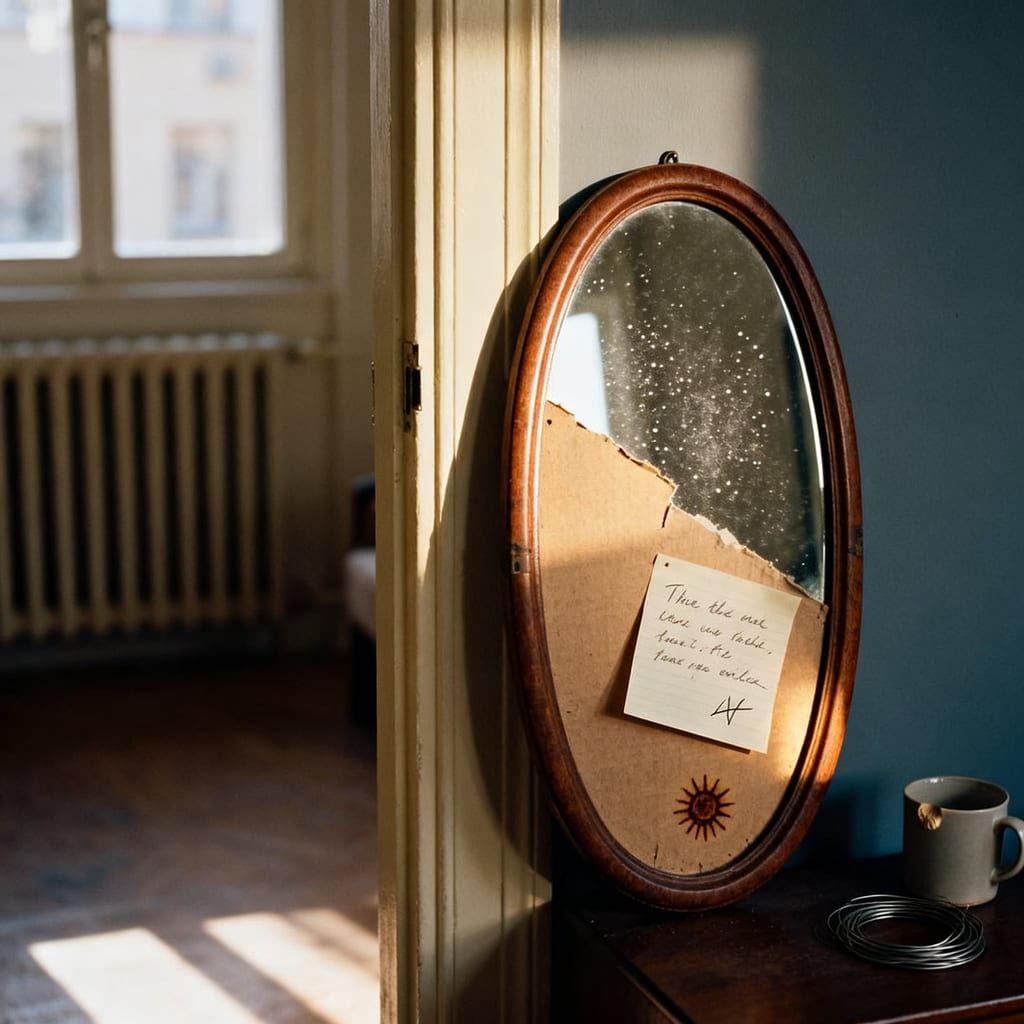
A frame, a note, and the rooms they make inside us
Read more →

Elena stares at the fluorescent hum until it blurs into a sound she can step through. The courthouse hallway never ends-just a looping ribbon of scuffed linoleum, paper cups, and grief with a number. Her phone buzzes; rent reminder. She thumbs it silent and tucks the notice deeper into the folder already fat with impossible.
"Ortiz?" she calls, and a boy with tired shoulders looks up from a plastic chair, his hands folded like he's keeping them calm. Nineteen. Cheeks still soft, the first bloom of a mustache attempting confidence. He stands too quickly and almost apologizes to the air.
"I didn't," he says before hello. "My abuela-she gets dizzy sometimes. I gotta... I'm just saying I can't be in here long."
Elena meets his eyes. They are dark and earnest, two deep wells. "Let's get you in front of a judge and then we'll talk about what didn't happen."
In court, the charges pile like bricks: armed robbery at a corner bodega, grainy footage of a hooded figure, a partial print that fits like a shoe one size too big. An officer's affidavit: he saw a kid running.
"Your Honor, Mr. Ortiz has strong community ties," Elena says, steady voice over the paper stack. "He delivers food. He cares for his grandmother."
The prosecutor doesn't look up. "The video is clear enough."
Clear is a kind word for snow. Elena watches the thirty-pixel man in a gray hoodie sweep an arm across the counter, the clerk's hands up. Somewhere in the fuzz, the robber's face ought to be. It isn't. The time stamp blinks a cheap green. 1:17 a.m.
Back on the bench, Jamal leans forward. "I was across town. Mercy Hospital. I had empanadas. The app-" He stops himself, like he's intruded on a grown-up conversation. "It glitched. It didn't log it. I swear."
"I believe you," Elena says before she can talk herself out of saying it.
He swallows. "My abuela's sugar gets low at night. I put her water by the bed. If I don't... Can I call her?"
He is nineteen and already belongs to someone-the way love makes a person both larger and pinned. Elena feels it in the center of her tired body, a brightness that resists the fluorescent drag.
Elena starts where the system never starts. Doors, not databases. She stands on a cracked stoop with paint peeling like old nail polish. The apartment smells of fried onions and lavender. The walls are a collage: church bulletins, bus transfer stubs, a Sunday school drawing of a dove with a too-big eye.
"Señora Ortiz?" Elena asks.
"I'm the grandmother," the woman says, voice lined with both steel and sugar. Carmen Ortiz. Bandanna tied at the crown of her head, hands that learned to make ends meet long before ends stopped looking for each other. "My Jamal-he don't go inside no store with a gun."
They sit at a small table. A jar of Vicks by a bowl of plantains. A rosary looped around a chipped salt shaker.
"He works nights sometimes," Carmen says. "Says the tips are better when the city is quiet. He texts me when he's close. He says, 'Abuela, water next to bed.' He never forgets." She taps a photo on the fridge-Jamal, taller than her by a head, his arm around her shoulders. Both of them mid-laugh, their eyes squinted to slivers of joy.
Elena writes down names of neighbors, the nurse on three, the pastor who keeps a key to everything. She takes a photo of the bus transfer with last Tuesday's date circled. She listens until the listening feels like a map.
"Thank you for contacting MealDash support. My name is Lila. I am happy to help you today."
Elena keeps her voice warm. "I need delivery logs for a driver, Jamal Ortiz, between 12:30 a.m. and 2:00 a.m., date is-"
"I can definitely look into that. For privacy reasons I will need a subpoena."
"I have one," Elena lies, already drafting the motion in her head. "Also, the system may have glitched. He says the empanada order to Mercy Hospital didn't log."
"I'm sorry to hear that your experience did not meet expectations."
Hold music: a marimba trapped in an elevator. Elena pictures her inbox like a trash chute. She switches ears; the same ache. She files the motion. She calls again. Twelve minutes. Twenty-three. Lila becomes Anthony becomes Samira becomes, finally, a direct line to a human whose sigh sounds like a person.
"We did have a server issue that night," the human admits. "About seven minutes of lost data between 1:10 and 1:17 a.m." A pause. "I can confirm a payout at 1:29 a.m. to a driver ending in 5932. No full log, but... something."
"What about GPS pings?"
"Partial. The outage-" Another sigh. "It's like a skipped heartbeat."
Elena thanks them like they've handed her the moon. It isn't the moon. It's a geode: dull outside, something glittering inside if you know where to hit.
The bodega is two narrow aisles smelling of coffee grounds and last summer's fruit. A bell tinks as Elena steps in. The clerk, a thin man with eyes that dart between her face and the door, says, "No more reporters."
"I'm not press," she says. "Public defender." She buys a scratch-off and a bottle of water she doesn't need. "I want to stand where it happened."
He shrugs, nervous energy in his forearms. "There." He points to tape scuffed into the floor where the counter begins. Elena imagines the robber's breath, the quick math of risk and need. The video she's watched a dozen times. The aisle narrows until it's a throat.
She traces the path to the door. Outside, the street yawns into late afternoon. Across the road, a worn apartment block leans into itself-brick dulled by winters, lace curtains in some windows, blinds cut ragged in others. A pigeon struts, imperial and ridiculous.
There, in a second-floor window across from the bodega, a small black camcorder sits on a tripod, angled toward the street. Barely there-a watching dot.
Elena blinks. The lens blinks back.
She steps into the crosswalk. A car honks. She raises a hand, apology and insistence in one motion. The apartment buzzer is a tooth with an exposed nerve.
An elderly man opens the door with the slow caution of someone who's been knocked on too many times. He wears a sweater the color of tea left on the counter too long. His living room is a museum of small chairs and big plants. On the windowsill, the camcorder faces the bodega, patient as a cat.
"I'm sorry to bother you," Elena says, and means it. "I'm an attorney. I noticed your camera."
He follows her gaze. "My birds," he says. "My daughter thinks it's silly. But the starlings do a... how you say... murmuration. Sometimes they come right over the store sign. It's like gossip in the sky."
"Do you keep recordings?"
He hesitates. The room contracts and expands with his breath. "The police came before, about this. I told them I delete every week."
Elena hears herself pleading and softens before she starts. "A boy-Jamal. He didn't do this. I need any chance."
The man looks at her face for something money can't buy. He nods toward the camcorder with a tenderness people reserve for pets and fragile machines. "I forget sometimes," he says, embarrassed. "To delete. My grandkids... they put the camera there when I got sick. It just stays watching."
He shows her the playback. The time stamp stutters; the cheap green of all cheap greens. 1:12 a.m. Empty street. A man stumbles past-older, heavy coat, arm clutched to his side. Two minutes. A figure in a gray hoodie enters the bodega. A beat. Another figure appears from the left-no hood, slim, a delivery bag slung across a shoulder.
"That's Jamal," Elena whispers.
The hooded figure bursts out, a blur of urgency, shoulders hunched like a question mark. A clerk-just a flash of his shirt-follows to the door, yelling. The hooded figure runs right, and in that window of motion, Jamal bends to the older man who has fallen to his knees on the sidewalk. Jamal sets the delivery bag down. He pulls the man's arm around his shoulder and lifts-awkward, gentle, two strangers finding a way. They move slowly left, out of frame, as the noise travels right. The camcorder watches what nobody else watched.
Elena feels air find a deeper room in her body. "Can I... make a copy?"
The man nods. "They turned off the body camera," he says, not asking, just stating a sad fact he can see from the way she arrives and the way she's looking. "At least this one was on."
The evidence is a shaky, miraculous thing-soundless, grainy, human. Elena tucks the USB into a sealable bag like it's a relic. She files a motion the length of all her stubborn years. She writes, "Previously unavailable third-party footage," and, beneath it, the small truth: Someone was watching because they love birds.
The prosecutor calls, voice clipped to efficiency. "We're reviewing." Then: "You're lucky."
Elena almost laughs. "No," she says, surprising herself with the calm of it. "We're persistent."
At the hearing, the officer fidgets under the oath. Elena keeps her questions neat and small.
"Your body camera?"
"It malfunctioned," he says, the script well-worn.
"Before or after you chased the suspect?"
"Before."
"Did you render aid to a man who fell on the sidewalk?"
A flicker. "I... did not see that."
She enters the birdwatcher's video. The courtroom watches the unremarkable miracle: a kid doing what you'd hope someone would do if your father fell at one in the morning. The hooded figure peels into the night like a strip of Velcro; Jamal shoulders the weight of a stranger.
Something warm loosens in the room. Even the judge leans back, a fraction, as if a knot has unclenched in his tie.
The charge doesn't dissolve on contact with truth-it never does-but it begins to thin. The prosecutor confers, whispers stacking like cards.
Outside, during a recess, Jamal stands by the radiator, hands in his pockets, staring at the city like it might ask him a question. Elena says, "We're close."
He nods once, twice. "I kept thinking, if I had run faster, maybe I could've told the cop. But he went the other way."
"You did the right thing," she says.
He shrugs, not fishing for praise. "He fell. You pick people up." He glances at her, almost shy. "You know?"
She does.
The case doesn't end with fanfare. It steps down. The robbery charge deflates into a file stamped "Dismissed without prejudice," and Elena knows the phrase like an old roommate: can come back any time. But the prosecutor's eyes tell her it won't.
By late afternoon, the fluorescent hum of the courthouse recedes into real air. Carmen Ortiz waits on the steps with a plastic grocery bag crinkled in her hands. When she sees Jamal, she makes a sound like a prayer finishing. He tucks his head into her scarfed shoulder. They stand that way until the city agrees to continue around them.
Elena walks them to the bus stop. The sun lays a long scrap of syrup across the avenue. A pigeon, possibly the same imperial idiot, fluffs its neck and considers the world.
"Abuela, water by the bed," Jamal murmurs, and Carmen swats his arm like a punctuation mark. They laugh in the same twin sliver-eyed way as the photo on the fridge.
Across from the bodega, in the second-floor window, the camcorder sits again on its slim tripod. The elderly man-his name is Mr. Halvorsen, she learned, a retired lineman with a fondness for cardinals-has the lace curtain pinched between two fingers. He sees Elena see him and lifts a hand half an inch. The smallest wave.
She thinks of systems strong enough to crush and too clumsy to care. She thinks of the kitchen tables that make different kinds of maps. Of the skipped heartbeat in a server and the pulse caught by a birdwatcher's patient eye.
On the bus, Carmen leans into Jamal, and Jamal leans back without moving. Elena stands, one hand looped into the metal bar, the other holding a folder that's lighter by one life. Her phone buzzes with three new cases and the rent reminder resurfacing like a fish.
At the next stop, she gets off to walk. Past the bodega with its plastic-wrapped bananas, past the taped square where fear pressed itself into the floor, past the crosswalk where a car had honked and she had not flinched. The afternoon has that particular Midwest trick light-flat and endless, then suddenly tender around the edges. She breathes it in like an apology she doesn't require.
When she reaches the corner, she looks back. From up on the second floor, the camcorder stares at the street, indifferent and entirely faithful, a small black dot insisting that sometimes what we need is not better heroes but truer seeing. The pigeon takes off-one, then two, then a scatter-like gossip becoming, just for a second, a murmuration.
Elena stands a moment longer. Then she tucks her hands into her coat and walks toward the next door she'll have to knock on, the next kitchen table, the next narrow aisle where a life might tilt and, with any luck, tilt back.
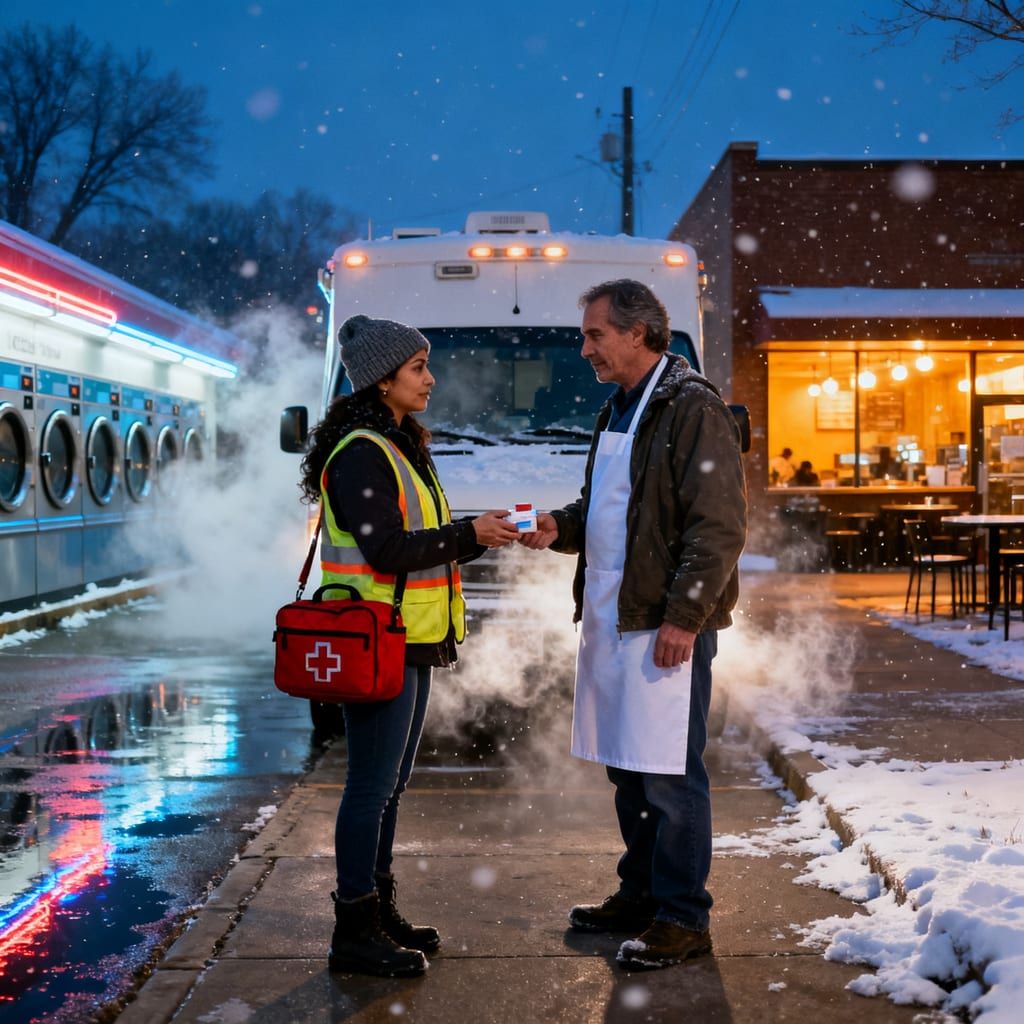
Between a laundromat's hum and a café's light, a van keeps score another way
Read more →
Story audiobooks for children of all ages — a new one every day on Smarter Way Stories.