The Weight We Hold Together
In the soft hours before dawn, staying becomes its own kind of rescue
Read more →

By three-thirty, the shelter hums like a refrigerator-steady, low, a presence that slips under doors and down the hall.
Lila pours the first coffee and pins a new card to the corkboard by the pot. The board's title, hand-lettered in a wavy script, reads: Small Braveries. Beneath it, a mosaic of paper squares blooms: First full night of sleep. Called my sister. Laughed. Ate an apple without checking the blinds. Told the truth out loud.
She presses her thumb to the pushpin. The card flutters like it wants to fly.
Outside, the city coughs up a siren, then swallows it again. In here-white tile, scuffed baseboards, the sheen of industrial wax-bravery is measured in inches, not miles. Lila has learned to love inches.
They come at four forty-seven: a woman in an oil-green jacket with a boy pressed to her side and a cat carrier with a sagging handle. The woman's scarf is knotted like it's holding her together.
"Hi," Lila says, opening the door wide with her hip. "I'm Lila. Come in."
The woman exhales in a single, ragged sound. "Noor," she manages. The boy-eyes the polished brown of river stones-leans into the cat carrier.
"I'm Sami," he says, trying on boldness. Inside the crate, the cat flinches, then settles, a small living comma.
It's not Lila's first intake before dawn. She moves through it with careful hands. Tea-always first. Paperwork-second, but eased like a new pair of shoes. The rules-no last names, no late-night visitors, no apologies for survival.
"Say that again," Noor says softly, as if testing the weight of each word.
"No apologies for survival," Lila repeats. "Not in this building." She slides a basket of teabags across the counter. The lemon ginger one is always chosen by women whose hands are still shaking. "Lemon ginger is good," Lila adds, casual, like weather. "Sami, do you want cocoa?"
"Yes," he says, with the immediate clarity of seven. "And for Dusty, water." He taps the crate. The cat blinks like a council of elders.
The clipboard waits, pages neat and accusing. Noor looks at the lines where last names would sit and sets her mouth. "Can I just be... Noor?"
"You can be Noor," Lila says. "And this is a safe house for your cat-for now." She draws a small heart by the emergency vet's number. "We have a volunteer. Weekdays only at first. I'll make the calls."
By six, a room is ready. Two twin beds. A dresser missing a knob. A window that sticks, but faces the alley's lone maple tree, which in June shakes itself awake like a sleepy aunt.
Noor and Sami stand in the doorway and regard the two clean blankets as if they've never seen such blue.
"The shower pressure's good," Lila says, as if this is the most important detail. In some homes, it's not small. "We'll do court later this morning. Clinic after lunch. Noor-your scarf is beautiful."
Noor's palm finds the scarf's end and holds it. "My mother sent it from Amman." She glances at the board by the coffee. "That's for...?"
"Small braveries," Lila says. "People pin their inches. It helps."
"I have no inches," Noor says.
"You'll have a drawer jammed with them by Friday," Lila answers, certain as sunrise.
Thunder starts that night in the pewter hour, low and close, rolling like some bored god moving furniture. Sami sits cross-legged on the floor of the office, his hands pressed over his ears. Dusty has built a cautious fort of files and a sweater.
"Here," Lila says, riffling the basket near the printer. Appointment slips-hundreds. "We can fold these." She flattens one and creases it into a crane. "You want to make a flock?"
"What's a flock?" Sami asks, distracted enough to take the paper.
"A family that can fly," she says.
Together they crease the thin paper into beaks and wings. The thunder grows less like a door slammed and more like texture. Lila hums-low, tuneless, something her mother used to murmur when the building's heat clanged on.
"Does it work?" Sami asks. "The humming?"
"For me," Lila says. "Sometimes." What she doesn't say: I still flinch at slammed doors. The reflex is stitched in. But so is the humming. Both survive.
By midnight their cranes line the windowsill, pale birds aimed at the maple tree's leaves, which flash silver in the storm.
Weeks fold like those cranes: crisp, practiced. Daylight brings courtrooms with air like old paper, judges with patient hands, forms in triplicate. Lila learns to be a bridge where policy has gaps-if the rule says no pets, the loophole says temporary boarding with Ms. Jeannie on 114th Street and a vet voucher in the file.
She writes notes for Noor to ask at the clinic. She labels donated food in three languages, because once a woman stood for ten minutes holding a can and a dictionary, cheeks burning, and Lila decided no one would stand like that again if she could help it.
"Are you always this... careful?" Noor asks one afternoon, after Lila translates an immunization line with her phone held under the fluorescents.
"Only when it matters," Lila says. Then she smiles, an early spring. "And this matters."
The day for the retrieval is gray as an unwashed bowl. The officer assigned is polite in the way of men who have seen a lot they'd rather not hold.
"It's just me today," Lila says to Noor in the lobby. "Janet's out. I'll go with you." She can feel her own heartbeat in her wrists. She hasn't told anyone why the smell of damp towels can make her swallow twice. She hasn't told anyone about the year she stopped making jokes.
Noor ties her scarf, the ends trembling a little. "I can do this."
"You can," Lila says. Then she steps into the staff room, closes her fist around a card from the board, and slides it into her pocket. The card reads: I can do hard things scared.
The apartment is stale with the old damp of someone who left the dryer door open and the wet never quite left. The couch leans like it's remembering a weight. On the table: a bowl, a keychain, the accretion of a life.
"Take what takes you forward," Lila says, because the list can balloon and swallow you: whose mugs were these, and were they ever truly yours?
Noor moves like a surgeon through a body she knows too well: passports, birth certificates, a copy of rent receipts, the boy's school shoes from under the bed.
On a shelf, a framed photo. A younger Noor and a sea that looks like a dress spreading. Noor reaches for it and stops so suddenly her arm quivers midair.
"It was the only day," she whispers. Her hand falls. "But if I take it, I'm taking him, too."
Lila feels a flicker in her mouth-the shape of something she needed to hear once and didn't. "Take what takes you forward," she repeats. "Leave what takes you back." She nods at a different photo: Noor's mother in a pressed blouse, laughing at something off-camera, a line of children's hands reaching toward her. "Her. Take her."
Noor's mouth loosens. She slides her mother into the bag. The officer clears his throat in the gentle distance people give to grief.
On the way out, Lila catches sight of herself in the mirror by the coat rack. A woman whose work badge hangs like a shield. A mouth so careful it could be a scar.
Her hands are shaking. Still, the key turns, the door clicks, and somewhere downstairs a neighbor slams something heavy-Lila startles so hard the world doubles. Breath returns slowly. She hums-one note, one roof tile. Noor touches her elbow. "Thank you," Noor says, and in the elevator's fluorescent wash, thanks feels like a blessing and a benediction and a remembering.
Back at the shelter, the soup smells like cumin and long afternoons. Noor hands bowls to anyone with a spoon as if she's known them all her life.
"To strangers," she says, raising her ladle.
"Who are not strangers anymore," Lila answers. It comes out before she thinks. Everyone nods, the way people nod when their ribs agree.
Lila pins a new square on the corkboard: Brought soup for strangers who are not strangers anymore. She writes in a slower hand than usual. The card's edge catches the light.
Days later, the lobby fills with boxes of mismatched plates from a restaurant closing on 12th. Someone bumps a stack; the whole top column cascades in a clean, heartbreaking song. For a breath, the room holds its ribs.
Then it's Lila who laughs first-she doesn't mean to. The sound lifts the gloom like a wind takes pollen. "I guess we're done being fancy," she says, and the women wince and grin and begin sweeping.
"Don't throw them out," Noor calls from the kitchen doorway. "We'll make a mosaic-on the entry wall."
A week after Noor and Sami have moved to transitional housing-keys on a ribbon, Dusty boarded with Ms. Jeannie and booked for neutering-Lila finds a parcel on the desk. No return address. A glass jar inside, fat with birds.
Paper cranes-dozens. Appointment slips. Grocery receipts. The back of a community flier. Each folded with a care that made Lila's throat move.
A note at the bottom in a tight, familiar script: From Anika-she of the scar knee and the cherry ChapStick-now EMT #743. She'd called months ago to say she was okay but living out of her rig. The note reads: Open carefully. We've been keeping a ledger.
Lila smooths a crane and finds writing inside. The inked triangles meet like two people leaning in to hear.
Thank you for humming outside my door the first night. I slept.
You labeled the halal meat in Arabic so I didn't have to guess.
When you laughed at the broken plates, I remembered laughter wasn't a trap.
You held the phone while I called my sister and nodded like you could hear her too.
You let me cry in the pantry and didn't call it weak.
They go on, the tiny testaments, the quiet mirror held up to a face Lila only catches in glimpses between tasks. Her hands find her own ribs. She doesn't realize she's sitting on the floor until the file cabinet's cold reaches through her jeans.
"Lila." It's Janet at the door, eyebrows folded like origami. "You okay?"
Lila lifts the jar so the cranes glitter. "Ledger," she says, and then laughs-the word too official, the contents anything but.
The mosaic grows in the entryway, the plates' white bellies and blue rims arranged into flights and rivers. Kids press gum wrappers into empty grout lines like offerings. A woman named Tasha teaches everyone how to butter the cement on with a knife's back. Noor returns with a bag of tiles from a craft store, dusty with coupons.
"What are we spelling?" someone asks, neck craned.
Lila thinks of the cranes in their jar by the coffee, the weight of them like a second heart. She thinks of the maple outside, the way it keeps shaking loose new leaves as if the tree can't help itself.
They settle on a phrase, tried, tested, and more than true. It takes a week of evening hands. When it's done, the entry's wall says it like it means it:
You are already brave.
The words catch every afternoon's gold as if the sun meant to sign its name.
That night Lila sits at the desk with the jar of cranes to her left and the application portal open to her right. The cursor blinks like a metronome set too fast. Master of Social Work, half-time, weekends, financial aid available.
Her personal statement-drafted months ago-stares up, polite and thin. In it, there's no belittling boyfriend who called her careful like it was a slur. There's no year she moved like a ghost through Saturdays. There's only service verbs: coordinate, liaise, facilitate, as if she were a filing system with legs.
She pulls a crane at random and reads: You told me, 'Take what takes you forward,' and it made a door where there wasn't one.
It lands soft as a feather and heavy as a brick. She adds three sentences to the statement, then deletes one. She takes a breath. She presses submit.
For a second, nothing happens. The site coughs in bureaucratic doubt. Then the status bar fills like dawn.
She looks up at the mosaic. You are already brave, it says, objectively, like weather. Like the maple shaking rain from itself.
Sometime after midnight, Janet returns with a sack of oranges and a new set of spare keys. "You're still here," she says, half-accusation, half-love.
"Couldn't sleep," Lila says. She lifts the jar. "We have birds."
Janet peers in. "Who made these?"
"Everyone," Lila says, which is true. Even the ones who are gone, gone and still here.
At five, the city huffs a breath. Trucks yawn. Somewhere, a baker rolls the first croissant tight as a secret.
The corkboard catches the thin pre-dawn light. The cards shift, tethered and tremulous. Lila adds a new one, the corner neat:
Sent the application anyway.
She stands with her palm flat to the cool tile, just for a count of five. Somewhere in the building, a woman turns over in her twin bed and keeps sleeping.
At six fifteen, a new knock-the rhythm she knows already, the quiet kind, the kind with questions packed inside it. Lila opens the door wide with her hip. "Hi," she says. "I'm Lila. Come in."
Behind her, the mosaic gathers the early light and holds it. The cranes on the sill lean toward the maple like birds learning to roar.
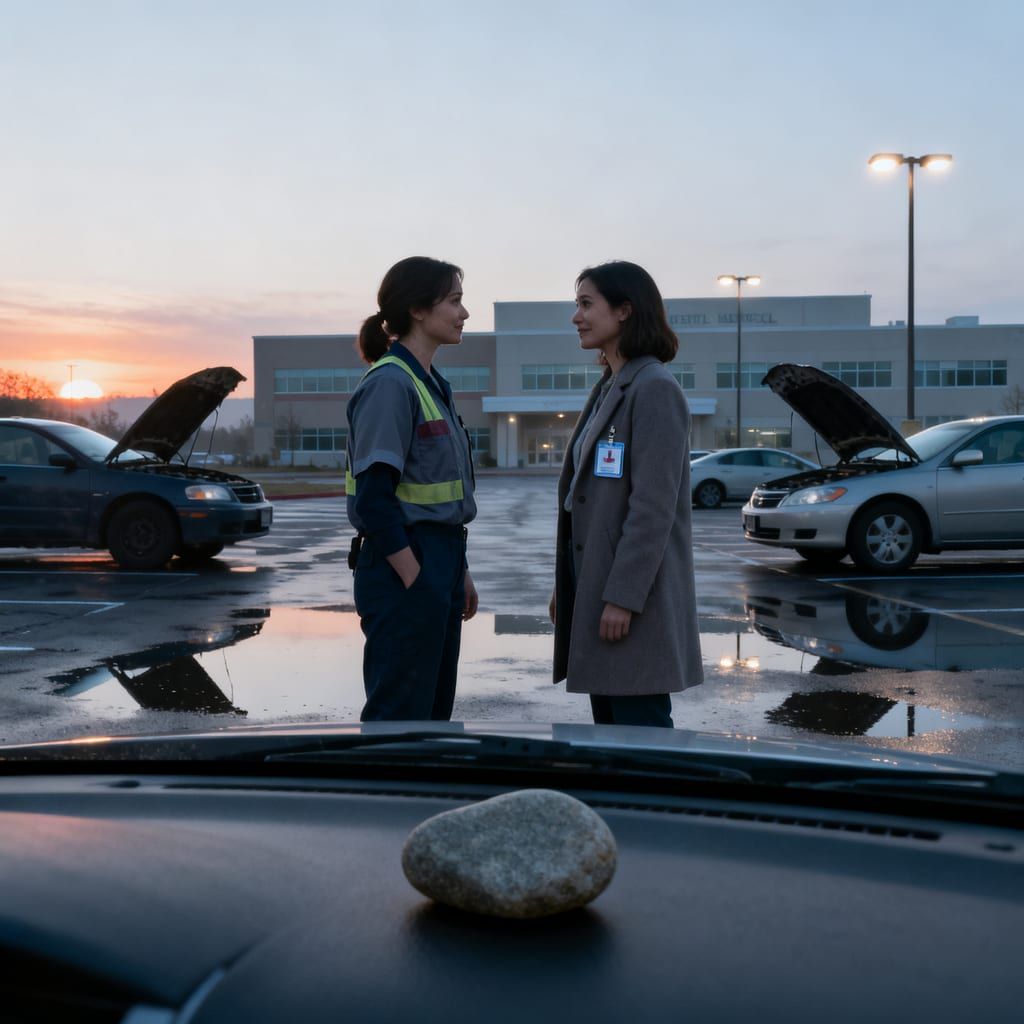
In the soft hours before dawn, staying becomes its own kind of rescue
Read more →
Story audiobooks for children of all ages — a new one every day on Smarter Way Stories.