Two Houses and One Quiet Heart
A daughter learns to read between the lines of a life split in two
Read more →
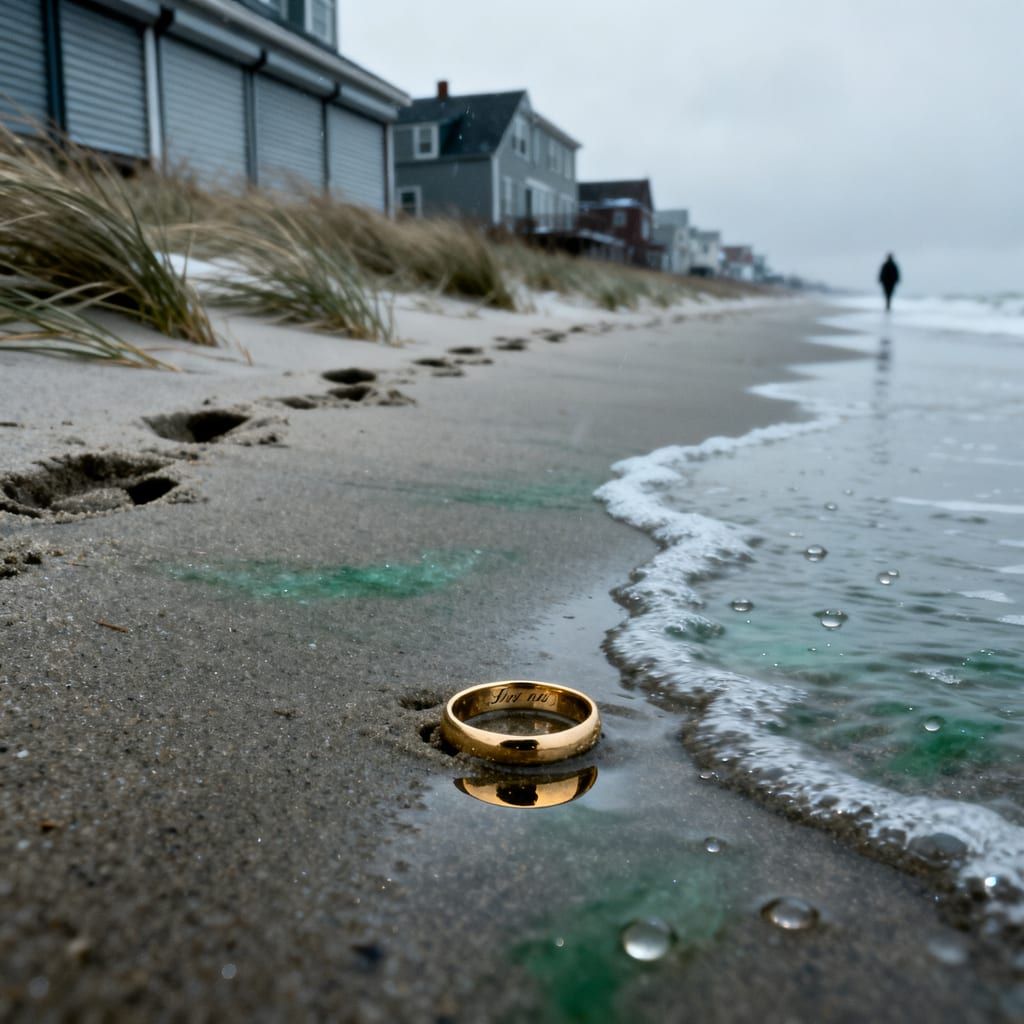
The gulls sounded hoarse, like smokers clearing their throats. Jonah walked the morning strand because the apartment above the bait shop had grown too loud with its refrigerator hum and the clock's arrhythmic tick. The ocean wore its winter gray and the dunes hunched like sleeping animals. He kept his hands in the pockets of his windbreaker, rubbing a coin that wasn't a coin-a key, still, to an apartment he no longer had a right to enter.
A curl of metal winked at him from the wet seam where one wave had just conceded and the next hadn't yet arrived. He nudged it free with the toe of his sneaker. Gold, dulled, half-sugared with sand. A ring, plain but for the stubborn brightness at its edge.
He rinsed it in the shallows. Cold sank his knuckles. Inside the band, the letters were small and certain: "Still my home - 9.17.11 - M & L."
For a breath, he held its weight on the pad of his thumb. The inscription landed like a pebble in his chest, ripples going wide. He was thirty-two and recently single, sharing drywall with thawing squid and a man who tied flies over the sink. He wore quiet like a rash he couldn't stop scratching. The ring was gravity, soft and simple. He couldn't pocket it and walk away.
He snapped a photo with his phone: the band on a strip of driftwood, the beach's slate behind it. On the local forum he wrote, Found gold ring at Breaker's Cove this morning. Inscription inside. If it's yours, tell me the date and initials. He hit Post, then walked to the bait shop stairs, boots squeaking. The smell of brine rose through the treads.
By noon his post had three comments: two jokes about proposals, one earnest message from a woman whose ring had been stolen in 2009-no date match. He scrolled, thumb jittery, then remembered the jeweler with the bell that coughed when you pushed the door.
The sign on the window read O'Malley & Son, though the son was now the father with a granddaughter who did piercings on weekends. The case held a tired congregation of watches with stopped hearts. Mr. O'Malley looked up from a loupe like a Cyclops returning to his human eye.
"You don't look like you need financing," he said. His accent scalloped his consonants. Jonah placed the ring on a square of felt.
O'Malley lifted it, humming, and turned it under the fluorescent light. "Plain gold, nice weight. That engraving-yes, that's familiar." He angled the band so the tiny letters caught. "There was a fellow who used to do this hand-tight loops, the ampersand a ribbon. Did all the sets for weddings at Sandturn House before they closed."
"Sandturn House?" Jonah said. He'd passed the old beachfront venue a dozen times, its faded clapboard shuttered, the yard grown feral with beach rose.
"Closed up, what, three years now? Weddings there were a small industry. The engraver died last winter. Cancer." O'Malley set the ring back down gently, as if not to wake it. "You might talk to Mrs. Harrigan-managed the place till the end. Lives over the bakery."
The bakery had a bell like a throat clearing, too. The glass fogged at the corners where sourdough loaves leaned against it like lullabies. A woman at the back in a flour-dusted apron rolled out dough with the heft of someone who understood that grief and bread rose from warmth.
"Looking for Mrs. Harrigan?" the cashier asked when Jonah hovered. "Upstairs. Left door."
On the landing, he knocked. The left door cracked; a fine-boned woman peered out, cardigan tugged closed. Her breath smelled faintly of cinnamon.
"Sorry to bother you," Jonah said, the words catching on the net of his mouth. He held up the ring. "Found this at the cove. Mr. O'Malley said you might know the engraving, from Sandturn House days."
Her fingers, spot-sunned and knuckled, lifted the ring as if it were an egg. Her eyes thinned, then widened. "M and L," she murmured. "That day. The morning the fog burned off the marsh at the last possible minute. Gray like a promise." She glanced at him, measuring. "Come in. I might have something."
Her living room bore the light of people who collect it on purpose-plants angled toward the window, frames crowded along the sill. She pulled a cardboard box from under a chair and began digging: place cards, a crumpled bunting; a guest book whose cover peeled at the corners.
"There was a wedding-September seventeenth, 2011." She licked her finger, turned the page. "Maya and Luca." She held up a photo, its colors damped by time: a woman in a tea-length dress laughing into the wind, a man with hair the color of wet sand, the ocean a gray wall behind them.
"They ordered rings with that little ampersand. He was a fisherman, I think. They wanted the ceremony at the dunes, no arch, no fuss. There was a storm brewing out over the horizon that never quite reached us." She tapped the guest book's page. "Maya Leone. Luca-oh, what was his last name? It'll be in the ledger."
From another envelope, she pulled a catering invoice stamped with a familiar bakery logo. "Ask June," she said. "She catered that day. She remembers everything she's fed."
Downstairs, the baker wiped her hands on her apron when he said the names. "Gray morning, yes," she said. "Tea cakes with lemon glaze that slid off in the damp. The bride ate two before she walked to the dunes. Pretty couple. He had that look-men who work where things can kill them."
The day swelled around Jonah, gathering details that pricked and warmed. He thanked them, dropped a few dollars in the tip jar because it felt like rent for standing inside their memories.
On the walk back to the cove, a man with a metal detector swept the beach in long, reverent arcs. His baseball cap had a shark stitched on the front. Jonah lifted a hand.
"Find anything good?" he called, the way you call to fishermen about their catch.
"Bottle caps and wishes," the man said. He stopped, eyes going to Jonah's hand out of pure habit. Jonah showed him the ring.
The man whistled softly. "That's a story you stepped on. Rings are always stories. You putting it back where it belongs?"
"Trying," Jonah said.
"Sometimes the sea gives you a breadcrumb," the man said, sweeping again. "Sometimes it gives you the whole loaf."
Maya's storefront had been a seamstress's once, then a candle shop. Now the windows were fogged with brushstrokes; inside, canvases leaned like doors into other days. Jonah stood in the threshold with his windbreaker draped over his arm, his nerves beating in his wrists.
Maya was at a work table, her hair piled loosely as if every pin had given up. She wore a man's sweater with the sleeves pushed to her elbows. Paint freckled her forearms, sun-bleached with the ghost of summer.
"We're closed for the season," she said without looking up. The bell finished its small ring. Jonah took a breath.
"I found something of yours," he said. The ring lay in his palm, heavy as a word said late.
She looked hard, then not at all. Her fingers didn't reach. Her eyes did a thing he recognized: the wince of a door opening onto a room you'd kept sealed.
"Where?" she asked. Her voice had gravel in it.
"Breaker's Cove. This morning."
She nodded, as if this matched a map she held privately. A bead of paint rolled down the brush in her hand and fell onto the table with a soft, absurd plink.
"I threw it," she said. "Last November. Nor'easter on the horizon, wind loud as anger. I went to the dunes where we said our words, and I threw it as far as I could. I wanted-" She swallowed. She looked at Jonah as if he were a post to tie a boat to. "I wanted to stop drowning on land."
He let the silence do some work. In the quiet, the radiator ticked like someone thinking.
"I'm sorry," he said. It wasn't performative. It wasn't him trying to enter her house with his shoes on. It was a small thing put where it belonged.
"He went out with Micah's boat," she said. "Squall came up fast. They found the boat with its mouth open. They didn't find him." She let out a breath she'd been hiding and laughed, a dry sound. "I kept the ring for months. I wore it on a chain, then I couldn't bear even that. I thought if I gave it to the sea, maybe it would take the weight with it." She looked at the circle in his palm now as if it were a creature returned from wherever the sea keeps its borrowed things. "And now you're standing here."
"It felt like it didn't want to stay gone," Jonah said. He didn't add: I have a key I can't seem to stop holding. He could feel it even now, pressing a small, insistent bruise into his pocket.
Maya's mouth tilted. "Or the ocean changed its mind."
They stood in the angled light of late afternoon and the dust looked like snow no one had to shovel. She set down her brush. "Would you walk with me to the dunes?"
He nodded.
The path cut between hummocked grasses, their tips bleached like old bones. The air had that wet cold that sneaks beneath your clothes. The closer they drew, the more the sound of the waves adjusted the skeleton of the day.
"We were here," Maya said, stopping at a gap where the dune swelled away to show the beach like a shoulder-blade. She pointed to where the wrack line arced. "There was a gull that stood the whole time like an indifferent priest. He kept waiting, as if someone would drop a french fry from heaven." She smiled, and then the smile thinned. "Luca said he never felt as solid as he did with sand in his shoes."
Jonah held the ring. He could feel the place his thumb wanted to worry smooth. He thought of his own ceremony of sorts: the day he'd moved out, his ex, El, standing in the kitchen with her hair gathered like she meant business. He'd taken the key off his ring and slid it into his pocket because his fingers weren't ready to let go of the old choreography of the lock, the turn, the entering. He'd told himself he would mail it when the bruise colored down. Months. It was smaller now, but he could still press and find it.
"Do you want it back?" he asked now. He didn't mean as a question about objects. He meant: Do you want to feel this weight again because it's changed shape.
Maya's hand hovered, then settled on the ring. She didn't slip it on her finger. She cradled it, as if warming a small animal. The wind blew their hair in the same direction; for a second they looked like people in an old postcard, strangers stitched by weather.
"I don't want to put it where it was," she said. "But I don't want it to go back to the dark."
She reached into her satchel and pulled out a thin chain with a small hook where something else had once hung. She slid the ring on and fastened it. The circle lay against the hollow at her throat, not as a claim but as a landmark.
"It was never about erasing him," she said, almost to herself. "I thought I had to hurl instead of hold. No one teaches you the middle."
They stood until their toes went numb. The tide exhaled, the line of wet sand inching back with the patience of old furniture being moved.
"I have something too," Jonah said, surprising himself. He fished the key from his pocket. The metal had warmed to his grip. He held it out, ridiculous and holy.
Maya looked at it with the same tenderness she'd given the ring. "Ex?"
"El. We were together six years. I moved out in July and still-" He closed his fist and opened it again. "I keep thinking there will be a day when I open the door and she'll be in the kitchen playing the radio too loud."
"And maybe there will be, but not with that key," Maya said.
He laughed, a breath slipping finally. "I brought an envelope. Stamped and everything. I didn't know why until now."
He wrote the address on the flap with the stub of a pencil he used for grocery lists and ideas he never texted himself. He slid the key in, pressed the strip of glue with his thumb. For a second he wanted to lick and seal it with his breath, but the cold air did the work.
"There's a blue box by the post office," Maya said. "We can pass it on the way back."
She touched the ring at her throat and inhaled. The chain disappeared under the sweater's collar like a stream going to ground.
On the walk back, the town moved at the low speed of the off-season: a boy on a scooter, a man hosing down fish bins, a note taped to the surf shop door promising a spring reopening. The air had that old pennies smell that comes when the wind is due east.
At the post office, Jonah fed the envelope into the metal mouth and felt, stupidly, a flash of panic, like a child dropping a toy into a well. It thunked in quiet and was gone.
Maya watched his face go through it. "I brought him coffee every morning the first month," she said. "To the dock. I thought I was being brave. Then I realized I was just keeping my hands busy."
"There are worse ways to use your hands," Jonah said.
"Sure," she said, and the corner of her mouth lifted. "Like throwing perfectly good gold into a storm."
"The sea seems to have opinions," he said.
They stood there a minute, citizens of a small act. The bell on the bakery door below Mrs. Harrigan rang like a small applause. Somewhere inside, someone laughed, a sound like warm sugar.
"Come by the studio sometime," Maya said, pulling her sweater tighter. "I make terrible coffee. The kind that admits how little I pay attention."
"I'll bring a filter," he said. "Maybe two."
She started down the street, the ring catching a small flash of winter light at her throat whenever she turned. He watched her go the way you watch a boat find its line with the current-hesitation, then a quiet sure.
Back at the beach, the tide had pulled further from the foot of the dunes. Where the ring had been, a crescent of shells made a pale parenthesis. He stood at the edge of the bright wet line, listening to the sound of absence that is not loss but space.
He put his hands in his empty pockets and breathed. The refrigerator hum would still be there when he climbed the stairs. The clock would still not agree with itself. But something in him had shifted half an inch to the left, where there was room.
The ocean drew its forearms back and sent a wave that didn't quite reach his sneakers. He waited. When the water returned, it only touched, like greeting, not claim.
In the thin sun, a small courage held its shape.
A daughter learns to read between the lines of a life split in two
Read more →
A fog-draped night, two souls found, and the quiet shape of a life
Read more →
Story audiobooks for children of all ages — a new one every day on Smarter Way Stories.