Two Houses and One Quiet Heart
A daughter learns to read between the lines of a life split in two
Read more →
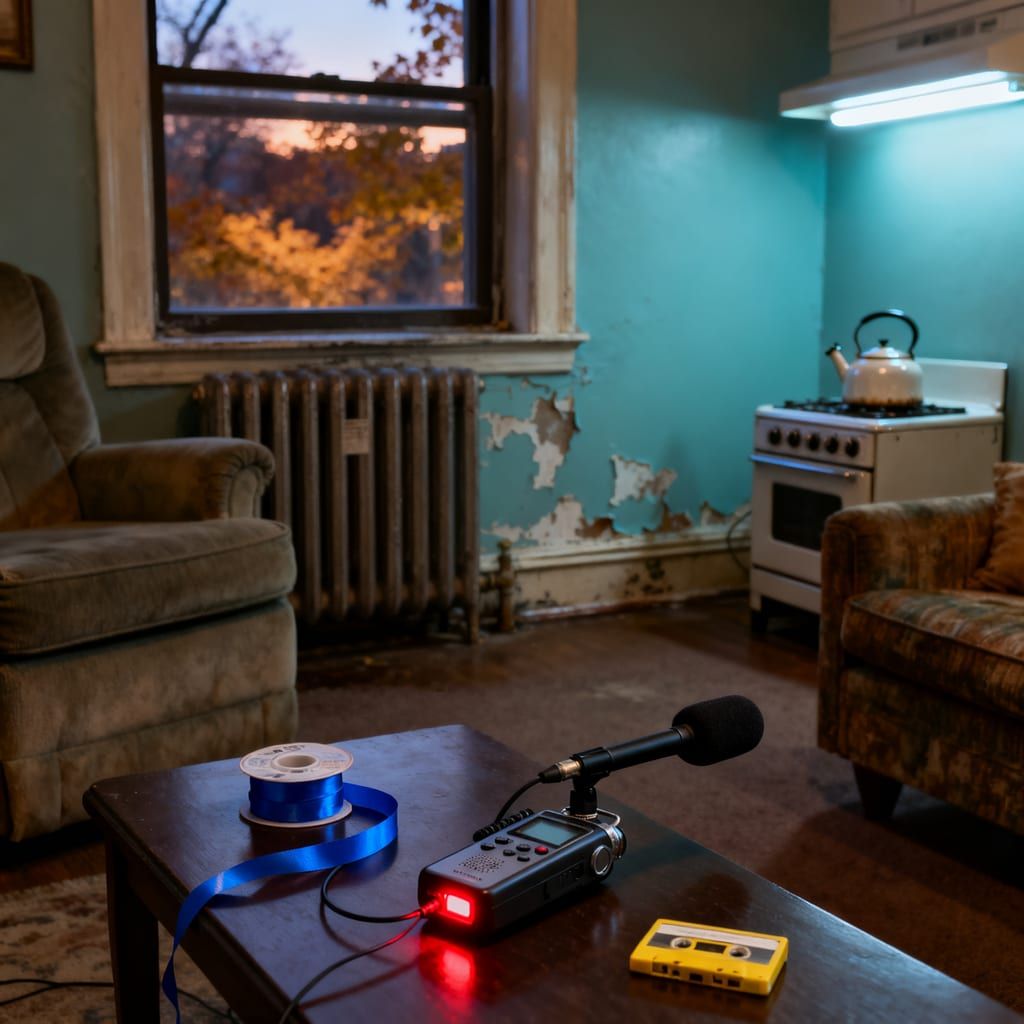
The radiator in my mother's apartment knocks like a neighbor with a grievance-three quick raps, a bright hush, then a sigh that travels the pipes. I set the boom low, cradle it like a violin, and watch the meters on my handheld recorder rise and fall with each clank, each breath in the room.
"Do I need lipstick for this?" my mother asks from the recliner the hospice delivered yesterday. The chair barely fits between the bookcase and the window. Outside, a bus exhales at the curb, its doors gasping open.
"It's audio, Ma," I say, though I check her anyway. Her hair is tied back with the blue ribbon she wore when she'd iron on Sunday nights, the one I'd tug like a bell-pull until she laughed.
We agree on rules: two taps on the arm of the chair to pause, one to rest, a squeeze of my wrist if she wants me to stop. Everything we do is permission now. The nurse shows me how to time her pills. I show my mother the red light that means we're rolling. She approves of the symmetry.
"I'll only say nice things," she says. "You can bleep me like on TV if I don't."
She looks thinner under the hospital blanket. Winter found us early this year. I roll a throw across her shins and clip a lavalier to the neck of her sweater. The wire dips like a fishing line and disappears at her waist.
I grew up in this apartment-four rooms that knew my first lie and my first geography test and the sound of my father leaving with a suitcase whose zipper always stuck on the curve. After he left, we learned new noises together. I knew the portfolios of our neighbors by their footsteps, the handsy hiss of the kettle, the particular click our lock made when turned once, twice, safe now. If I concentrate, I can hear all of it at once: the hum of the refrigerator, the rill of traffic on Roosevelt, the thin whine of the old fluorescent in the kitchen-white noise that has never been white to me.
"Okay," I say. "Levels. Count to ten for me, Ma. Natural voice."
She stares into the corner of the room like the numbers live there. "One," she says, and the meter smiles. "Two. Three. Four." Her voice thins at seven, remakes itself at eight. She nods when she reaches ten, like a student told the answer is correct.
"That good?" she asks.
"Perfect," I tell her, though the radiator chooses then to cough a punctuation mark. I mark the timecode anyway. We keep it.
I start small. A story about the recipe for her arroz con gandules, which is less a recipe than muscle memory and an argument with the rice. She describes the way her hand knows how much salt is "enough enough"-her words-then scolds me for buying the wrong brand of pigeon peas. I list the ingredients, she laughs at my pronunciation, I catch the clink of her spoon against the enamel mug she insists is better for tea because it "tastes like home." The lav picks up the delicate bell of it.
We capture the knock pattern of the radiator and the throat-clear of the downstairs neighbor with the loud TV. She tells me how as a kid in Manila she used to press an ear to the wall and hear the tenants' lives like rain-"not their words, mijo, just the way they're not alone." I want to ask if she feels alone now. Instead I check if she needs water.
Her hospice nurse, Denise, learns our signals. She speaks softly, like rooms have ears that bruise. On day three, she finds me mic'ing the kettle handle for the whistle. "Only a recordist would think a kitchen sings," she says, smiling, then wipes the corners of my mother's mouth with a tissue like a stage manager.
We pause often. We rest more. I ask for consent before I begin every file, name each one aloud: "Luz Reyes, apartment ambience, afternoon, November twenty-ninth." The naming steadies me. Files will outlast breath.
At night, I bring the recorder to the hospice room when she needs to be there. She hates the florescent lights most. We compromise with a bedside lamp and a scarf thrown over it, our old trick for cozier Sunday dinners. In the hospice, the sounds are colder-monitors that beep with correctness, wheels that complain, whispered apologies from strangers who don't owe us any. I don't roll then. Some rooms aren't mine to keep. We sleep to the pulse of the machine that measures how the bed is not a boat.
Back at the apartment, the windows leak a draft, and the radiator answers in its language. We listen to the neighborhood clear its throat before dinner.
"Tell me the story of the singing lady upstairs," I say.
"She died," my mother says flatly, then softens. "Long time ago. Before you were born. She was always practicing-afternoons, with the window open. Scales. I thought she was a canary the first week. Your father complained, but I told him, 'Let her be. One day, we'll miss the noise.'"
It happens on a Wednesday that feels like rain but never delivers. I am checking levels, the form a scaffolding over hours that otherwise sag. "Count for me?" I ask, and my mother clears her throat, takes a breath that stalls, and instead of "one," she hums.
The tune is thin at first, just a thread pulled through a stubborn needle. I feel it like a draft from the past-familiar, impossible. Then her voice finds the note below the note, the one that steadies. She sings the melody she hummed when I was small and feverish, the lullaby that sometimes lifted through the vents when the lights were out. I lost it at ten when I recorded over a cassette by accident, chasing a radio song I loved for a week and forgot by summer. I had cried between the couch cushions then, inconsolable about a song without a name.
Now it returns in the creases of my mother's voice, vowels made round by years. The radiator contributes a soft tap on the downbeat, the kettle pretends to boil, someone in the hallway argues and the words arrive only as weather. I do not stop the recorder. I do not speak. My mother closes her eyes and becomes the woman I know from photographs-her lips less pale, her hands sure on my baby back. The meters hover in green, for once.
When she finishes, she opens her eyes and looks startled, like she has been found in a private room.
"You remember that?" I ask, my voice too loud in the headphones.
"I didn't, until I did," she says, and laughs, but the laugh breaks into a cough, and I mute the track to rub circles on her back. She signals one tap. We rest. We cry without saying we are crying. The recorder keeps rolling, taking it all in-the tissue pulled from the box, the squeak of the chair.
"You saved it," I say, meaning more than the song.
"Ay, mijo," she says, brushing my wrist with her fingertips, the old gesture of shooing and holding. "Sometimes the house saves for us."
She dies on a Sunday morning when the bus out front is empty and unhurried. The hospice calls while I am rinsing a mug, the enamel grazing the sink with that small bell it only makes when you are not thinking about it. Denise helps me sit. Grief is a sound that gets recorded without mics. For a while, I don't know where the recorder is. The apartment is quiet in a way that means no one will answer if you call out.
When the necessary people have come and gone, I gather the files. The laptop opens like a patient animal. I make a folder called LUZ_FINAL and hate myself for it. I bring the clips onto a timeline and begin to edit as if neatness can cure.
First, I try to strip the radiator clicks. The software shows me their peaks-little teeth biting into the lullaby. I notch them out, one by surgical one, and with each subtraction her voice sounds farther away, like I am remembering her memory instead of being inside it. I undo. I listen again. The apartment hums in its own key. I pull down the traffic but leave its tail, the way you leave a breeze.
I find two seconds of my own laughter when she called my Lav a "lavalamp." I wince at how my younger self used to mock her accent and then layer that laughter, older now, underneath her voice from last week, and suddenly it feels like someone is holding my head above water.
In the sewing drawer, looking for black thread to sew a button on my only suit, I find a microcassette the size of a mint. The faint handwriting on the label says: JONAH 10-HUMS. I have not owned a player in years, but the neighbor's son loans me one from his grandfather's box of cables and defunct things. The machine is yellowed at the edges. When I press play, the room makes itself smaller to listen.
Static first. Then my voice, high and unselfconscious: "Mom, do the song, do the song, pleeeease." And her, young too, a smile inside the tape: "Later, hijo, later. We will save it for when you need it."
Then me again, humming a mess of something that might be the lullaby, might be the theme from a cartoon, might be both. I realize I did not erase it entirely; I kept a ghost.
I bring the microcassette audio into the session. The hiss is fierce, like a weather report from far away. I clean it just enough to keep its shape, leave the rest. I layer it beneath her new voice, like a memory answering a memory. I splice in the counting to ten. I leave the kettle patter intact. I set a generous room tone at the end-thirty seconds of the apartment breathing.
Every time I try to remove the hallway echo from her laughter, the room goes cold. I undo the surgical cuts and let the bleeding be a kind of warmth. The noise is not the enemy; it is the house speaking in the spaces between us.
At the service, the chairs are the same cheap ones we used for birthdays, the plastic a little translucent when the sun shoots through the church basement window. People fan themselves with the program. Tías I have not seen since college hold my hands in both of theirs, press my knuckles like beads. Denise sits in the back in her scrubs, off-shift and off-duty but here anyway.
The podium mic is not a mic I would choose. It is cruel to S's and P's, a showoff. I tape the recorder near it anyway, old habits die loud. I introduce the piece with my mother's voice in my mouth: "Okay, levels. Count to ten for me, Ma." The audience laughs the way crowds in theaters do-glad to be told how to enter the next hour.
On the speakers, she counts. "One." The room leans forward. "Two. Three..." By "ten," there are sniffles like shoes on wet tile. Then the kettle in our kitchen begins to sound like rain against a tin roof, and her lullaby comes in not like a performance but like someone humming through a doorway. Over it, younger me hums along in fits, a tangle of melody, the way a kid believes they know the words because they know the feeling.
Traffic breathes. Somewhere a siren passes and is not in a hurry. The radiator keeps time with a tender rudeness. I left my own laugh once, then again, a glissando I didn't know my throat could make. My mother says, recorded last week and ten lifetimes ago, "Sometimes the house saves for us." There is a murmur in the room as if agreeing.
I let the last note spill and stop touching anything. The piece ends-but I don't. The room tone stays, full and faithful. People shift, cough, wipe their faces. A baby's squeal-sharp, unscripted-cuts the hush, lands like a cymbal crash we didn't know we needed. Someone's bracelet clinks. Someone's stomach growls, honest. We hear ourselves inside her absence and find it is not empty. It has texture, and that texture is us.
When the thirty seconds end, no one claps. They wouldn't know how. Instead, people rise as if to catch something falling.
After, I sit on the church steps with the recorder heavy in my lap. Denise comes to stand beside me. The sun is lowering over the el tracks, turning the rails into lines you could pluck. The trains sing a little. Queens does what Queens always does-keeps going in a dozen languages at once.
"That was beautiful," Denise says. "You let it be itself."
"I almost didn't," I admit. "I almost took out the radiator."
She laughs. "What are you, new?"
I smile, because I can hear my mother in that too-her impatience with my perfection, her faith in the stubborn kindness of a flawed thing. In the distance, someone knocks three times on a door and waits. I would recognize that rhythm anywhere.
I press record and leave it alone. A bus sighs. A pigeon lifts off like a card thrown into the air. Somewhere, a kettle starts to warm.
I let the room tone have its say.
A daughter learns to read between the lines of a life split in two
Read more →
A fog-draped night, two souls found, and the quiet shape of a life
Read more →
Story audiobooks for children of all ages — a new one every day on Smarter Way Stories.