Two Houses and One Quiet Heart
A daughter learns to read between the lines of a life split in two
Read more →
Late-summer light makes a cathedral out of rowhouse cornices. Heat rises off Market like a tired sigh, and the smell-yeast from an early bake, diesel from the buses, the damp sweet of the river-lays a hand on my shoulder as if to say, again. I gather my smile, my clipboard, the facts I can recite without breath.
"Good morning," I tell the small half circle in front of me. "Welcome to Philadelphia. A city of-"
I pause, hearing my father's voice thread into the pause. He always arrived in pauses.
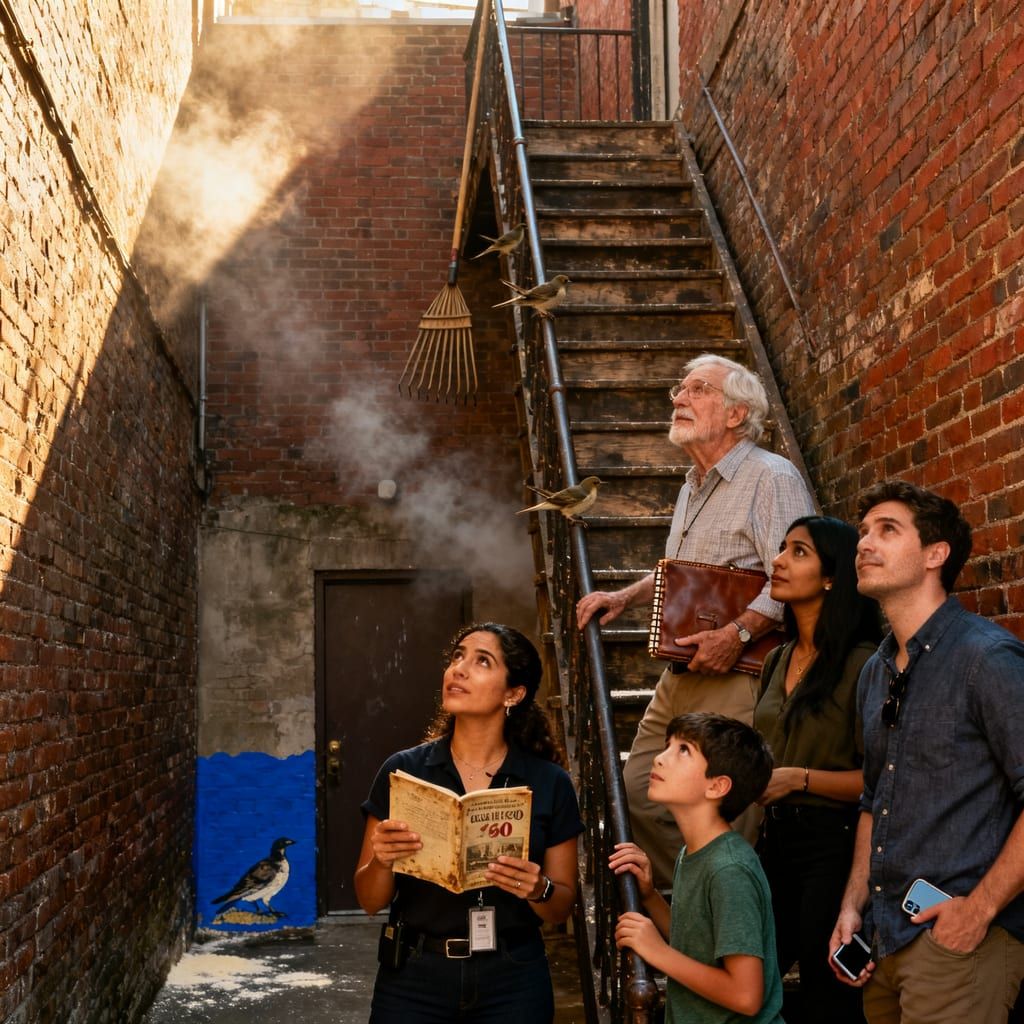
They are a collage more vivid than the mural behind us. The widower holds a soft leather sketchbook to his chest as if it hums. A tech couple wear fitness bands that blink, thumbs making nervous orbits around their phones. Two college roommates have the giggly attention span of pigeons and keep whispering, We're making this a thing. A mother dips her head toward her boy-eleven, maybe-who is already scanning the sky.
And a woman named Noor, with a guidebook whose spine looks like it remembers other hands. The cover is sun-faded, a city sketched in line and shadow, the letters embossed: Philadelphia, A Place of Firsts.
We start up Third Street through a quilt of cobblestones. I perform-William Penn's grid, the yellow-brick house where Dolley Madison once danced, the oldest continuously operating something. I could thread this route blindfolded.
The widower lifts a hand. "Why that blue?" he asks, nodding at a mural-an ocean of color rippling over brick, faces rising like islands.
"It's called cobalt," I say, on autopilot. "Symbolic of-"
"It looks like the blue we used on our porch in Mayagüez," he says, half to himself, and shades fall across his eyelids as if he's seeing it. He opens his sketchbook and starts tracing the mural's negative space-the way light cuts shapes out of color.
The boy-Noah, I learn at the crosswalk-counts sparrows as if they're precious stones. "Seven," he says, then under his breath, "eight," when one drops from the plane tree and startles a cigarette butt.
The tech couple asks how long until the waterfront. "We've got a Zoom at two," the man says, and his partner flinches when a bicycle bell rings.
"Two hours," I say. "But we'll get you there."
Noor walks close to me. "I hope this isn't strange," she says, tapping her guidebook. "There's a photo in the back. It's a staircase-narrow, behind a bakery? Would it be possible to see it?" Her voice is careful, like someone stepping into a river she doesn't know the depth of.
My rule about detours sits beside me in the hot light-don't. The day folds into muscle memory. Deviations bleed minutes and minutes are tips.
But the word staircase opens a door in my chest. I can smell cinnamon and pencil shavings.
"Let's do it," I hear myself say.
The tech couple look at each other. The roommates cheer. The widower smiles without looking up. Noah counts a starling that's not a sparrow and corrects himself with a frown. His mother squeezes his shoulder.
We slip into an alley behind a bakery whose ovens have warmed this brick for fifty years. The flour-dusted man at the back door doesn't even blink at our procession. The narrow staircase climbs the wall-iron kissed with rust, wood rubbed bare at the center of each tread by feet that had somewhere to be. The smell up close is the same as then: proofing dough, wet metal after rain.
I used to wait on that landing as a teenager, my father parking his cab at the curb, stepping out with that tired-joy walk of someone who counted the minutes for this. He'd have a paper bag between his teeth-still-warm rolls-and he'd say, Elenita, show me what I missed. I'd talk about a new alley someone painted, the way Old City shifts in twilight, he'd nod like I was a professor and he was late to class.
On the landing, Noor opens the book. The photo at the back is in black and white-the same staircase, the same tilt of shadow where the gutter kisses brick. The caption says: In this city of firsts, even a back stair can be a ribbon to somewhere you didn't expect. The author: J. R. Stone.
My chest goes quiet. I know that name the way I know the shape of my own teeth with my tongue. My father once said, in the kitchen over a plate of halved grapes, that if he ever wrote for the paper he'd use a name like a corner-something to turn around. "J. R. Stone," he tried it out, grinning like he had a secret handshake with English.
"My father carried this book into the country," Noor says softly, as if noticing my breath. "From Cairo. He said it made him feel like he wasn't entirely lost. He'd choose a page and walk it. He used to tell me, 'When you cannot make friends yet, make friends with the corners.'" She smiles at the word. "This staircase-he loved it. He said it was where he learned patience."
The widower touches the railing. "My wife made me a list," he says, and opens his sketchbook as if it might crack. Penciled in a careful hand: Walk Elena Ramos's tour. Eat where she says. Sit when she says sit. He laughs once. "She liked a plan. She died in March. I am terrible at plans."
The tech couple's phones vibrate with the insistence of trapped insects. He reaches for his, then stops. She takes hers, slides the airplane down over the screen like a shade. The click is louder than the alley.
We stand there, all of us, within the quiet made by small decisions.
"Would you mind if I," I begin, and then swallow. "This author-J. R. Stone-my dad joked about using that name when he wrote little pieces for the neighborhood column. He drove a cab. He knew every alley like it had a birthday. I don't know if he-" I stop because the syntax for wonder is breath.
Noor tilts the book into the sun. The grain of the photo shows me a version of my teenage knees, of my father's shadow as he climbed.
Maybe and maybe not. But the maybes link elbow to elbow until they feel like a bridge.
We move toward the river without marching, more like a conversation that found its feet. I stop naming centuries. I start pointing at small things: the cuff of ivy tugging at a window grate; the paint flake on a mailbox that looks like Delaware; the way the bricks on Bread Street list like drunk sailors.
"What used to stand here?" one of the roommates asks in front of an empty lot filled with Queen Anne's lace and a shopping cart like a metal skeleton.
"Rowhouses," I say, then, "A family that fought loudly and loved loudly. A grocery with hands that knew your hands." I don't know for sure, but I hear the ghost of my father's tours, his habit of inventorying tenderness.
Noah stops us suddenly. "Tree," he says, kneeling to read the tag around a new sapling tucked into a square of cut-out sidewalk. Handwritten in a looping carefulness: For what grows after.
The widower crouches beside him so they are the same height. "I could put that in my next sketch," he says. He draws a square, a stick, a leaf, and looks at it like it might talk back.
We find a bench along the river and let the water wider than a road carry our eyes east. The wind tastes like pepper and ferry exhaust. The widower opens his book and draws quickly-a few lines to grant us presence, to hang our bodies where they belong. He makes me taller than I am, the skyline behind my ear like an earring.
"For you," he says, tearing the page carefully and pressing it into my palm. The paper is soft from years of agreeing to be touched.
"Why me?" I ask, and the question comes out without makeup.
"Because it's the first time today you're not reciting," he says, not unkind.
Noor sits at the edge of the bench, her guidebook between her knees. "My father used to mark tiny stars beside places he returned to," she says, and shows me the back page. It is constellated-alley, churchyard, stoop. I see the staircase starred twice. "Every home needs a new edition," she adds, and presses the book into my hands.
I recoil as if it's a bird that might still be alive. "I can't-this is yours."
"It was his," she says. "He would like it to go back into the streets with someone who knows how to listen."
Something slots. Not like a puzzle-more like a sliding door finding its rail again.
By the time we loop toward where I would normally end-with three last facts and a joke that used to land-I am thinking about what it would mean to close differently. We pass a community fridge I have walked by daily and not seen, not seen, because I had my lane and the city was just scenery. Someone's written on it in chalk: Take what you need. Leave what you can. Inside are three oranges and half a jar of pickles.
"We could," the tech woman says, shy, "we could put something in." She holds up the bakery bag I forgot we had. The flour-dusted man had handed it to us when he caught us staring at the proofing loaves like religious art. "For the road," he'd said. I'd meant to hand them out at the river and then didn't.
We line the shelf with sweet buns and two rolls still warm in the center. Noah, solemn as a priest, arranges them like an offering. The widower adds a wrapped sandwich he was saving. One roommate slips in a little note: For what grows after, with a heart that looks a little embarrassed. The tech man digs out two granola bars from somewhere prepares-for-everything.
When I lift my head, the group is watching me in that unblinking way that happens when people are present without performance. My mouth goes to its usual script-and misses.
"Here's how I end," I hear myself say. "Look up sometimes. Ask why. Leave one small kindness-it doesn't have to be bigger than what you wish someone had left you."
No one claps. The best endings don't need applause. Noah counts a plane carving the blue, gives up at four when it slips into a cloud. The river moves like it always does, unwilling to be more than water.
"Thank you," the widower says, and for a second I think he is speaking to the staircase, the river, the unseen audience of our day. Maybe he is.
We shake hands and they peel away into separate lives with the ridiculous dignity of strangers who were briefly a we.
I take the way home that passes the bakery on purpose. The staircase throws down a longer shadow than it did this morning. I stand at the landing where my father's absence is a shape I could trace. The guidebook is heavy in my bag, dense with the weight of words other hands read first. A breeze flips it open to the map that looks like veins.
I used to think the city had cooled on me, gone impersonal, a boyfriend who stopped asking how I slept. But as the air moves down the alley and carries cinnamon into me, the truer sentence arrives: I did the cooling.
At my desk-wobbly leg, coffee ring, window full of the street's old trees-I place Noor's guidebook beside a blank notebook. The sketch from the river leans against the lamp, my face with the skyline as a borrowed crown. I write the title first, before the route, which I have never done: Firsts.
I think: first questions instead of first answers. First detour. First time ending at the fridge and not the statue. First time naming my father without flinching. I think of the widower's careful tear, Noah's tally, Noor's stars. I think of how my father would say, when he put the cab in park, that the job was not to carry people but to recall the city aloud so others could hear themselves in it.
Out the window, a sparrow drags a string across a stoop with more determination than seems possible. A boy below me counts-wrong, then right. Someone-maybe the tech couple, maybe not-has chalked a new line near the fridge: firsts happen quietly.
I close the book my father may have written and open the one I certainly will. The spine sighs like a stair accepting another foot. The page makes a space. I begin with a corner-J. R. Stone-then turn it.
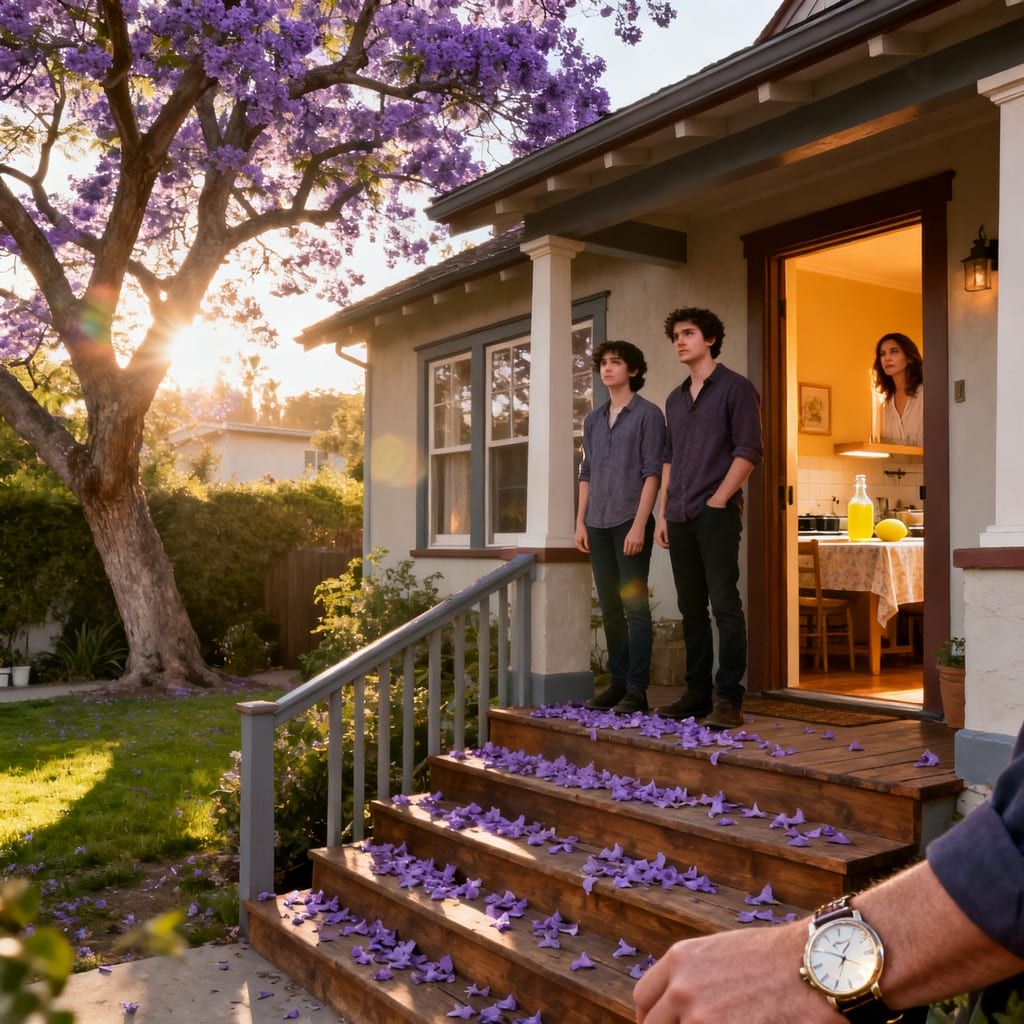
A daughter learns to read between the lines of a life split in two
Read more →
A fog-draped night, two souls found, and the quiet shape of a life
Read more →
Story audiobooks for children of all ages — a new one every day on Smarter Way Stories.