Paper Cranes on the Mountain
A fog-draped night, two souls found, and the quiet shape of a life
Read more →
Nadia was third in line at the pharmacy, holding a basket and her breath, when a stranger touched her elbow. A warm, ordinary touch-paper-thin skin over knuckles-and a voice that sounded like it had practiced gentleness.
"You look like you're holding up the ceiling," the woman said.
The ceiling trembled. Or maybe Nadia did. The basket thunked against her leg. She tried to say she was fine-good, busy, just need these pills-but the fluorescent hum braided with her father's far-off, looping voice, and the floor swam as if the tiles had learned to float. She made it to a plastic chair and drank water from a conical paper cup. The woman sat beside her until the color came back to her fingers. Then she pressed a scrap of receipt into Nadia's palm with a number and a sentence: You can call. Or not. But you don't have to hold it alone.
That night, after her father fell asleep with the television whispering to no one, Nadia opened a blank document and typed without breathing: THURSDAY CAREGIVER CIRCLE-BRING NOTHING BUT YOUR TIRED.
She printed six crooked flyers because the printer chewed the eighth. She taped them at eye level: bodega window, laundromat corkboard, the bus shelter where schedules went to be ignored, the church with the basement that always smelled like old radishes and mop water. The tape puckered in the damp. Her reflection looked like someone she used to know.
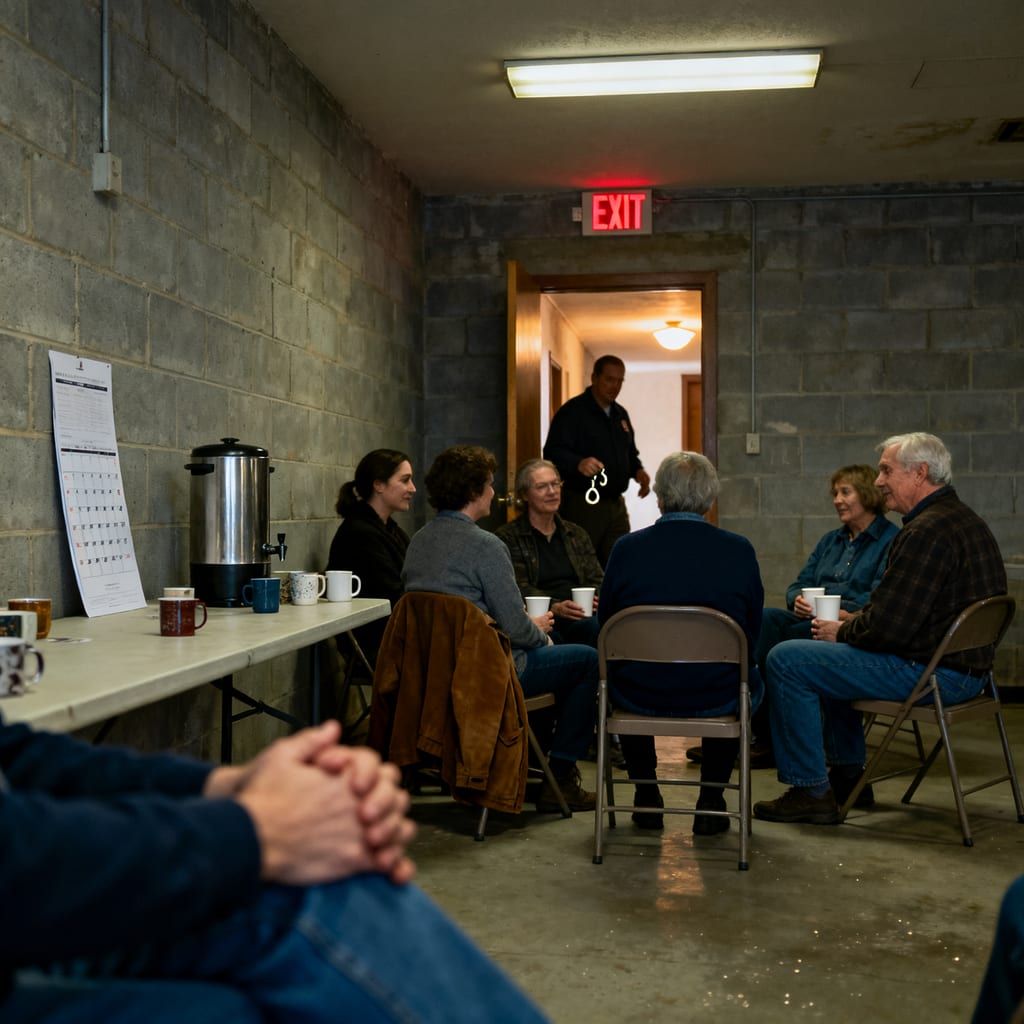
The basement was too big for them. Five folding chairs, a table with a silver urn that moaned like a storm, three packets of sugar torn with nervous hands. Someone had donated paper cups; their rims clicked like wind chimes.
They came in ones and twos. A woman with a sleeping baby in a sling and the kind of under-eye shadows that counted as topography. A young man who hovered at the doorway, then sat and laced and unlaced his fingers. An older man with a shirt ironed within an inch of its life. Nadia, who had started this and wished she hadn't. She kept standing, then sitting, then standing again.
Silence took the first chair. It set itself down and refused to leave. Nadia cleared her throat and said her name. The words were small as pennies. She said she worked days and was a daughter at night. She said her father kept placing the television remote in the freezer and calling every lamp television too.
No fixing, she said. The sentence found her mouth like it had been waiting there. No fixing people. Just saying what is.
The baby snuffled. The urn sighed. Someone pressed a cup into Nadia's hand and let it heat the skin between wrist and thumb. The older man-Mr. Levin-struggled with his cup lid until his knuckle gave way with a small pop, and everyone stared at that pop as if it had been a gunshot. He looked up, red-faced, and said, "I haven't showered in four days. The house smells like soup that burned. My mother needs me and I can't breathe inside my own shirt."
They nodded like citizens of the same small, invisible country.
By the end of that first hour, the silence had learned their names. Someone suggested a pact. It arrived without debate and with a lopsided beauty.
Nadia wrote it on a sheet of printer paper and taped it to the cinderblock wall with medical tape from her purse. Above it, they tacked up a calendar grid salvaged from a free clinic flyer. The pen bled blue like a small vein.
Week two, the circle grew by three. A nurse named Em who dealt with other people's bodies by day and her mother's at night. Chelsea, who wore a blazer like armor and said very little. Jamal, who held his jaw as if every muscle had a job to do.
The Thursday Exchange became a pattern of small rescues. Chelsea sat with Mr. Levin's mother so he could take a shower that lasted precisely nine minutes longer than he meant it to. Jamal taught Em to use a medication tracker that chirped instead of screamed. Nadia said yes to a ride home and found her hand reaching for the car door before her mouth could argue. They formed a quiet scaffolding: fridge lists magneted where everyone could see; shared calendars that lived in the cloud and also printed, leaning against a coffeemaker; borrowed sleep measured not in hours but in breaths.
They did not get lighter. They learned to hold differently.
The custodian kept switching the lights off at nine. He moved with the bone-weary competence of someone who had mopped more than most people would admit to walking. He clicked the switches twice, like punctuation. "Building closes at nine," he said, not looking at them.
They learned to talk faster at eight-fifty. They learned the shape of their words in the dark for the walk upstairs.
On the fourth Thursday, the custodian lingered at the door like a scold. His face, all planes and caution. His name tag read H. G.
"We're wrapping up," Nadia said, because that had become her line. Her voice tried to make it friendly.
He shook his head-no at the concept, not the schedule-and turned away. The light went. The exit sign oozed a tired red.
They were halfway into their coats when the thud came: a body against cinderblock, a breath grabbing at air. Nadia was running before the thought finished. Jamal caught the door with a hip and shoved it wide. The hallway had a draft that smelled like bleach and winter.
The custodian was on his knees. His eyes found the floor, chest heaving like it had its own fists. Nadia knelt, not too close. "Hey. I'm Nadia."
He waved a hand toward his chest. "Just-just-" Words smacked at his teeth and fell.
Em slid in with a paper bag; Mr. Levin pulled a chair with the efficiency of panic. Chelsea took his wrist and counted under her breath. The group gathered around him in a little, awkward, determined constellation. They did not tell him to calm down. They let their breathing be a grammar he could join.
After a while, the breath unhooked from its panic. After a while, his eyes came up like divers breaking surface. He had tears on his beard he seemed surprised to find.
"Hector," he said when his mouth could make it. He held up the ring of keys like proof. "Hector Garcia."
"What do you need, Hector?" Nadia asked.
The question tipped something. He stared at the ring of keys, then at his hands, then at the slouch of his body on the chair. "I've been..." He motioned at the thin line between door and jamb. "Listening. To you. Through the crack."
No one made a joke about eavesdropping. He swallowed. "My wife-Lupe-she's got ALS. We don't say it out loud because saying it makes it more true. The lifts scare her. The nights are... long. Insurance-" He threw a hand toward the ceiling as if insurance was stored on rafters with pigeons. "I work doubles so it stays alive. I keep hearing you people say things. I keep-" He closed his hand like he could catch the sentences. "'You're not failing-the job is impossible.' 'Grief can arrive early.' I walk away before anyone sees. But tonight I just... didn't."
There it was: the body under the jacket.
Nadia reached forward and set her hand on the cold metal of the chair back. Not touching him. Not yet. "One thing you need," she said, softly. "One hour you can give."
Hector made a sound that could have been a laugh if laughter weren't such expensive currency. "I need a way not to drop her when we turn. I need a-bar? In the bathroom. I need sleep that stays. An hour I can give-" He paused. "I'm good at fixing things. Not people. Things. I can patch drywall. Change locks. Install whatever needs installing."
Mr. Levin pointed at the calendar. Jamal was already on his phone, googling transfer bars. Em wrote "dawn hour" next to Hector's name and circled it twice. Chelsea, who rarely said anything about herself, said, "I make soup." That was enough.
They walked him back to the basement, lights on. The exit sign still pretended it had the last word.
The next week, a bar appeared by Lupe's shower. A thermos clanged softly on Hector's stoop at five a.m. in a relay of hands. Someone remembered to ask what music Lupe liked; it was boleros that cracked like sugar on fire. An old portable speaker showed up in a grocery bag. The building manager, who had once threatened overtime fees for the lights, left a box of mismatched mugs by the basement door and didn't ask for the key back. One mug read BEST GRANDPA and another simply, THIS MIGHT BE WINE.
By then, the circle had routines that made someone in the room exhale just by looking at them: the calendar, leaning against the coffeepot; the tape on the wall, now a little less sticky; the extra pens because pens disappear first in any crisis. They said their names slower now, as if each held a story that could not be told at speed. They learned to accept rides home without shrinking three sizes. They learned to carry each other's grocery lists in their pockets like folded prayers.
Nadia's father began to remove his name from his own sentences. He called her teacher, then lady, then nothing. He wandered some afternoons and always circled back as if reeled in by a line only he could feel. She woke at three to silence that throbbed.
On a Thursday that felt like the inside of a bruise, he didn't come back.
The police took a description. Nadia walked the blocks in widening squares, saying her father's name to the air like it might be contagious. She checked the bodega, the bus shelter, the church steps. Dawn released the street from its grip and left it damp, a skin after fever.
She found him at the edge of the park, shoes crooked, whispering to a puddle the way children chant the alphabet to coax it to grow. "Monday, Tuesday, Wednesday..." He rocked with the list, searching for the next rung.
Nadia stopped because the breath did that old trick of turning to stone. She didn't want to startle him into flight. A shadow lengthened beside her-the shape of a man and a ring of keys.
Hector stepped forward like the morning belonged to him. He put his hand, steady as a beam, under her father's elbow and eased him upright. The puddle drank the last Wednesday.
"Thursday," Hector said.
It was just a word. It felt like a promise.
Her father blinked, tilted his head, then nodded as if the word had been waiting for him somewhere in his pocket. "Thursday," he agreed, gentle as a rain becoming a language.
Nadia did not cry there; she did not fall apart. Her body knew what to do with the word: hand to elbow, elbow to shoulder, shoulder to the room that had been warmed for them. When they reached the church, the basement light was already on. Em was there with a towel. Jamal had brought a dry pair of socks. Mr. Levin was pouring coffee with the focus of a surgeon. Chelsea set a chair just where the air was soft. The calendar leaned against the coffeepot like a hymn.
They did not ask what had happened. They made room.
By the time her father could no longer find her face in a crowded page of faces, the Thursday Exchange ran itself. People took turns holding the center so no one had to be the center forever. A hand went up, a task went down, an hour slid into place. A bar appeared where needed; a soup replaced the thing no one could put a name to. The room smelled like coffee and wet winter and the faint sweetness of boleros on an old speaker.
Nadia realized one day, washing a mug that read WORLD'S OKAYEST HUMAN, that she hadn't been holding up the ceiling. She had been showing everyone where the studs were. Hands as rafters. Small hours as beams. The burden sat down among them. It did not leave. It changed shape until it could be carried.
They kept to the pact. They told the truth. They did not fix what could not be fixed. They called Thursdays by their name and meant it.
On a Thursday in spring, a flyer curled free of its old tape and floated to the floor like a tired bird. Nadia picked it up and smoothed it open. The letters were still crooked. The word TIRED had a coffee ring through the D.
She taped it back, palms flat to cinderblock, and felt the room press back, sure as any ceiling ever was.

A fog-draped night, two souls found, and the quiet shape of a life
Read more →
Story audiobooks for children of all ages — a new one every day on Smarter Way Stories.