Two Houses and One Quiet Heart
A daughter learns to read between the lines of a life split in two
Read more →
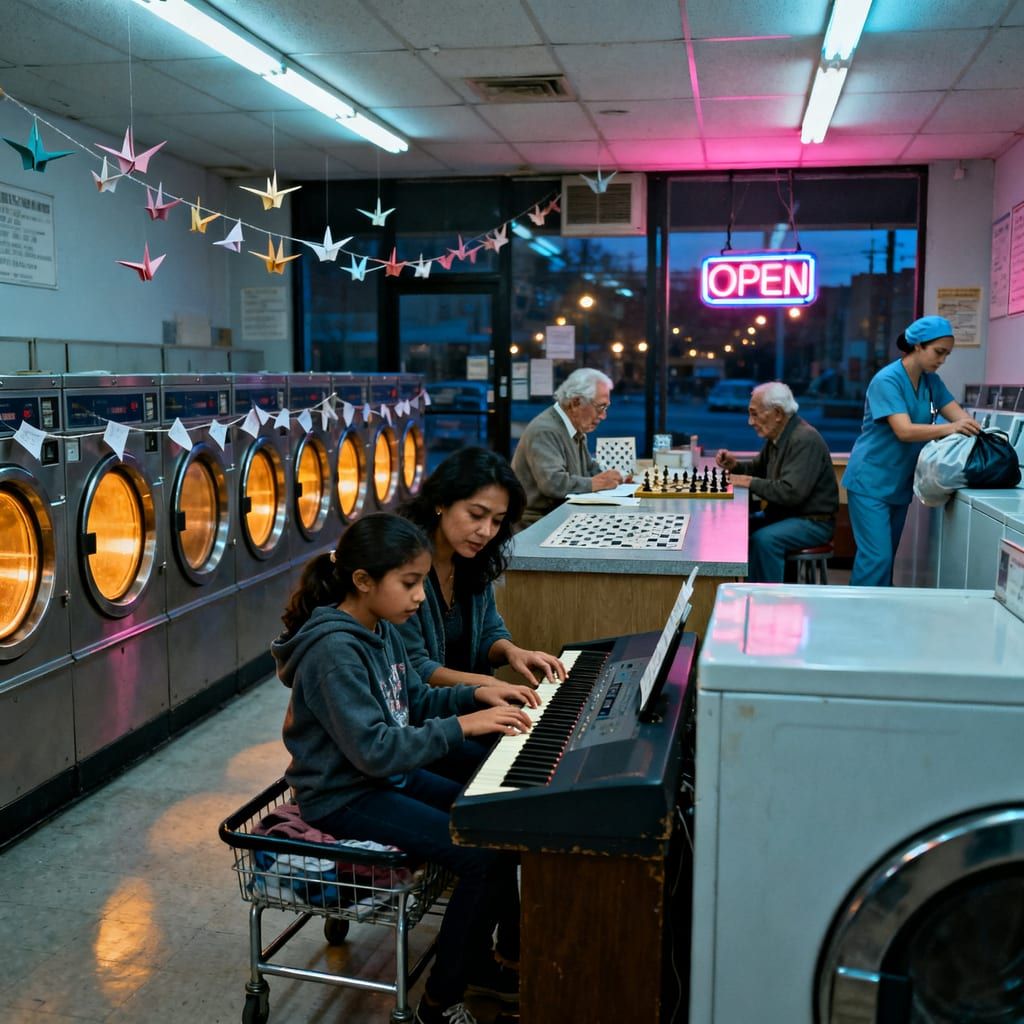
On the agenda, the line read: "Allocations-Arts." In the room, it sounded like a slow, polite funeral. Elena kept her hands folded to keep from drumming the table, her thumb tracing the blue vein at her wrist-metronome against the talk of cuts that took bites out of instruments, then after-school pay, then the part of her that believed you could coax a life into key.
She walked out into a Chicago sky the color of dryer lint and cut three blocks east, past the taquería with steamed windows, past the mural of a trumpet catching stars. The corner laundromat sighed its door open. Warm air breathed over her face, as sweet as detergent and a little burnt at the edges.
She fed quarters to a machine and leaned, forehead to glass, watching a red T-shirt begin its slow orbit. That's when she heard it: not a radio, not a ringtone-something threaded into the machines' drone. A melody riding the hum, daring it to be harmony.
At the back, on a cracked vinyl bench, a girl was playing a keyboard drawn onto a rectangle of cardboard with a black marker. Her hands flickered, left then right, like she was trying to catch a moth. The lines were uneven, fat and thin. Tape framed the edges where the fake keys had started to curl.
"That's a Bach shape," Elena said, before she could stop herself.
The girl startled. Her eyes hung somewhere near Elena's shoulder. She smiled with one corner of her mouth and clutched the cardboard tighter.
"Sorry," Elena said, lowering her voice. "I teach over at Garza. After-school music." She pointed west as if that compass meant anything. "You sounded-nice. I mean, you were making something with... these." She gestured at the washers, the dull choir of them.
The girl tugged the edge of the cardboard. "They go in G a lot," she said. Her words came clipped, careful, each one set down like a coin.
Elena cocked her head. Behind the thrum, one dryer had a high, clean whistle-the missing G string she'd been hunting all week.
"I'm Elena," she said. "You?"
A pause, the one-corner smile again. "Amaya. I wait here. My mom cleans offices." She lifted a shoulder. "Nights."
A sock hit the glass, white planet against the round darkness. Amaya's fingers traced air over a drawn C major, hovering above the cardboard's ink and finding it anyway.
Later, on a stool by the folding table, Mr. Patel-mustached, tidy, the guardian of the coin changer and the crossword-murmured, "Her ma. Good lady. Works hard." He lifted his chin at Amaya. "She sings with the machines."
Elena watched the girl's hands listen.
She went back the next day with a square practice keyboard scavenged from the school's back closet, the kind with thin speakers and missing battery cover. She'd stuck colored dots on middle C and its sturdy neighbors during her bus ride, the adhesive still warm under her thumb.
Amaya touched the plastic like it might cut her. Then she pressed the red dot. The sound was thin, almost paper. She pressed it again, quicker, matching it to the far dryer that wheezed on every fifth breath.
"Your ear," Elena said softly, "is good."
Amaya tapped her left temple. "Just this one." She looked at the floor. "The other ear-it doesn't do." She lifted her hair: a small scar behind the right one, pale as a fishbone.
"I'm sorry," Elena said. It wasn't exactly what she meant. What she meant was: You've built a bridge out of hum and luck and stubbornness.
Amaya set her palm on the keyboard, not playing, just feeling. "I watch videos at Ms. Luz's upstairs," she said. "No sound. The hands show how. I match it here." She lifted her hand and the laundromat sang its own chord-spin, hiss, the bell on the door.
They tucked lessons between cycles. Scales that tasted like peppermint because Elena brought mints and set them on the bench between notes like commas. A Bach prelude peeled back to four brave tones, the skeleton under the coat. Elena's hand guided, then withdrew. Amaya's fingers found their own grammar.
The old chess pair in coats that never unbuttoned nudged pawns and didn't look over. The nurse in blue scrubs dozed with her head on a laundry bag that printed the word Sunshine in a cheerful lie. Mr. Patel did his crossword in ink. When a dryer thumped like a bad tympani, he rose and settled it with a mug on top, then sat again.
"Spring showcase at school next month," Elena said one afternoon, folding the hem of a conversation as if it were a T-shirt that didn't want to lie flat. "You could-" She didn't finish. The room had rules about suggestions.
Amaya's shoulders crept up. "Papers are tricky," she said. She pointed toward the ceiling. "My mom. Nights. Buses are stories with bad people in them."
Elena nodded. Of course they were.
So she brought the showcase to the laundromat instead. On a Sunday, they raffled off minutes of quiet between cycles. Elena strung paper cranes with fishing line from the change machine to the Out of Order sign, each crane a folded secret from the art teacher who knew how to make something beautiful out of leftover bulletin paper. The keyboard went on a rolling cart that wobbled like a shopping cart with one stubborn wheel.
The regulars took their places as if this, too, required attendance. The chess men made space between bishops. The nurse brought empanadas wrapped in foil and set them on the counter without a word. Mr. Patel erased the neon OPEN, then turned it back on again, superstition dressed as practicality.
"You start," Elena whispered, but Amaya shook her head and rubbed her fingers as if warming them on an invisible mug.
So Elena played first-something small, a hymn from her grandmother's church that always shivered the dust in her throat. Then she slid aside. "Four notes," she told Amaya, the ones they'd rehearsed until the stickers were almost rubbed to ghosts. "You know them."
Amaya stared at the keyboard as if it were water she had to learn to walk on. She set her hand on middle C. The dryer behind them sighed an F. A sock smacked glass. A crane twitched in the draft. Then Amaya lifted one finger and let the C fall into the room.
It had no right to be as large as it was. It startled a laugh out of the nurse. It made Mr. Patel set down his pen.
Four notes. A sequence with a hole in it that made the air lean forward. The laundromat applause was hands and the whisper of warm lint, a sound that didn't travel, just gathered.
After, Mr. Patel stood and adjusted his sweater vest like it needed to be in the right key too. "I do not know how to put this on the internet," he confessed, flushed with something like pride and something like fear. "But-" He lifted a sheet he'd drawn up on the receipt printer. A flyer: LAUNDROMAT CONCERT-TUESDAY LESSONS-BRING EARS. The font was sleepy and perfect.
A woman from upstairs, hair tucked into a scarf, leaned over the counter and slipped a note under the register. "That's a prelude," she said, to Elena, in a voice with a history in it. "My brother used to play. He passed last winter. His piano-" She swallowed. "It still takes up a good corner of my living room. If someone could give it a good..." She didn't finish. The note had a number and an address and a word that might have been Please.
They went up after closing. The apartment smelled like cumin and lemon. The digital piano sat against a wall with faint sun-bleached squares where pictures had been, the bench tucked neatly, as if still waiting for the weight that wasn't coming back.
Elena and Mr. Patel carried it down the stairs as if it were a sleeping child. Plastic clacked, stand legs squeaked, a screw rolled under a mat and was retrieved by the chessman with the better knees. They set it on the cleanest spot by the window. The neon OPEN made a pink edge on middle C.
When they plugged it in, the room changed. Not louder-truer. The hum of the dryers didn't vanish; it stepped aside.
Amaya sat. She blinked at the keys like they were a row of doors. She pressed one and flinched, then pressed it again and didn't.
"New rooms," Elena murmured.
Amaya's fingers went looking. She found the prelude they'd built from four notes and added a fifth. She turned the cardboard's suggestion into something with weight, as if the line she'd drawn in marker had bloomed into a road you could actually walk.
Elena felt it then, a pressure at the base of her throat she'd been ignoring all year-the quiet hum she'd blamed on trains or radiators or too little sleep. It wasn't the city. It was the unlived parts of her life singing from the corners: pay attention, pay attention. She placed her palm on the top of the piano until the vibration slid into her bones.
That night, back at her kitchen table under a bulb that hummed a sharp-suspicious E, Elena opened her laptop and typed the words she'd never been able to mean: Grant proposal. Not for "gifted"-as if talent needed a permission slip-but for "Neighborhood Listening Sessions." Tuesdays, 6-8 p.m., open chairs, borrowed instruments, no sheet music required. She wrote about dryers in G, about hands that learn by watching, about rooms that can be stages if you ask them nicely.
She didn't use the word salvation. She didn't have to.
The next Tuesday, the sky was a better gray. Buses coughed at corners. Inside, quarters clicked like beetles. Shirts rose like pale moons, and a pair of jeans slapped the glass with a satisfied rhythm.
Elena uncoiled the extension cord. Amaya stood, small and certain in her too-big hoodie, and set one hand over her good ear. With the other, she rested her fingertips on the keys like a doctor taking a pulse.
"I can feel the C before I hear it," she said, not looking up.
Elena watched the tiny tendons move under the girl's skin, the held breath of the room, the chessmen pausing mid-argument, Mr. Patel's shoulders softening as if the word C meant chair, meant chance.
"Me too," Elena said, and meant it for the first time since the budget meetings started eating the weeks.
Amaya played. The dryers purred their familiar harmony. A paper crane turned on its string and faced the neon like a bird that had decided to trust a strange sun. The melody found its own way-not exactly Bach anymore, not exactly not. Something stitched to the steady drone, something that would always be there if you knew how to lean your head and listen.
Outside, the street did what streets do. Inside, the laundromat listened back.
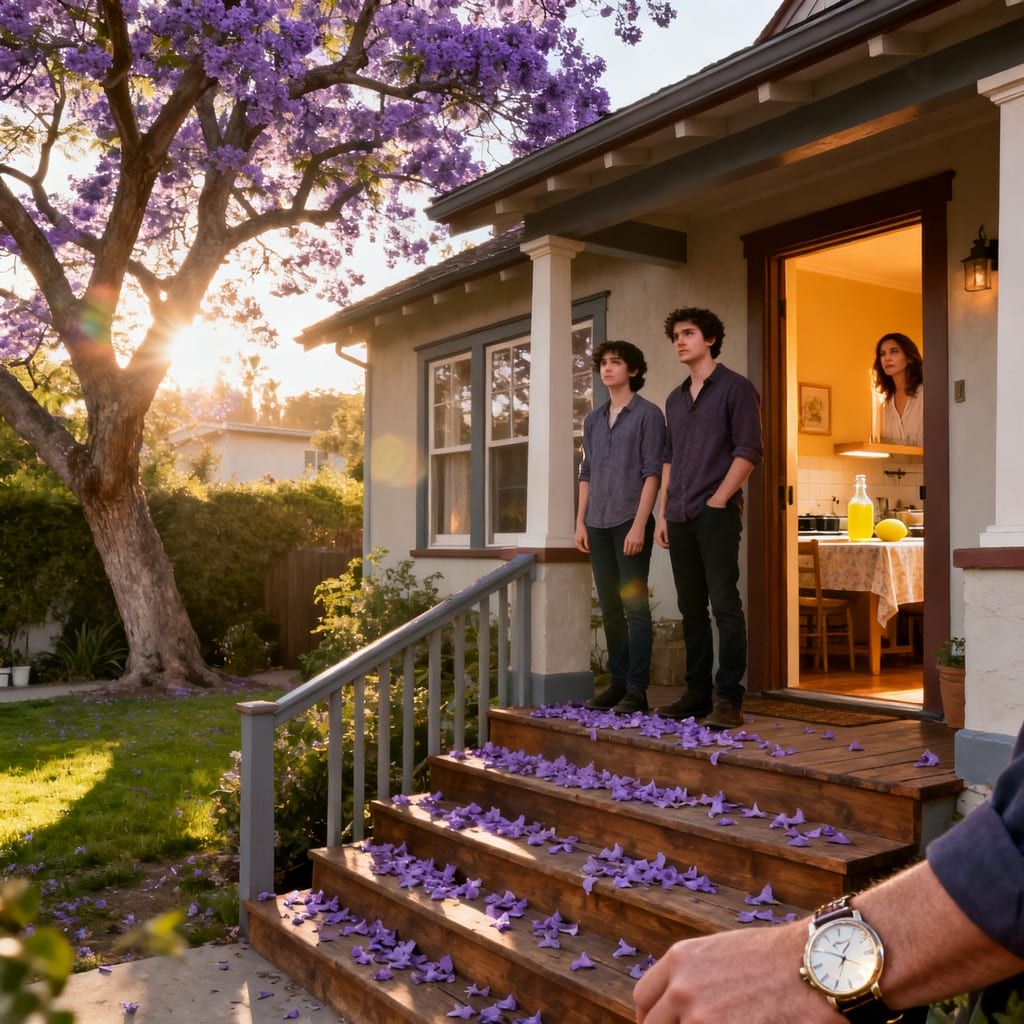
A daughter learns to read between the lines of a life split in two
Read more →
A fog-draped night, two souls found, and the quiet shape of a life
Read more →
Story audiobooks for children of all ages — a new one every day on Smarter Way Stories.