Two Houses and One Quiet Heart
A daughter learns to read between the lines of a life split in two
Read more →
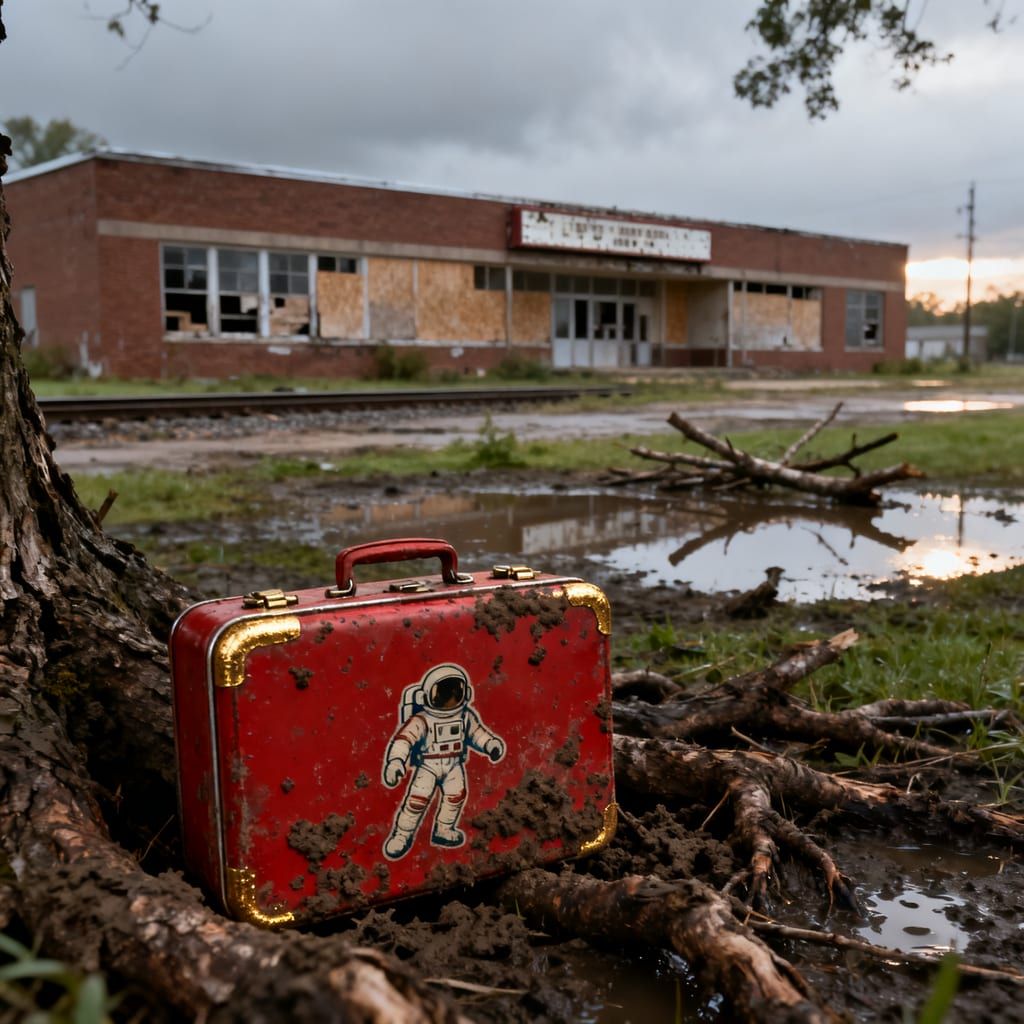
On the morning the wind finally stopped, the street sounded like someone had turned the world down low and walked out of the room. Branches lay crooked over mailboxes. A trampoline slept in the ditch, pale belly to the sky.
Jordan walked past the shuttered elementary school he used to hear before he could see it-bells, sneakers, the breathy chorus of dodgeball rules. Now, clapboard blinds snapped in the breeze and the marquee said DEMOLITION PENDING. In the grass, where their class tree once stood, the roots heaved up like the back of a whale, and something metal clung to them-mud-caked, scuffed, edges fretted with rust.
He knew it before he touched it. The shape tugged a string straight through his chest.
He pried the lunchbox free. Red paint showed through the brown in a stubborn rash. On the lid, a cartoon astronaut still floated, blissful and chipped. By the latch, the ghost of a sticker: Ms. Alvarez's star. His fingers came away gritty. The smell of old earth rose-metal, wet cardboard, the way basements keep secrets.
He had come home to empty his father's garage because grief was a better story than burnout. People nodded at loss. They made casseroles and braided sympathy with time. Burnout asked questions he dodged with cleaning supplies and a schedule.
He took the lunchbox back to the garage and set it on a towel beside a space heater, heat ticking like an old engine. He undid the warped latch. Inside lay a bundle bound with string, stickers softened to watercolor corners. A note on top, curling at the edges, in Ms. Alvarez's looping hand:
If you find this, it means time couldn't keep its promise. Please be the grown-up we hoped you'd be. Deliver what you can. And Jordan-check on Liam.
He read it twice. The loop of his own name did something strange to his throat.
He eased the string. Inside: folded letters, a Polaroid of kids in paper crowns, a bracelet that had bled its colors into everything it touched. A cafeteria recipe card, modest and stained. A trading card nested between two valentines. A page with stars he himself had drawn-crude robots marching off the margin.
He found the letter addressed to him and didn't recognize his writing until he did. Fat pencil strokes, pressed so hard the grooves still showed their path. Dear Future Me, don't be too busy to be kind. Also, I hope you still draw robots.
He laughed, small and dry, then put his wrist over his eyes. In the Polaroid, a fourth-grade version of him gaped and grinned, a paper crown tilting over his ear. Liam stood at the edge, thinner than the others, a crown slumped modest, smile clipped short as if he didn't trust it to stay.
Evening glued itself to the garage windows before Jordan moved. He plugged in an old lamp his dad had kept near the vise, its metal shade dented like a ruin. The light haloed the dust and made it personal.
He opened his laptop. Columns marched into place-name, clue, last known address, status. It was the kind of order he used to make his living at, except what he'd managed lately was triage by calendar invite and a heart like a mosquito caught under glass.
He matched handwriting to memory, to yearbook faces, to town gossip overheard by accident at the grocery store as he scanned cantaloupes by weight. He sent messages. He licked envelopes. He stood at the little post office where the clerk knew his father, and by extension, him-the clerk who said, softly, he was sorry, then slid stamps across the counter like communion.
In the morning he walked letters down sidewalks still freckled with storm grit. He left a bracelet on a porch where a woman unfolded it and pressed it to her cheek-and cried in a way that didn't ask him to stay and didn't ask him to leave.
At the laundromat, a man with silver at his temples opened a creased envelope and burst into a laugh that made people look up from their tumbling machines. He held up the trading card like a found passport. You don't know, he said, what I traded for this. His eyes were wet and delighted the way kids get over a magic trick they know is simple and still can't explain.
He tracked down the granddaughter of the cafeteria lady through a cousin who ran the bowling alley bar. He slid the stained recipe card onto a table between them. The granddaughter put two fingers on the card, then both hands, as if it might run away. She said her grandmother had loved kids who said thank you, and the way peas looked like confetti when soup was really cooking.
Each small delivery tugged at something taut inside him. Threads loosened. The kitchen drawer in his father's house swallowed and spit up a tin of old pens that still wrote. He unshelved a plastic bin of art supplies with a crack across the lid and ran his thumb over the charcoal sticks like checking a pulse. At night, he drew a robot the way he would have wanted to see it back then-complicated joints like knuckles, a tiny flag waving from its shoulder. He smudged the shadows with the side of his hand.
The last letter had no full name, just a single L.
He stared at the envelope until the L looked like a road that had taken a corner and never told anyone. He asked around. People shrugged. Some remembered. A few flinched.
Liam, a woman said at the pharmacy, like she was tasting it for ripeness. Quiet kid. Good at art. I think he did signs somewhere? By the tracks? His heart tripped.
The sign shop wore hand-painted promises on its own windows-curlicues of gold and green, a steady hand making claims it could keep. Inside, the air smelled of turpentine and something sweet, like oranges peeled days ago. The radio hummed about old trucks and rivers. He found a man hunched over a plank propped on sawhorses, coaxing a curve of gold leaf into a letter so tender it looked like breath on glass.
Liam was older, obviously, but the bones of his face hadn't changed-collarbone winging a shadow where a shirt fell open, jaw set like he was holding a thought in place. A crooked paper crown could have fit there and meant the same thing.
Jordan cleared his throat.
Hey, he said. I-
Liam didn't look up at first, the kind of concentration that makes the world go quiet. When he did, his eyes widened, then settled. He angled the brush away, bristles glistening.
Jordan held out the envelope. Ms. Alvarez's time capsule, he said. The storm dug it up. She asked me to check on you. I should have-
Liam wiped his hands on a rag that had probably once been a T-shirt. He tilted a drawer forward. Inside, a thicket of pencils, ruler nicks, paper corners softened by touch. He pinched a creased sheet from the back and slid it onto the table between them.
It was a spaceship. Eight windows. A ladder like a backbone. His own childhood signature in the corner, misspelled and earnest.
Ms. Alvarez used to put your extras on my desk, Liam said. You drew fast. I kept this. I figured if someone my age could draw a world that big, maybe I could live in it.
Jordan felt his face heat the way it did when he'd biked hard and almost crashed-aftershock and breath. He had a sudden, impossible vision of himself at ten, sliding a paper onto a desk he barely noticed, everything he was sure would be true bleeding into the margins.
I'm sorry, he said. For fourth grade. For after. For forgetting.
Liam's mouth quirked. He touched the spaceship with the back of a knuckle like checking it for fever.
We were kids, he said. Some of us were satellites. Some of us were weather.
He opened the envelope and took out the single page inside. A letter from Ms. Alvarez-ink smudged by damp and time. Liam read. His lashes made small shadows on his cheeks. He smiled in a way that tightened and lifted all at once.
She always said the trick to letters is the part you don't write, he murmured.
They stood there in the music of the radio and the silence after a storm. A freight train ghosted by, the windows rattling a low percussion under their feet.
You still draw? Liam asked.
Sometimes, Jordan said, and they both heard the lie and the wish in it.
I could use a hand on Saturdays, Liam said, nodding at a blank sign leaning shyly against the wall. Paint doesn't care what your resume looks like.
Jordan laughed, surprised into it. Yeah, he said. I could do that.
He came back that weekend. He learned how to lay down a letter so its spine stood up. He learned the thrill of gold leaf catching late light, tiny suns arguing with each other until they agreed. He learned the names of brushes and the way you breathe when you don't want a line to shake.
The lunchbox sat on a shelf in the shop above the register, cleaned but not restored, its scars part of what made it real. People asked about it and Liam said, with a soft shrug, that the ground had good memory, better than most of us.
Jordan kept the spreadsheet but stopped needing it like a map. Deliveries still happened-an overdue note slipped into a mailbox, a message sent late-but they felt less like penance and more like what hands do when you give them something honest to hold.
He drew at night, yes, but he also drew at noon on scrap wood and on a Saturday when a father and daughter came in needing a sign for the treehouse they were building. He watched the girl grip a pencil in her fist and make a crooked crown over the name they chose. The father paid in cash and a warm six-pack, and the girl looked at the brushes the way someone looks at an ocean for the first time.
On Tuesdays, he walked by the elementary school and stood by the stump where their class tree had been cut clean. Grass already softened the scar. He could still smell the turned earth that first morning, the way it rose up like a kept secret finally taking air.
Sometimes he put his palm flat on the stump and closed his eyes. He didn't make a wish. He listened to the sap in other trees, to the after-sound of children who weren't there, to a promise that had been delayed and kept anyway.
When he left the shop in the evenings, gold dust clung to his sleeves. He didn't shake it off. He liked the reminder that things stuck. He liked walking home glittering faintly in the breath of oncoming night.
Liam kept the spaceship drawing in the drawer but brought it out sometimes, unfolding the creases with his thumbs, smoothing the corners with the patience of someone who understood that care is its own kind of art. He would rest his elbow against the table and tell a story about Ms. Alvarez-how she once took the whole class outside for math and had them count cracks in the sidewalk until numbers felt like air.
On a day when the sky was the color of wet paper, Jordan took his father's old stepladder and hung a sign they'd finished together-white letters on cobalt-over the door of a woman's new bakery. She stepped out, flour dusting her sleeves, and looked up like she was trying not to cry because it would mess with something she needed to do next.
Thank you, she said, to them and to the sign and to the afternoon. She went back inside to knead what would feed this town.
Jordan climbed down, felt the world under his feet register his weight. He pictured the lunchbox on the shelf, the Polaroid smile he had finally forgiven, the letter with his own absurd hope scribbled across it.
Don't be too busy to be kind, the boy had written.
Okay, he thought, and the air felt newly full. Okay.
He slung the ladder on his shoulder. The rails hummed a little under a passing train. The ground kept its counsel but remembered, he was sure of it-remembered their crowns and their cruel days, their letters and their leafed gold, the names they had been and the ones they were trying to become.
And if you stood still long enough, it felt like the town breathed with you, like it had been waiting for you to catch up to the person you promised once to grow into, and was happy, simply, that you had finally found your way back.
A daughter learns to read between the lines of a life split in two
Read more →
A fog-draped night, two souls found, and the quiet shape of a life
Read more →
Story audiobooks for children of all ages — a new one every day on Smarter Way Stories.